
The traditional approach to quality control in shipbuilding electrical installation operates on a fundamentally flawed premise: discover problems after they occur, then scramble to fix them. This reactive model—where inspectors uncover cable segregation violations weeks after installation, commissioning engineers discover incomplete test records during handover, or classification surveyors identify missing documentation at the eleventh hour—creates a cascade of expensive consequences. Rework costs escalate. Schedules slip. Penalties accumulate. And project teams find themselves trapped in an endless cycle of firefighting, diverting resources from productive work to corrective action, which underscores the importance of installation error prevention.
Consider the real economics of late error discovery. When an inspector identifies a cable segregation violation during a scheduled audit—perhaps a power cable routed too close to sensitive instrumentation—the resulting rework can easily cost $50,000 to $150,000 per incident. The cable must be de-installed, alternative routing must be engineered, new support structures may need fabrication, and the reinstallation must be scheduled around other trades. More severe issues, such as discovering during commissioning that entire cable groups lack proper testing documentation or that fire-stop penetrations don’t meet regulatory requirements, can trigger delays measured in weeks and costs exceeding $500,000 when penalty clauses activate, highlighting the need for installation error prevention.
Cable Pilot fundamentally inverts this model through proactive quality enforcement—an automated rules engine that prevents errors at the point of work rather than catching them too late. By embedding installation sequence logic, dependency prerequisites, and compliance checks directly into the digital workflow, the system makes it impossible for electricians to execute work in incorrect sequences or skip mandatory steps. This shift from reactive inspection to real-time quality gates represents more than incremental improvement; it’s a structural transformation that eliminates entire categories of rework before they materialize, thereby enhancing installation error prevention.
The Hidden Cost of Reactive Quality Systems: Installation Error Prevention
Before examining how automated compliance rules transform electrical installation quality, it’s essential to understand why traditional inspection-based approaches fail so consistently, particularly in the complex environment of shipbuilding.
Implementing effective installation error prevention strategies is essential for minimizing costly rework and ensuring project timelines are met.
Traditional quality control relies on periodic sampling. Inspectors review a percentage of completed work—perhaps 10-20% of cable installations—and extrapolate findings across the entire scope. This statistical sampling model works reasonably well in high-volume manufacturing where defect patterns are predictable, but it breaks down catastrophically in one-off ship construction where every vessel presents unique configurations and every installation zone contains different variables, making installation error prevention more challenging.
The fundamental problem is temporal disconnection. When an inspector discovers a problem three weeks after installation, the electrician who performed the work has moved to a different zone. The specific conditions that contributed to the error—temporary obstructions, verbal instructions from the foreman, unclear documentation—have disappeared. Reconstructing what happened requires interviews, guesswork, and finger-pointing. Correcting the error requires mobilizing resources back to a zone that may now be occupied by other trades, creating scheduling conflicts and access problems. This emphasizes the critical role of installation error prevention.
This temporal lag also means that patterns of systematic error can propagate extensively before detection. If an electrician misunderstands a segregation requirement and installs fifty cables incorrectly over two weeks, all fifty require rework when the error is finally discovered. The rework cost reduction opportunity isn’t just fixing one cable faster—it’s preventing the multiplication of a single misunderstanding into fifty separate problems, reinforcing the necessity of installation error prevention.
Documentation gaps compound these issues. Paper-based inspection records create their own latency. An inspector notes a deficiency in a logbook, which must be transcribed into a tracking spreadsheet, which generates a non-conformance report, which eventually reaches the responsible foreman days later. By the time corrective action begins, additional work may have built upon the deficient installation, multiplying the scope of rework required.
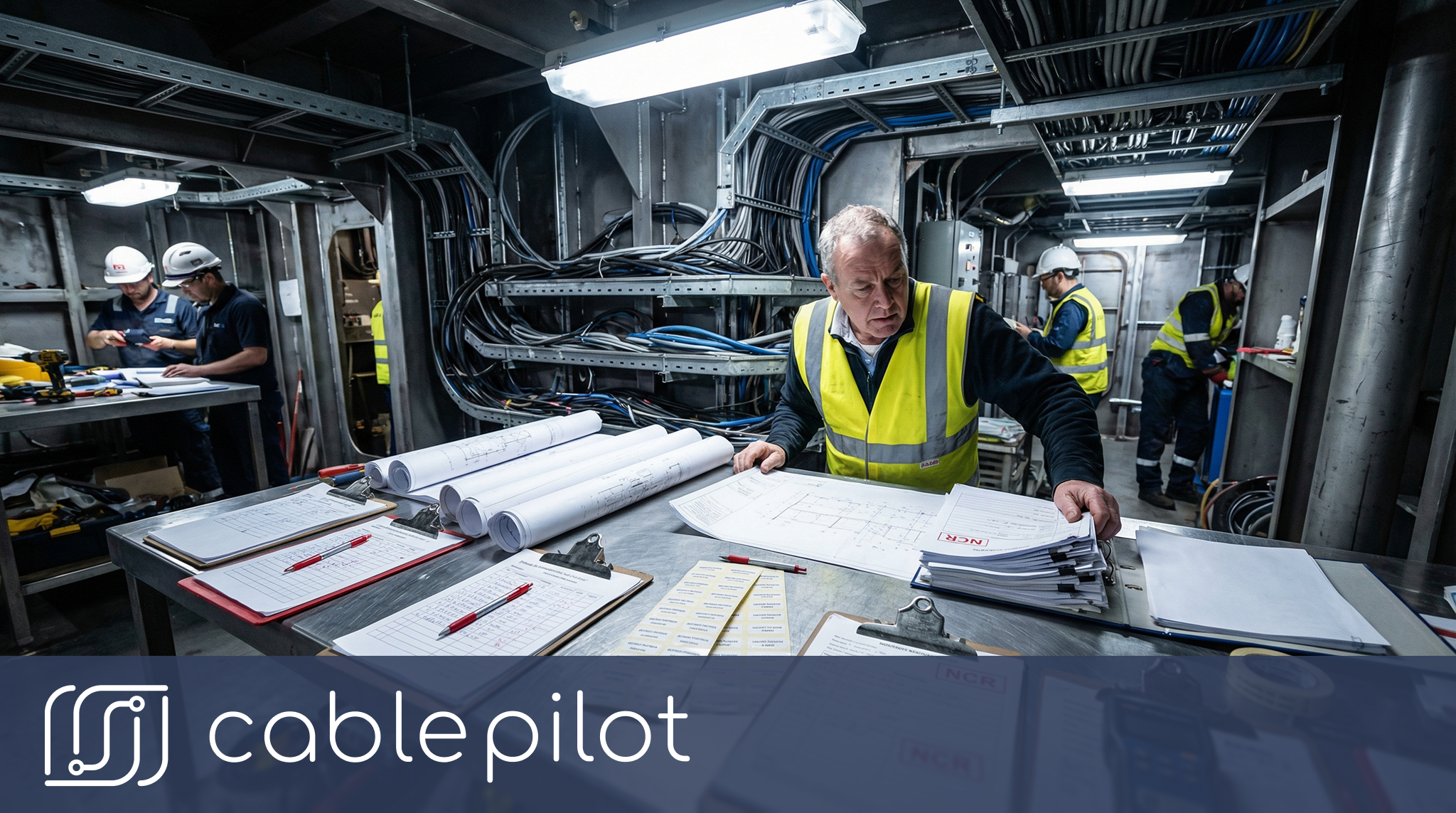
The commissioning phase reveals the most expensive consequences of reactive quality. When systems engineers attempt to energize electrical systems and discover that test records are missing, incomplete, or questionable, the entire commissioning schedule stalls. Unlike installation rework, commissioning delays directly impact vessel delivery dates, triggering late-delivery penalties that can reach hundreds of thousands of dollars per day on commercial vessels and millions on complex offshore units.
Three Pillars of Proactive Quality Enforcement
Cable Pilot’s installation error prevention architecture rests on three interconnected enforcement mechanisms that collectively prevent quality problems before they occur.
Physical Dependency Logic
The system enforces the immutable physical reality that certain installation steps must occur in specific sequences. You cannot terminate a cable before it’s pulled. You cannot test a connection before both ends are terminated. You cannot commission a system before all constituent cables are complete.
These rules seem obvious, yet traditional paper-based or loosely structured digital systems allow electricians to mark steps complete out of sequence—either through honest mistakes or shortcut attempts to show progress. Cable Pilot makes premature status changes structurally impossible through dependency workflow logic embedded in the system architecture.
Consider a practical example: a cable connecting a motor control center to a pump motor. The correct installation sequence requires: (1) cable pulled through defined route, (2) both ends stripped and prepared, (3) source end terminated at MCCs, (4) load end terminated at motor, (5) insulation resistance test conducted, (6) continuity verified, (7) final inspection approved. Each step serves as a prerequisite for the next.
In Cable Pilot, when an electrician attempts to mark the cable as “Terminated” without first completing the “Pulled” status, the system blocks the action and displays the prerequisite requirement. The electrician must document cable pulling —before the system enables the termination workflow. This forced sequencing ensures that every cable progresses through the physically necessary steps without shortcuts or omissions.
The enforcement extends to equipment-level dependencies. A junction box cannot be marked as “Complete” until all cables connected to it show “Terminated” status. A distribution panel cannot proceed to testing until all feeder cables are installed and terminated. These equipment-level rules prevent the common problem of premature equipment sign-off that creates confusion and rework when the remaining cable connections are eventually completed.
Compliance Rule Enforcement
Beyond physical dependencies, electrical installations must satisfy numerous regulatory, classification, and design requirements. Cable segregation compliance rules prohibit routing power cables too close to instrumentation or communication cables. Fire zone penetrations require specific sealing materials and installation methods. Hazardous area cables demand special termination techniques and documentation.
Traditional compliance management relies on electricians remembering these requirements and inspectors checking adherence after the fact. Cable Pilot embeds compliance rules directly into the workflow, making violations impossible rather than merely detectable.
The system achieves this through attribute-based rule evaluation. Each cable in the cable list carries attributes defining its function category (power, instrumentation, communication), voltage level, fire zone classifications, and hazardous area requirements. When an electrician scans a cable tag, the system displays segregation requirements and approved pathway.
Fire-stop penetration enforcement follows similar logic. When a cable route passes through a fire zone boundary, Cable Pilot automatically flags the penetration requirement and creates a quality gate. The cable cannot achieve “Complete” status until photographic evidence of proper fire-stop installation is uploaded and linked to the penetration point. This prevents the endemic problem of cables installed but fire-stops left incomplete, only to be discovered during fire safety audits weeks later.

Quality Gate Documentation
The third enforcement pillar ensures that objective evidence of quality exists before work advances to subsequent phases. Real-time quality gates block progress until required documentation, test results, and approvals are properly linked to the asset.
Testing requirements provide the clearest example. Before any cable can transition from “Installed” to “Tested” status, Cable Pilot requires attachment of actual test result documentation. For a power cable, this might include insulation resistance measurements showing values above minimum thresholds, continuity verification confirming correct core identification, and high-potential test results if specified.
The system doesn’t merely require a checkbox claiming “tested”—it requires documented evidence. An electrician or test technician must either enter numerical test values directly into structured fields (enabling automated pass/fail evaluation). Only when test results meeting specified criteria are properly linked does the system enable transition to the next workflow stage.
This quality gate approach transforms first-pass inspection rates because inspectors no longer need to track down test records or question whether tests were actually performed. The audit trail documentation is structurally bound to the asset record, timestamped, and includes photographic evidence of the physical test execution.
Automated Escalation and Hour-Level Problem Resolution
Even with comprehensive preventive enforcement, installation workflows encounter legitimate blockers—missing materials, design ambiguities, access restrictions, or discovered field conditions requiring engineering resolution. The difference between minor schedule impacts and major delays lies in how quickly these blockers surface and reach the people who can resolve them.
Traditional communication of installation problems follows painfully slow paths. An electrician discovers a missing cable gland, mentions it to the foreman at the end of the shift, who adds it to a materials shortage list, which gets reviewed in the next morning’s coordination meeting, after which someone places an order that arrives three days later. Meanwhile, the electrician has moved to other work, and when the material finally arrives, mobilizing back to complete that cable creates scheduling friction.
Cable Pilot’s proactive quality enforcement system includes automated notification and escalation that compress these resolution cycles from days to hours.
When an electrician encounters a blocker during cable installation workflow, they immediately log it through the smartphone application. The blocker logging interface requires classification (material shortage, design issue, access problem, damage discovered, etc.), and allows attachment of photographs showing the specific situation. The electrician adds a brief text description, then submits the blocker report.
The system immediately routes this notification based on blocker type and predefined responsibility matrices. Material shortages go directly to the materials coordinator with details of the specific item needed and the exact location where it’s required. Design questions route to the responsible electrical engineer with photos of the field condition. Access conflicts notify the construction coordinator and the trade currently occupying the space.
These notifications arrive as push alerts on responsible parties’ smartphones, ensuring visibility within minutes rather than waiting for the next scheduled meeting. Each notification includes direct links to the affected cable record, attached photos, and location context, giving recipients everything needed to make immediate decisions.
The escalation system includes automatic time-based escalation. If a blocker remains unresolved for a defined period (typically 4-8 hours for material issues, 2 hours for safety concerns), the system automatically escalates the notification to the next management level. A material shortage that doesn’t receive a response from the materials coordinator within four hours automatically notifies the construction manager, ensuring critical path issues don’t languish in one person’s queue.
This rapid escalation mechanism transforms commissioning handover acceleration by preventing the accumulation of unresolved minor issues that collectively delay system completion. In traditional projects, dozens or hundreds of small open items accumulate over months, requiring extensive punch-list efforts at the end. Cable Pilot’s hour-level resolution cycles close issues continuously, maintaining near-zero punch-list states throughout the project.
The impact on project velocity is measurable. Projects using Cable Pilot become blocker resolution cycles compress from an average of 3.2 days to 0.4 days—an 8x improvement. This acceleration directly translates to reduced labor effort because electricians spend less time waiting for resolutions and more time executing productive work.
Building an Immutable Audit Trail for Classification and Compliance
Classification society surveys and regulatory inspections represent critical milestones in ship delivery schedules, yet they often devolve into adversarial, time-consuming processes when documentation is incomplete or questionable. Surveyors must verify that electrical installations meet safety regulations, classification rules, and approved designs—a task that traditionally requires examining thousands of physical installations while cross-referencing paper documentation of varying quality and completeness.
Cable Pilot’s audit trail documentation architecture transforms these surveys from adversarial audits into data-driven verification exercises, compressing survey durations while improving compliance confidence.
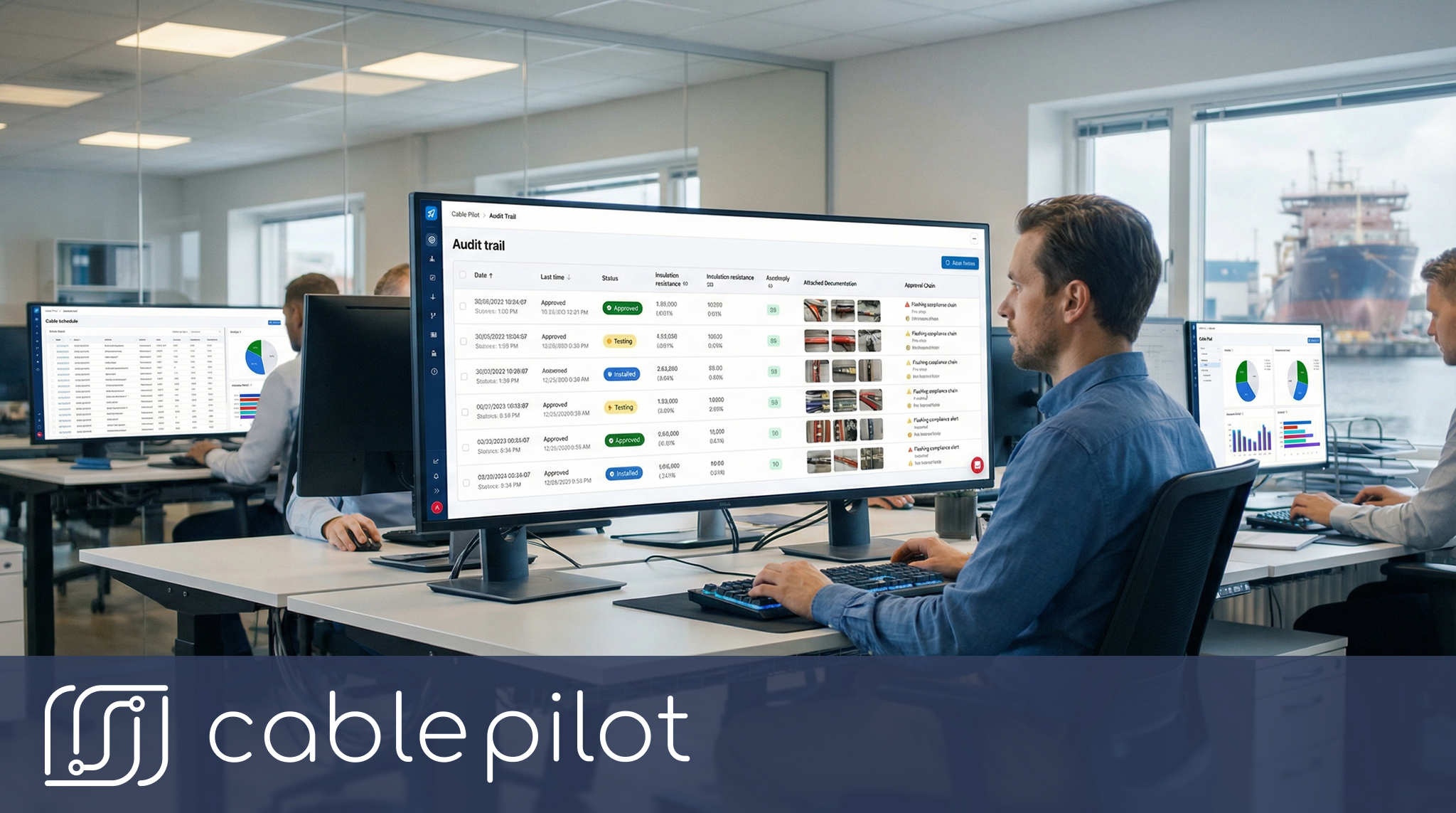
The system creates an immutable record of every installation action, timestamped and linked to specific user identities. When electrician John Smith terminates cable 440V-MOT-035 at 14:23 on March 15, that action records his user ID, the precise timestamp, the location (which equipment unit), and links to any photos he captured of the completed termination. This record cannot be altered or deleted—even by system administrators—creating tamper-proof documentation that classification surveyors can trust.
Testing documentation receives similar treatment. When test technician Sarah Johnson performs an insulation resistance test on cable 440V-MOT-035 at 09:47 on March 17, the system records her identity, the test timestamp, the specific test instrument used, the measured values. The system evaluates whether these values meet specification requirements (minimum 100 MΩ) and assigns a pass/fail status with zero ambiguity.
Quality gate completions add additional audit trail layers. When inspector Michael Chen approves the final inspection of cable 440V-MOT-035 at 16:12 on March 18, his approval links to the complete chain of prior activities: installation by John Smith on March 15, testing by Sarah Johnson on March 17, automatic segregation compliance verification, fire-stop documentation photos. This complete chain provides classification surveyors with comprehensive evidence of compliant installation without requiring them to physically trace and inspect every cable.
The audit trail extends to engineering changes and approved deviations. If cable 440V-MOT-035 required a field modification—perhaps terminating to a different terminal position than originally designed—the complete approval chain is preserved: the electrician’s initial mismatch detection, the engineering concession request with photos explaining the field condition, the electrical engineer’s approval with updated terminal assignment, and the subsequent completion of work to the approved modified configuration. Classification surveyors can review this complete change history and verify that modifications followed proper approval processes.
This comprehensive documentation architecture directly addresses one of the most time-consuming aspects of classification surveys: resolving discrepancies between as-designed and as-built conditions. Traditional surveys often uncover installations that don’t match original drawings, triggering lengthy investigations to determine whether the deviation represents an error requiring correction or an approved field modification that was properly documented. Cable Pilot’s audit trail makes this distinction immediately clear—approved modifications show complete approval chains, while any installation that doesn’t match approved documentation is automatically flagged as a discrepancy requiring resolution.
Quantifying the Impact: From Reactive Firefighting to Proactive Prevention
The transformation from reactive quality inspection to proactive quality enforcement delivers measurable improvements across every dimension of project performance. Organizations that have implemented Cable Pilot’s automated compliance rules report consistent patterns of improvement that fundamentally reshape project economics.
First-pass inspection rates show the most dramatic improvement. Traditional electrical installations typically achieve 82-88% first-pass approval—meaning 12-18% of inspected work contains deficiencies requiring correction. This statistic might seem acceptable until you calculate the rework implications across a 50,000-cable vessel: 6,000–9,000 cables requiring some form of correction, consuming thousands of labor hours and compressing delivery schedules.
Projects using Cable Pilot’s enforcement mechanisms report first-pass rates improving to 96-98%. The reduction in deficiency rates from 15% to 2% represents an 87% decrease in rework volume. On a 50,000-cable vessel, this improvement prevents 6,500 rework instances, saving approximately $3.2 million in direct rework costs while recovering 8,000–12,000 labor hours that can be redirected to productive work.
Rework cost reduction extends beyond direct labor savings. Rework creates secondary costs through schedule disruption (mobilizing crews back to previously completed zones), trade coordination friction (accessing spaces now occupied by other trades), and materials waste (cables damaged during removal, fittings that can’t be reused). Industry studies estimate that total rework costs run 2.5–3.5 times the direct labor cost of correction.
The commissioning handover acceleration impact manifests through multiple mechanisms. First, the near-elimination of test documentation gaps means commissioning engineers don’t encounter the endemic problem of cables claimed as complete but lacking verified test records. Second, the real-time resolution of blockers prevents the accumulation of hundreds of minor open items that traditionally create extensive punch-list efforts. Third, the comprehensive audit trail documentation enables rapid verification by commissioning teams and classification surveyors.
Projects report that electrical system handover to commissioning compresses from typical durations of 6-8 weeks to 2-3 weeks—a 60-70% reduction. This acceleration directly impacts vessel delivery schedules. On projects where late delivery penalties run $100,000–$500,000 per day, shaving 3-4 weeks from the electrical completion timeline can prevent $2.1–$14 million in penalty exposure.
Classification survey efficiency shows similar dramatic improvement. Traditional electrical surveys of large vessels consume 8-12 surveyor-days examining installations and reviewing documentation, with additional days addressing documentation gaps and resolving discrepancies. Cable Pilot’s comprehensive audit trail documentation enables surveyors to shift from physical sampling inspection to data-driven verification.
Surveyors can review the complete installation and testing history of any cable from their office computer, examining timestamped photos of critical work, verifying test result values against requirements, and confirming that all quality gates were properly satisfied. Physical inspection focuses on statistical sampling to verify that documented work accurately represents physical reality, rather than attempting to verify every installation detail.
This efficiency compresses survey durations to 2-4 surveyor-days—a 60-75% reduction that translates to faster survey completion, reduced surveyor fees, and elimination of survey-driven schedule delays. Multiple shipyards report that classification electrical surveys have shifted from adversarial audits focused on finding documentation gaps to collaborative verification sessions where surveyors confirm the quality of an already-comprehensive digital record.
Implementation Strategy: Building Enforcement Without Workflow Disruption
The substantial benefits of installation error prevention through automated compliance rules raise an important practical question: how do organizations implement these enforcement mechanisms without disrupting ongoing work or triggering resistance from installation crews accustomed to traditional methods?
Successful implementations follow a phased approach that builds enforcement gradually while maintaining productivity and securing crew buy-in through demonstrated value.
The initial phase establishes basic digital workflow without aggressive enforcement. Electricians begin using Cable Pilot to scan cables and document installation progress. This phase familiarizes crews with the smartphone application interface and demonstrates the convenience of digital documentation (no paperwork, automatic photo linking, real-time progress visibility) without introducing workflow constraints that might generate resistance.
During this initial phase, project teams configure the dependency rules and compliance logic that will eventually activate. Electrical engineers define the prerequisite chains (what must be complete before each workflow stage becomes available), configure segregation requirements based on the specific vessel’s design, and establish quality gate criteria (what test results are required, what photographic evidence is necessary, what approvals must be obtained).
The second phase activates enforcement selectively on non-critical-path work. The system begins blocking premature status changes and enforcing prerequisite sequences. This allows electricians to experience the enforcement mechanisms and understand their logic while providing project managers with opportunities to refine rules based on feedback before rolling out to critical-path work.
This selective activation often reveals edge cases that require rule adjustments. Perhaps a particular equipment type has a non-standard termination sequence that differs from the default logic. Perhaps certain test types are performed by specialized subcontractors using different documentation methods. The selective phase allows these situations to surface and be addressed through configuration adjustments before full enforcement activation would create project impact.
The third phase implements full enforcement across all work after crews have adapted to the new workflow and rules have been refined through real-world feedback. At this stage, the dependency workflow logic operates comprehensively—all prerequisite chains are active, all segregation rules are enforced, all quality gates block progress until satisfied. The key success factor is that by this point, electricians understand why each rule exists and have experienced the benefits of preventing errors, so enforcement feels like helpful guardrails rather than arbitrary restrictions.
Organizations that follow this phased implementation report minimal productivity disruption during transition. The initial advisory phase actually improves productivity by 8-12% through elimination of paperwork and reduction of coordination delays, creating positive momentum that carries through the enforcement activation phases. By the time full enforcement is active, crews have adapted their work habits to align with the digital workflow, and the enforcement mechanisms feel natural rather than obtrusive.
The Strategic Transformation: From Quality Control to Quality Assurance
The shift from reactive inspection to proactive quality enforcement represents more than operational improvement—it transforms the fundamental nature of quality management in electrical installation. Traditional quality control attempts to detect and correct errors after they occur. Cable Pilot’s approach prevents errors from occurring in the first place, shifting the paradigm from quality control to quality assurance.
This transformation has strategic implications for how shipyards compete. In an industry where vessel delivery delays and cost overruns are endemic, the ability to guarantee schedule adherence and minimize rework creates powerful competitive differentiation. Shipyards that implement comprehensive quality enforcement can confidently commit to compressed schedules and fixed-price contracts that would be unacceptably risky under traditional reactive quality models.
The data transparency created by audit trail documentation enables entirely new approaches to client relationships. Rather than viewing classification surveys and owner inspections as adversarial audits, shipyards can provide clients with real-time access to the same quality data that drives internal operations. Owners can observe installation progress, review test results as they’re generated, and verify compliance continuously rather than discovering issues during final inspections.
This transparency builds trust that translates to commercial advantage. Owners willing to pay premiums for schedule certainty and quality confidence increasingly select shipyards that can demonstrate systematic quality enforcement rather than merely claim adherence to quality management systems. The immutable audit trail provides objective evidence that quality management systems are actually followed, not just documented.
The strategic value extends to workforce development. New electricians entering the trade benefit from automated guidance that accelerates their learning curve. Rather than relying entirely on experienced workers to teach correct installation sequences and compliance requirements, the digital workflow provides continuous just-in-time training. When a less experienced electrician attempts to skip a prerequisite step, the system explains why that step is necessary before allowing work to proceed, building understanding along with compliance.
Conclusion: Prevention as the Foundation of Modern Quality Management
The electrical installation quality crisis in shipbuilding—with its endemic rework, commissioning delays, and last-minute documentation scrambles—is not inevitable. It’s the predictable result of quality management approaches designed for different eras and different industries, applied to work that has fundamentally changed in complexity and regulatory burden.
Cable Pilot’s proactive quality enforcement architecture aligns quality management with the realities of modern ship electrical systems: thousands of cables, stringent regulatory requirements, demanding classification rules, and fixed-price contracts with penalty-laden delivery commitments. By preventing errors at their source through automated compliance rules, the system eliminates entire categories of rework while creating the comprehensive audit trail documentation that modern regulatory frameworks demand.
The measurable outcomes—first-pass inspection rates above 98%, rework cost reduction exceeding 75%, commissioning handover acceleration of 60-70%, and classification survey compression of similar magnitude—transform project economics. A typical large vessel electrical installation generates millions in total savings through eliminated rework, recovered schedule, and prevented penalties.
But the deeper transformation lies in shifting from reactive firefighting to proactive prevention. When quality is enforced in real-time through dependency workflow logic and real-time quality gates, project teams escape the endless cycle of discovering problems too late and scrambling for solutions. They work systematically toward completion with confidence that each completed cable meets all requirements, properly documented and ready for commissioning without surprises.
This is the future of quality management in shipbuilding electrical installation—not more intensive inspection of completed work, but intelligent systems that make incorrect work impossible to execute in the first place. The question for shipyards and contractors is no longer whether to adopt this approach, but how quickly they can implement it before competitors gain insurmountable advantages in cost, schedule, and quality performance.
Ready to transform your electrical installation quality from reactive inspection to proactive prevention? Contact Cable Pilot today to discover how real-time quality enforcement can eliminate rework, accelerate commissioning, and deliver measurable improvements in first-pass inspection rates on your next vessel project.