
Is your next bid an accurate calculation or a high-stakes bet on your company’s future?
For a Project Manager in the maritime industry, this isn’t a rhetorical question. It’s a daily, draining reality. You are fully responsible for the financial outcome, yet you’re forced to build a budget on a shaky foundation of intuition, scattered spreadsheets from past projects, and completely opaque estimates from contractors. You sit in planning meetings, presenting a budget you can’t fully defend, knowing that a single miscalculation could have million-dollar consequences. This is especially true when it comes to shipbuilding cost estimation.
The result? Your days are spent fighting fires, not managing strategy. You’re haunted by the dread of that one uncontrollable budget overrun—the one that wipes out profitability, damages your company’s reputation, and puts your career on the line. Every scope creep feels like a personal failure, even when you know the process itself is broken.
The hard truth is that relying on subjective assessments and outdated metrics is a guaranteed path to financial failure in today’s complex projects. In this article, we’ll dissect why the old ways are broken and show how a shift to objective, standardized metrics for measuring work can transform your project budgeting from guesswork into a precise science.
Understanding shipbuilding cost estimation is crucial for ensuring project viability and success.
The Anatomy of Failure: Why Traditional Estimates Are a Trap
For decades, the industry has run on experience. A seasoned manager could estimate the scope of work “by eye.” But as vessel complexity has grown exponentially—with integrated automation, advanced navigation systems, and stringent environmental regulations—these traditional methods have become a dangerous trap. What once felt like informed judgment has become a primary source of unacceptable risk.
Trap #1: The Expert’s Curse
Experience is a double-edged sword. Psychologists call it “cognitive entrenchment”—a state where past success narrows our perspective and creates dangerous blind spots. A manager who masterfully delivered a series of simple tugs has a mental model built on that specific type of project. When faced with a complex research vessel, that model is no longer just irrelevant; it’s dangerous. They might grossly underestimate the labor required for cabling in sensitive laboratory spaces with strict anti-vibration and electromagnetic shielding requirements. They apply old assumptions to a new reality, and the budget pays the price.
This is amplified by the fact that human memory is selective. We tend to remember typical outcomes, conveniently forgetting the “black swan” events that devour contingency funds. Research in project budgeting and financial risks in shipbuilding confirms that traditional estimating methods systematically underpredict cost overruns. The budget becomes an exercise in optimistic averaging, ignoring the very risks that have the greatest potential to sink the project’s profitability.
Trap #2: The Tyranny of Flawed Metrics
To create a semblance of order, the industry has long relied on metrics like “man-hours” and “cost per meter.” But these are illusions of objectivity. They are, in fact, the most deceptive numbers in shipbuilding cost estimation.
A “man-hour” is not a standardized unit of output. It’s a wildly variable measure of input. Is it a man-hour from a master electrician with 20 years of experience or a new apprentice on their first vessel? Is that hour spent in a spacious, well-lit workshop or in a cramped, overheated compartment, contorting around existing pipework? Treating these hours as equal is a fundamental flaw in accounting.
The same is true for “cost per meter” of cable. This metric completely ignores the most labor-intensive parts of the job. The cost of pulling a light, flexible 3×1.5 signal cable is vastly different from that of a heavy, armored 3×95 power cable. More importantly, this metric says nothing about the complexity of termination at either end or the method of securing the cable. It reduces a complex, multi-faceted task to a single, misleading dimension.
When you receive quotes from different contractors using these metrics, you aren’t comparing a scope of work; you’re comparing their faith in their team’s productivity multiplied by their desired profit margin. It’s an apples-to-oranges comparison that introduces massive financial risks in shipbuilding.
Trap #3: The Iceberg of Hidden Complexity
No intuitive estimate can possibly account for the thousands of variables that impact labor on a modern vessel. A simple task like “pull one cable” is an iceberg. The visible part is the cable itself. The hidden, project-sinking mass below the surface is the true cost, determined by a web of complex factors, including:
- Cable Properties: Beyond simple size, this includes flexibility, armor type, shielding requirements, and fire-retardant ratings, all of which affect handling and installation difficulty.
- Installation Method: Is it a straight pull along an open, prefabricated tray, or a tortuous route that must be threaded through a dozen sealed bulkheads and congested pathways?
- Location & Environment: Working under the floor in the main engine room is physically more demanding—and therefore slower—than working in a spacious control room.
- Concurrent Operations: Is your electrical team trying to work in the same space as welders or pipefitters? These clashes create delays and inefficiencies that “man-hour” estimates never predict.
- Regulatory & Class Demands: The specific requirements of DNV, Lloyd’s Register, or ABS can impose different installation standards, adding a layer of complexity that must be accounted for.
- Termination Complexity: The number of cores to be terminated, the type of connectors used, and the intricacy of the connection points can often consume more labor than the physical pulling of the cable.
A traditional estimate can’t process this level of detail. It glosses over it, creating a budget that is detached from reality from day one.
The Birth of Precision: Calculated Workload Standards for Shipbuilding Cost Estimation
To escape this trap, the industry needs what the industrial revolution brought to manufacturing: standardization. Before the concept of “horsepower,” engine power was described in vague, subjective terms. Standardization created a common language for measuring performance. Shipbuilding needs the same for measuring work.
The only way out is to abandon subjective metrics for an objective, standardized system of measurement. Imagine if every task had a “work score,” automatically calculated by a system based on its objective, physical characteristics.
This is the principle behind “Cable Points” (CP). This isn’t a number you input; it’s a composite, weighted metric that represents the true, calculated workload. It is the “horsepower” for electrical work. The system computes CPs for a task by analyzing dozens of parameters, grouped into key categories:
- Physical Attributes: Cross-section, number of cores, insulation type, armor, shielding, flexibility.
- Installation Attributes: Routing method, number of bulkhead penetrations, installation environment (e.g., engine room vs. accommodation).
- Connection Attributes: Number of wires to terminate, connector types, special requirements.
This score isn’t just a number; it’s a unit of truth, representing the real work required, independent of who performs it. Adopting this system isn’t just an improvement—it’s a power shift. Here are the three revolutionary changes it delivers:
- Comparison Becomes Objective: You can now say with certainty that Contractor A’s bid for 15,000 CP of work is more demanding than Contractor B’s for 12,000 CP, allowing you to make a truly informed decision based on a like-for-like comparison of scope.
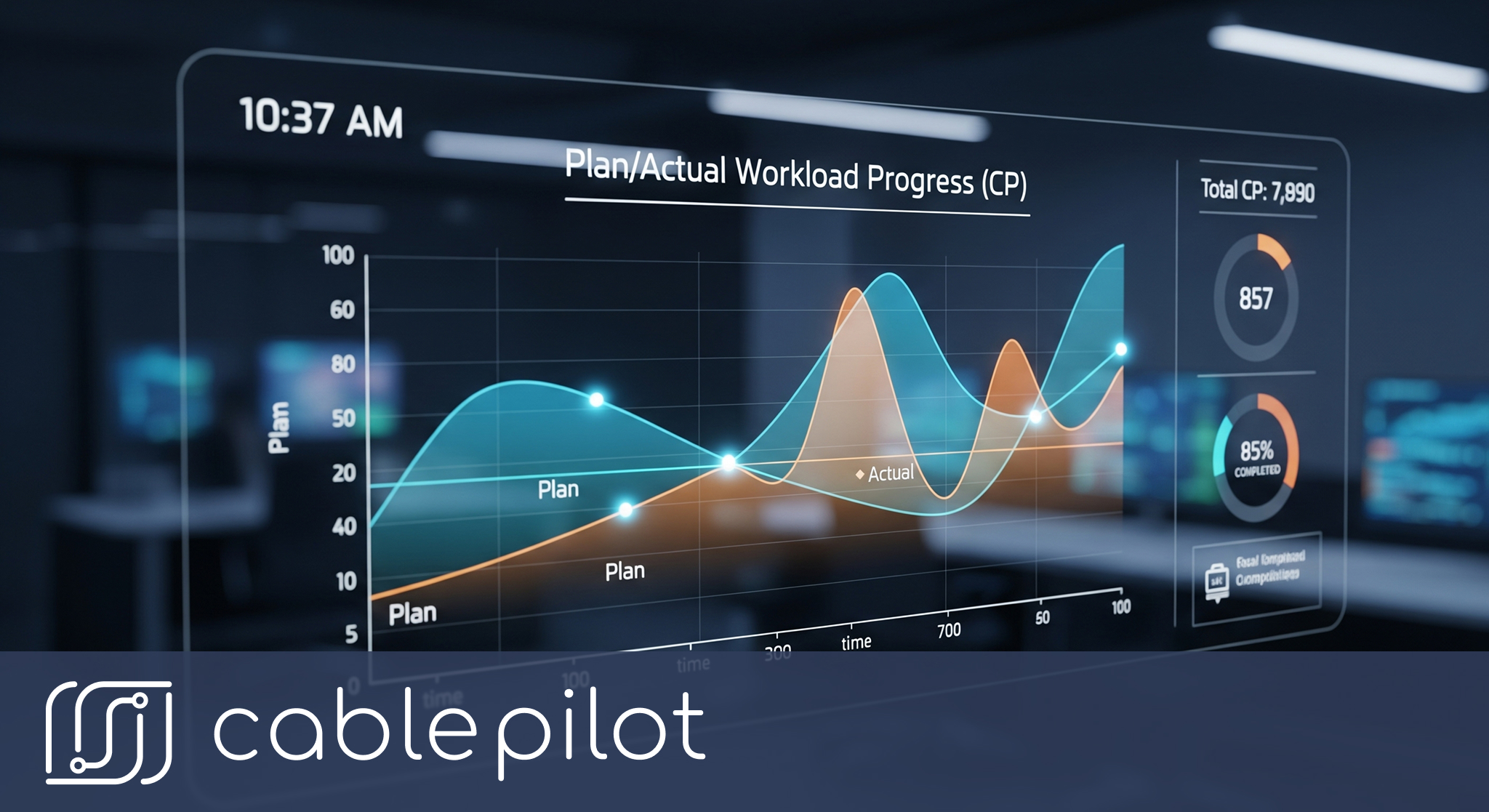
- Progress Becomes Measurable: The morning progress meeting is transformed. Instead of a supervisor’s subjective guess of “we’re about 80% done,” you operate on facts: “As of 8:00 AM, 82,150 CP of the planned 100,000 CP for this system are complete.” Progress is no longer a feeling; it’s a number.
- You Start Building a Library of Truth: Most importantly, with every single task completed, you begin accumulating clean, standardized, incorruptible data about the true scope of your projects.
From Data to Dominance: Your New Competitive Advantage
When every task has an objective weight, you stop just closing projects—you start building an invaluable library of facts. This transforms the chaotic, anecdotal experience of the past into a structured, digital knowledge base that becomes your company’s most powerful asset. Here’s how that asset translates into market dominance:
- Build a Library of Precedents: Every completed project becomes a detailed, digital precedent. When estimating a new tender for a similar vessel, you no longer rely on memory or dig through old, inconsistent spreadsheets. You query your own knowledge base: “Show me the average CP, cost, and duration for installing a ‘Navigation Lights System’ on all vessels under 100 meters we’ve built.” You receive an instant, data-driven answer. The statement, “On our last project, this system with a scope of 12,450 CP was delivered in X days for Y dollars,” becomes an irrefutable argument for your internal budget approval and a powerful tool in client negotiations.
- Conduct Fearless Performance Analysis: By comparing the calculated workload (in CP) against the actual cost and time spent, you get a true, unbiased measure of performance. The data will clearly show you which types of work are most costly and where your processes have bottlenecks. You can benchmark teams, shipyards, and contractors. You might discover that “Team A is 15% more cost-effective at installing armored cables in engine rooms, but Team B excels at delicate fiber optic work.” This allows you to deploy your resources with surgical precision, optimizing your entire operation based on facts, not favoritism or flawed assumptions.
- Win Bids with Unshakable Confidence: Armed with this data, you enter negotiations with a new level of power. You can create proposals that are neither dangerously low nor uncompetitively high. You can stand behind your pricing with complete confidence. When a client questions a line item, you can show them it’s based on the averaged data of five similar, successfully completed projects. This shifts the conversation from haggling over price to a strategic discussion about scope and value. It eliminates doubt and builds the kind of deep, long-term trust that turns clients into partners, mitigating one of the biggest financial risks in shipbuilding: the adversarial client relationship.
Conclusion: From a Risky Art to a Precise Science
Inaccurate shipbuilding cost estimation isn’t an unavoidable evil; it’s a choice. It’s the predictable result of clinging to outdated tools and subjective methods in an era defined by data and digitization. Continuing down that path is a conscious decision to accept high risks and forfeit profitability.
The shift to data-driven project budgeting and the use of calculated workload metrics like Cable Points is the single most impactful change you can make to your operation. This approach to shipbuilding cost estimation transforms project budgeting from a high-stakes gamble into a manageable science, drastically reducing financial risks in shipbuilding. It gives you the power not just to survive in a fiercely competitive market, but to dominate it, laying a solid foundation for the long-term profitability and technological leadership of your business.
Ready to swap guesswork for certainty in shipbuilding cost estimation? Explore our other comprehensive resources on project budgeting, mitigating financial risks in shipbuilding, and implementing calculated workload methodologies to boost operational efficiency in the maritime industry. Transform your approach to project budgeting today.