
What’s more important to your project’s success: how fast your teams work, or how fast they get the right information?
For generations, the answer in shipbuilding has been simple: speed is king. The primary measure of success on the shipyard floor has always been physical velocity—how many tons of steel are erected, how many meters of pipe are fitted, how many cables are pulled per shift. We push our teams and our contractors to work faster, believing that relentless physical momentum is the key to delivering a vessel on time. However, modern shipbuilding efficiency requires a fundamental shift from pure speed to strategic intelligence in shipyard management.
But this approach represents a dangerous illusion in today’s complex maritime industry. In the face of modern vessel sophistication, this obsession with physical speed has become a trap that undermines true shipbuilding efficiency.
It encourages teams to work quickly, but not necessarily intelligently.
The pressure prioritizes motion over strategic direction, often leading to situations where teams are working at maximum speed—but in completely the wrong direction. This misalignment between speed and accuracy creates significant obstacles for effective shipyard management, where digitalization in shipbuilding should be enhancing precision rather than promoting hasty decisions.
The hard truth is that in today’s complex environment, raw construction speed is no longer the primary driver of shipbuilding efficiency. It has been replaced by the speed and accuracy of information flow.
This article challenges the old “faster is better” mindset and demonstrates that a more deliberate work pace guided by real-time project management will consistently outperform a faster pace driven by outdated information.
Through data-driven decision making, modern shipyards can achieve unprecedented levels of operational excellence. Welcome to the new era where digital intelligence drives physical performance.
The Cult of Physical Speed: Working Harder, Not Smarter
The traditional shipyard environment is a culture of visible effort. We value the sight of teams in motion, sparks flying, and components being lifted into place. A team sitting idle is seen as a cardinal sin. This mindset pressures supervisors and managers to keep their teams “busy” at all costs.
But what happens when “busy” is based on bad information?
Imagine this scenario: A team is tasked with installing a series of complex cable trays in a compartment. They are highly skilled and motivated, and they complete the work in record time—two days ahead of schedule. The project manager is thrilled. But on the third day, a quality inspector arrives with a revised drawing that was issued 24 hours ago but hadn’t yet been printed and distributed to the installation team. The new design requires a different tray layout to avoid a conflict with a recently added ventilation duct.
The result? The two days of record-breaking work are now two days of high-cost rework. The entire installation must be ripped out and redone. The initial “speed” was an illusion. It didn’t accelerate the project; it set it back by a week and blew a hole in the budget.
The cost of fixing the error—including the new materials, the wasted labor for the first installation, the labor for the removal, and the labor for the second installation—is exponentially higher than the cost of a few hours of delay it would have taken to ensure the team had the right information in the first place.
This is the speed trap in action. By prioritizing physical action over information accuracy, we create the very rework and delays we are trying to avoid. True shipbuilding efficiency is not about how fast a mistake can be made. It’s about how effectively mistakes can be prevented.
The New Paradigm: Data Speed Dictates Project Speed
The fundamental shift required is recognizing information as the primary driver of production schedules in modern shipbuilding efficiency. The real bottlenecks in contemporary shipbuilding projects are rarely physical; they are informational. A project doesn’t halt because an electrician can’t work faster; it stops because the electrician has the wrong drawing, is waiting for an inspection, or lacks required materials. Effective shipyard management recognizes that digitalization in shipbuilding must address these information gaps to achieve optimal workflow coordination.
Real-time project management is about solving these informational bottlenecks before they can impact physical work. It’s about creating a frictionless flow of data that ensures the right information is in the right hands at the exact moment it’s needed.
This is not a futuristic concept; it is a practical, achievable strategy built on a single source of truth—a digital platform where all project data is live, interconnected, and universally accessible. When you achieve this, you change the entire dynamic of project management.
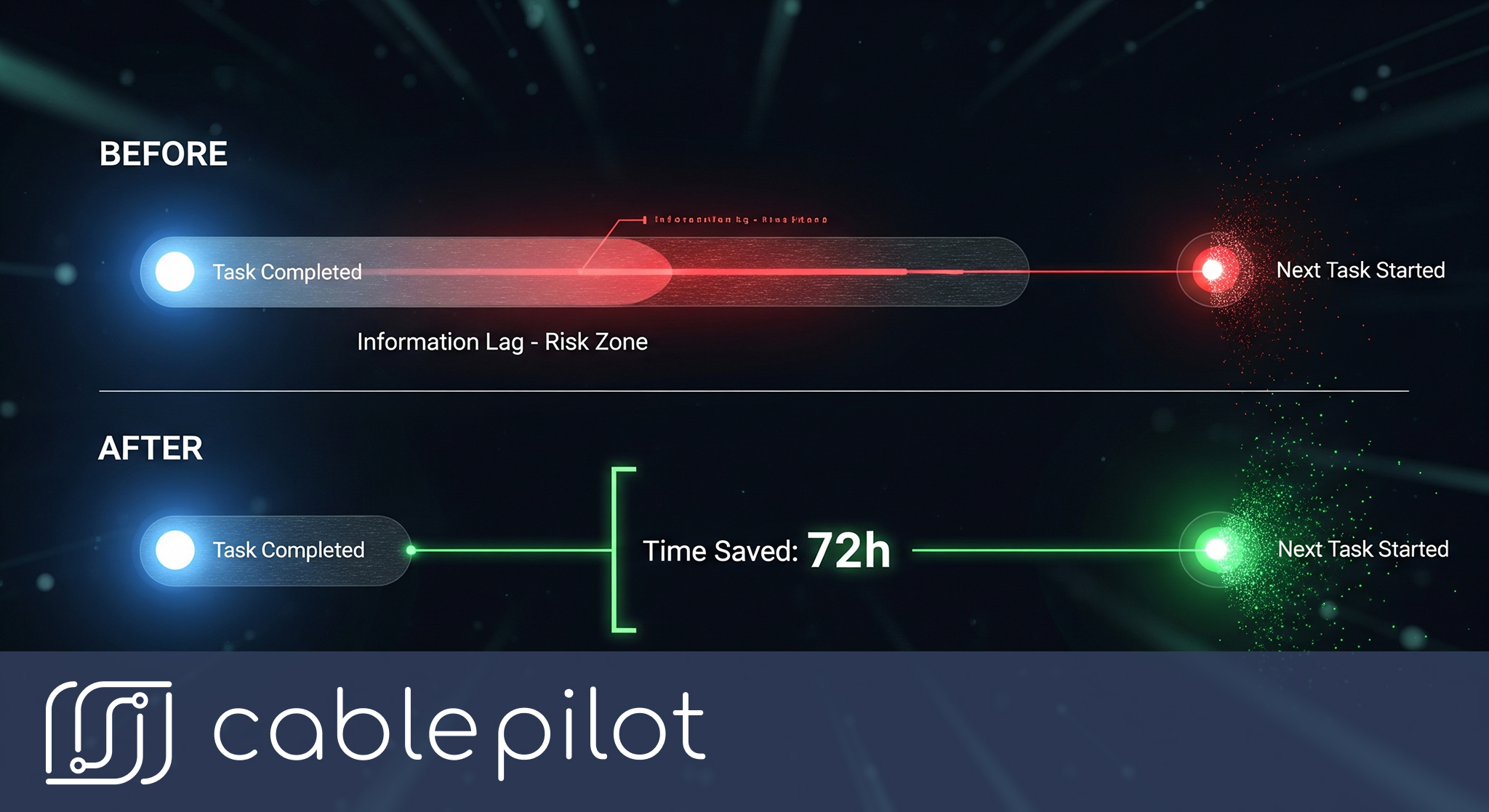
From Firefighting to Foresight: How Real-Time Management Works
A real-time data environment gives project leaders a new superpower: foresight. Instead of reacting to yesterday’s problems, you can anticipate and solve tomorrow’s.
Example 1: The Proactive Bottleneck
- The Old Way (Reactive): An electrical team is scheduled to begin work in a compartment on Wednesday. On Monday, the procurement team logs in their separate system that the specific glands needed are delayed by a week. This information sits in the procurement system. The project manager, relying on a weekly status report, doesn’t see this. On Wednesday, the electrical team arrives on site, discovers the material is missing, and an entire team is sent home or reassigned, their planned work completely lost.
- The New Way (Proactive): The project manager looks at a live project dashboard on Monday morning. The system, which integrates design, procurement, and production data, automatically flags a risk: “Work in Compartment C-205 scheduled to start in 48 hours is blocked by a material shortage (Gland-XYZ).” The project manager now has two full days to react. They can re-sequence the work, move the team to another prepared location, and completely avoid the wasted mobilization and downtime. They haven’t made the team work faster; they’ve made the entire project faster by eliminating a day of zero progress. This is data-driven decision making in action.
Example 2: The Trust Accelerator
- The Old Way (Adversarial): A client is nervous about progress. They demand a special report on the status of the fire detection system. The PM’s team spends a day pulling data from multiple spreadsheets, arguing over which numbers are correct, and building a presentation. The client receives the report two days later, scrutinizes the subjective “percent complete” numbers, and schedules a follow-up meeting to challenge the data. This cycle of reporting, questioning, and defending consumes days of high-level management time.
- The New Way (Collaborative): The client has access to a dedicated, read-only dashboard. They can log in at any time and see the exact same data as the PM. They don’t see a subjective percentage; they see hard numbers: “850 of 1,000 smoke detectors installed,” “92% of required cables connected.” The data is objective and pulled live from the system. The client’s trust grows, and the need for defensive reporting evaporates. The time saved from this administrative friction is now re-invested in actual project execution.
Conclusion: The Fastest Shipyard Is the Smartest Shipyard
The future of shipyard management belongs to those who understand that the old metrics of success are obsolete. In an era of immense complexity, a relentless focus on physical speed is a recipe for disaster. It creates a frantic, chaotic environment where errors are inevitable and rework is the norm.
True shipbuilding efficiency is born from operational clarity. It comes from building a resilient, data-driven operation where information flows so quickly and accurately that problems are solved before they can manifest in the physical world. This is the essence of data-driven decision making.

The fastest shipyards of the next decade will not be the ones with the fastest teams. They will be the ones with the fastest, most reliable flow of information, supported by advanced real-time project management systems. These operations will compete and win based on their ability to make smarter decisions through data-driven decision making, to anticipate and mitigate risk, and to build unshakeable trust with their clients. Modern shipbuilding efficiency will be the hallmark of organizations that embrace digitalization in shipbuilding as a core competitive advantage. They will prove that in modern shipbuilding, the smartest and most predictable shipyard is always the fastest.
Is your project caught in the speed trap? Read our other articles on risk management and discover how to build a more predictable and profitable operation.