
As the Design Engineer, where does your responsibility for a cable’s segregation end?
When the drawing is approved?
When the vessel is delivered?
Or when a critical navigation system fails at sea because of an entirely preventable installation error?
For you, this isn’t a theoretical question. It’s one of the most complex and highest-stakes challenges you face. Ensuring proper cable segregation in shipbuilding and electromagnetic compatibility is a non-negotiable requirement, enforced by strict standards from classification societies and underpinned by the unforgiving laws of physics. The consequences of getting it wrong range from expensive project delays to potentially catastrophic equipment failure at sea.
Yet, for such a critical task, our management methods are often terrifyingly primitive. We rely on complex tables buried in technical manuals, notes scribbled in the margins of drawings, and the hope that every single installer on the deck understands and correctly interprets these intricate rules in the chaotic, tightly-packed environment of a cable tray.
This is a recipe for failure. This article will take a deep dive into the technical and practical realities of cable segregation. We’ll explore why it’s so critical, what the standards demand, and how modern digital tools can transform this high-risk, manual process into a controlled, verifiable, and ultimately safer system.
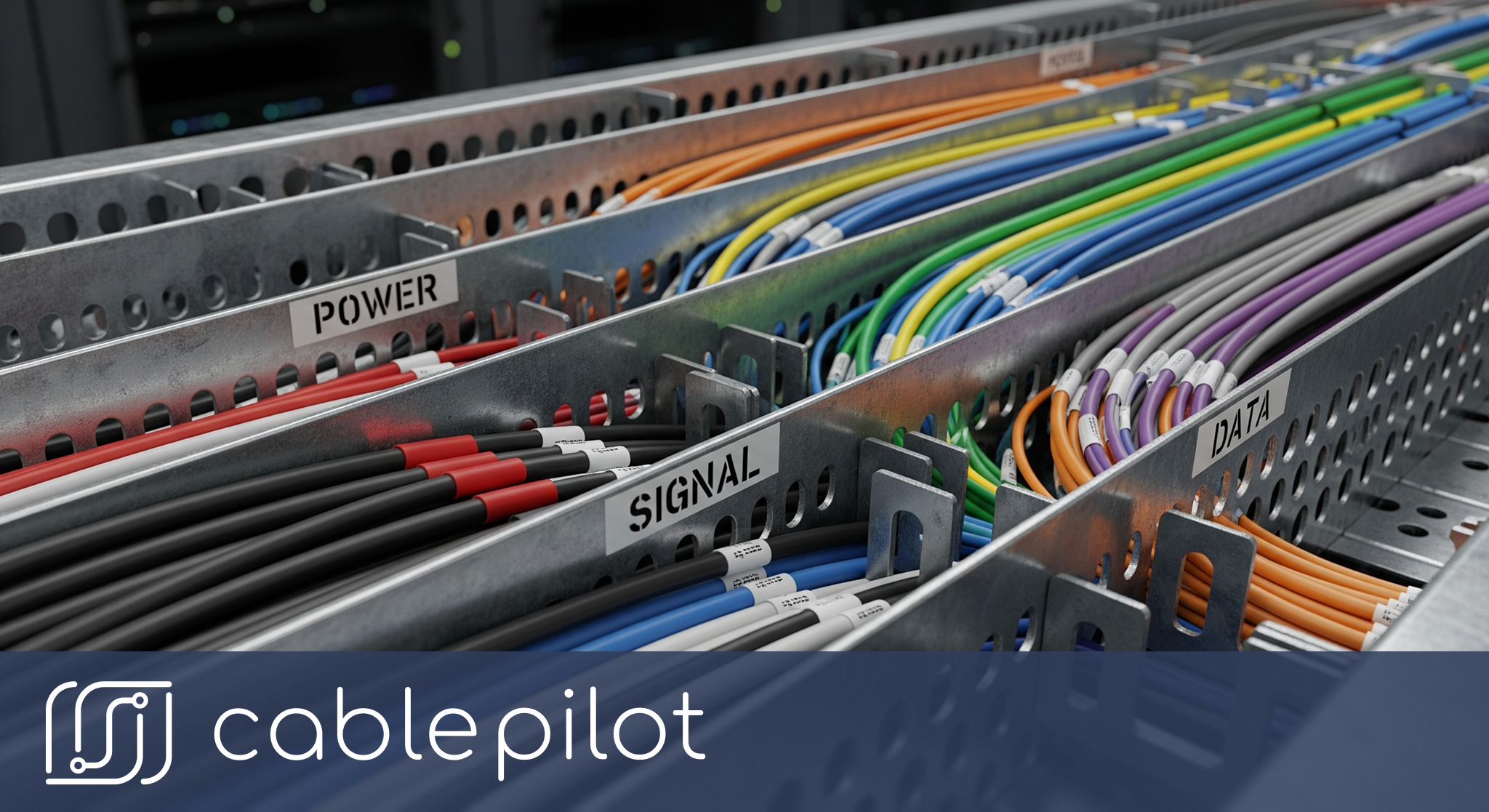
More Than Just Spacing: The Physics and Standards of Segregation and electromagnetic compatibility
At its core, the requirement for cable segregation is about one thing: managing invisible energy. It’s about ensuring electromagnetic compatibility (EMC) in an environment saturated with electrical noise.
The Physics of Interference
Every cable carrying a significant current generates an electromagnetic field (EMF) around it. This is a simple fact of physics. For a high-voltage power cable, this field is powerful. For a low-voltage data cable carrying sensitive digital signals, this field is a source of electromagnetic interference (EMI), or “noise.”
When a sensitive data cable is placed too close to a noisy power cable, this interference can induce unwanted currents, corrupting the delicate signals it carries. These aren’t minor glitches; they are project-sinking, career-damaging failures that originate from a single, preventable source. They can manifest in terrifying ways:
- Navigation systems receiving ghost signals or losing their lock.
- Engine control sensors providing false readings, leading to inefficient operation or false alarms.
- Communication systems becoming filled with static or losing connectivity at critical moments.
- Automated control systems behaving erratically.
The goal of segregation is to maintain a safe physical distance between “noisy” cables and “sensitive” cables, ensuring the integrity of every system on the vessel.
The Authority of Classification Societies for maritime engineering
Because of these high stakes, cable segregation is not left to chance. It is rigidly defined by classification society requirements. Organizations like DNV, Lloyd’s Register (LR), Bureau Veritas (BV), and standards bodies like the IEC publish detailed rules that dictate the minimum required distances between different cable families.
These standards group cables into categories based on their voltage, signal type, and sensitivity to interference. For example, a common grouping might look like this:
- Group 1: High Voltage Power (over 1kV)
- Group 2: Low Voltage Power (under 1kV)
- Group 3: Signal & Control Cables (analog and digital)
- Group 4: Telecommunication & Data Cables (LAN, etc.)
- Group 5: Radio Frequency (RF) Cables (antennas, etc.)
The rules then provide a matrix defining the minimum separation distance required between each group, both in open air and when run in the same cable tray separated by a metallic divider. These are not guidelines; they are hard-and-fast rules that will be meticulously checked by the class surveyor. A failed inspection means a non-conformance report and, often, an order to rip out and reinstall entire sections of cable, at a staggering cost.
The Practical Challenge: From the Rulebook to the Shipyard Electrical Design
Understanding the rules is one thing. Enforcing them across thousands of cables in the tight, chaotic confines of a vessel under construction is another challenge entirely. This is where the theoretical requirement crashes into the practical limitations of traditional, drawing-based management.
The core problem of cable tray management is the impossible task we assign to paper. We expect a static, 2D drawing to somehow enforce a complex, multi-dimensional set of rules in a chaotic, three-dimensional environment. This workflow is riddled with potential failure points.

An engineer might create a note on a drawing specifying “Segregation Class P+S,” but what does that mean to an installer who may not have the DNV rulebook memorized? The engineer is relying on the installer’s tribal knowledge about electromagnetic compatibility, which is an unacceptably risky proposition.
Furthermore, how does a Project Manager or a Quality Inspector quickly verify that all segregation requirements have been met in a specific area? They are forced into a slow, manual audit, trying to visually trace hundreds of cables on-site and cross-reference them with multiple drawings. It’s an almost impossible task, which is why segregation errors are so often missed until the final, most expensive stages of inspection or commissioning.
Digital by Design: Embedding Cable Segregation into the Data Model
To solve this, you need to stop treating segregation as a note or a comment. It must be treated as a fundamental, core attribute of the cable itself. This is what a modern shipyard electrical design platform does.
The only way to solve this is to stop treating segregation as a human instruction and start treating it as a machine-enforceable property of the system itself. In a system built for this purpose, cable segregation is not a memo; it’s metadata.

1. Assigning a Digital DNA:
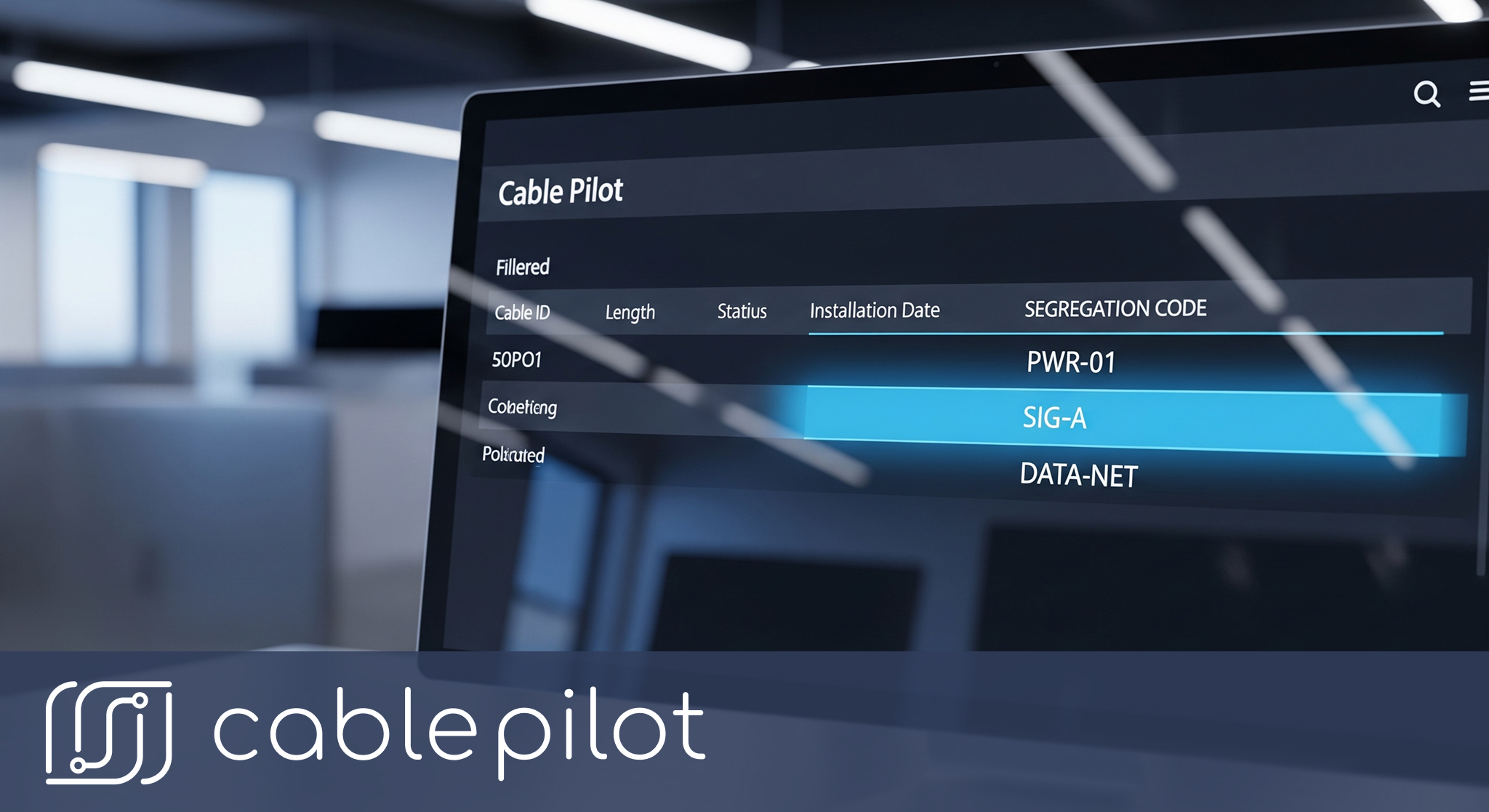
From the moment a cable is created in the system, it is assigned a specific, non-negotiable Segregation Code. This code, drawn from a library that reflects the classification society’s rules (e.g., “1-3 P” for power), becomes part of that cable’s digital DNA. It is not just a label; it is a machine-readable attribute that follows the cable through its entire lifecycle.
2. Clarity for the Installer:
When the installer on the deck scans a cable’s QR code, the mobile app doesn’t just show them a drawing number. It displays the cable’s essential attributes, including its mandatory Segregation Code for electromagnetic compatibility. The ambiguity is removed. The requirement is presented clearly and directly at the point of work, dramatically reducing the risk of human error.
3. Empowering the Engineer with Audit Tools:
This is the most powerful benefit for you, the Design Engineer and shipyard electrical design. Because segregation is a structured data field, you can now use the platform to perform powerful, near-instantaneous audits that are impossible with paper or Excel. You no longer have to guess or hope that the rules are being followed. You can verify.
For example, you can run a query to:
- “Show me all cables with Segregation Code ‘Group 5 – RF’ and list the cable trays they are assigned to.” You can now quickly cross-reference this list with your tray layout to ensure these highly sensitive cables are routed correctly.
- “Generate a report of all cables passing through Engine Room #1, and group them by Segregation Code.” This allows you to see the mix of cable types in a congested area and spot potential issues before they are built.
- “Select all cables for the ‘Navigation’ system and highlight any that are not assigned the highest level of segregation.” This allows you to perform a system-level audit to ensure your most critical systems are fully protected from EMI.
This ability to filter, group, and audit based on segregation codes transforms your role in maritime engineering. You move from being a “rule-keeper” who hopes their instructions are followed to a “system auditor” who can easily and quickly verify compliance.
Before a final inspection, you can proactively generate the exact reports the class surveyor will need, demonstrating with data that all classification society requirements have been met. This dramatically de-risks the inspection process and prevents last-minute surprises.
Conclusion: From Ambiguity to Certainty
Proper cable segregation in shipbuilding is a complex discipline that sits at the intersection of physics, regulatory compliance, and practical construction for maritime engineering. Relying on manual processes and human memory to manage this complexity is an outdated and unacceptably risky strategy. It creates a work environment defined by ambiguity, where the odds of a costly error are high.
The modern, digital approach for shipyard electrical design removes that ambiguity. By embedding the rules of segregation for cable tray management directly into the core data model of a project, you transform them from abstract requirements into tangible, manageable, and auditable attributes. You give engineers the tools they need to design and verify with confidence, and you give installers the clear, unambiguous instructions they need to execute correctly the first time.
For the modern Design Engineer, this is the new standard of professional due diligence. It’s a shift cable segregation from just creating a correct design to architecting a process that guarantees a correct installation. It’s how you build not just a safe vessel, but a resilient, data-driven project that stands as a testament to your engineering skill.
Want to dive deeper into the technical nuances of modern electrical design? Read our other expert articles to learn more.