
Every revolutionary technology introduces a new vocabulary. To master a data-driven approach, your entire team must speak the same language of data. This glossary is your dictionary.
As you transition to a powerful, data-driven platform, you’ll encounter terms that go beyond traditional project management vocabulary. Concepts like “Cable Points,” “Digital Twin,” and “Spatial Accountability” are not just jargon; they represent a fundamental shift in how complex projects are managed. Understanding them is the key to unlocking the full potential of your team and your projects.
This glossary is your definitive guide. We’ve compiled and explained every key term and concept that forms the foundation of the Cable Pilot ecosystem. Use it as a reference, a training tool, and a way to build a shared, common language across your entire organization—from the installer on deck to the director in the C-suite.
A
Adjustment Factor
- Definition: A multiplier applied to a task’s baseline workload (measured in Cable Points) to account for specific on-site complexities like confined spaces, work at height, or hazardous conditions.
- Why it Matters: This tool bridges the gap between the “clean” plan and the “messy” reality of the shipyard. It empowers Site Managers to create more accurate and fair plans by quantifying the real-world difficulty of a task, leading to better forecasts and more motivated teams.
AI Importer
- Definition: An Artificial Intelligence-powered tool that analyzes user-uploaded spreadsheets (like cable schedules) in their original format and automatically suggests how to map the data to the system’s fields.
- Why it Matters: This eliminates the single biggest barrier to adopting new software: the painful, time-consuming, and error-prone process of manual data migration. It reduces weeks of work to minutes, allowing projects to achieve value from day one.
AI Version Comparison
- Definition: An AI-powered tool that automatically compares two versions of a document (e.g., a cable list or drawing) and generates a clear report of all additions, deletions, and modifications.
- Why it Matters: It eliminates the high-risk, manual nightmare of trying to find changes between massive spreadsheets, preventing costly errors caused by working with outdated information.
API (Application Programming Interface)
- Definition: A set of rules and protocols that allows Cable Pilot to connect and share data with other software systems, such as CAD, ERP, or business intelligence tools. (This is a roadmap item).
- Why it Matters: An open API is the key to creating a truly integrated digital ecosystem, breaking down data silos between departments and ensuring that all corporate systems are working from a single source of truth.
Area
- Definition: A large-scale construction or functional zone of a vessel (e.g., “Engine Room,” “Accommodation Block”). It is a high-level component of the Project Hierarchy.
- Why it Matters: Grouping work by Area allows for high-level strategic oversight, helping Project Managers quickly identify which major zones of the project are on track and which are falling behind.
As-Built Documentation
- Definition: The final set of documents that reflects the project as it was actually constructed, including all on-site changes and modifications.
- Why it Matters: Cable Pilot automates the creation of this critical handover package by maintaining a live, accurate record of the project, saving hundreds of hours of manual compilation at the end of a project.
B
Blocker
- Definition: Any issue or obstacle that prevents a task from being completed (e.g., an error in a drawing, lack of materials, denied access).
- Why it Matters: The system allows any user to log a blocker and link it to a specific object (like a cable or compartment). This makes problems instantly visible to the right people, ensuring they are resolved quickly instead of festering and causing major delays.
C
Cable Points (CP)
- Definition: A standardized, calculated unit of measurement that represents the true workload of a task, not just its length or time. It is objectively derived from a cable’s physical properties (cross-section, core count, weight, etc.).
- Why it Matters: CP is the foundation of objective project management. It replaces misleading metrics like “meters pulled” with a true measure of effort, leading to radically accurate progress tracking, forecasting, and budgeting.
Cable Type
- Definition: A specific, commercial product from a particular manufacturer that meets the technical requirements of a given Specification.
- Why it Matters: Decoupling the Cable Type (the “who”) from the Specification (the “what”) is the key to supply chain resilience. It gives the procurement team the flexibility to choose from multiple approved suppliers without forcing costly engineering changes.
Category
- Definition: A user-definable classification level for objects like cables and equipment, used for enhanced filtering and reporting.
- Why it Matters: It provides an extra layer of organizational flexibility, allowing teams to group assets in ways that make sense for their specific workflow.
Compartment / Location
- Definition: The most granular physical unit of space within the Project Hierarchy, such as a specific room.
- Why it Matters: It allows for precise, location-based task management, enabling Site Managers to direct teams to the exact point where work is needed.
Contractor
- Definition: An external company responsible for executing a package of work. It is a distinct entity in the system.
- Why it Matters: Defining contractors as separate entities allows you to assign specific scopes of work to them and track their performance objectively using workload metrics (CP), ensuring clear accountability.
Customer
- Definition: The person or entity for whom the project is being built.
- Why it Matters: The system allows you to provide the Customer with a special “Guest” role, giving them read-only access to project dashboards. This radical transparency builds unbreakable trust and turns adversarial oversight into a true partnership.
D
Dashboard
- Definition: A customizable, real-time “control panel” for your project, composed of various widgets that display key performance indicators (KPIs).
- Why it Matters: It transforms project data from a static report into a live, interactive overview, allowing managers at every level to see the health of the project at a glance and drill down into emerging problems.
Deck
- Definition: A horizontal level within a vessel’s structure. It is a key element of the Project Hierarchy.
- Why it Matters: Structuring the project by Deck is essential for logical navigation and for analyzing progress in a way that mirrors the actual construction sequence.
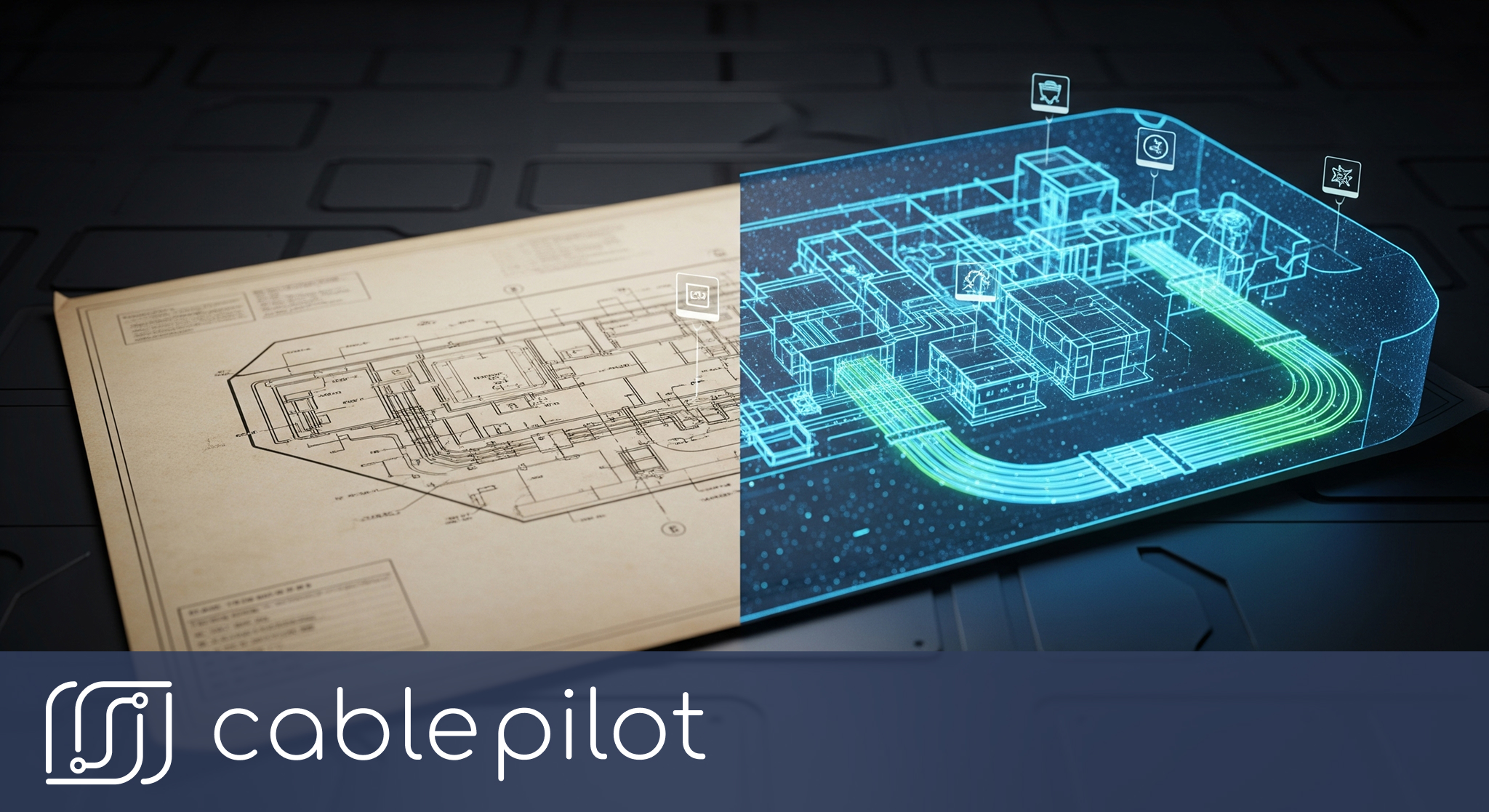
Digital Twin
- Definition: A dynamic, digital replica of your project where every physical object (cable, equipment, compartment) is represented as an intelligent digital asset with all its attributes, relationships, statuses, and history. Think of it less as a 3D model and more as a detailed, interactive ‘medical chart’ for your entire project, tracking the health, status, and history of every component.
- Why it Matters: The Digital Twin is the ultimate expression of a Single Source of Truth. It moves beyond static drawings and spreadsheets to create a living model that evolves in lockstep with the physical project, providing unprecedented clarity and control.
Discipline
- Definition: A logical grouping of work based on engineering specialty (e.g., “Electrical,” “Automation,” “Piping”).
- Why it Matters: It allows for clear separation of responsibilities and enables powerful, discipline-specific reporting and analysis.
E
Effort
- Definition: The general term for the amount and complexity of work required to complete a task.
- Why it Matters: In Cable Pilot, this abstract concept is made concrete and measurable through the use of Cable Points (CP).
Equipment
- Definition: A core entity in the system representing a physical device (e.g., switchboard, panel, sensor) that cables connect to.
- Why it Matters: By treating equipment as intelligent objects, the system understands the entire network of connections, enabling advanced dependency checks and automated quality control.
F
Flag
- Definition: A binary indicator of an object’s state (e.g., “Data Error,” “All Cables Connected”). Flags can be set manually by users or automatically by the system based on predefined rules.
- Why it Matters: Automated flags act as a “digital watchman,” enforcing process integrity. For example, the system can prevent a quality inspection from starting until it automatically verifies that all prerequisite work is complete, eliminating a major source of rework.
Fitter / Cable Puller
- Definition: The user role representing the on-site installer who physically performs the installation and termination work.
- Why it Matters: Empowering this role with a simple mobile app to report progress instantly is the key to eliminating information lag and ensuring data accuracy at its source.
I
Information Lag
- Definition: The delay between a physical event happening on-site and the moment that information becomes available to managers in a usable format.
- Why it Matters: This is the primary enemy of proactive management. The core purpose of a real-time system is to shrink this lag from hours or days to mere seconds.
L
Length
- Definition: A set of attributes for a cable, including Estimated, Pulled, Installed, and Final As-Built Length.
- Why it Matters: Tracking these different length states allows for precise material management, waste reduction, and accurate final documentation.
Lifecycle
- Definition: The complete sequence of Statuses that an object (like a cable or piece of equipment) moves through, from design and procurement to installation, testing, and final commissioning.
- Why it Matters: A well-defined lifecycle provides a clear and standardized roadmap for every component in the project, ensuring that all necessary steps are completed in the correct order.
List
- Definition: A custom, user-defined collection of objects (cables, equipment, etc.), often grouped by shared Tags, for easy access and management.
- Why it Matters: It provides a flexible way for individual users to organize their work and create personal to-do lists without altering the project’s core structure.
M
Manufacturer
- Definition: The company that produces a specific Cable Type or piece of Equipment.
- Why it Matters: Tracking manufacturers is essential for procurement, quality control, and managing supply chain diversity.
Mobile Application
- Definition: The tool used by field workers to receive tasks, view technical data, and report progress and problems directly from the worksite, typically via QR Code scanning.
- Why it Matters: The mobile app is the bridge between the physical and digital worlds. It is the primary mechanism for eliminating information lag and capturing clean, accurate data at the source.
N
Node
- Definition: A logical or physical point in space through which a cable’s route can be planned.
- Why it Matters: For highly detailed planning, nodes allow for a more granular definition of cable pathways, improving the accuracy of length estimations and installation instructions.
Notification
- Definition: An automated alert (e.g., email, push notification) sent to specific users or roles when a predefined event (a “trigger”) occurs in the system.
- Why it Matters: A flexible notification system allows you to cut through information noise. Each user can create a “personal radar” to be alerted only to the events that are relevant to their specific responsibilities, ensuring critical signals are never missed.
O
Onboarding
- Definition: The initial process of setting up a new project and migrating existing data into the system.
- Why it Matters: This is often the biggest barrier to adopting new software. Cable Pilot aims to make this process fast and painless through tools like the AI Importer.
P
Proactive Management
- Definition: A style of management focused on anticipating and preventing problems before they happen, as opposed to the reactive “firefighting” of solving problems after they’ve already caused delays.
- Why it Matters: This is the ultimate goal of implementing a data-driven system. By providing real-time visibility and predictive insights, the platform empowers managers to become truly proactive.
Project Hierarchy
- Definition: The foundational structure of the digital twin, mirroring the vessel’s physical layout: Ship -> Area -> Deck -> Compartment.
- Why it Matters: This gives all data crucial spatial context, enabling location-based analysis, progress tracking, and problem-solving. It’s the difference between managing a list and managing a map.
Project Manager
- Definition: The key user role responsible for the overall success of the project, including schedule, budget, and resources.
- Why it Matters: This role typically has the highest level of access and uses the system’s strategic dashboards to monitor project health and make key decisions.
Q
QR Code
- Definition: A unique, scannable code affixed to physical objects (equipment, compartments, etc.) that acts as a bridge to their digital counterparts in the system.
- Why it Matters: Scanning a QR code is the fastest, most error-proof way to identify an object in the field, retrieve its information, and update its status.
Quality Inspector
- Definition: The user role responsible for verifying that completed work meets all required standards and specifications.
- Why it Matters: The system provides this role with a trusted, automated worklist, ensuring they only inspect work that is 100% ready, eliminating wasted time and effort.
R
Role
- Definition: A set of permissions that defines what a user can see and do within the system.
- Why it Matters: Role-Based Access Control (RBAC) is essential for security and efficiency in a multi-contractor environment. It allows you to give each user access to only the information they need, protecting sensitive data and providing a clutter-free work environment.
S
Scalability
- Definition: An architectural principle ensuring that the system’s performance remains fast and reliable even as the project size and data volume grow exponentially.
- Why it Matters: This guarantees that the platform is an enterprise-grade solution capable of handling the largest and most complex shipbuilding projects without compromise.
Segregation
- Definition: A critical technical attribute of a cable that defines the rules for its physical separation from other cable types to prevent electromagnetic interference (EMI).
- Why it Matters: Building segregation rules into the digital twin helps engineers design compliant cable routes and prevents costly installation errors.
Ship
- Definition: The top-level entity in the Project Hierarchy, representing the entire vessel or project.
- Why it Matters: It acts as the primary container for all project data and is the starting point for navigating the digital twin.
Single Source of Truth (SSOT)
- Definition: The core objective of the system: to create one centralized, universally trusted, and always up-to-date repository for all project data.
- Why it Matters: An SSOT eliminates the chaos, errors, and disputes that arise from teams working with different versions of reality (e.g., outdated spreadsheets or drawings).
Spatial Accountability
- Definition: The concept of tracking and analyzing project progress in the context of specific physical locations (areas, decks, compartments).
- Why it Matters: It allows managers to move beyond misleading overall averages and pinpoint the exact physical locations of bottlenecks and delays, enabling targeted, effective intervention.
Specification
- Definition: An abstract technical requirement for a cable or piece of equipment, defined by engineering (e.g., “must be a 3-core, 2.5mm², fire-resistant power cable”). It is not tied to a specific manufacturer.
- Why it Matters: By managing to the Specification, you decouple your project from specific suppliers, building supply chain resilience and creating opportunities for cost optimization.
Status
- Definition: The specific stage of an object’s Lifecycle (e.g., for a cable: “On-site,” “Installed,” “Terminated,” “Tested”).
- Why it Matters: Tracking status in real-time is the fundamental mechanism for understanding project progress and triggering automated workflows.
Status Log
- Definition: A detailed, immutable, and automatically generated record of every status change for any object, including what the change was, who made it, and when.
- Why it Matters: It provides a complete, undeniable audit trail for the entire project, ensuring total accountability and traceability.
Supervisor
- Definition: The user role responsible for the tactical management of installation teams and the coordination of work within a specific area.
- Why it Matters: The system provides this role with the real-time data and tools needed to optimize resource allocation and maximize the productivity of their crews.
Supplier
- Definition: An external organization that provides materials and equipment for the project.
- Why it Matters: Tracking suppliers as distinct entities is crucial for effective procurement management and supply chain visibility.
System
- Definition: A logical grouping of cables and equipment based on their shared function (e.g., “Ballast System,” “Fire Alarm System”).
- Why it Matters: This allows for powerful, function-based progress tracking, which is essential for planning commissioning and testing sequences.
T
Tag
- Definition: A flexible, user-defined text label that can be applied to any object for custom grouping, filtering, and creating Lists.
- Why it Matters: Tags provide a simple yet powerful way to organize project data in ways that are meaningful to your specific workflow, without needing to change the core data structure.
W
Widget
- Definition: An individual information block (e.g., a chart, graph, KPI counter) that can be placed on a Dashboard.
- Why it Matters: Widgets are the building blocks of your personalized control panel, allowing you to visualize the project data that is most important to you and your role.
Wire
- Definition: An individual core within a cable, which has its own specific properties like cross-section and color.
- Why it Matters: The system’s ability to understand the properties of individual wires is part of what allows for a highly accurate calculation of termination workload in Cable Points (CP).
Wire Cross Section
- Definition: A technical characteristic of a wire that directly impacts the difficulty and effort required for termination.
- Why it Matters: This is one of the key objective parameters used to calculate a cable’s workload in Cable Points (CP), ensuring the metric accurately reflects reality.
Conclusion: A Shared Language for a Smarter Shipyard
This shared vocabulary does more than prevent confusion; it creates alignment. When an installer, an engineer, and a project manager all use the term ‘Cable Points’ to mean the same thing, they are operating from a shared reality. This linguistic alignment, built on the concepts in this glossary, is the true foundation of a high-performing, data-driven organization.
Have questions about a term or concept? Request a personalized demo and our experts will be happy to answer them.