
Cable lifecycle management begins here. Thousands of cables. One system. Total control over every meter of the journey.
For a Project Manager in shipbuilding process control, a single cable lives a chaotic, fragmented life. It’s born as a line in a design spreadsheet, its procurement status is a ghost in the ERP system, its installation is a rumor carried on paper forms, and its inspection results are buried in an email graveyard. Without construction traceability, it exists everywhere and nowhere at once, making true control impossible.
This information fragmentation means that no one has a complete, continuous view of any single component. Without a single source of truth, it’s a system riddled with blind spots—gaps where small errors can fester into major, costly problems that are only discovered when it’s too late.
But what if you could attach a “digital thread” to every single cable, allowing you to follow its entire lifecycle in one unbroken, transparent view?
In this article, we will take you on that journey. We will follow a single cable, NAV-112, through the complete cable lifecycle management process—from its birth as a line item in a cable list to its final status as a fully commissioned asset, ready for sea trials. You will see how a truly integrated platform like Cable Pilot creates this unbroken digital thread, providing shipbuilding process control and visibility at every stage.
Act 1: The Digital Birth (Design & Procurement)
The lifecycle of a cable doesn’t begin when it arrives at the shipyard. It begins the moment it becomes a digital entity in your project’s single source of truth.
Scene 1: From a Line Item to a Digital Asset
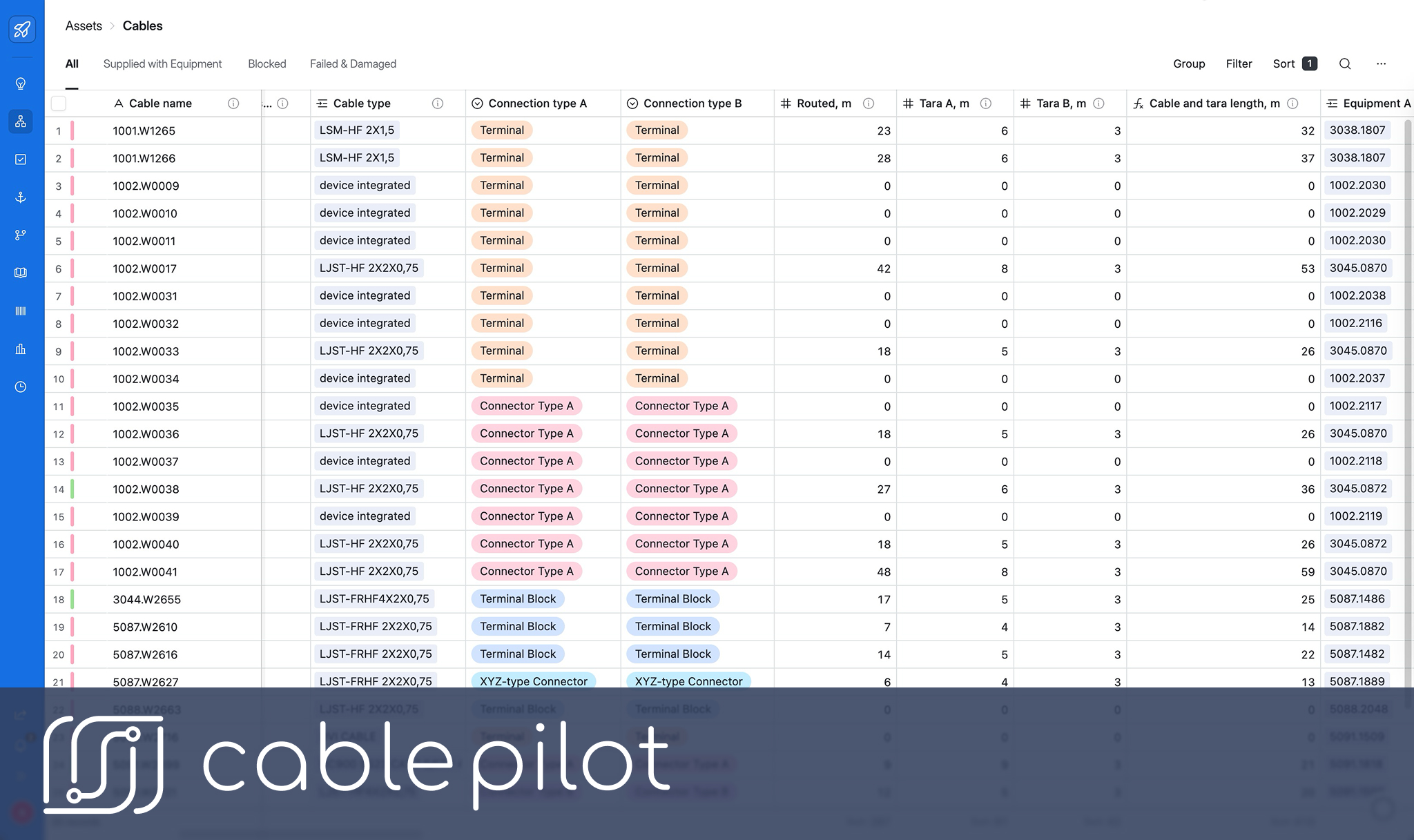
Our cable, NAV-112, starts its life as a row in an engineer’s Excel cable list. Using the AI Importer, this entire schedule is uploaded into Cable Pilot. At this moment, NAV-112 is transformed. It’s no longer just a passive line of text. It is now an intelligent digital asset with a unique ID, automatically linked to the “Navigation” System and assigned to its designated Compartments. The system sees its technical Specification and assigns it an initial Status: “Design Approved.”
Scene 2: The Procurement Workflow
The system automatically flags NAV-112 with a new status: “Procurement Required.” This makes it instantly visible on the procurement team’s dashboard. They don’t need to consult a separate BOM or drawing; they can see the exact technical requirements directly from the cable’s linked Specification. They place an order with an approved Supplier, and the cable’s status seamlessly updates to “Ordered.”
Scene 3: Arrival and Verification
Weeks later, a drum of cable arrives at the shipyard warehouse. The storeman scans the QR code on the drum with his mobile device. The system instantly identifies it as the purchase order for NAV-112 and updates its status to “On-Site.”
The Benefit: In this first act, effective cable lifecycle management has transformed the Project Manager from managing a black box to managing a transparent pipeline. He can see, in real-time, the exact state of his material readiness through construction traceability. This clarity allows him to de-risk the entire production schedule, confidently allocating installation teams with the certainty that the required materials are physically on-site.
Act 2: The Physical Journey (Installation & Termination)
Now that NAV-112 exists as a physical asset on the shipyard, its digital twin will mirror its every move.
Scene 1: The Task is Assigned
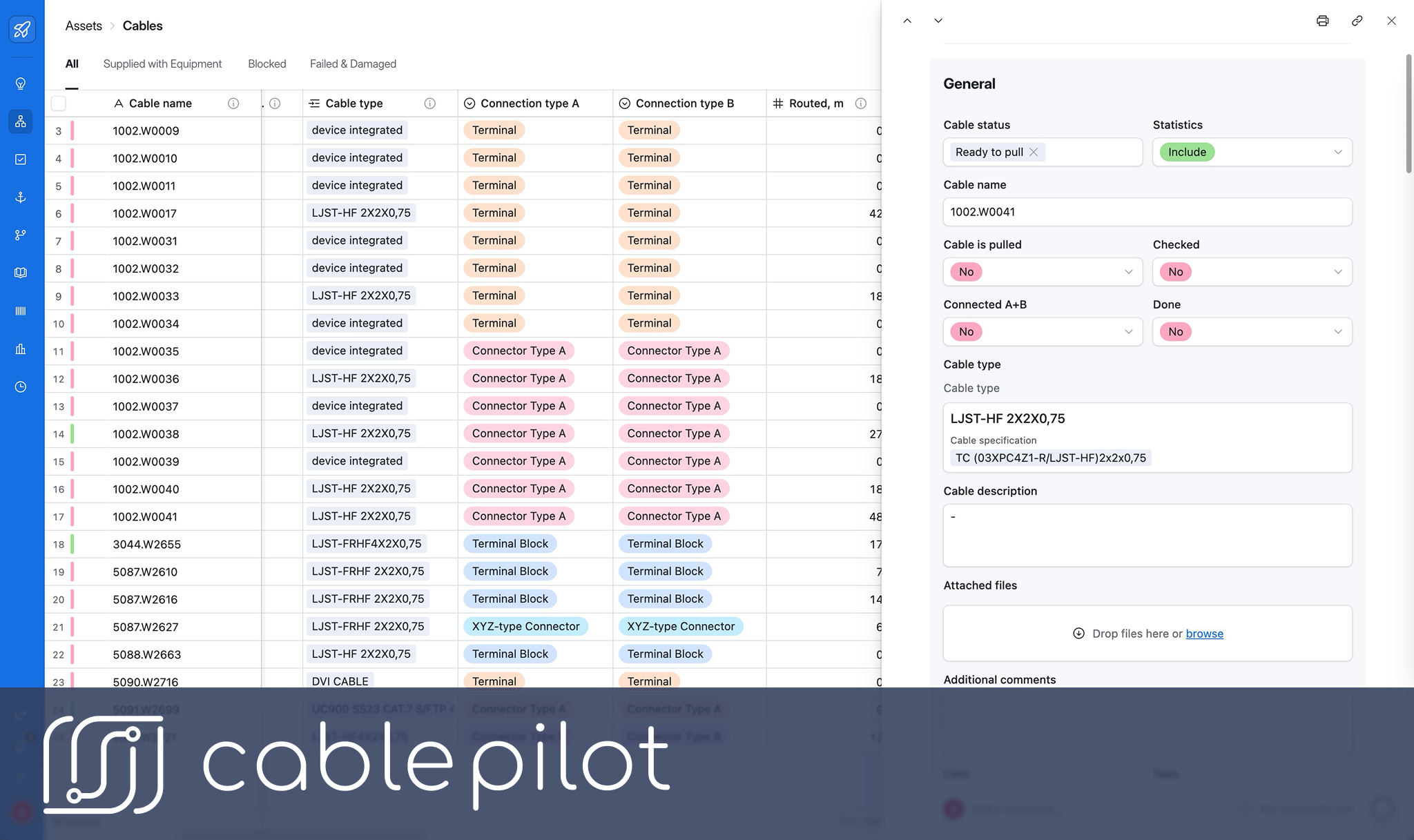
A Site Manager, looking at his dashboard, sees that the compartments for the Navigation system are ready for installation. He assigns the task of installing NAV-112 to a specific installer’s work queue in the mobile app.
Scene 2: Foolproof Identification
The installer receives the task on his phone. He goes to the warehouse, finds the drum for NAV-112, and scans its QR code. The app confirms he has the correct cable, eliminating the risk of pulling the wrong one.
Scene 3: Real-Time Progress Updates
After pulling the cable from its start point to its end point, the installer opens the app and updates the status to “Pulled.” Later, an electrician connects the cable ends to equipment EQ-34 and EQ-52. After each connection, he updates the status again: first to “Termination A Complete,” and then to “Termination B Complete.”
The Benefit: The project team now has granular, real-time visibility through construction traceability that distinguishes between different types of work. The Design Engineer sees not just that the cable is ‘in progress,’ but that the physically demanding ‘pulling’ phase is complete and the detailed ‘termination’ phase can begin. This level of shipbuilding process control allows the Site Manager to track team productivity with incredible accuracy, as the system understands that the workload for pulling (measured in Cable Points) is different from the workload for termination.
Act 3: The Final Mile (Inspection & Handover)
The final act of the cable’s lifecycle is about quality, verification, and the creation of a permanent, auditable record.
Scene 1: The Automated Quality Gate
The moment the installer sets the final termination status, the system’s intelligence kicks in. An automated rule can be configured to instantly send a notification to the Quality Inspector, informing her that NAV-112 is now ready for her review. There is no manual request, no email, no delay.
Scene 2: The Inspection
The inspector arrives, scans the cable’s QR code to pull up its full history, performs her checks, and updates the status to “Inspection Passed.”
Scene 3: System-Level Certification
NAV-112 does not exist in isolation; it is a vital component of the “Navigation” system. As individual cables achieve the “Inspection Passed” status, the system acts as an automated quality auditor. The moment the final of the 80 cables in the Navigation system passes its inspection, the system doesn’t just change a status—it certifies readiness. It automatically applies a system-level Flag, ‘Ready for Commissioning,’ to the entire system. This isn’t a human judgment; it’s a data-driven certification.
Scene 4: The Unbroken Record
The journey of NAV-112 is now complete. Every single action—from the initial import to the final inspection—has been logged with a user ID and a timestamp. This construction traceability creates an entire, unbroken history that is now a permanent part of the project’s As-Built Documentation, ready to be handed over to the client with complete confidence.
Conclusion: From Fragmentation to Flow
By following a single cable through complete cable lifecycle management, we see the true power of an integrated, data-driven system acting as a single source of truth. The fragmented, error-prone processes of the past are replaced by a single, unbroken “digital thread.”
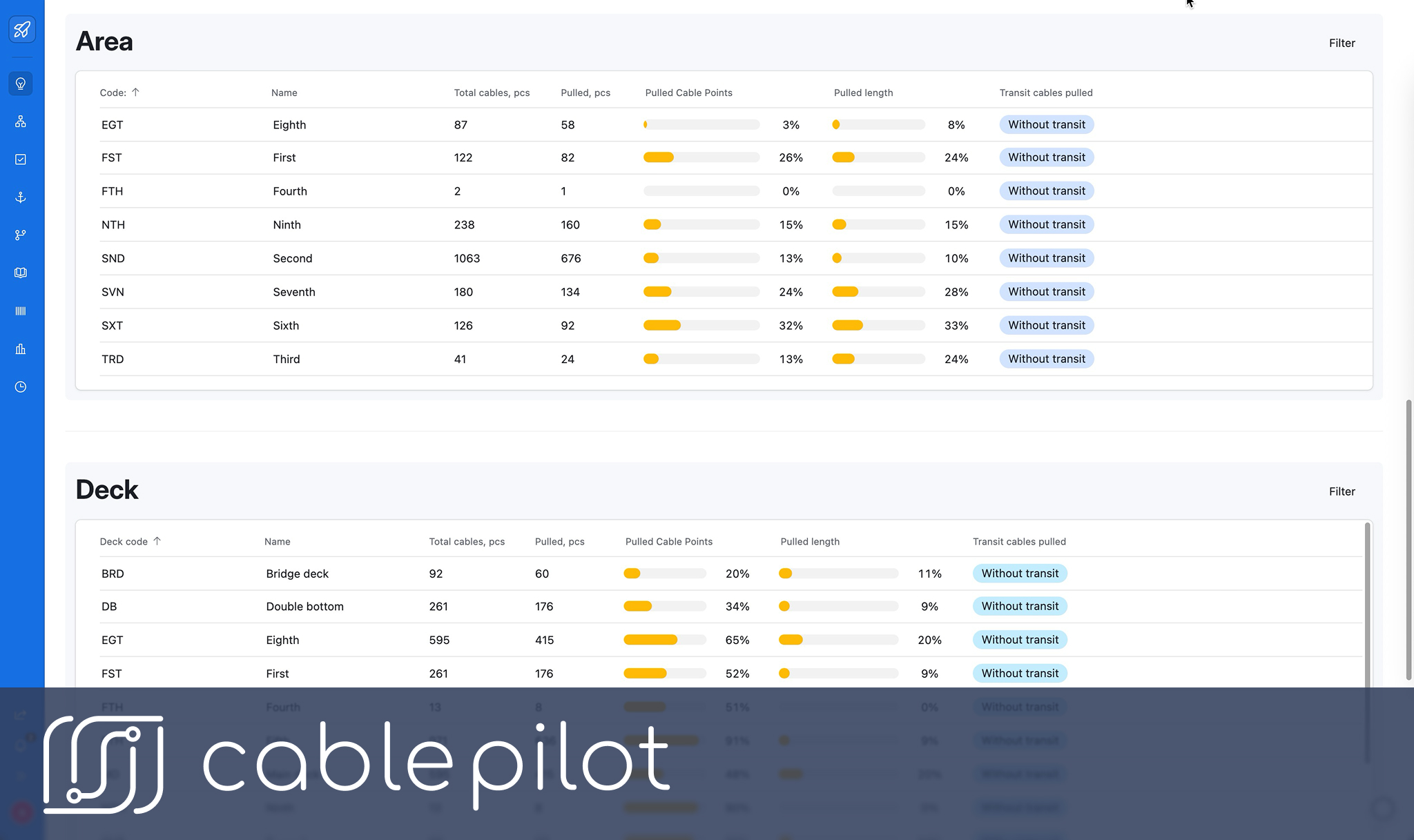
Shipbuilding process control transforms from a reactive hunt for information into the proactive direction of a predictable production flow. The ability to see the complete, unblemished history of one cable is powerful. The ability to do it for all fifty thousand, simultaneously and in real-time, is a revolutionary competitive advantage. This is how you move beyond simply controlling a project to mastering it.
Ready to gain end-to-end visibility over every component in your project? Request a demo to see the full lifecycle management capabilities of Cable Pilot.