
The moment of truth in any electrical project is the final power-up. But as you stand in front of the switchboard, a critical question hangs in the air: are you absolutely certain that every one of the twenty cables feeding this unit has been fully terminated and inspected? For most Project Managers handling equipment lifecycle management, the honest answer is a deeply uncomfortable ‘I hope so.’
For most Project Managers, answering this question with 100% confidence is impossible. The equipment itself is a black box. Its procurement history lives in one system, its installation status is on a paper form, and the status of the cables that connect to it are scattered across a dozen other reports. This information fragmentation creates a massive blind spot at the most critical phase of the project: commissioning. Powering up a piece of equipment that is “almost” ready is a recipe for catastrophic failure, costly rework, and major schedule delays. This is where effective asset management shipbuilding practices become essential.
The problem isn’t tracking the asset; it’s understanding its state of connection. An isolated piece of equipment is just a metal box. Its true value and its readiness is defined entirely by its dependencies. Without a live, 360-degree view of every connection, you aren’t managing an asset, you’re managing a liability. Modern construction asset tracking systems solve this challenge by providing real-time visibility into every connection and dependency.
In this article, we will follow the complete lifecycle of a single asset – switchboard EQ-42 – from its creation in the design phase to its final handover. You will see how a truly integrated platform like Cable Pilot transforms a piece of equipment from an isolated object into an intelligent, data-rich hub that provides a complete, 360-degree view of its readiness, eliminating guesswork and bringing certainty to the commissioning process. This approach to equipment lifecycle management ensures nothing is left to chance.
Act 1: The Digital Blueprint (Design & Procurement)
The journey of EQ-42 doesn’t start with a forklift on the shipyard. It starts as a digital entity in an asset management shipbuilding system, where its entire history and all its future requirements are defined.
Scene 1: Creating the Digital Asset
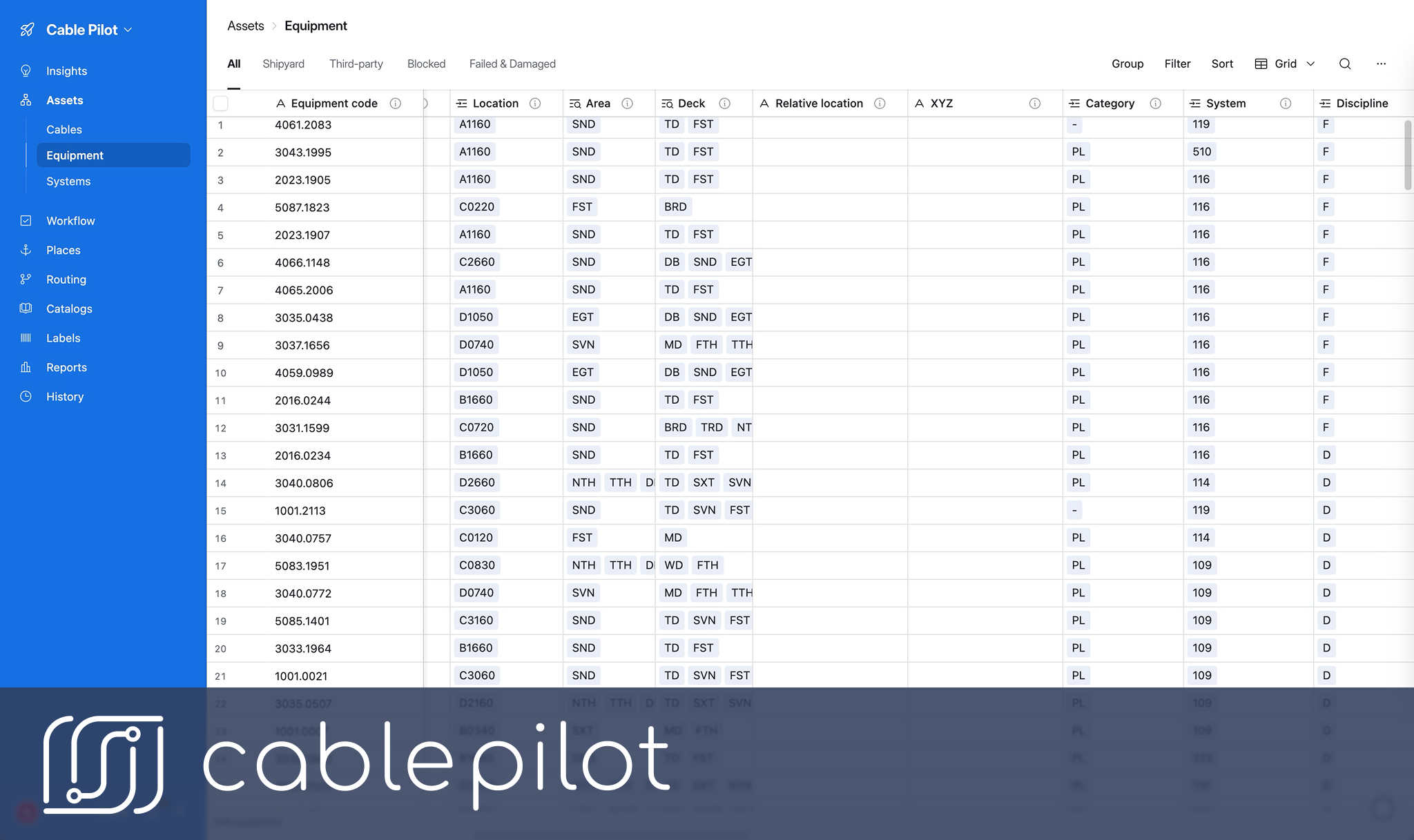
A Design Engineer creates EQ-42 as a new Equipment object in the Cable Pilot system. This is more than just adding a name to a list. She defines its core identity, establishing the foundation for comprehensive equipment lifecycle management:
- Category: “Switchboard”
- Location: It is assigned to its precise home in the Project Hierarchy – Compartment C-101 on Deck 2 of the Engine Room.
- Documentation: All relevant technical specifications, drawings, connection diagram and vendor manuals are attached directly to the object.
- Dependencies: Crucially, the system knows from the cable schedule that 20 specific cables must be connected to EQ-42 for it to function.
From its birth, EQ-42 is not an isolated item; it is a node in the project’s digital twin, aware of its location and its relationships with other objects. This level of construction asset tracking ensures complete visibility from day one.
Scene 2: The Procurement Pipeline
With its technical requirements defined, the system automatically assigns EQ-42 the status “Procurement Required.” The procurement team now has a clear, unambiguous signal. They can access the linked specifications and place an order with the designated Supplier. The moment the purchase order is issued, the status of EQ-42 seamlessly updates to “Ordered.”
Scene 3: Arrival and Verification
When the physical switchboard arrives at the shipyard, a storeman scans the QR code on its crate. The system instantly recognizes the asset, and its status is updated to “On-Site.”
The Benefit: The Project Manager now has complete clarity on his material readiness through integrated construction asset tracking. He doesn’t need to consult a separate ERP or spreadsheet. His main dashboard tells him that EQ-42 is physically available and ready to be scheduled for installation.
Act 2: The Physical Installation (Mounting & Connecting)
This is where the digital twin connects with the physical reality of the shipyard, and where the asset management shipbuilding system’s intelligence begins to actively prevent errors.
Scene 1: The Installation Task
The Site Manager sees that EQ-42 is “On-Site” and that its designated compartment is ready. He assigns the task “Install EQ-42” to a team via the mobile app. The team goes to the location, scans the QR code on the switchboard to confirm they have the right asset, and mounts it in place. A quick scan and a tap on their app updates the status to “Installed.” This construction asset tracking workflow ensures accuracy at every step.
Scene 2: The Patient Watchman (Dependency Control)
Now, the electrical work begins. Over the next several days, electricians connect the 20 required cables to EQ-42. After each connection is made and terminated, the installer updates the status of that specific cable.
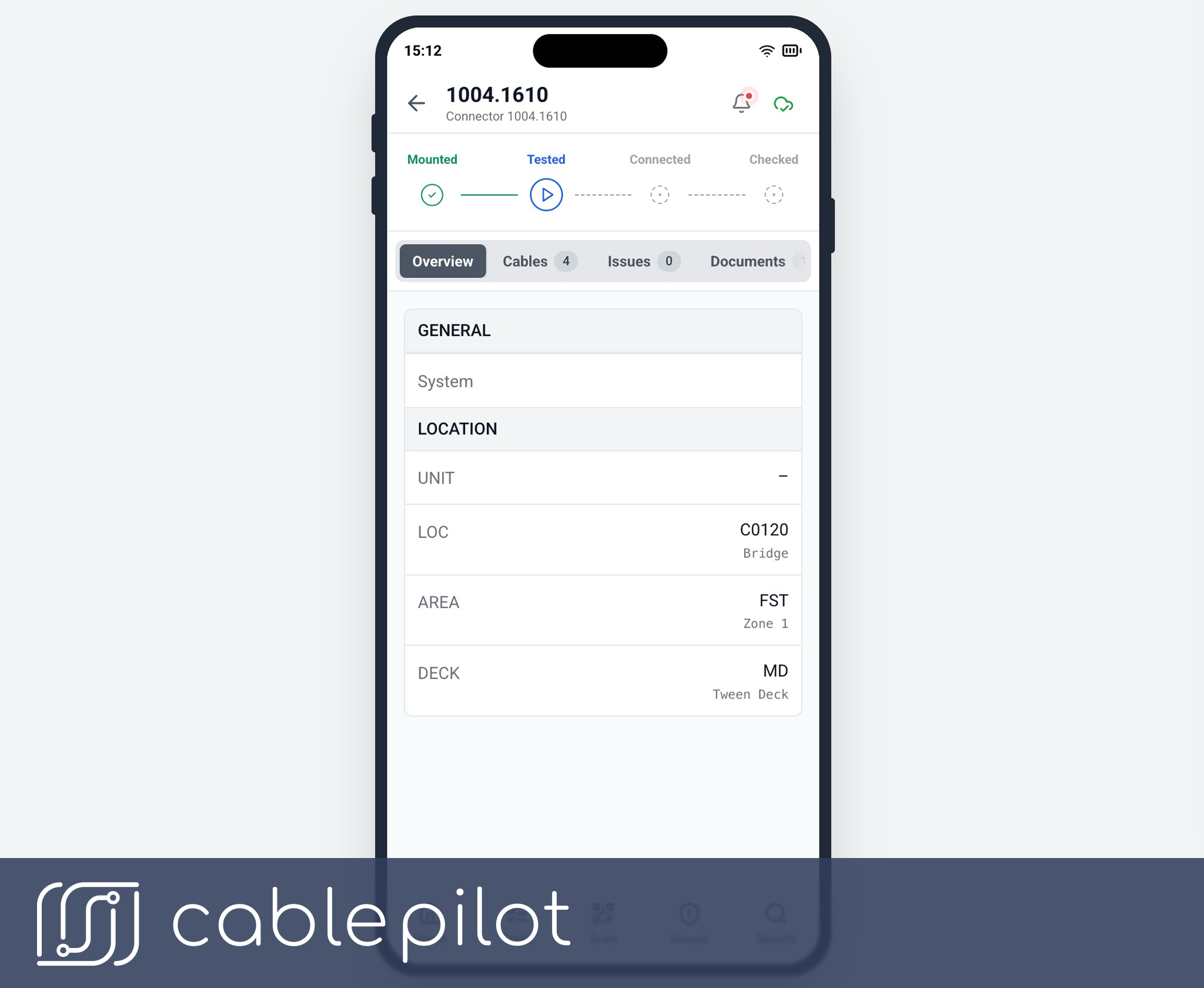
This is the critical phase. The Site Manager, looking at EQ-42, might be tempted to declare it “Ready for Inspection.” But the system will not allow it. The status of EQ-42 cannot be manually changed. It is locked, waiting. The system is acting as a patient, digital watchman, silently counting the completed dependencies.
Scene 3: The Automated Trigger
An electrician connects the 20th and final cable. He scans its QR code and updates its status to “Terminated.” The moment this last piece of data is received, the system’s rules engine fires. It checks the dependencies for EQ-42, verifies that all 20 required cables now have the status “Terminated,” and automatically applies a new Flag to the switchboard: “All Cables Connected.”
The Benefit: From Human Hope to System-Enforced Certainty.
The responsibility for declaring readiness has been transferred from fallible human memory to infallible system logic. It is now physically impossible to proceed based on a guess or a misremembered detail. The system doesn’t just reduce the risk of human error; it eliminates it entirely, providing a verifiable guarantee of completeness that no manual checklist ever could.
Act 3: The Final Verification (Inspection & Handover)
The final act of the equipment’s lifecycle is a smooth, transparent, and fully auditable process.
Scene 1: The Targeted Notification
The automatic “All Cables Connected” flag can be configured to trigger a notification that is sent directly to the Quality Inspector responsible for this system. The inspector doesn’t need to be told what to do; her worklist is automatically updated with a new, high-priority task.
Scene 2: The Informed Inspection
The inspector arrives at Compartment C-101. She scans the QR code on EQ-42. Her mobile app doesn’t just show her the equipment’s status; it shows her a complete list of all 20 cables connected to it, along with their individual statuses and histories. She can perform her inspection with full context and confidence. Once complete, she updates the status to “Inspection Passed.”
Scene 3: The Digital Passport
The journey of EQ-42 is now complete, and its entire history is preserved in its digital DNA. At any point, the Project Manager or Engineer can generate a complete “digital passport” for the asset. This document contains:
- All technical specifications and drawings.
- A full log of every status change, with timestamps and user IDs.
- A complete list of every cable connected to it.
- All related inspection reports and quality checks.
This automated, comprehensive documentation makes the final handover to the client a simple, transparent, and data-driven process.
Conclusion: From Black Box to Intelligent Hub
Mastering the lifecycle of a single asset is the key to mastering the project. When you can guarantee the readiness of one switchboard, you can guarantee the readiness of them all. By transforming each piece of equipment from an isolated black box into an intelligent, self-aware node in your project’s digital nervous system, Cable Pilot gives you more than just control. It gives you certainty. It replaces the anxiety of the unknown with the confidence of a predictable, data-driven, and successful commissioning process.
Ready to gain full lifecycle control over every piece of equipment in your project? Request a demo and see how it works.