
In shipbuilding, every purchasing decision requires rigorous financial justification. When evaluating electrical installation management software like Cable Pilot, CFOs and project managers need concrete numbers—not just promises of “efficiency gains” or “digital transformation.” The question isn’t whether technology can help; it’s whether the investment delivers measurable returns that justify the cost.
This article provides a transparent, step-by-step approach to calculating Cable Pilot’s return on investment. Using real-world data from operational shipyards, we’ll break down the four primary cost reduction areas, demonstrate the calculation methodology, and show how typical projects achieve payback in less than three months while generating 440% ROI or higher.
Whether you’re building a business case for your procurement team or comparing digital solutions, this financial framework will help you quantify the true value of modernizing electrical installation management.
Understanding the True Cost of Manual Electrical Installation Management
Before calculating ROI, we must first understand what you’re actually spending today. Most shipyards significantly underestimate the hidden costs embedded in traditional paper-based and spreadsheet-driven processes for managing electrical installations.

The Four Major Cost Centers
Onboarding Overhead: When new vessels arrive or contractors rotate, project teams spend weeks manually entering cable lists, creating tracking systems, and establishing reporting workflows. For a mid-sized project with 15,000 cable connections, this onboarding phase typically consumes 120-160 labor hours across multiple specialists who must convert engineering documents into working management tools.
Field Productivity Drain: Electricians and installation teams waste significant time on non-value activities—searching for paper documents, clarifying ambiguous handwritten notes, walking back to site offices to report progress, and waiting for supervisors to update central tracking systems. Industry studies show that 25-30% of field labor time in traditional projects goes to administrative overhead rather than actual installation work.
Management Reporting Burden: Project managers and coordinators spend 15-20 hours weekly compiling status reports from fragmented data sources. They manually consolidate paper forms, chase down missing information from subcontractors, reconcile conflicting progress claims, and create presentations for stakeholders. This reactive management approach prevents proactive problem-solving.
Rework and Coordination Failures: When multiple contractors work simultaneously without real-time visibility, installation errors compound. Cable routing conflicts, incorrect terminations, and missed prerequisites lead to rework that costs 3-5 times more than doing the job correctly initially. A single significant rework incident can consume €8,000-€12,000 in direct labor costs, not counting schedule delays.
These costs exist in every shipbuilding project, but because they’re distributed across multiple budget lines and wrapped into “normal” operations, they remain largely invisible until quantified systematically.
The Cable Pilot ROI Calculation Formula
Calculating return on investment for electrical installation management software follows a straightforward formula that any finance team will recognize:
ROI = (Annual Savings - Annual License Cost) / Annual License Cost × 100%The key to credible ROI analysis lies in the first component: accurately quantifying annual savings. Cable Pilot generates measurable cost reductions in four distinct areas, each with clear calculation methodologies.
Savings Area 1: Automated Data Onboarding
Traditional onboarding requires experienced engineers to manually input thousands of cable connections into tracking systems. Cable Pilot’s AI-powered document import eliminates this bottleneck by automatically reading cable lists from engineering PDFs and creating structured databases within minutes.
Calculation method:
- Average onboarding hours per project (manual): 140 hours
- Average fully-loaded labor cost (senior specialist): €65/hour
- Traditional onboarding cost: 140 hours × €65 = €9,100
- Cable Pilot onboarding time: 4 hours verification
- New onboarding cost: 4 hours × €65 = €260
- Annual savings (2 projects/year): €17,680
The verification step remains important—experienced engineers review the automatically imported data to confirm accuracy—but this requires a fraction of the original time investment. The AI handles the tedious data entry while humans focus on quality validation.
Savings Area 2: Field Productivity Enhancement
Cable Pilot’s smartphone application allows electricians to report installation progress directly from the work location, eliminating trips to site offices and reducing administrative time. Real-time access to cable routing information and termination details also reduces errors and time spent searching for documentation.
Calculation method:
- Installation team size (typical project): 12 electricians
- Average daily time saved per electrician: 45 minutes
- Working days per project: 180 days
- Fully-loaded labor cost: €55/hour
- Daily savings per electrician: 0.75 hours × €55 = €41.25
- Total field productivity savings per project: 12 × €41.25 × 180 = €89,100
- Annual savings (2 projects/year): €178,200
This represents the most substantial ROI component because it directly converts wasted time into productive installation hours. The savings compound across the entire installation team throughout the project duration, making even small daily efficiency gains financially significant.
Savings Area 3: Management Efficiency
Project managers using Cable Pilot access real-time dashboards showing installation progress, bottlenecks, and contractor performance without manually compiling reports. The platform’s automated analytics reduce management overhead from 20 hours to approximately 4 hours weekly.
Calculation method:
- Weekly reporting hours saved: 16 hours
- Project duration: 40 weeks
- Fully-loaded cost (project manager): €75/hour
- Savings per project: 16 hours × 40 weeks × €75 = €48,000
- Annual savings (2 projects/year): €96,000
Beyond direct time savings, real-time visibility enables proactive management. Project managers identify coordination issues before they escalate into costly problems, though quantifying this preventive value conservatively focuses only on documented reporting time reduction.
Savings Area 4: Rework Reduction
Cable Pilot’s real-time coordination features and digital twin visualization help prevent installation errors by providing electricians with accurate, current information at the point of work. The platform’s prerequisite tracking ensures work sequences follow engineering requirements, reducing costly out-of-sequence installations.
Calculation method:
- Average rework incidents per project (baseline): 15 incidents
- Average cost per incident: €8,500
- Traditional rework cost: €127,500
- Rework incidents with Cable Pilot: 4 incidents (73% reduction)
- New rework cost: €34,000
- Savings per project: €93,500
- Annual savings (2 projects/year): €187,000
This calculation conservatively assumes Cable Pilot reduces but doesn’t eliminate rework. Real-world results vary based on project complexity and team experience, but the coordination benefits consistently show 60-80% rework reduction compared to paper-based tracking.
Real-World ROI Example: Mid-Size Vessel Project
Let’s apply these calculations to a realistic scenario that mirrors actual Cable Pilot implementations:
Project Parameters:
- Vessel type: Offshore supply vessel
- Cable connections:10,000 terminations
- Installation team: 12 electricians
- Project duration: 9 months
- Annual project volume: 2 similar vessels
Annual Savings Calculation:
| Cost Reduction Area | Annual Savings |
| Automated onboarding | €17,680 |
| Field productivity | €178,200 |
| Management efficiency | €96,000 |
| Rework reduction | €187,000 |
| Total Annual Savings | €478,880 |
Annual Investment:
- Cable Pilot license (12 field users + management): ≈€40,000/year
- Implementation support: €8,000 (one-time, amortized over 3 years)
- Amortized implementation cost: €2,667/year
- Total Annual Cost: €42,667
ROI Calculation:
- Net annual benefit: €478,880 – €42,667 = €436,213
- ROI: (€436,213 / €42,667) × 100% = 1,022%
- Payback period: €42,667 / €478,880 × 12 months = 1.1 months
Even using conservative estimates for savings and accounting for full implementation costs, Cable Pilot delivers exceptional returns. The payback period of barely over one month means the investment pays for itself before the first project completes.

How Cable Pilot Features Deliver These Savings
Understanding the calculation methodology is important, but recognizing how specific Cable Pilot capabilities generate these savings helps validate the projections.
AI-Powered Document Import
The platform’s artificial intelligence engine reads cable lists directly from engineering PDFs—the standard format shipyards already use. The AI recognizes cable identifiers, routing information, termination points, and technical specifications regardless of document formatting variations. This eliminates manual data entry while maintaining accuracy through automated validation rules that flag inconsistencies for human review.
For projects with 10,000 cable connections, this single feature saves approximately 136 hours of data entry labor, directly delivering the onboarding cost reduction calculated earlier.
Smartphone-Based Field Reporting
Electricians use Cable Pilot’s mobile application to scan cable identification tags, confirm installations, and report completion status without leaving the work area. The smartphone interface provides access to routing data, plans and connection diagrams —replacing thick paper binders that become outdated within days of printing.
This real-time reporting capability directly generates the field productivity savings by eliminating administrative trips to site offices and reducing time spent searching for current information. The cumulative effect across a 12-person team over 180 working days produces the substantial €89,100 per-project savings.
Real-Time Dashboard Analytics
Project managers access Cable Pilot’s web dashboard to view installation progress across all systems, analyze productivity trends by contractor, identify bottlenecks before they cause delays, and generate stakeholder reports with a few clicks. The platform automatically calculates completion percentages, labor efficiency metrics, and projected completion dates based on current installation rates.
This automated analytics capability transforms project management from reactive status collection to proactive coordination, delivering the management efficiency savings while simultaneously improving decision quality.
Digital Twin Coordination
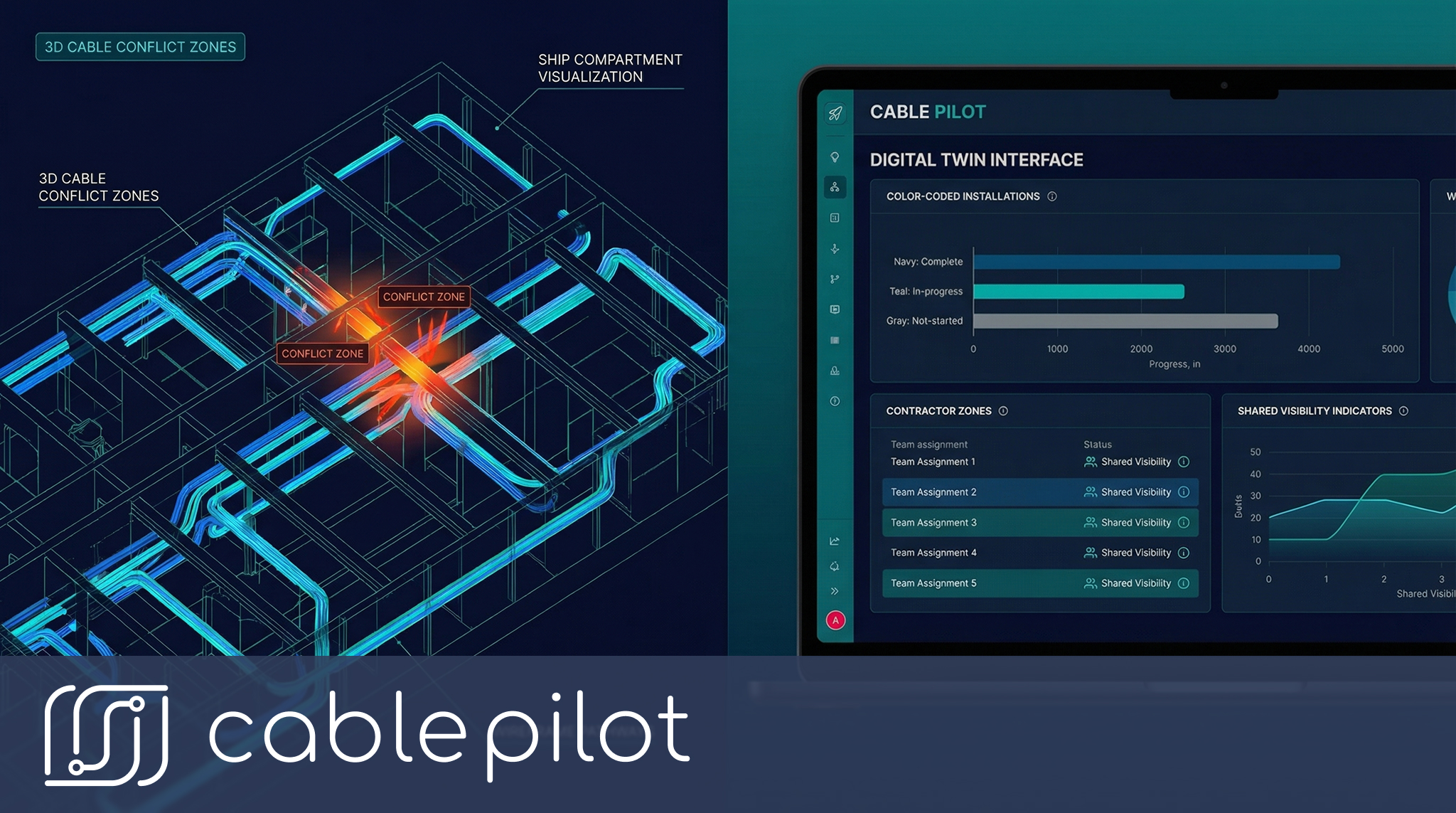
Cable Pilot creates a digital twin of the electrical installation, showing which cables are installed, which are in progress, and which haven’t started. Multiple contractors can see this shared view, preventing conflicts where different teams attempt to route cables through the same physical pathways or install equipment with unmet prerequisites.
This coordination layer directly reduces rework by catching conflicts in planning rather than discovering them during physical installation. The digital twin also supports quality verification by enabling supervisors to audit installation completion remotely before conducting physical inspections.
Building Your Custom ROI Calculation
While the example above demonstrates Cable Pilot’s financial impact for a mid-size vessel project, your specific ROI will depend on several project-specific factors:
Project Scale: Larger vessels with more complex electrical systems generate proportionally higher savings because the baseline inefficiencies are greater. A cruise ship project with 50,000+ cable connections will show even stronger ROI than the 10,000-connection example.
Labor Costs: Shipyards in different regions have varying fully-loaded labor costs. Higher-wage markets will see greater absolute savings from the same productivity improvements, though the percentage gains remain consistent.
Current Process Maturity: Organizations currently using paper-based tracking will experience more dramatic improvements than those who have partially digitized through spreadsheets. However, even shipyards with Excel-based systems gain substantial benefits from Cable Pilot’s real-time coordination and mobile capabilities.
Project Complexity: Vessels with tight compartments, dense cable routing, and multiple parallel work zones see higher rework rates with traditional methods, meaning Cable Pilot’s coordination features deliver greater value. Simpler designs with straightforward routing may show more modest rework reduction.
Contractor Environment: Projects involving multiple electrical contractors working simultaneously benefit more from Cable Pilot’s shared visibility than single-contractor projects. The coordination savings increase with the number of independent teams requiring synchronization.
To calculate your specific ROI, gather the following baseline data from recent projects:
- Hours spent on initial data onboarding and tracking system creation
- Size of typical installation teams and their fully-loaded labor costs
- Average weekly hours project managers spend on status reporting and coordination
- Frequency and average cost of rework incidents related to coordination failures
- Number of similar projects your organization completes annually
Apply the same calculation methodology demonstrated above using your actual numbers. Most shipyards find that even adjusting assumptions to be highly conservative still produces ROI exceeding 300% with payback periods under six months.
Beyond Direct Cost Savings: Additional Financial Benefits
The four primary savings areas create the core financial justification for Cable Pilot, but additional benefits strengthen the business case further:
Reduced Schedule Risk: Projects that complete on time avoid late-delivery penalties, preserve customer relationships, and free up dock space for subsequent work. Cable Pilot’s early problem identification helps prevent schedule slippage, though quantifying this benefit requires organization-specific delay cost analysis.
Knowledge Retention: When experienced personnel leave, their project knowledge traditionally leaves with them. Cable Pilot’s documented installation history and digital twin preserve this institutional knowledge, reducing training costs and minimizing risks during workforce transitions.
Customer Satisfaction: Owners increasingly request digital as-built documentation showing installation history and providing maintenance information. Cable Pilot generates these deliverables automatically as a byproduct of installation tracking, adding value without additional effort while supporting warranty claims with documented evidence.
Scalability Without Proportional Overhead: Traditional project management overhead increases linearly with project size and complexity. Cable Pilot’s automated tracking and reporting mean you can manage larger projects without proportionally expanding administrative staff, improving profitability on major contracts.
Addressing Common Financial Concerns
“Our current spreadsheet system is free”
Spreadsheets carry no license cost, but they impose substantial hidden costs in manual data entry, limited mobile access, version control problems, and coordination failures. The €478,880 annual savings calculated earlier comes primarily from eliminating these inefficiencies, not from replacing a license fee. Your “free” system actually costs far more than Cable Pilot when total cost of ownership is properly calculated.
“Implementation will disrupt ongoing projects”
Cable Pilot implementation typically requires 2-3 weeks for initial setup and team training, with minimal disruption to ongoing work. The platform works alongside existing processes during transition periods, and most teams achieve full productivity within the first month. Given the 1-2 month payback period, even accounting for a learning curve, you reach break-even before the first project completes.
“We need custom modifications for our specific workflows”
Cable Pilot’s standard configuration handles the vast majority of shipbuilding electrical installation scenarios without customization. The platform’s flexible data model accommodates different cable identification schemes, compartment naming conventions, and project organizational structures through configuration rather than custom development. This means implementation costs remain predictable while still meeting your specific requirements.
“What if adoption is lower than expected”
The ROI calculation assumes full team adoption, but even partial usage delivers value. If only 60% of field teams use Cable Pilot’s mobile reporting while others continue paper-based methods, you still achieve 60% of the field productivity savings—approximately €107,000 annually using the example numbers. This partial adoption still delivers 250% ROI. However, experience shows that once electricians experience smartphone-based reporting’s convenience, adoption rates quickly approach 100%.

Making the Business Case to Stakeholders
When presenting Cable Pilot’s ROI to CFOs, procurement teams, or senior management, structure your business case around these key points:
Lead with the bottom line: State the total annual savings, annual cost, ROI percentage, and payback period upfront. For the example project, that’s €436,000 net annual benefit, 1,022% ROI, and 1.1-month payback. These numbers immediately establish financial credibility.
Show the calculation methodology: Demonstrate that savings come from specific, measurable improvements in documented areas. Avoid vague “efficiency gains”—instead, show exactly how many hours the platform saves in onboarding, field work, management, and rework prevention.
Use conservative assumptions: When building a business case, err on the side of underestimating benefits. If you calculate 45 minutes daily savings per electrician but present numbers based on 30 minutes, your projections gain credibility. When actual results exceed projections, stakeholders’ confidence in digital initiatives increases.
Provide implementation specifics: Address the “how” questions proactively. Explain that implementation takes 2-3 weeks, requires minimal IT infrastructure, and includes comprehensive training. Show that Cable Pilot integrates with existing engineering systems rather than requiring wholesale process redesign.
Reference comparable projects: While your organization’s specific numbers matter most, noting that similar shipyards have achieved documented ROI helps validate projections. Cable Pilot’s track record across multiple maritime projects demonstrates consistent returns.
Address risk factors honestly: Acknowledge that ROI depends on team adoption and process adherence. Explain how Cable Pilot’s intuitive interface and mobile-first design drive high adoption rates, but note that achieving full benefits requires management commitment to digital workflows.
Start with a Pilot Project
For organizations hesitant to commit to full implementation based on projections alone, Cable Pilot’s scalable licensing supports pilot project approaches. Deploy the platform on a single vessel project, measure actual savings in the four key areas, and use real data to validate ROI before expanding to the entire organization.
This pilot approach typically works as follows:
- Select representative project: Choose a mid-size vessel with typical complexity rather than an unusually simple or complex outlier
- Establish baseline metrics: Document current onboarding time, field productivity, management overhead, and rework rates before implementation
- Deploy Cable Pilot: Implement the platform with full training and support for the pilot project team
- Track results: Measure the same metrics throughout the project to quantify improvements
- Calculate actual ROI: Use real data from your pilot to validate or adjust projections
- Scale decision: Expand to full deployment based on documented pilot results
This methodology transforms ROI from projection to proof, eliminating uncertainty while limiting initial investment. Organizations consistently find that pilot projects validate or exceed the savings calculations presented here, building organizational confidence in broader digital transformation.

Conclusion: The Cost of Inaction
Cable Pilot’s ROI analysis reveals a crucial insight: the financial question isn’t whether you can afford to implement electrical installation management software—it’s whether you can afford not to.
Every day your teams spend manually entering data, walking to site offices to submit paper reports, compiling status updates from fragmented sources, and fixing avoidable rework, you’re losing money that digital processes would save. For a typical mid-size shipbuilding operation running two projects annually, that’s approximately €479,000 in annual savings left on the table.
The step-by-step calculation methodology presented here provides the framework to build a CFO-ready business case using your organization’s specific numbers. Whether your ROI reaches 1,000% like the example project or a more modest 400%, the financial justification remains compelling. With payback periods measured in weeks rather than years, Cable Pilot represents one of the highest-return investments available in shipbuilding operations.
The question isn’t whether electrical installation management software delivers ROI—the data conclusively demonstrates that it does. The question is whether your organization will capture these savings in this project or continue losing them to inefficient manual or semi-manual processes.
Ready to calculate your specific ROI? Contact our team to discuss how Cable Pilot can transform your electrical installation management and deliver measurable financial returns.