
The shipbuilding industry stands at a critical inflection point. As vessels become increasingly sophisticated and electrical systems grow more complex, traditional paper-based workflows and fragmented communication channels are no longer sustainable. Project managers watch helplessly as rework consumes budgets, schedule delays cascade across departments, and disputes with contractors drain resources that should be driving innovation. Yet despite these mounting pressures, many shipyards struggle to build a compelling business case for digital transformation.
The answer lies in understanding and quantifying the return on investment that modern electrical installation management platforms deliver. By adopting a digital twin approach—creating a real-time virtual representation of the physical installation process—shipyards can achieve dramatic reductions in waste, accelerate project completion, and establish a competitive advantage that translates directly to the bottom line. This article breaks down the financial impact in concrete terms, providing project managers and financial leaders with the data they need to justify investment in platforms like Cable Pilot.

Understanding the Digital Twin Concept in Electrical Installation
Before diving into ROI calculations, we must clarify what a digital twin means in the context of ship electrical installation. Unlike traditional document management systems that simply store static files, a digital twin creates a living, breathing virtual representation of your electrical installation project that mirrors every physical activity in real time.
When an electrician pulls a cable on the vessel, that action is immediately captured and reflected in the digital model. When a connection is tested and verified, the digital twin updates instantly. When engineering changes occur, the virtual model adapts automatically, ensuring every stakeholder works from a single source of truth. This synchronization between physical work and digital representation eliminates the information lag that plagues conventional workflows.
Traditional approaches rely on paper checklists, spreadsheets updated at day’s end, and email chains that quickly become obsolete. Project managers spend hours each week consolidating reports, chasing updates from contractors, and reconciling conflicting information. The digital twin approach transforms this reactive, labor-intensive process into a proactive, automated system where data flows seamlessly from the installation site to management dashboards without human intervention.
The distinction matters because it fundamentally changes how work is coordinated, verified, and controlled. Instead of discovering problems during late-stage inspections, project managers identify issues immediately and intervene before they escalate. Instead of waiting for weekly progress meetings to understand status, stakeholders access live data on demand. This shift from periodic snapshots to continuous visibility drives the financial benefits we will now quantify.
The Hidden Costs of Traditional Electrical Installation Management
To calculate ROI accurately, we must first understand the baseline costs that digital transformation will eliminate or reduce. Most shipyards significantly underestimate these expenses because they are dispersed across multiple budget categories and often appear as “normal business costs” rather than inefficiencies.
Manual Reporting Burden
Consider the time electricians and foremen spend on paperwork each day. In traditional workflows, field workers complete paper checklists during breaks or at shift end. These documents are collected, manually transcribed into spreadsheets or project management systems, and then reviewed by supervisors. Quality control personnel conduct redundant checks to verify accuracy. Project managers spend additional hours consolidating this data into reports for clients and senior management.
Industry research indicates that skilled electrical workers in shipbuilding environments spend approximately 15-20% of their time on administrative tasks rather than productive installation work. For a project employing 50 electricians at an average fully burdened labor rate of 45 euros per hour, this administrative overhead costs approximately 1,800 to 2,400 labor hours per month. At current rates, that translates to 81,000 to 108,000 euros monthly—or nearly one million euros annually—spent on manual data handling rather than value-adding installation work.
Rework and Error Correction
Information delays and version control failures drive costly rework cycles. When field crews work from outdated cable lists, they pull incorrect cables or route them to wrong destinations. When connection diagrams are not updated promptly after engineering changes, electricians make connections that must later be reversed. When quality inspections are conducted against obsolete specifications, work that meets current standards is nevertheless rejected and redone.
Shipyard quality data suggests that rework typically accounts for 8-15% of total electrical installation labor hours. For a mid-sized vessel with 20,000 electrical installation labor hours, this means 1,600 to 3,000 hours of pure waste. At 45 euros per hour, rework costs range from 72,000 to 135,000 euros per vessel. Larger projects with more complex electrical systems can see rework costs exceed 250,000 euros.
Schedule Delays and Cascade Effects
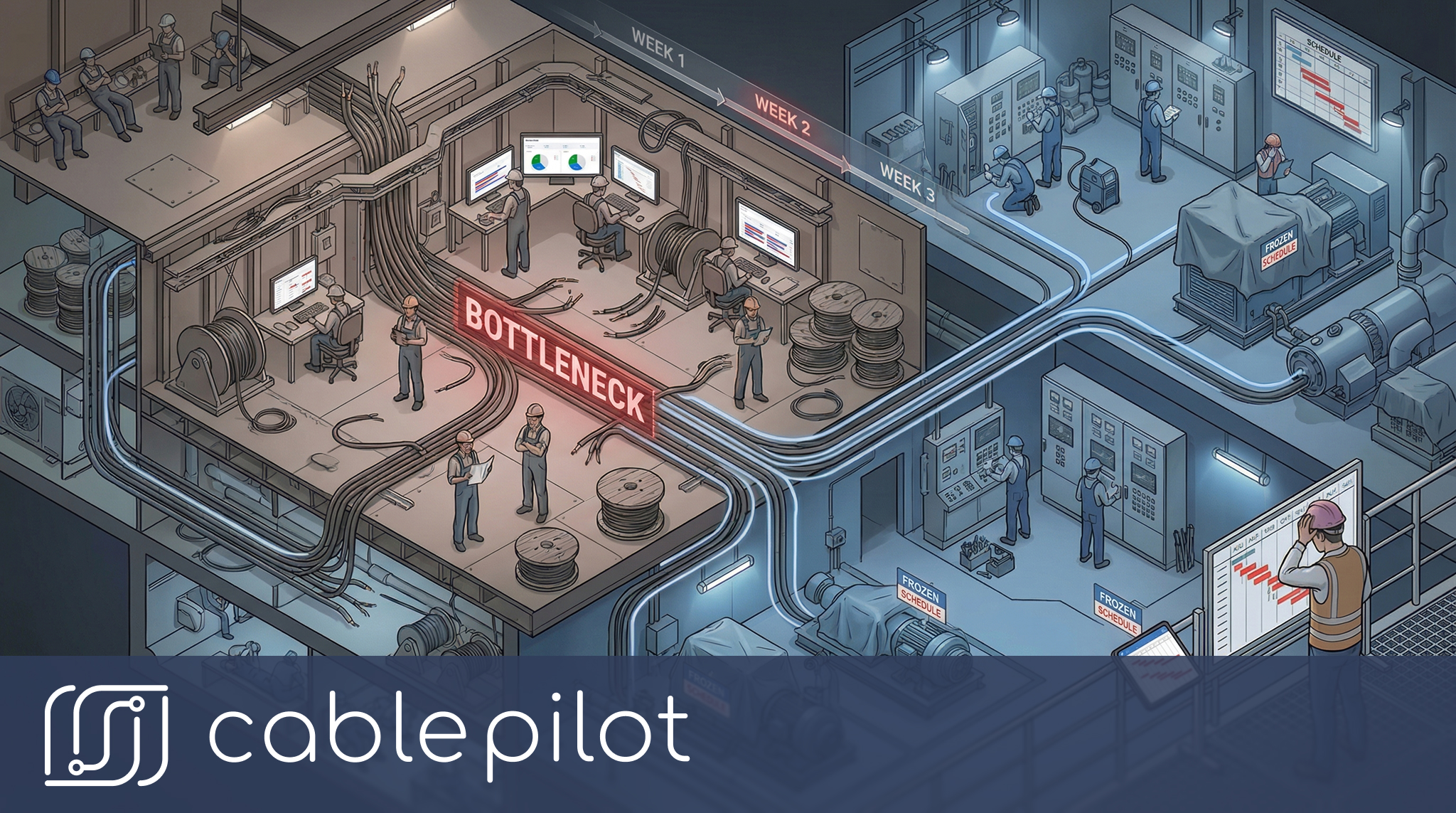
When electrical installation falls behind schedule, the ripple effects extend far beyond the electrical department. Outfitting work cannot proceed. System commissioning is delayed. Client inspections must be rescheduled. Vessel delivery dates slip, triggering penalty clauses and damaging client relationships.
Each week of delay on a newbuild project typically costs the shipyard between 150,000 and 300,000 euros in direct and indirect expenses: extended overhead, idle labor retained at premium rates, expedited material shipments, and contractual penalties. Electrical installation bottlenecks are consistently cited as a major contributor to schedule delays, frequently adding two to four weeks to project timelines. For a single vessel, electrical-related schedule delays can therefore cost 600,000 to 2,400,000 euros.
Dispute Resolution and Claims Management
When information is fragmented and documentation is incomplete, disputes between shipyards and contractors escalate quickly. Disagreements about what work was completed, whether specifications were met, and who is responsible for defects consume enormous management attention and often result in expensive arbitration or litigation.
Project managers on complex electrical installations report spending 10-20 hours per month managing contractor disputes and related administrative burdens. Legal and claims management costs for electrical installation disputes average 50,000 to 150,000 euros per major project. While not every project experiences major disputes, the risk represents a significant financial exposure that effective management systems can mitigate.
Building the ROI Calculation Framework
With baseline costs established, we can now construct a framework for calculating the return on investment from implementing a digital twin approach to electrical installation management. This framework breaks ROI into four primary benefit categories: direct labor savings, rework reduction, schedule acceleration, and risk mitigation.
Direct Labor Savings
Automated reporting and real-time data capture eliminate the majority of manual administrative work. When electricians use smartphones to report completed work with a few taps instead of filling out paper forms, and when project managers access live dashboards instead of consolidating spreadsheets, labor hours are freed for productive installation work.
Conservative estimates suggest that digital platforms reduce administrative overhead by 60-75%. Using our earlier example of 50 electricians spending 15-20% of time on administrative tasks, automation saves approximately 1,080 to 1,800 labor hours monthly. At 45 euros per hour, this generates savings of 48,600 to 81,000 euros per month, or 583,200 to 972,000 euros annually.
For project managers and supervisors, time savings are equally dramatic. Automated status tracking and exception-based management reduce coordination time by approximately 40-50%. A project management team of five people spending 50% of their time on electrical installation coordination can reclaim 400-500 hours per month. At a burdened management labor rate of 65 euros per hour, this produces additional monthly savings of 26,000 to 32,500 euros, or 312,000 to 390,000 euros annually.
Rework Reduction
Real-time visibility and single-source-of-truth documentation dramatically reduce errors that drive rework. When field crews access current cable lists on their smartphones and receive instant notifications about engineering changes, installation errors decline sharply. When automated quality checks flag discrepancies before work proceeds to the next stage, defects are caught immediately rather than during final inspection.
Industry data from early adopters of digital installation management platforms indicates rework reduction of 35-50%. Applying this to our baseline rework estimate of 1,600 to 3,000 hours per vessel yields savings of 560 to 1,500 hours. At 45 euros per hour, this translates to 25,200 to 67,500 euros saved per vessel through rework elimination.
For shipyards completing four to six vessels annually, aggregate rework savings range from 100,800 to 405,000 euros per year. These savings compound over time as improved work quality builds crew competency and reduces systemic error patterns.
Schedule Acceleration
Improved coordination and reduced rework directly compress project timelines. When bottlenecks are identified and resolved in real time rather than discovered during weekly meetings, critical path activities progress more smoothly. When contractors have clear visibility into upcoming work and can plan resource allocation more effectively, idle time decreases.
Shipyards using digital installation management platforms report electrical installation cycle time reductions of 15-25%. For a project with a baseline electrical installation duration of 20 weeks, this acceleration saves three to five weeks of project time. As previously noted, each week saved avoids 150,000 to 300,000 euros in delay costs, producing total savings of 450,000 to 1,500,000 euros per vessel.
Beyond direct cost avoidance, schedule acceleration enables shipyards to increase throughput capacity. Completing vessels faster means starting new projects sooner, generating revenue earlier, and improving cash flow. For financially constrained shipyards, this working capital benefit can be as valuable as direct cost savings.
Risk Mitigation and Dispute Avoidance
Comprehensive audit trails and transparent documentation reduce disputes and associated costs. When every cable pull or every test result is automatically logged with timestamp and technician identity, when every engineering change is tracked with full revision history, disagreements about work quality and completion are resolved quickly with objective evidence.
Shipyards implementing robust digital documentation systems report 50-70% reductions in dispute frequency and severity. Using our baseline estimate of 50,000 to 150,000 euros in dispute-related costs per project, this produces savings of 25,000 to 105,000 euros per vessel. Across a shipyard’s annual production, this amounts to 100,000 to 630,000 euros in avoided legal and claims management expenses.
Beyond direct cost savings, reduced disputes improve client relationships and enhance the shipyard’s reputation for quality and professionalism. These intangible benefits translate to competitive advantages in securing future contracts and commanding premium pricing.
Real-World ROI: A Worked Example
To make these calculations concrete, let us work through a detailed example for a mid-sized shipyard building four vessels per year with the following characteristics:
- 50 electricians working on electrical installation at average burdened rate of 45 euros per hour
- Project management team of 5 people at 65 euros per hour
- Average electrical installation duration of 20 weeks per vessel
- Baseline rework rate of 12% (2,400 hours per vessel)
- Historical electrical-related schedule delays of 3 weeks per vessel
- Average dispute costs of 75,000 euros per vessel
Annual Baseline Costs (Before Digital Twin Implementation)
- Administrative labor overhead: 787,500 euros (mid-range estimate)
- Annual rework costs: 432,000 euros (4 vessels × 108,000 euros)
- Schedule delay costs: 2,700,000 euros (4 vessels × 675,000 euros)
- Dispute and claims costs: 300,000 euros (4 vessels × 75,000 euros)
Total Annual Inefficiency Cost: 4,219,500 eurosProjected Annual Benefits (After Digital Twin Implementation)
- Administrative labor savings: 630,000 euros (80% improvement)
- Rework reduction: 172,800 euros (40% improvement)
- Schedule acceleration: 1,620,000 euros (60% improvement)
- Dispute avoidance: 180,000 euros (60% improvement)
Total Annual Benefit: 2,602,800 eurosImplementation Investment
- Platform subscription: 78,000 euros annually
- Initial onboarding and training: 25,000 euros (one-time)
- Ongoing support and maintenance: 12,000 euros annually
Total First Year Investment: 115,000 eurosROI Calculation
- First Year Net Benefit: 2,487,800 euros (2,602,800 – 115,000)
- First Year ROI: 2,163% (2,487,800 / 115,000)
- Payback Period: 2.2 weeks
For subsequent years, with only recurring subscription and support costs, the ROI increases.
This example demonstrates that even with conservative benefit estimates, the financial case for digital twin implementation in electrical installation management is overwhelming. The payback period measured in weeks rather than years makes this one of the highest-return technology investments available to modern shipyards.
How Cable Pilot Delivers These Financial Benefits
Understanding the theoretical ROI is valuable, but practical implementation determines whether projected benefits materialize. Cable Pilot’s architecture and workflow design are specifically optimized to deliver the financial outcomes outlined in this analysis.
Smartphone-Based Reporting for Zero Administrative Overhead
Cable Pilot eliminates manual reporting by enabling electricians to capture work progress directly from smartphones with minimal effort. Workers photograph completed cable pulls, scan QR codes to identify equipment, and mark tasks complete with a few taps. The system automatically timestamps entries, and synchronizes data to the central platform in real time.

This approach reduces reporting time from 15-20 minutes per task to under 30 seconds. The cumulative time savings across an entire electrical installation crew generates the labor cost reductions projected in our ROI calculation. More importantly, the near-zero friction of smartphone-based reporting ensures high compliance rates. When reporting is easy, workers do it consistently, and data quality remains high.
Single Source of Truth to Eliminate Rework
Cable Pilot maintains one unified database for all project documentation: cable lists, connection diagrams, test procedures, and equipment mounting specifications. When engineering makes a change, the update propagates instantly to all users. Field crews always access current information on their smartphones, ensuring installations match the latest specifications.
This single-source-of-truth architecture eliminates the version control failures that drive rework. Electricians never pull cables from outdated lists. Quality inspectors never check against obsolete specifications. The real-time synchronization between engineering and execution prevents the information delays that cause expensive errors.
Real-Time Dashboards for Proactive Schedule Management
Cable Pilot’s management dashboard provides live visibility into installation progress, resource utilization, and emerging bottlenecks. Project managers see exactly which cables have been pulled, which connections have been tested, and which systems are ready for commissioning—all updated continuously as work proceeds.
This real-time visibility enables proactive intervention before problems escalate. When a particular electrical system falls behind schedule, managers identify the issue immediately and reallocate resources to accelerate progress. When a contractor’s productivity declines, the data supports rapid corrective action. The shift from reactive problem-solving to proactive management drives the schedule acceleration benefits quantified in our ROI model.
Comprehensive Audit Trails for Dispute Prevention
Every action in Cable Pilot is automatically logged with full audit trail: who performed the work, when it was completed, which specification was followed, and photographic evidence of results. This comprehensive documentation provides objective evidence that resolves disputes quickly and fairly.
When disagreements arise about whether work was completed correctly, Cable Pilot’s records provide definitive answers. The platform’s transparency also changes contractor behavior. When contractors know that all work is documented and traceable, quality and accountability improve organically. This combination of dispute resolution and behavioral improvement delivers the risk mitigation benefits projected in our financial analysis.
Sustained Competitive Advantage Beyond Direct Cost Savings
While the direct financial benefits outlined in this article are substantial and compelling, digital twin implementation through platforms like Cable Pilot also delivers strategic advantages that compound over time and strengthen competitive positioning.

Data-Driven Continuous Improvement
Cable Pilot captures detailed productivity data for every crew, every work package, and every project phase. Over time, this data reveals patterns that inform process optimization: which work sequences are most efficient, which training interventions improve quality most effectively, which contractor performance metrics predict project success.
Shipyards that leverage this data systematically improve their electrical installation processes, year after year, creating a widening performance gap versus competitors still operating on intuition and experience alone. The compounding effect of data-driven improvement transforms initial cost savings into sustained competitive advantage.
Enhanced Client Relationships and Premium Pricing
Clients increasingly demand transparency and proof of progress. Cable Pilot’s real-time dashboards and comprehensive documentation enable shipyards to provide clients with unprecedented visibility into project status and quality assurance.
This transparency builds trust and strengthens client relationships. Satisfied clients become repeat customers and provide positive references that win new business. Over time, shipyards known for superior project management and client communication can command premium pricing that further improves profitability.
Faster New Hire Onboarding and Knowledge Retention
Cable Pilot’s structured workflows and smartphone-based guidance accelerate new hire productivity. The platform’s built-in guidance reduces dependence on experienced mentors and shortens the learning curve for complex electrical systems.
As experienced workers retire and labor shortages intensify, this faster onboarding capability becomes increasingly valuable. Shipyards that can rapidly develop competent electrical installation crews maintain productivity while competitors struggle with workforce challenges.
Building Your Business Case: A Practical Checklist
Armed with the ROI framework and real-world examples provided in this article, project managers and financial leaders can now build compelling internal business cases for digital transformation. Use this checklist to structure your analysis:
Establish Your Baseline Costs
- Calculate monthly administrative labor hours spent on electrical installation reporting and coordination
- Review historical rework percentages and associated labor costs for recent projects
- Document electrical-related schedule delays and their financial impact over the past two years
- Analyze dispute frequency and legal costs attributable to electrical installation issues
Estimate Platform Benefits
- Apply conservative improvement percentages (60% administrative reduction, 35% rework reduction, 15% schedule acceleration, 50% dispute reduction)
- Calculate annual financial benefits using your shipyard’s specific labor rates and project volume
- Include both direct cost savings and strategic benefits like improved throughput capacity
Assess Implementation Costs
- Request detailed pricing from digital platform vendors including subscription fees, onboarding, training, and support
- Budget for internal change management resources and process optimization time
- Consider phased implementation to reduce upfront investment and manage organizational risk
Calculate ROI and Payback Period
- Compare total annual benefits to total implementation investment
- Calculate first-year ROI percentage and payback period in months
- Project multi-year cumulative benefits to show long-term financial impact
Present the Business Case
- Emphasize the short payback period (typically under three months for electrical installation management platforms)
- Highlight strategic benefits beyond direct cost savings: competitive advantage, client satisfaction, workforce development
- Propose a pilot implementation on one or two projects to demonstrate benefits before full-scale rollout
The financial case for digital twin implementation in electrical installation management is compelling and supported by concrete data. Shipyards that quantify these benefits systematically and communicate them effectively to financial decision makers will secure the resources needed for successful digital transformation.
Conclusion: From Cost Center to Competitive Weapon
Electrical installation has traditionally been viewed as a necessary cost center—a complex, labor-intensive process to be managed defensively and completed as efficiently as possible within tight constraints. Digital twin technology transforms this perspective. Real-time electrical installation management becomes a competitive weapon that differentiates leading shipyards from lagging competitors.

The financial impact is substantial and measurable: hundreds of thousands of euros in direct cost savings per vessel, compressed project timelines that improve cash flow and increase throughput capacity, reduced disputes that strengthen client relationships and protect margins. For shipyards building multiple vessels annually, these benefits compound into millions of euros in additional profitability.
Yet beyond the immediate ROI, digital transformation in electrical installation management positions shipyards for long-term success in an increasingly competitive and technologically sophisticated industry. The data-driven insights, process improvements, and workforce capabilities that platforms like Cable Pilot enable create sustained competitive advantages that grow stronger over time.
The question facing shipyard leadership is no longer whether to invest in digital twin technology for electrical installation management. The financial case is too compelling and the competitive necessity too clear. The relevant question is how quickly can the organization implement these capabilities and begin capturing the substantial benefits that await. With payback periods measured in weeks and ROI percentages measured in thousands, the answer should be: immediately.
Ready to quantify your shipyard’s specific ROI from digital twin implementation? Contact our team to schedule a comprehensive assessment and discover how much your shipyard can save through real-time electrical installation management.