
In modern shipbuilding, electrical installation represents one of the most complex, resource-intensive phases of vessel construction. Coordinating hundreds of cables, thousands of connection points, and multiple contractor teams across months-long schedules demands precision at every step. Yet most shipyards and electrical contractors still rely on reporting workflows that introduce delays of hours or even days between field work and management visibility. This lag creates a cascade of inefficiencies: wasted labor hours, reactive firefighting, cost overruns, and schedule slippage that erode profitability and competitiveness.
The difference between projects that finish on time and on budget versus those that spiral into costly delays often comes down to one critical factor: the speed and accuracy of project data. Real-time, field-sourced data—captured the moment work happens and instantly accessible to all stakeholders—has evolved from a convenience to a strategic necessity. Platforms like Cable Pilot are transforming how shipyards and contractors manage electrical installation by eliminating reporting delays, enabling data-driven decisions, and delivering measurable financial and schedule certainty.
This article explores how real-time data fundamentally reshapes electrical installation workflows in shipbuilding, demonstrating the concrete financial benefits, schedule improvements, and risk mitigation that make it indispensable for competitive project delivery.
The Hidden Cost of Delayed Reporting in Traditional Workflows
To understand the value of real-time data, we must first recognize the inefficiencies embedded in conventional reporting practices. In traditional electrical installation workflows, field workers complete tasks—pulling cables, making connections, conducting tests—and then document their work manually on paper forms or in disconnected spreadsheets. This documentation is collected at shift end or day’s end, then transcribed or uploaded by supervisors, who consolidate reports before forwarding them to project managers and engineering teams.
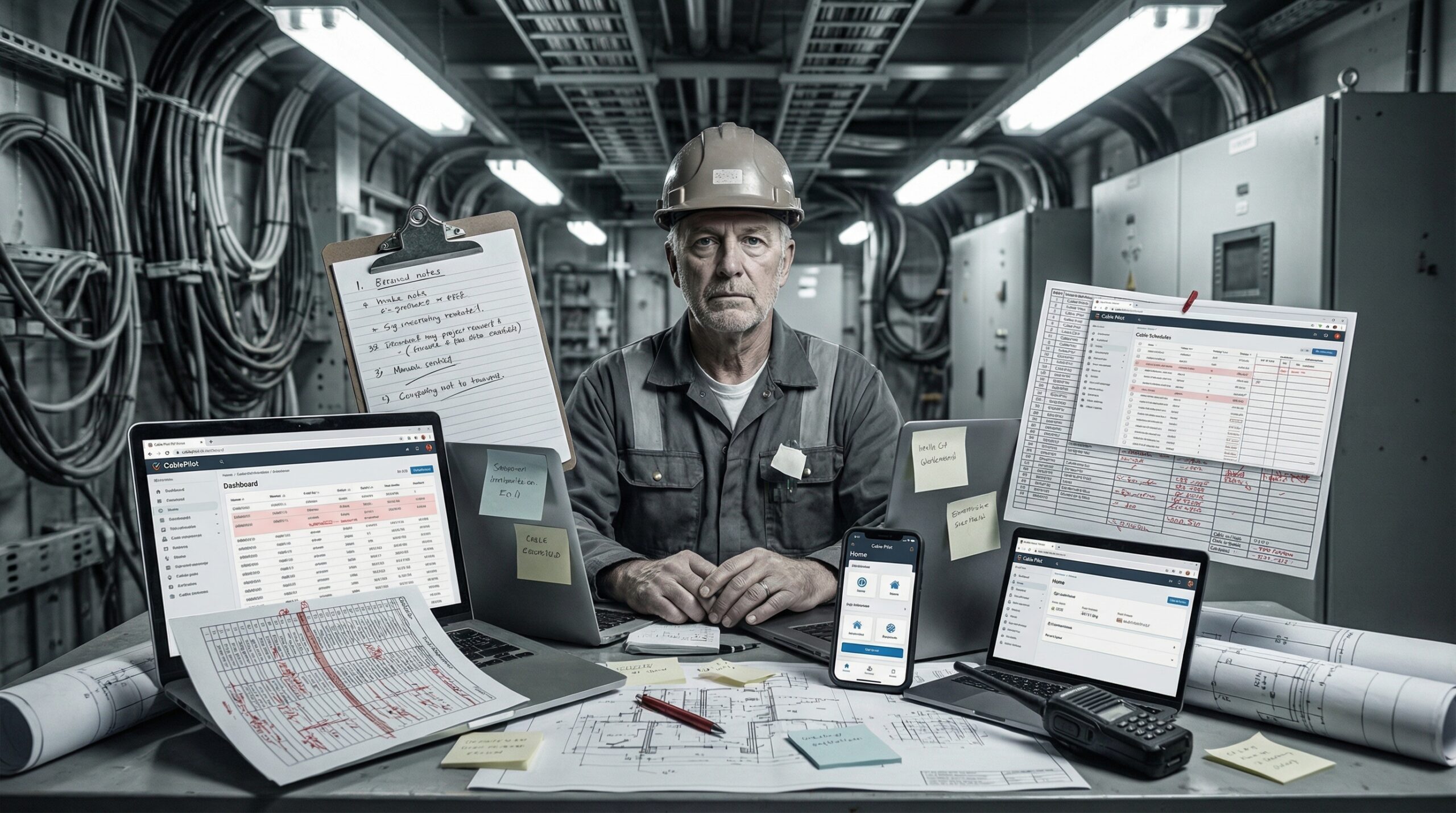
This process introduces multiple friction points:
Time Lag Between Work and Visibility: Management may not see accurate progress data until 24 to 48 hours after work is performed. In that window, decisions are made based on outdated information, resources are allocated inefficiently, and problems remain undetected.
Data Fragmentation and Inconsistency: When different contractors use different reporting formats, and data passes through multiple handoffs, errors multiply. A supervisor might misread a form, a spreadsheet might not update correctly, or conflicting versions of the same report might circulate among stakeholders.
Reactive Management Instead of Proactive Control: Without real-time visibility, project managers operate reactively. They learn about bottlenecks only after schedules slip, discover material shortages only when crews are idled, and identify quality issues only during inspections—when corrections are most expensive.
Wasted Labor Hours: Electricians and supervisors spend significant time on manual documentation instead of productive installation work. Studies in construction and shipbuilding suggest that administrative and rework tasks can consume 10-15% of total labor hours on complex projects.
Erosion of Accountability and Audit Trail: Paper-based or disconnected digital records make it difficult to establish clear timelines, verify who did what when, and resolve disputes about completed work or responsibility for errors.
The cumulative impact of these inefficiencies is substantial. A mid-sized vessel project with thousands of cable connections can lose dozens or even hundreds of labor hours to reporting delays, miscommunications, and avoidable rework. These losses translate directly into cost overruns and schedule pressure, making the difference between a profitable project and one that erodes margins.
Cable Pilot’s Real-Time Data Platform: Instant Reporting from Field to Dashboard
Cable Pilot fundamentally eliminates reporting delays by digitizing the entire electrical installation workflow and capturing data in real time at the point of work. Built specifically for the unique demands of shipbuilding, Cable Pilot combines a smartphone-based field app with an online management platform to create a seamless, instant data flow from installation crews to project stakeholders.

Real-Time Field Reporting via Smartphone
Electricians and installation teams use the Cable Pilot smartphone app directly on the shop floor or vessel. As each task is completed—whether pulling a cable, terminating a connection, or completing a test—workers scan the relevant QR code, select the task status, and optionally add photos or notes. This data is captured instantly and synchronized to the server in real time, making it immediately visible to supervisors, project managers, and engineering teams.
The smartphone interface is designed for simplicity and speed, requiring minimal training and reducing the time spent on documentation from minutes per task to seconds. Because the app is optimized for shipbuilding workflows, it understands the structure of cable lists, work orders, and vessel systems, guiding users through tasks and preventing common errors.
Instant Dashboard Updates for Stakeholders
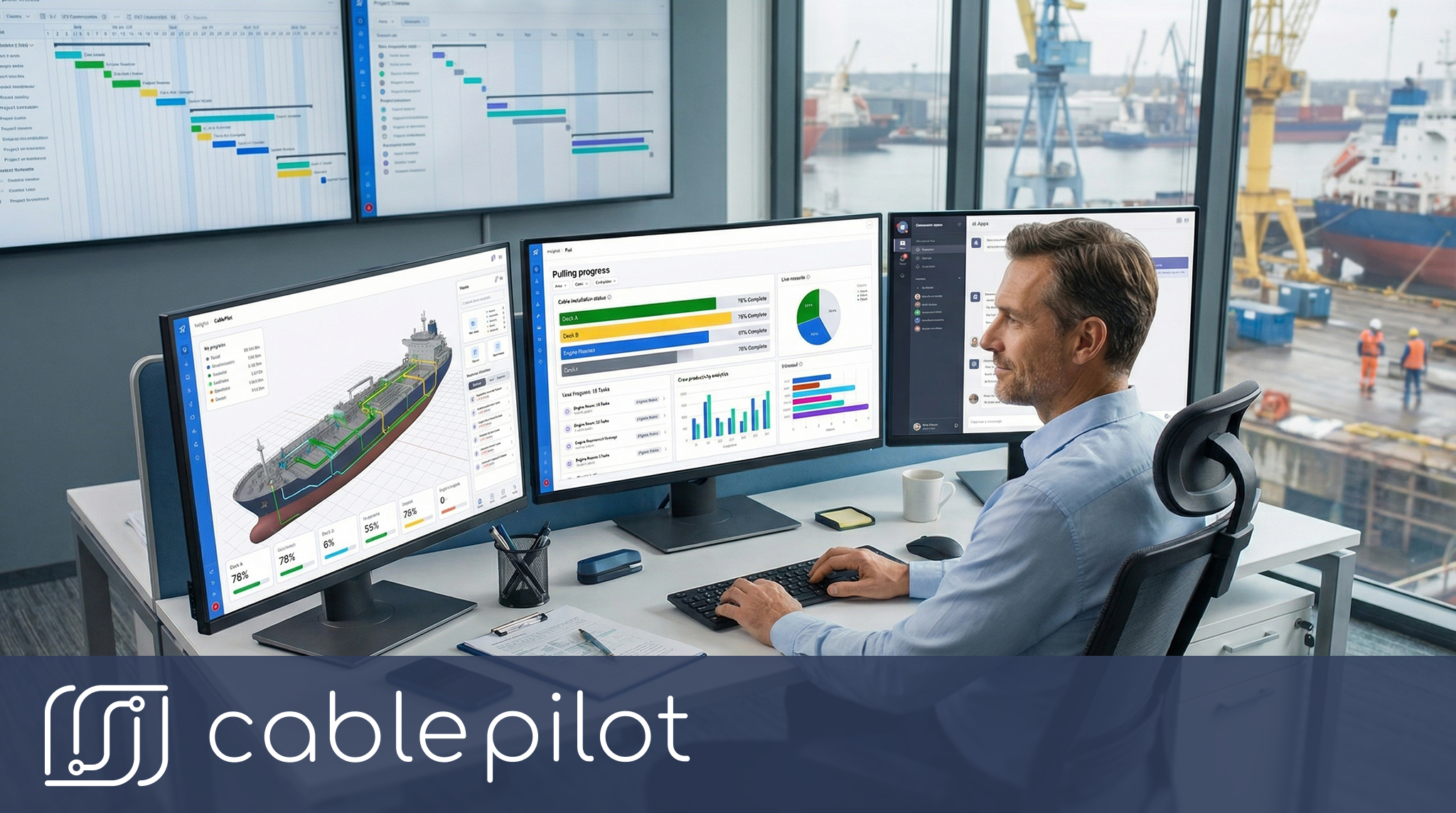
Every action captured in the field immediately updates the Cable Pilot online platform, where project managers, supervisors, and clients can view real-time progress dashboards, detailed reports, and historical trends. The platform serves as the single source of truth for project data, consolidating information from all contractors and trades into one unified view.
Stakeholders can see:
- Live Progress Metrics: Percentage and workload of cables pulled, connected, and tested, updated in real time as work progresses.
- Task Status by Location, System, or Cable Type: Granular visibility into which areas of the vessel are on schedule, which are falling behind, and where bottlenecks are forming.
- Resource Allocation and Crew Productivity: Detailed tracking of labor effort by worker, team, or contractor, enabling precise cost control and fair billing.
- Quality and Test Results: Immediate visibility into test outcomes, defect reports, and quality issues, allowing rapid response before problems cascade.
This instant visibility transforms project management from reactive to proactive. Instead of waiting for daily reports to identify problems, managers can detect issues the moment they arise and take corrective action within minutes or hours, not days.
Measurable Financial Benefits: ROI of Real-Time Data
The financial case for real-time data in shipbuilding electrical installation is compelling and quantifiable. By eliminating reporting delays and enabling data-driven decisions, Cable Pilot delivers measurable labor savings, cost avoidance, and improved profitability.
Labor Hour Savings Through Reduced Administrative Overhead
Manual documentation and reporting consume significant electrician and supervisor time. On a typical project, each electrician might spend 15-30 minutes per shift documenting work on paper forms, and supervisors might spend an additional hour or more consolidating and uploading reports. Across a large project with dozens of workers over months, this adds up to hundreds of hours of non-productive labor.
Cable Pilot reduces documentation time to seconds per task through QR code scanning and simplified smartphone workflows. A conservative estimate suggests a 50% reduction in administrative overhead, freeing 7-15 minutes per electrician per shift. On a project with 50 electricians working 200 shifts, this reclaims 1,167 to 2,500 labor hours—equivalent to tens of thousands of dollars in direct cost savings.
Faster Decision Cycles and Reduced Downtime
Real-time visibility enables project managers to make faster, more informed decisions. When a bottleneck appears—such as a missing cable specification, a blocked work area, or a failed test—managers can respond immediately instead of waiting for end-of-day reports. This reduces crew downtime and idle time, which are among the most expensive inefficiencies in project execution.
For example, if real-time data allows a manager to reassign a team from a blocked area to an available one within 30 minutes instead of waiting until the next day, that decision might save 6-8 hours of idle time per crew. Over the course of a project, dozens of such decisions add up to significant cost avoidance.
Cost Avoidance Through Early Problem Detection
Delayed reporting means problems are detected late, when corrections are most expensive. A cable pulled incorrectly might not be discovered until testing weeks later, requiring costly rework and schedule delays. A material shortage might not be identified until crews arrive on site and find missing components, leading to idle time and expedited shipping costs.
Real-time data enables early detection of quality issues, drawings errors, and logistical gaps, allowing corrections at the least expensive point in the workflow. Industry studies suggest that catching errors during installation instead of during testing or commissioning can reduce correction costs by 50-70%. On a complex electrical installation project, early detection of just a handful of major errors can save tens of thousands of dollars.
ROI Calculation Example
Consider a mid-sized vessel project with an electrical installation budget of 2 million dollars and 40,000 budgeted labor hours. Traditional delayed reporting might result in:
- Administrative waste: 10% of labor hours, or 4,000 hours at 60 dollars per hour = 240,000 dollars
- Rework and late corrections: 5% of total cost = 100,000 dollars
- Schedule delays and expedited costs: 50,000 dollars
Total avoidable costs: 390,000 dollarsBy implementing Cable Pilot and eliminating reporting delays, the project might achieve:
- Labor savings: Reduction of administrative waste by 50%, saving 120,000 dollars
- Rework reduction: Early detection cutting rework costs by 50%, saving 50,000 dollars
- Schedule adherence: Avoiding expedited costs, saving 50,000 dollars
Total savings: 220,000 dollarsAssuming Cable Pilot’s implementation cost is 30,000-50,000 dollars for the project, the ROI is immediate and substantial, with savings exceeding costs by a factor of 4-7x.
Schedule Certainty: Reducing Firefighting and Enabling Proactive Coordination
Beyond direct cost savings, real-time data delivers critical improvements in schedule predictability and adherence. Shipbuilding projects operate under intense schedule pressure, with vessel delivery dates tied to contractual penalties, financing arrangements, and client obligations. Electrical installation is often on the critical path, meaning delays directly impact overall vessel delivery.
Eliminating Reactive Firefighting
Traditional delayed reporting forces project managers into a reactive mode, constantly responding to problems discovered too late. This “firefighting” mentality consumes management bandwidth, disrupts crew schedules, and creates a chaotic work environment where long-term planning gives way to short-term crisis management.
Real-time data shifts the dynamic from reactive to proactive. When managers have instant visibility into progress, bottlenecks, and issues, they can anticipate problems before they escalate and coordinate solutions before schedules slip. For example:
- If a particular cable type is being installed slower than planned, managers can identify the issue within hours and reassign additional crew or adjust the schedule for downstream tasks.
- If test results reveal a pattern of failures in a specific system, engineers can investigate and correct the root cause before hundreds of additional connections are made incorrectly.
- If a work area becomes blocked by another trade, supervisors can redirect crews to alternative tasks immediately, avoiding idle time.
This proactive coordination reduces the frequency and severity of schedule disruptions, creating a smoother, more predictable workflow.
Shrinking Task Lag and Improving Team Utilization
In traditional workflows, the lag between task completion and data availability creates inefficiencies in crew utilization. Supervisors might assign crews to tasks that are already complete or blocked, or miss opportunities to reassign idle crews to available work. Real-time data eliminates this lag, allowing supervisors to make resource allocation decisions based on the current state of the project, not yesterday’s state.
Cable Pilot’s instant visibility into task status enables dynamic crew management, ensuring that every electrician is working on the highest-priority available task at all times. This improves crew utilization rates and accelerates overall project velocity.
Rapid Redeployment and Contingency Response
When unexpected issues arise—such as engineering changes, material delays, or scope adjustments—real-time data enables rapid response. Project managers can assess the impact instantly, identify affected tasks, and redeploy resources to minimize disruption. Without real-time data, responding to changes requires time-consuming manual investigation and coordination, often resulting in days of lost productivity.
For example, if an engineering change requires rerouting 50 cables, Cable Pilot’s instant visibility into which cables are already installed, which are in progress, and which are pending allows the project manager to isolate the impact, communicate changes to the field, and adjust priorities within hours, not days.

Risk Mitigation: Transparency, Audit Trails, and Early Warning Systems
Real-time data not only improves efficiency and schedule adherence but also fundamentally strengthens risk management and project resilience.
Transparent Audit Trail for Disputes and Compliance
Shipbuilding projects involve complex contractual relationships between shipyards, contractors, subcontractors, and clients. Disputes over scope, completed work, and responsibility for errors are common and can result in costly litigation or contractual penalties. Real-time data captured at the point of work creates an immutable, timestamped audit trail that documents exactly what work was performed, when, and by whom.
Cable Pilot’s detailed logs—including QR code scans, task status updates, photos, and test results—provide objective, verifiable evidence that can resolve disputes quickly and fairly. This transparency protects both contractors and shipyards, reducing the legal and financial risk associated with project disagreements.
Early Detection of Quality Issues and Bottlenecks
Real-time data acts as an early warning system for quality problems and schedule risks. By monitoring installation progress, test results, and defect rates in real time, project managers can identify patterns and anomalies before they escalate into major issues.
For example:
- If defect rates spike in a particular area or system, managers can investigate immediately, identify the root cause (such as inadequate training or faulty materials), and implement corrective action before the problem spreads.
- If progress in a critical work area lags behind schedule, managers can allocate additional resources or adjust dependencies to prevent the delay from impacting the overall project timeline.
This proactive risk management transforms project execution from a reactive scramble into a controlled, predictable process.
Reducing Financial Surprises and Overruns
Budget overruns are one of the most damaging risks in shipbuilding projects, eroding profitability and straining client relationships. Real-time data provides continuous visibility into labor effort, material consumption, and progress, allowing project managers to track actual costs against budgets with precision. Any deviation from the plan is immediately visible, enabling prompt corrective action before overruns become unmanageable.
Cable Pilot’s detailed reporting on team productivity, and task completion empowers managers to forecast final costs accurately and adjust resource allocation to stay within budget.
Case Study: Quantifying the Impact of Real-Time Data
To illustrate the tangible benefits of real-time data, consider a before-and-after scenario based on typical shipbuilding electrical installation challenges.
Before Cable Pilot: Traditional Delayed Reporting
A shipyard undertakes a 6,000-cable installation project with 40 electricians working over 120 days. Progress reports are submitted daily at shift end, consolidated by supervisors, and uploaded to the project management system by the next morning. Management receives accurate data with a 1-day lag.
Challenges encountered:
- Delayed problem detection: A specification error affecting 150 cables is discovered during testing, three weeks after installation. Rework requires 300 additional labor hours and delays the schedule by one week.
- Idle time: Crews arrive at work areas that are blocked by other trades, but the information is not communicated until mid-shift. Total idle time: 200 labor hours over the project.
- Administrative burden: Electricians spend 20 minutes per shift on manual documentation, supervisors spend 2 hours daily consolidating reports. Total administrative overhead: 1,600 labor hours.
Total impact:
- Rework cost: 18,000 dollars (300 hours at 60 dollars per hour)
- Idle time cost: 12,000 dollars (200 hours)
- Administrative waste: 96,000 dollars (1,600 hours)
- Schedule delay penalty: 25,000 dollars
Total avoidable cost: 151,000 dollarsAfter Cable Pilot: Real-Time Data Workflow
The same project is executed using Cable Pilot’s real-time data platform. Electricians scan QR codes and update task status via smartphone app, with data instantly visible to management.
Improvements achieved:
- Early error detection: The specification error is detected during installation, within two days. Correction requires only 50 labor hours and no schedule delay.
- Dynamic crew redeployment: Real-time visibility into blocked work areas allows supervisors to reassign crews immediately, reducing idle time to 50 hours.
- Reduced administrative burden: Documentation time drops to 5 minutes per shift, supervisor consolidation is automated. Total administrative overhead: 400 labor hours.
Total impact:
- Rework cost: 3,000 dollars (50 hours)
- Idle time cost: 3,000 dollars (50 hours)
- Administrative overhead: 24,000 dollars (400 hours)
- Schedule delay penalty: 0 dollars
Total cost: 30,000 dollarsSavings: 121,000 dollarsThis example demonstrates how real-time data delivers substantial, measurable financial benefits by eliminating waste, accelerating corrections, and enabling proactive management.

Building the Business Case: ROI Methods for Decision Makers
For shipyard executives, project managers, and contractors considering real-time data platforms like Cable Pilot, building a clear business case is essential. Here are practical methods for quantifying ROI:
Step 1: Baseline Current Costs
Analyze recent projects to identify avoidable costs related to delayed reporting:
- Labor hours spent on manual documentation and reporting: Survey electricians and supervisors to estimate time spent per shift.
- Rework costs: Review project close-out reports to quantify rework hours and costs attributed to late error detection.
- Idle time and schedule delays: Identify instances where crews were idled due to lack of real-time information or where schedule delays resulted from reactive management.
- Dispute resolution costs: Calculate time and legal fees spent resolving disputes over completed work or responsibility.
Step 2: Estimate Savings from Real-Time Data
Apply conservative reduction factors based on industry benchmarks and case studies:
- Administrative overhead reduction: 40-60% time savings on documentation.
- Rework cost reduction: 30-50% through early detection.
- Idle time reduction: 20-40% through dynamic crew management.
- Dispute resolution savings: 50-70% reduction in dispute-related costs.
Step 3: Calculate Implementation Costs
Assess the cost of adopting Cable Pilot, including:
- Software licensing fees: Typically based on number of users or project scope.
- Training and onboarding: Time required to train crews and supervisors.
- Integration effort: Any technical work required to integrate with existing systems.
Step 4: Compute Net ROI
Subtract implementation costs from projected savings to calculate net ROI. In most shipbuilding electrical installation scenarios, payback periods are measured in months, with ROI multiples of 3x to 10x over the project lifecycle.
Step 5: Factor in Strategic Benefits
Beyond direct cost savings, real-time data delivers strategic advantages that strengthen competitiveness:
- Enhanced client confidence: Clients value transparency and real-time progress visibility, improving relationships and increasing the likelihood of repeat business.
- Improved bidding accuracy: Historical data from real-time platforms enables more accurate cost estimation and more competitive, profitable bids on future projects.
- Workforce productivity and satisfaction: Reducing administrative burden and firefighting improves crew morale and retention, reducing recruitment and training costs.
The Competitive Imperative: Real-Time Data as a Market Differentiator
As shipbuilding electrical installation grows more complex and competitive, the gap between data-driven companies and those relying on traditional methods continues to widen. Clients increasingly expect transparency, predictability, and evidence-based progress reporting. Contractors who can demonstrate real-time visibility, rigorous quality control, and consistent on-time, on-budget delivery gain a decisive competitive advantage.
Real-time data platforms like Cable Pilot are not just operational tools—they are strategic assets that transform how projects are managed, how risks are mitigated, and how value is delivered to clients. Companies that embrace real-time data position themselves as industry leaders, capable of executing the most complex projects with confidence and precision.
For decision makers in shipyards and electrical contracting firms, the question is no longer whether to adopt real-time data workflows, but how quickly they can implement them to stay ahead of competitors and meet the demands of an evolving market.
Conclusion: From Uncertainty to Certainty Through Real-Time Data
Shipbuilding electrical installation is inherently complex, but the inefficiencies and risks associated with delayed reporting are not inevitable. Real-time data—captured at the point of work and instantly accessible to all stakeholders—fundamentally transforms project execution, delivering measurable financial savings, schedule certainty, and risk mitigation.
Cable Pilot’s real-time platform eliminates the reporting delays that plague traditional workflows, enabling proactive management, data-driven decisions, and continuous visibility into progress, costs, and quality. The financial case is clear: projects save tens to hundreds of thousands of dollars by reducing administrative waste, preventing costly rework, and avoiding schedule overruns. The strategic benefits are equally compelling: enhanced client relationships, competitive differentiation, and the organizational resilience to deliver even the most challenging projects successfully.
For shipyards, contractors, and project managers seeking to deliver electrical installations on time, on budget, and with unwavering quality, real-time data is not a luxury—it is a necessity. The future of shipbuilding belongs to those who embrace the certainty that real-time data provides.
Ready to transform your electrical installation workflow with real-time data? Discover how Cable Pilot delivers financial certainty, schedule confidence, and competitive advantage. Contact us today to see the platform in action and calculate your project ROI.