
The maritime industry stands at a pivotal moment. Electric propulsion systems, once reserved for ferries and research vessels, now power commercial cargo ships, naval platforms, and cruise liners. The United States electric ship market alone is accelerating at a 14% compound annual growth rate, driven by hybrid tugs navigating congested ports and wave-powered pilot vessels demonstrating zero-emission operations. As yards secure contracts for battery-electric ferries and LNG-hybrid container ships, project managers face an urgent reality: traditional electrical installation metrics are failing.
The problem isn’t a lack of effort. Electrical contractors still track progress in cable meters installed and man-hours consumed, the same metrics used for diesel-powered vessels three decades ago. But electric ships introduce cable networks with dramatically different complexity profiles. A single high-voltage battery distribution system may involve fewer physical cable runs than a conventional auxiliary system, yet require triple the installation rigor due to segregation requirements, specialized termination procedures, and multi-stage testing protocols. When a project manager reports “75% of cable meters installed” on an electric propulsion project, that number reveals almost nothing about actual readiness for sea trials or compliance with classification society requirements.
Cable Pilot emerges as the answer to this measurement crisis, transforming electrical installation management through its signature innovation: Cable Points. This isn’t just another digital tool—it’s a fundamental rethinking of how yards quantify and manage electrical work in the high-voltage, battery-integrated environments that define modern electric ships.
The Measurement Gap in Electric Ship Electrical Installations
To understand why Cable Pilot matters, consider the journey of a mid-sized shipyard that recently won its first contract for a battery-electric passenger ferry. The electrical supervisor, experienced with decades of conventional vessel installations, initially approached the project with confidence. His team would pull cables, make connections, conduct tests, and document results—standard procedure. The cable list showed 2,847 cables totaling 34,200 meters, numbers that seemed manageable compared to previous projects.
Three months into installation, the reality became clear. The high-voltage cables connecting battery modules to propulsion inverters represented only 8% of total cable length but consumed 31% of installation labor. Specialized crews needed additional time for torque-verified terminations, insulation resistance measurements at multiple voltage levels, and mandatory witness points for classification inspectors. Meanwhile, the low-voltage monitoring cables for the battery management system, though numerous and short, required meticulous segregation from power circuits and individual commissioning verification.
The weekly progress reports, based on cable meters completed, painted an increasingly misleading picture. By the time the ferry reached the commissioning stage, supposedly at 88% electrical completion, the team discovered they had barely 60% of actual installation work finished when measured by remaining labor effort. The discrepancy triggered budget overruns, delayed handover dates, and strained relationships with the vessel owner. The root cause wasn’t poor workmanship or inadequate planning—it was using the wrong ruler to measure progress.

Traditional metrics assume relatively uniform installation effort across cable types. Pull a 50-meter power cable or a 50-meter control cable, and your progress report treats them similarly. This assumption collapses in electric ship installations where:
- Voltage levels vary dramatically: A 1000V DC battery feeder cable demands different installation procedures, testing equipment, and safety protocols than a 24V DC monitoring cable, even if both span the same distance
- Termination complexity diverges sharply: High-current connections with compression lugs and heat-shrink insulation require exponentially more skilled labor than standard terminal block connections
- Testing intensity escalates: High-voltage circuits undergo multi-stage testing including insulation resistance at voltage, hi-pot testing, and often thermographic inspection before energization
- Documentation requirements multiply: Classification societies mandate detailed as-built records, test certificates, and traceability documentation for safety-critical electrical systems in electric propulsion installations
Measuring progress by cable length in this environment is like judging construction progress by counting bricks—it ignores everything that makes the work actually difficult.
Cable Points: Objective Measurement for Complex Electrical Work
Cable Pilot solves the measurement problem through its Cable Points system, which automatically calculates installation effort for every cable based on its specific characteristics. Rather than treating all cables as equivalent, Cable Points assigns weight to the factors that actually drive installation labor:
Voltage Rating Adjustment: The system recognizes that high-voltage cables require specialized crews, additional safety procedures, and extended testing protocols. A 690V AC motor feeder cable automatically receives higher Cable Point value than a 110V AC lighting circuit of identical length, reflecting the real-world difference in installation complexity.
Armor and Construction Weighting: Armored cables demand more careful handling, specialized bending radius management, and often mechanical support requirements that lightweight control cables don’t face. Cable Points factors in whether a cable has steel wire armor, aluminum tape shielding, or simple PVC jacket construction.
Termination Type Recognition: The difference between a simple crimp connection and a multi-layer high-voltage termination with stress control is enormous. Cable Points accounts for termination complexity, ensuring that cables with demanding connection requirements receive appropriate weight in progress calculations.
Segregation and Routing Complexity: Electric ships often require strict segregation between battery system cables, propulsion control circuits, and conventional ship services. Cables routed through congested machinery spaces or requiring dedicated tray systems contribute more Cable Points than simple point-to-point runs.
For the electrical supervisor managing that battery-electric ferry, Cable Points would have immediately revealed the true project landscape. The high-voltage battery distribution cables, representing 8% of cable meters, would show up as 28% of total Cable Points—a figure closely aligned with their actual 31% labor consumption. The project manager could have allocated resources accordingly, communicated realistic timelines to stakeholders, and avoided the painful discovery at commissioning.
Real-Time Dashboards: System Filtering for Targeted Management
Cable Pilot doesn’t just calculate Cable Points—it transforms them into actionable intelligence through real-time dashboards tailored to electric ship installations. Project managers access live views of installation progress filtered by system discipline and
cables category.
Electric-Specific Bottleneck Detection: The dashboard highlights when high-voltage battery system installations lag behind schedule, even when overall cable completion percentages look healthy. A project manager sees instantly if the specialized crew assigned to propulsion inverter cabling is falling behind, allowing immediate resource reallocation before delays cascade.
Voltage-Level Progress Tracking: Separate progress indicators for high-voltage distribution (>1000V), medium-voltage systems (690-1000V), and low-voltage circuits (<690V) reveal imbalances that aggregate metrics would hide. If low-voltage work races ahead while high-voltage critical path items stall, the dashboard makes the problem visible.
System Integration Readiness: Cable Pilot tracks not just individual cable completion but system-level readiness for energization. For a battery-electric vessel, this means monitoring when all cables in the battery distribution system reach the “ready for insulation testing” milestone, not just when individual cables are pulled.
Spatial Heatmaps: Visual deck-by-deck and compartment-by-compartment progress displays show where electrical work concentrates. In electric ship projects, battery rooms and converter spaces often represent critical path locations.
A yard managing simultaneous projects—a diesel-electric tug, a battery-hybrid ferry, and a conventional cargo vessel—can view progress metrics tailored to each vessel’s electrical complexity. The diesel-electric project shows progress filtered to highlight generator set cabling and switchboard connections. The battery-hybrid dashboard focuses on DC distribution, charging system integration, and battery management network status. The conventional vessel displays traditional progress tracking sufficient for its simpler electrical requirements.
Contractor Coordination: Objective Scope Assignment for High-Voltage Work
Electric ship projects frequently involve multiple electrical contractors, each with different specializations. One contractor may focus on high-voltage battery systems and propulsion inverters, requiring certified high-voltage technicians and specialized testing equipment. Another handles conventional ship services—lighting, small power, navigation systems—with standard maritime electrical crews. A third might specialize in the intricate low-voltage networks that connect battery management systems, fire detection, and integrated bridge systems.
Coordinating these teams using traditional methods creates constant friction. How do you fairly divide scope when one contractor argues they received all the difficult cables while another claims equal workload based on cable count? How do you objectively verify that a contractor with fewer cables but higher complexity deserves proportional compensation?
Cable Pilot eliminates subjectivity through Cable Point-based scope assignment. When dividing work packages for bid, project managers assign scopes with defined Cable Point totals, not just cable counts. A high-voltage specialist receives a work package containing 2,800 Cable Points across 340 cables—mostly battery distribution and propulsion motor feeders. A general electrical contractor receives 3,200 Cable Points across 1,240 cables—ship services and auxiliary systems. Both contractors face proportional workload despite vastly different cable quantities.
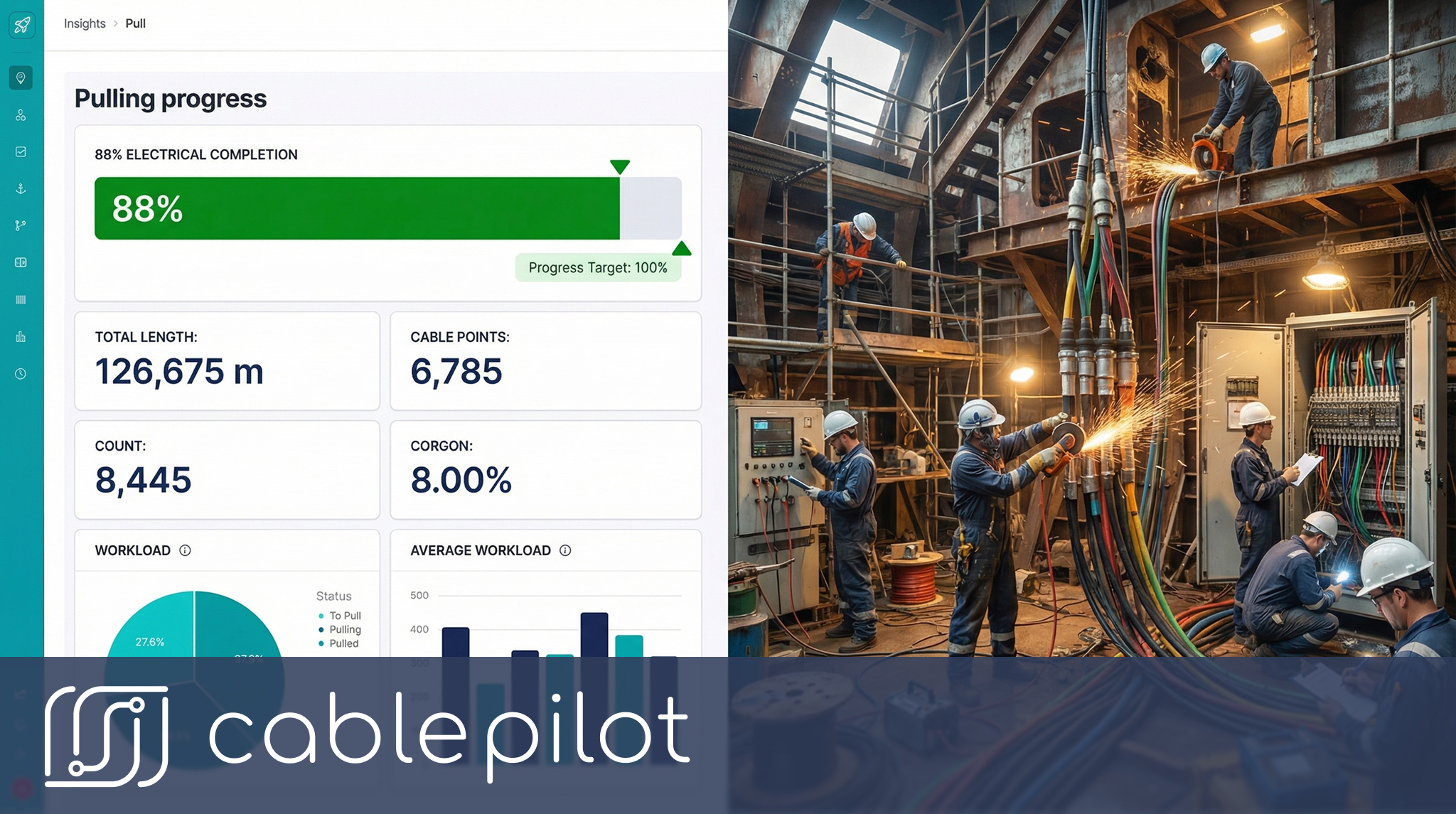
Balanced Workload Distribution: International teams working across multiple zones of the vessel can be assigned scopes with equivalent Cable Point totals, ensuring fair distribution regardless of whether one team handles numerous small cables while another tackles fewer high-voltage runs.
Objective Performance Measurement: When contractors complete assigned scopes, Cable Pilot tracks actual Cable Points achieved per labor hour. This creates transparent performance metrics that identify high-performing teams and reveal where additional training or support might help struggling contractors.
Change Order Quantification: When owners request electrical modifications mid-project—adding shore power connection capability, upgrading battery capacity, or integrating additional monitoring systems—Cable Pilot instantly calculates the Cable Point impact. Contractors receive change orders quantified in objective terms that reflect actual installation effort, not just cable counts that might dramatically underrepresent complexity.
Skill-Appropriate Assignment:. High-voltage work requiring certified technicians shows as a distinct category, allowing project managers to assign only appropriately qualified crews. This prevents the costly mistakes that occur when standard electricians attempt specialized high-voltage terminations without proper training.
For a large electric ship project with five electrical contractors working simultaneously, Cable Pilot becomes the single source of truth. Each contractor accesses role-based views showing their assigned scope, current Cable Point progress, upcoming testing milestones, and integration dependencies with other teams. The project manager sees the integrated picture: all contractors’ progress, system-level completion status, and critical path tracking—all based on objective Cable Point metrics that accurately reflect installation effort.
Compliance Infrastructure: Audit Trails for ABS and DNV Electric Propulsion Certification
Electric propulsion systems face intense scrutiny from classification societies. The American Bureau of Shipping (ABS) and Det Norske Veritas (DNV) maintain rigorous requirements for electric propulsion installations, driven by safety concerns around high-voltage systems, battery integration, and emergency power availability. Yards must demonstrate not just that cables were installed correctly, but that every installation step followed approved procedures, that qualified personnel performed the work, and that testing protocols matched class requirements.
Traditional documentation approaches—paper logbooks, Excel tracking spreadsheets, emailed test certificates—create compliance nightmares. An ABS surveyor arrives for battery system certification and requests complete installation records for the high-voltage DC distribution system: cable list with as-built routing, installation sign-offs by certified technicians, insulation resistance test results at each stage, hi-pot testing certificates, and thermographic inspection reports. The electrical superintendent spends two days gathering documents from multiple contractors, cross-referencing cable numbers, and assembling a presentation package. During the survey, gaps appear—a missing test certificate, unclear termination verification for three cables, and incomplete traceability for one high-voltage cable modification.
Cable Pilot eliminates these gaps through automatic audit trail generation integrated into the installation workflow. Every action taken in the platform—cable installation recorded via QR code scanning, termination completed, test results uploaded—creates a timestamped, attributed record linked to the specific cable and system.
Installation Verification Trails: When a technician scans a high-voltage battery feeder cable’s QR code and marks termination complete in Cable Pilot’s mobile application, the system records who performed the work, when it occurred, and whether the technician holds required certifications. If only certified high-voltage technicians may terminate battery system cables, Cable Pilot enforces that rule through the mobile app—uncertified users cannot mark high-voltage terminations complete.
Testing Protocol Enforcement: The platform mandates testing sequences. Before a 1000V DC battery distribution cable can show as “ready for energization,” Cable Pilot requires uploading insulation resistance test results at multiple voltage levels and hi-pot test certification. Project managers can’t skip steps or declare systems ready without completing required testing phases.
Modification Documentation: When owners request cable routing changes or connection modifications, Cable Pilot creates change records linked to affected cables. The audit trail shows the original specification, the modification approval, who implemented the change, and verification that modified installations underwent appropriate testing.
Certification Package Generation: When the ABS surveyor arrives, the electrical superintendent generates a complete certification package from Cable Pilot with a few clicks. The system assembles all high-voltage DC system cables, their installation records, test certificates, technician qualifications, and modification history into a comprehensive document set. Gaps are impossible—if any cable lacks required documentation, it shows as incomplete in the system and won’t appear in the certification package.

This compliance infrastructure reduces classification society inspection cycles. Surveyors spend less time hunting documentation and more time conducting substantive technical reviews. For yards, this translates to faster class approval, earlier vessel handover, and reduced holding costs. The ferry operator receiving that battery-electric vessel reaches revenue service weeks earlier because class certification proceeds smoothly, all due to Cable Pilot’s comprehensive audit trails.
Quantified Performance Gains: 18.5% Labor Savings in Electric Ship Projects
Cable Pilot’s impact on electric ship electrical installations extends beyond better metrics and compliance—it delivers measurable labor savings.
These savings accumulate across multiple workflow improvements:
Reduced Rework Through Front-Loaded Accuracy: When Cable Pilot’s cable list import identifies specification conflicts or missing segregation codes before installation begins, contractors avoid pulling cables that must later be rerouted. Electric ship installations, with their stringent segregation requirements, are particularly prone to rework when low-voltage monitoring cables inadvertently share cable trays with high-voltage power distribution. Cable Pilot’s pre-installation validation flags these conflicts, preventing costly re-installation.
Optimized Testing Sequences: The platform’s system-level view allows test engineers to group cables by testing requirements and schedule insulation resistance testing, hi-pot testing, and continuity verification in efficient batches. Rather than testing cables individually as contractors complete them, test teams work through logical groupings—all battery room distribution cables, then all converter space feeders—reducing setup time and equipment moves between locations.
Elimination of Status Meetings: When every stakeholder accesses real-time progress data through Cable Pilot’s dashboards, time-consuming weekly status meetings shrink or disappear entirely. The superintendent no longer spends Friday afternoons collecting progress reports from five contractors, consolidating spreadsheets, and preparing presentations for Monday morning reviews. Stakeholders check the dashboard when they need current information.
Faster Commissioning Through Complete Documentation: The most significant savings often occur at commissioning. When Cable Pilot delivers complete, verified documentation packages to commissioning engineers, system energization proceeds without delays for missing test certificates or unclear cable routing. A battery-electric ferry project that would traditionally spend three weeks resolving documentation gaps before beginning energization completes the same process in five days with Cable Pilot’s audit trails.
Predictive Bidding for Profitability: Beyond individual project savings, Cable Pilot creates a historical database of Cable Point production rates by cable type, contractor, and vessel class. Yards leverage this data for increasingly accurate cost estimation on future electric ship bids. When a ferry operator requests a proposal for a battery-electric vessel similar to a previous project, the estimating team uses actual Cable Point production data to build labor budgets with unprecedented precision. Bid margins tighten, win rates improve, and executed projects track closer to budget.

The 18.5% labor savings figure represents an average across multiple project types and yard sizes. Individual projects show variation—a yard’s first battery-electric vessel might see 12% savings as teams learn the platform and adapt workflows, while that yard’s third electric ship project might achieve 24% savings as Cable Pilot use becomes second nature and historical data enables better planning. The consistency of positive returns, however, remains striking across implementations.
Strategic Positioning: Backbone for the $58 Billion Electric Ships Era
The business case for Cable Pilot extends beyond immediate project savings into strategic positioning for the electric maritime future. Industry analysts project the global electric ship market will reach $58 billion by 2035, driven by regulatory pressure for emission reduction, falling battery costs, and owner recognition that electric propulsion delivers operational savings through reduced fuel costs and maintenance. Yards that master electric ship electrical installations today gain competitive advantage for tomorrow’s dominant market segment.
Cable Pilot serves as infrastructure for this strategic shift. Yards implementing the platform don’t just execute individual electric ship projects more efficiently—they build institutional knowledge about electric propulsion electrical work. The Cable Point database captures learning across projects: which high-voltage cable types prove most challenging to install, which termination methods deliver best productivity, where testing protocols consume more time than estimated, and how battery room spatial constraints impact installation sequences.
From Ferries to Mega-Vessels: The electric ship market isn’t monolithic. Battery-electric ferries for short routes represent current volume, but hybrid propulsion systems are entering much larger vessels—container ships, tankers, and cruise liners that combine conventional engines with electric boost capability for maneuvering and hotel loads. Cable Pilot’s scalability means yards apply the same management approach whether installing 2,000 cables on a coastal ferry or 15,000 cables on a hybrid-propulsion cruise ship. The platform’s filtering and system-organization capabilities handle size variation without requiring different management processes.
International Team Coordination: Electric ship projects increasingly involve international partnerships. A European yard might subcontract battery system integration to a specialized Asian firm while using local contractors for conventional electrical work. Cable Pilot’s cloud-based architecture supports distributed teams working in different time zones, with role-based access ensuring each contractor sees relevant scope while project managers maintain integrated oversight. Language support and standard terminology reduce confusion when multicultural teams collaborate.
Owner Confidence Through Transparency: Vessel owners investing in electric propulsion technology—often their first departure from conventional diesel vessels—want assurance their shipyard can manage the electrical complexity. Cable Pilot provides that confidence through transparent progress visibility. Owners access customized dashboards showing high-level completion status, system integration milestones, and class certification progress. When questions arise, project managers share detailed views demonstrating control and professionalism that win repeat business.
Regulatory Readiness for Evolving Standards: As electric ship adoption grows, classification societies and maritime authorities continue refining requirements for high-voltage systems, battery installations, and charging infrastructure. Cable Pilot’s flexible cable list structure and configurable compliance rules allow yards to adapt as standards evolve. When DNV updates battery system installation requirements, a yard updates Cable Pilot’s validation rules and testing checklists, ensuring all ongoing projects immediately comply.
The Path Forward: Implementing Cable Pilot for Electric Ship Electrical Installations
Shipyards considering Cable Pilot for electric ship projects typically progress through a structured implementation that builds confidence while delivering immediate value. The platform’s design accommodates both pilot projects on single vessels and enterprise deployments across all electrical installations.

Phase One – Proof of Concept: Most yards begin with a single electric or hybrid-propulsion project, using Cable Pilot to manage high-voltage electrical scope while potentially maintaining legacy systems for conventional electrical work. This limited deployment proves Cable Point accuracy, demonstrates mobile app adoption among technicians, and validates compliance audit trail generation. Success at this stage provides the foundation for broader adoption.
Phase Two – Contractor Integration: Once internal teams gain Cable Pilot proficiency, yards extend access to electrical contractors. Contractors receive training on mobile app use, QR code scanning for progress tracking, and photo documentation requirements. The platform’s role-based access means contractors see only their assigned scope, preventing information overload while maintaining integrated project tracking for superintendents.
Phase Three – Enterprise Expansion: Yards that validate Cable Pilot value on electric ship projects typically expand to all vessel types—electric propulsion, diesel-electric, hybrid, and conventional. The platform’s adaptability means the same infrastructure manages varying electrical complexity levels. Cable Point weighting adjusts automatically based on each project’s cable specifications, delivering appropriate measurement precision whether managing a simple cargo vessel or a complex cruise ship hybrid propulsion system.
Ongoing Optimization – Historical Data Leverage: As yards complete multiple projects using Cable Pilot, the historical database becomes increasingly valuable. Estimating teams access average Cable Point production rates by vessel type and electrical system category. Project managers compare current project performance against historical benchmarks, identifying early whether production rates meet expectations or require intervention. This continuous improvement loop transforms Cable Pilot from a project management tool into a strategic asset for business optimization.
The electric ships era demands more than enthusiasm—it requires rigorous management of complex electrical installations where traditional metrics fail and compliance requirements intensify. Cable Pilot delivers the measurement precision, real-time visibility, contractor coordination, and compliance infrastructure that yards need to execute high-voltage, battery-integrated electrical systems profitably and reliably. From battery-electric ferries serving coastal communities to hybrid-propulsion mega-vessels crossing oceans, Cable Pilot provides the backbone for electrical installation success as maritime transportation embraces its electric future.
Ready to transform your electrical installation management for electric ships? Discover how Cable Pilot’s adjusted Cable Points, real-time filtered dashboards, and automatic compliance audit trails deliver 18.5% labor savings on high-voltage installations. Contact our team for a demonstration tailored to your yard’s electric ship projects and see how objective metrics drive profitability in the era of maritime electrification.