
The Hidden Cost of Information Chaos in Electrical Installation
Walk onto any modern shipbuilding project, and you’ll witness a paradox: vessels packed with cutting-edge technology being built by teams drowning in outdated information management. An installer opens a paper drawing from last week while the actual revision sits in someone’s inbox. A supervisor radios three different people to confirm whether a cable run is approved. A QA inspector arrives at a compartment only to discover the work isn’t actually ready for inspection. Meanwhile, the project manager struggles to extract reliable progress metrics from a patchwork of spreadsheets, WhatsApp messages, and memory.
This isn’t negligence—it’s the natural consequence of managing thousands of cables, hundreds of panels, and dozens of systems across multiple decks without a unified data backbone. Every role operates from slightly different information, leading to questions that consume hours: “Is this the latest drawing?” “Which cables are actually installed here?” “Has this been inspected?” “What’s blocking Zone 3?”
The concept of a single source of truth sounds abstract until you experience its absence. In electrical installation for shipbuilding, where space constraints, trade dependencies, and regulatory requirements create brutal complexity, the lack of unified, real-time data doesn’t just slow projects—it fundamentally changes how people work. Teams develop defensive behaviors: over-communicating to compensate for information gaps, triple-checking details that should be certain, and building schedule buffers to absorb the inevitable surprises that come from working with stale data.
Cable Pilot eliminates this friction by becoming the authoritative system of record for every aspect of electrical installation—cables, equipment, documents, locations, statuses, and the relationships between them. But the real transformation isn’t technological; it’s operational. When everyone from deck-level installers to project managers works from the same continuously updated reality, daily work fundamentally changes. Tasks that once required phone calls become instant lookups. Decisions that once needed meetings become autonomous. Coordination that once demanded constant supervision becomes self-organizing.
This article examines exactly how Cable Pilot’s single source of truth transforms the daily workflow for five critical roles in electrical installation projects. Not in abstract terms, but in the specific tasks, questions, and friction points that define each person’s actual working day.

Role 1: The Installer – From Paper Chase to Instant Clarity
For the installer working in a cramped engine room or behind a bulkhead, information access isn’t a convenience—it’s the foundation of productive work. Traditional workflows burden installers with constant uncertainty: hunting for the correct drawing revision, clarifying which specific cables belong in this location, confirming mounting specifications, and then somehow communicating progress back to management through supervisors who are simultaneously fielding questions from ten other locations.
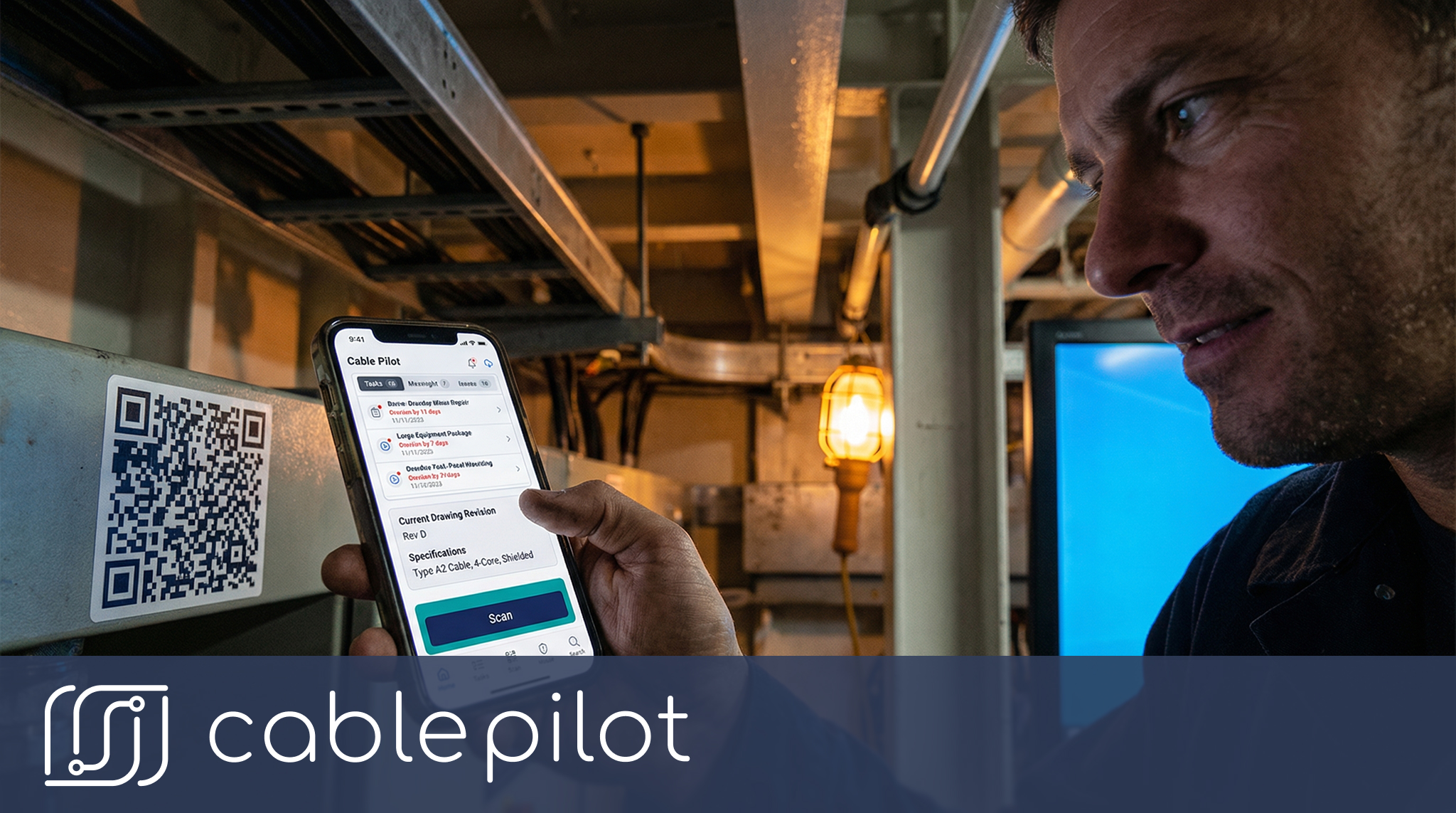
Cable Pilot replaces this friction with immediate, location-specific clarity through QR codes and the smartphone app. When an installer scans a QR code on a cable drum, comartment, or equipment tag, the app instantly displays everything relevant to that specific item or location: the official cable list filtered to show only what belongs here, the current drawing revision with automatic highlighting of the relevant section, installation specifications, and the clear next action—whether this cable should be pulled, terminated, or is waiting for another trade.
This eliminates the paper chase entirely. No more carrying rolled drawings that become outdated between shifts. No more radioing the supervisor to ask “Is cable A247 on this list?” The installer’s smartphone becomes a direct window into the project’s authoritative data, filtered and contextualized for the exact task at hand.
Progress reporting transforms from a bureaucratic burden into a five-second action. After completing a cable pull, the installer scans the destination panel’s QR code, selects the cables just installed from the pre-populated list, and taps “Complete.” That’s it. No paperwork. No waiting for the supervisor’s daily walkdown to discover what got done. The project database updates instantly, triggering automatic notifications to QA that this work is ready for inspection and updating the supervisor’s dashboard to show real progress.
The smartphone app also surfaces blocking issues that would otherwise remain invisible until someone physically visits. If Cable Pilot’s data shows that a cable run depends on a penetration that hasn’t been approved, or requires a panel that hasn’t arrived, the installer sees this before starting work—not after pulling cables to a location that isn’t actually ready. This prevents wasted labor effort and the frustration of repeatedly returning to the same incomplete task.
For installers, the single source of truth means replacing guesswork with certainty, replacing administrative overhead with productive work, and replacing delayed feedback loops with instant visibility. The job becomes focused on the actual craft—pulling cables, making terminations, ensuring quality—rather than managing information chaos.
Role 2: The Supervisor – From Firefighting to Orchestration
Supervisors and site managers exist in the permanent tension between strategic resource allocation and tactical firefighting. They’re supposed to plan crew assignments based on project priorities, coordinate with other trades, and maintain schedule momentum. Instead, they spend most of their day answering questions that shouldn’t need asking: “Where should I work next?” “Is this the right cable list?” “Why is this location blocked?” “Did QA approve Zone 4?”
Without a single source of truth, the supervisor becomes a human API—the person everyone must query to get reliable information. This creates a vicious cycle: the more the supervisor is interrupted with information requests, the less time they have for actual coordination, which creates more confusion, which generates more interruptions.
Cable Pilot breaks this cycle by making the supervisor’s knowledge visible and self-service through location-based and system-based dashboards. Instead of maintaining mental models of which zones are ready, which are blocked, and which need QA, the supervisor opens a dashboard that shows every location’s actual status derived from real-time data: cables installed, terminations completed, tests passed, inspections cleared.
This transforms crew assignment from educated guesswork into data-driven decisions. The supervisor can instantly identify which locations are genuinely ready for work—where all dependencies are satisfied, materials have arrived, and previous trades have completed their scope. When an installer finishes a task and asks “What’s next?”, the supervisor doesn’t need to walk the entire vessel or make phone calls; they check Cable Pilot’s ready-work list and assign the highest-priority task that’s actually executable today.
The system-based view provides equally powerful insights. When focusing on a specific electrical system—say, the emergency generator distribution—the supervisor sees every panel, cable, and device that belongs to this system, along with their current status. This makes it trivial to answer questions that once required hours of cross-referencing: “How much of the emergency power system is complete?” “What’s blocking final testing?” “Which zones need focused effort to reach the next milestone?”
Cable Pilot’s dependency tracking eliminates the constant surprise of discovering blocking issues. When a cable run depends on a hull penetration that another contractor must provide, this relationship is explicit in the system. The supervisor sees these dependencies on the dashboard and can proactively coordinate with other trades before crews arrive expecting to work. What was once reactive firefighting becomes proactive orchestration.
Perhaps most importantly, the single source of truth enables supervisors to trust their teams with autonomy. When installers have direct access to accurate information through the smartphone app, they need less hand-holding. When progress updates happen automatically through QR code scans, the supervisor doesn’t need daily walkdowns just to discover what got done. The supervisor’s role shifts from information bottleneck to strategic coordinator—focusing on genuine problem-solving rather than answering routine questions and verifying basic facts.
Role 3: The QA Inspector – From Wasted Trips to Targeted Verification
Quality assurance and inspection in electrical installation is a high-stakes function where timing, documentation, and thoroughness are non-negotiable. Yet traditional workflows sabotage inspectors with systemic inefficiencies that turn rigorous quality control into an exhausting battle against information gaps.
The most visible symptom: arriving at a location expecting to inspect completed work, only to discover it’s not actually ready. The cable list shows twelve cables, but only eight are installed. Or all cables are present, but terminations aren’t complete. Or terminations are finished, but there’s confusion about which revision of specifications applies. Each wasted trip compounds schedule pressure, erodes trust between trades, and forces inspectors to develop defensive scheduling practices—arriving later than optimal or demanding excessive confirmation before committing to inspections.

Cable Pilot eliminates wasted trips through status-driven inspection requests. When an installer completes work and updates Cable Pilot, the system automatically checks whether all required items for that location or equipment are finished. Only when the full scope is complete does Cable Pilot notify the inspector that work is ready. The inspector’s dashboard shows only genuinely ready items, sorted by priority and location. No more traveling to check “just in case.” No more surprise gaps. Every inspection trip is purposeful and productive.
When the inspector arrives, scanning a location’s QR code provides instant access to complete context: the full installation history showing who installed each cable and when, the applicable drawings and specifications with their exact revisions, any previous inspection findings and their resolution status, and photos uploaded by installers during installation. This eliminates the common scenario where the inspector discovers an issue but can’t determine when it was introduced or which crew was responsible.
Finding documentation becomes similarly efficient. When an inspector identifies a non-conformance—say, a cable with insufficient support spacing—they photograph the issue through the smartphone app, link it to the specific cable in Cable Pilot, and describe the finding. This creates a traceable record that flows immediately to the responsible supervisor. No paper forms. No ambiguity about which cable needs correction. No risk that the finding gets lost in email chains.
Closing findings becomes equally transparent. When the installer corrects the issue and rescans the cable, Cable Pilot shows the inspector exactly what changed: the new photo evidence, the updated status, and the timestamp. The inspector verifies the correction in person, updates the status to “approved,” and Cable Pilot automatically archives the complete audit trail. For regulatory purposes, this provides perfect documentation showing not just that inspections occurred, but exactly what was checked, what issues were found, how they were resolved, and who performed each action.
The single source of truth also protects inspectors from the professional risk of signing off on work based on incomplete or outdated information. When every inspection references the actual installed configuration as recorded in Cable Pilot—not someone’s memory or a potentially stale drawing—the inspector’s approval rests on verifiable fact. This reduces both the anxiety of “did I miss something?” and the actual risk of approving work that doesn’t meet specifications.
For QA inspectors, Cable Pilot transforms the role from defensive scrambling—constantly fighting information gaps and scheduling chaos—into focused verification. Time and attention shift from administrative overhead and coordination struggles to the actual task: ensuring the electrical installation meets specifications and regulatory requirements.

Role 4: The Design and Commissioning Engineer – From RFI Flood to Reliable As-Built Data
Engineers supporting electrical installation occupy a unique position: they’re responsible for the technical integrity of the design, yet they’re often the last to know when reality diverges from drawings. By the time an issue surfaces—a cable that won’t fit through the planned route, a panel location that conflicts with structural steel, a circuit that can’t be balanced as designed—installation is already delayed and crews are waiting for answers.
Traditional communication paths between design offices and installation teams create systematic information decay. An installer encounters a field condition that makes the drawing unworkable and tells the supervisor. The supervisor mentions it in a weekly meeting. Someone eventually sends an email to engineering. The engineer responds with a question for clarification. The response comes three days later. Meanwhile, the crew has moved to other work, and returning to complete the modified installation requires remobilization.
Cable Pilot short-circuits this dysfunction by making RFIs (Requests for Information) traceable and location-specific within the single source of truth. When an installer encounters an issue, they scan the relevant QR code, attach photos of the actual field condition, and submit an RFI directly through the smartphone app. The RFI automatically includes context—the specific cable or equipment, the location, the current drawing revision, and the installation history. This reaches the engineer not as vague text (“Zone 3 has a problem”) but as structured data with visual evidence.
The engineer reviews the RFI in Cable Pilot, sees the exact context, and responds with a solution—whether that’s a drawing revision, a clarification of existing specs, or approval of a field modification. Because this entire conversation happens in Cable Pilot, linked to the specific cable or location, there’s perfect traceability. Six months later, when someone asks “why was this cable routed differently than the drawing?”, the answer is instantly accessible: RFI #237, submitted October 15th, with photos and engineering approval.
Version control becomes automatic rather than bureaucratic. When the engineer issues a revised drawing, uploading it to Cable Pilot immediately makes the new revision visible to everyone working on that system or location. Installers see the update notification the next time they access that area. Supervisors see which locations are affected by the change. QA inspectors automatically reference the latest revision. There’s no lag period where some people work from old drawings while others have the update. No possibility of someone pulling cables based on superseded specifications.
For commissioning engineers preparing for system testing, Cable Pilot provides something previously impossible: reliable as-built data before commissioning begins. Instead of arriving at the testing phase and discovering that actual cable routes differ from drawings, panel configurations were field-modified, and documentation is scattered across email and paper markups, the commissioning engineer opens Cable Pilot and sees the verified installed state. Every cable’s actual location, every termination that passed inspection, every field modification with its engineering approval, and every component with its number and installation date.
This transforms pre-commissioning planning from archaeology—trying to reconstruct what was actually built—into straightforward analysis. The engineer can verify loop integrity, confirm shielding and grounding, check load distribution, and identify potential issues before energizing systems. When problems appear during testing, Cable Pilot provides immediate access to installation history, helping isolate whether the issue is design, installation, or component related.
For design and commissioning engineers, the single source of truth means replacing information scavenger hunts with instant data access, replacing delayed RFI cycles with responsive problem-solving, and replacing uncertainty about as-built conditions with verified facts. Engineering time shifts from administrative coordination and documentation detective work to actual technical analysis and problem-solving.
Role 5: Project and Commercial Management – From Hope to Evidence
Project managers and commercial leadership face a unique challenge: they’re accountable for schedule, budget, and contractual performance, yet they’re furthest from the physical work. Their decisions—whether to accelerate crews, how to respond to client questions, which risks deserve mitigation investment—depend entirely on the quality of information flowing up from the field.
Traditional reporting mechanisms are optimized for optimism. Supervisors report percentage-complete estimates that feel reasonable but lack objective basis. Progress meetings produce action items that may or may not reflect actual field conditions. Schedule updates reflect intended work rather than verified accomplishments. By the time reality becomes undeniable—usually when the client or surveyor conducts their own inspection—the project manager discovers that reported progress was systematically overstated and schedule recovery is far harder than expected.
Cable Pilot replaces this with evidence-based metrics derived automatically from verified field data. When the project manager opens the executive dashboard, every KPI reflects actual completed work: cables installed and inspected, systems commissioned, test protocols passed. There’s no ambiguity about what “90% complete” means because the metric is calculated from countable facts—782 of 869 cables installed—not subjective estimates.
This transforms client reporting from careful diplomacy into straightforward fact-sharing. When the client asks “What’s the status of the emergency power system?”, the project manager opens Cable Pilot, filters by that system, and shares real-time data: 94% of cables installed, 87% inspected and approved, 76% tested, with specific identification of the remaining work and its dependencies. The client receives not vague assurances but verifiable evidence, building trust and reducing the adversarial tension that often characterizes project communications.
Schedule discussions shift from subjective opinions to objective analysis. When a key milestone is at risk, Cable Pilot shows exactly why: not “Zone 5 is behind schedule” but “Zone 5 has 23 cables remaining, blocked by 4 hull penetrations awaiting structural approval and 2 panels delayed in procurement.” This specificity enables focused problem-solving. Instead of general schedule pressure, the project manager addresses the actual blocking issues: expediting structural approvals and escalating procurement delays.

Commercial management benefits from traceable productivity data that supports contract negotiations and defends against unwarranted claims. When a client suggests that the electrical contractor is causing delays, Cable Pilot provides objective evidence: installation crews completed their scope on schedule, but commissioning was delayed because other trades didn’t deliver ready spaces as contractually required. The data shows exact dates when locations were supposed to be handed over versus when they actually became available, removing subjective disputes.
Cable Pilot’s audit trail also protects project managers during variations and claims. When scope changes occur—additional equipment, modified routing, altered specifications—the system records exactly when changes were instructed, what work was affected, and what additional labor effort resulted. This documentation, captured in the normal course of work rather than reconstructed later, provides defensible evidence for commercial negotiations.
Perhaps most importantly, the single source of truth enables project managers to identify problems while they’re still solvable rather than after they’ve metastasized into crises. When Cable Pilot shows that a specific system’s progress has stalled, the project manager can investigate immediately: Is it blocking dependencies? Material shortages? Crew availability? Unclear specifications? Early identification enables early intervention, replacing reactive crisis management with proactive risk mitigation.
For project and commercial management, Cable Pilot transforms leadership from managing in the fog—making decisions based on delayed, filtered, optimistic information—into steering with clarity. Decisions rest on facts. Client relationships build on transparency. Schedule commitments are realistic. Commercial positions are defensible. The project manager’s role shifts from extracting truth from conflicting reports to analyzing verified data and making strategic choices.
The Day Before and The Day After: Life on a Cable Pilot Project
To appreciate the cumulative impact of Cable Pilot’s single source of truth, contrast the daily experience before and after implementation:
The Day Before: The morning starts with a coordination meeting where different people describe the same project reality in incompatible ways. The supervisor believes Zone 3 is ready for final inspection. The QA inspector’s records show outstanding findings. The project manager’s dashboard indicates 85% completion, but the commissioning engineer has identified discrepancies suggesting the number is optimistic. Reconciling these views consumes the first hour of everyone’s day.
Installers spend significant time hunting for information: finding the current drawing revision, confirming whether specific cables are on today’s work list, checking if panels have arrived. When questions arise, they interrupt supervisors, who interrupt engineers, who check email and eventually respond. Simple clarifications take hours. Complex issues take days.
Progress reporting is a separate activity disconnected from actual work. At shift end, supervisors walk sections and estimate completion, then enter data into spreadsheets. The estimates are educated guesses—supervisors can’t physically verify every cable installation, so they rely on crew reports and visual sampling. This data flows upward, becoming project KPIs that everyone treats with cautious skepticism.
QA inspectors maintain defensive schedules, adding buffer time because they’ve learned that “ready for inspection” often means “mostly ready, probably.” They arrive expecting to inspect twenty items but find thirteen actually complete, four partially done, and three blocked by other trades. The wasted time frustrates everyone and slows project momentum.
Engineers receive RFIs as vague text: “Cable A247 won’t fit.” Without photos, exact location context, or access to installation history, the engineer requests clarification, delaying resolution. When drawings are updated, distributing the new revision and ensuring everyone has it requires email, meetings, and persistent follow-up.
The project manager prepares for a client meeting by collecting data from multiple sources: supervisor reports, inspection logs, commissioning notes, and procurement status. The data doesn’t quite align—different sources show different completion percentages. Reconciliation requires phone calls and estimation. The final numbers feel reasonable but rest on soft foundation.
The Day After: The same project, now running on Cable Pilot as the single source of truth, starts differently. The morning coordination meeting is brief and focused. Everyone references the same live dashboard showing exactly which locations are ready, which are blocked, and which have outstanding issues. There’s no debate about basic facts—the data is authoritative. The meeting focuses on solving the handful of genuine blocking issues rather than reconciling conflicting reports.
Installers start work immediately. They scan a zone’s QR code and see today’s work list, automatically filtered for this location. The latest drawing loads instantly. Specifications are attached and current. When a cable is installed, they scan, select, confirm—five seconds. The supervisor’s dashboard updates immediately. QA receives an automatic notification. There’s no separate reporting step because working and reporting are the same action.
When an installer encounters an unexpected field condition—a structural beam interfering with the planned cable route—they photograph it, submit an RFI through the app, and move to other work in the same zone. The engineer receives the RFI fifteen minutes later, complete with photos and exact location context. They respond with approval for an alternate route within an hour. The installer gets the notification, completes the work, and everyone moves on. Total delay: one hour. Previous process: three days.
The QA inspector’s day is predictable and productive. The inspection list shows only verified-ready items. Each inspection visit accomplishes full scope because Cable Pilot only triggered the notification after all required work was complete. When the inspector scans equipment to begin inspection, complete context loads instantly: all installed items, applicable specs, installation history, photos. Inspections are thorough but efficient.
Supervisors spend their time actually supervising—coaching crews, coordinating with other trades, solving complex problems—rather than answering routine questions or chasing data. When someone asks “What’s the status of Zone 7?”, the supervisor doesn’t need to walk there or make calls; they open Cable Pilot and see real-time verified status. Crew assignments are strategic, based on data showing where work is genuinely ready and what priorities matter most.
Engineers focus on engineering. RFIs arrive with sufficient context for immediate response. Drawing revisions propagate automatically, eliminating distribution headaches. Pre-commissioning planning uses reliable as-built data instead of guesswork. Testing anomalies are investigated using complete installation history rather than tribal knowledge and assumptions.
The project manager prepares for the client meeting by opening Cable Pilot. Every metric is current, derived from verified field data. When the client asks “Why is commissioning delayed?”, the project manager shows objective evidence: electrical scope completed on schedule, delays caused by late access to spaces, with exact dates and locations documented. The client relationship is transparent and collaborative rather than adversarial.
The difference isn’t about working harder or being more disciplined. The teams in both scenarios are equally competent and committed. The difference is infrastructure: whether the project operates on fragmented, delayed information requiring constant reconciliation and verification, or on a unified, continuously updated reality that everyone trusts.
Conclusion: The Infrastructure of Effective Collaboration
The single source of truth isn’t a feature—it’s the foundation that makes everything else possible. When installers, supervisors, QA inspectors, engineers, and managers all work from the same real-time data, coordination shifts from constant manual effort to natural flow. Questions answer themselves. Progress is visible immediately. Problems surface while they’re still manageable. Decisions rest on facts rather than opinions.
Cable Pilot delivers this foundation for electrical installation in shipbuilding, where complexity, space constraints, and regulatory requirements make information management critical. By becoming the authoritative system of record for cables, equipment, documents, locations, and statuses, Cable Pilot transforms daily work for every role—not by adding features, but by removing friction.
The impact compounds over project duration. Each eliminated question, each avoided wasted trip, each prevented error, each faster decision adds up to dramatically different project economics and team experience. More work completed per labor hour. Fewer schedule delays. Higher quality. Less stress. Better outcomes.
For shipyards and electrical contractors evaluating digital tools, the question isn’t whether single-source-of-truth platforms like Cable Pilot are valuable—the question is how much longer you can afford to manage complex electrical installation without one. Every day spent coordinating through email, WhatsApp, and spreadsheets is a day where your teams work harder than necessary to achieve less than they could. The infrastructure for better collaboration already exists. The transformation is implementation, not invention.
Ready to transform your electrical installation workflow with a unified data platform? Discover how Cable Pilot’s single source of truth can eliminate information chaos and improve productivity for every role on your project. Visit cablepilot.com to explore the platform or schedule a demonstration with our team.