
The electrical installation phase of shipbuilding represents one of the most complex coordination challenges in modern maritime construction. Thousands of cables must traverse a labyrinth of specifications, procurement cycles, physical installation stages, testing protocols, and final commissioning—all while multiple contractors, subcontractors, and classification societies demand accurate, real-time documentation. For decades, shipyards have wrestled with fragmented tracking systems, typically built on Excel spreadsheets, paper checklists, and disconnected databases that transform what should be a streamlined process into an administrative nightmare.
This documentation chaos carries a steep price. Industry data consistently shows that 10-20% of electrical installation work consists of rework—correcting errors, replacing incorrectly terminated cables, re-pulling misrouted runs, and repeating tests on improperly documented circuits. These inefficiencies cascade through project schedules, inflate labor costs, delay commissioning milestones, and frequently trigger disputes during handover inspections.
Cable Pilot fundamentally transforms this landscape by introducing true end-to-end lifecycle management—a unified digital platform that tracks every cable from initial specification approval through final commissioning sign-off. By replacing Excel chaos with an integrated, QR-code-linked system that enforces dependencies and maintains complete audit trails, Cable Pilot enables shipyards to achieve what traditional methods cannot: a single source of truth that reduces rework, accelerates commissioning by 40%, and provides defensible documentation for classification surveys.
This article explores how Cable Pilot’s lifecycle approach revolutionizes cable management across all project phases, delivering measurable improvements in quality, speed, and contractor accountability.
The Hidden Cost of Fragmented Cable Tracking
Before examining Cable Pilot’s solution, it’s essential to understand why traditional cable tracking systems fail so consistently in shipbuilding environments.
The Multi-Stage Reality of Cable Installation
Unlike land-based construction where electrical work often follows predictable linear progressions, shipbuilding cable installation involves complex, overlapping phases:
Specification & Design: Engineering teams define cable types, routing paths, connection points, and technical requirements. These specifications must align with classification society rules, owner requirements, and equipment manufacturer guidelines.
Procurement: Approved cable specifications flow to purchasing departments who source materials from multiple suppliers. Lead times vary dramatically—from weeks for standard power cables to months for specialized instrumentation runs.
Physical Installation: Once materials arrive, installation crews pull cables through pre-fabricated cable trays, bulkhead penetrations, and equipment compartments. This phase requires precise coordination with steel erection, piping installation, and HVAC work.
Termination & Connection: After pulling, electricians terminate cable ends at distribution boards, junction boxes, and equipment terminals. Proper termination requires matching cable specifications to connection methods and verifying polarity.
Testing & Verification: Circuits undergo insulation resistance testing, continuity checks, and functional verification. Test results must meet classification requirements and manufacturer specifications.
Commissioning & Handover: Final commissioning involves system-level testing, documentation compilation, and formal acceptance by owners and classification societies.

Where Excel Systems Break Down
Most shipyards attempt to manage this complexity through Excel-based cable lists supplemented by various standalone tools. Project managers maintain master spreadsheets containing thousands of cable entries with columns for status, location, and progress notes. Foremen update printed copies during site walks. Procurement teams track material delivery in separate systems. Quality inspectors maintain independent test logs.
This fragmentation creates predictable failure modes:
Version Control Collapse: Multiple teams editing separate Excel files create conflicting versions. A cable marked “installed” in one spreadsheet appears “pending material” in another. Reconciling these discrepancies consumes hours of weekly coordination meetings.
Status Uncertainty: Without real-time updates, managers cannot reliably answer basic questions: “Are all cables for Panel 7 pulled?” “Which terminations passed testing yesterday?” This uncertainty forces conservative scheduling and prevents optimization.
Missed Dependencies: Excel cannot enforce logical workflow rules. Crews attempt to test cables before termination is complete. Commissioning proceeds despite failed insulation tests. Equipment energization happens with missing grounding connections.
Documentation Gaps: Paper-based progress tracking creates incomplete records. A cable might be physically installed but lack photographic evidence or inspector signatures. These documentation gaps surface during handover audits, triggering expensive retrofit documentation efforts.
Contractor Accountability Vacuum: When rework is needed, establishing responsibility proves difficult. Was the cable pulled incorrectly by the installation contractor? Did the termination subcontractor use wrong wrong connection diagrams? Without timestamped, role-attributed records, disputes escalate.
Research across multiple shipyards confirms that these tracking failures directly cause 10-20% of all electrical installation labor to be rework. A project with 100,000 labor-hours of electrical work effectively wastes 10,000-20,000 hours correcting preventable errors—representing hundreds of thousands of dollars in direct costs, plus schedule delays and quality risks.
Cable Pilot’s Lifecycle Management Architecture
Cable Pilot addresses fragmented tracking through a fundamental architectural principle: every cable exists as a unified digital object that progresses through formally defined lifecycle stages, with each transition validated, timestamped, and permanently recorded.
The Digital Twin Concept
Rather than treating cable installation as disconnected activities tracked in separate systems, Cable Pilot maintains a continuous “digital twin”—a complete, traceable record of every event affecting each cable from specification to commissioning.
This thread consists of:
Lifecycle Stages: Each cable resides in exactly one stage at any moment—Specified, Ordered, Pulled, Terminated, Tested, Commissioned—with clear definitions of what qualifies for stage advancement.
QR-Code Linking: Every cable receives a unique QR code during specification import. This code becomes the cable’s permanent identity across all physical and digital interactions.
Enforced Dependencies: The platform prevents illogical progressions. A cable cannot advance to “Connected” without first completing “Tested.” Commissioning cannot proceed until all prerequisite testing passes.
Multi-Role Attribution: Different personnel interact with cables at different stages—designers specify, procurement orders, foremen supervise pulling, electricians terminate, inspectors test. Cable Pilot captures who performed each action, when, and under what conditions.
Audit Trail Preservation: All status changes, photo attachments, test measurements, and comments become permanent, immutable records accessible during classification surveys and dispute resolution.
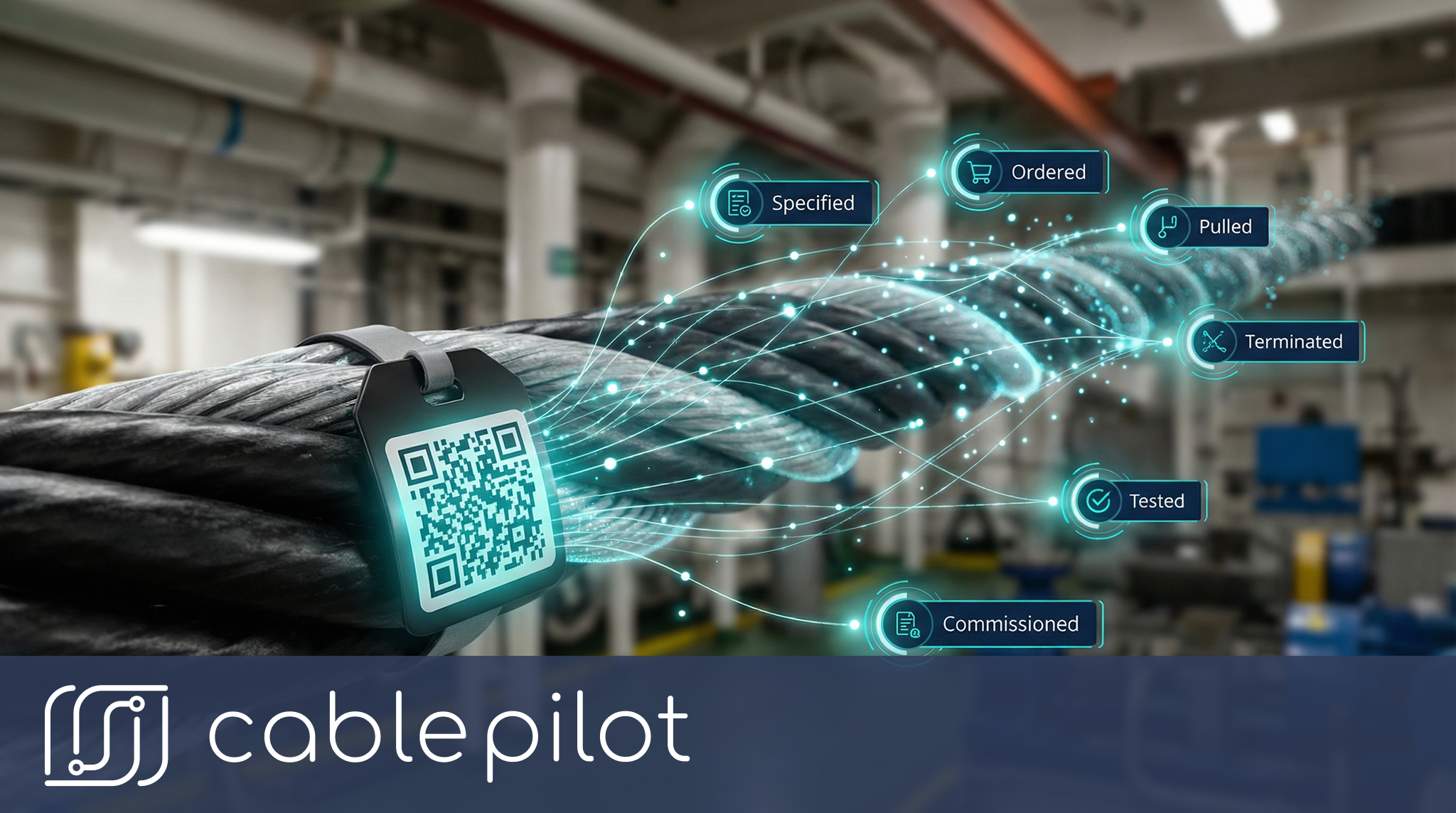
Mapping the Complete Cable Journey
Cable Pilot structures the full installation lifecycle as a series of gates, each representing a verified completion milestone:
Stage 1: Specification Approval Cables enter the system when designers import approved cable lists from design software or classification-approved drawings. Each entry contains technical specifications—cable type, cross-sectional area, voltage rating, termination details, routing path, and reference drawings. This import establishes the authoritative specification against which all subsequent work will be measured.
Stage 2: Pulling in Progress When pulling team receives the aggigned task to pull certain cables and grabs them in stock, cables get “Pulling” status with timestamp.
Stage 3: Cable Pulled As installation crews pull cables through trays and penetrations, foremen use smartphones to scan cable tags and mark cables “Pulled.” These scans can include route verification photos, pulled length correction, puller assignments, and completion timestamps. The platform automatically calculates pulling progress rates and highlights schedule deviations.
Stage 4: Testing Complete After pulling, quality inspectors perform insulation resistance tests, continuity checks, or bandwidth measurement depending on cable type and category. Cable Pilot captures test instrument readings, pass/fail status, inspector identity, and test date. Failed tests prevent advancement, triggering rework workflows.
Stage 5: Cable Terminated After successful testing, electricians terminate cable ends at connection points. Scanning the cable QR code advances it to “Connected” with final “Installed length” entry.
Stage 6: Checked After cable connection completed, quality inspectors perform check of fullfilling of norms and perform functionality tests. One more QR-code scan and cables are elevated to the “Checked” status with timestamp and inspector’s data, notes and photos attached.
Intelligent Automation and Flagging
Beyond simple status tracking, Cable Pilot applies business logic to detect problematic conditions and automatically flag issues requiring attention:
Readiness Flags: Before critical milestones—equipment startup, compartment handover, sea trials—the platform validates prerequisite completions. The system automatically checks conditions like “All Cables Terminated in Panel 3A” before allowing equipment commissioning to proceed, preventing false readiness claims.
Blocking Alerts: When teams reporting any peace of equipment, cable or location as “Blocked,” Cable Pilot generates warnings and notifications as wels as blcoks further workflow steps to prevent unproductive crew mobilization.

Practical Benefits Across Project Phases
Cable Pilot’s lifecycle management delivers tangible improvements at every project stage:
Design Phase: Establishing the Foundation
During engineering, Cable Pilot imports approved cable lists from design software, establishing the authoritative baseline. Cable Pilot’s intelligent import engine automatically maps columns, validates inteconnections and dependencies, and flags inconsistencies—reducing import preparation time by 70%.
Once imported, the platform enables designers to assign cables to installation zones, logical systems, and commissioning packages. These assignments flow automatically to all downstream users without manual redistribution of updated spreadsheets.
Installation Phase: Real-Time Progress Truth
During active installation, Cable Pilot transforms progress tracking from weekly estimation to continuous reality. Foremen issue smartphones to crew leaders who scan cables as pulling completes. These scans instantly update project dashboards visible to site managers, enabling real-time identification of productivity variations.
This automation freed coordinators to focus on resolving technical issues rather than compiling statistics.
The QR-code workflow also improves physical cable identification accuracy. In dense cable trays containing hundreds of runs, workers previously struggled to verify they were pulling correct cables. Scanning QR tags before pulling provides instant confirmation—the smartphone displays cable specifications, destination, and routing path, reducing mis-pulls by 85%.
Termination Phase: Quality Through Documentation
Termination quality directly impacts reliability, yet traditional tracking provides minimal termination verification beyond final inspections. Cable Pilot’s engine always save the full log of performed work, and delivers the latest connection diagrams and documents straight to the electrician’s hands.
During one commissioning fault investigation, engineers traced an intermittent connection to undertorqued terminals. Cable Pilot’s termination log instantly identified which electrician performed the work and when, enabling targeted retraining rather than wholesale rework of entire panels.
Testing Phase: Compliance Without Chaos
Testing generates massive data volumes—insulation resistance values, continuity checks, functional test results—that must be compiled into classification-compliant documentation. Traditional approaches involve inspectors recording measurements in notebooks, later transcribing them into Excel, and eventually formatting them for handover packages.
Cable Pilot eliminates transcription entirely. Inspectors enter test results directly into smartphones while standing at test points. The platform validates entries against specification limits—flagging failed tests immediately rather than days later during office review. This real-time validation enables same-shift rework resolution instead of expensive crew remobilization.
Test data automatically populates commissioning reports formatted to classification society requirements. One shipyard reported reducing commissioning documentation preparation time from 3 weeks to 2 days, enabling faster handover and earlier revenue recognition.
Commissioning Phase: Defensible Handover Documentation
Classification surveys and owner acceptance inspections require comprehensive documentation proving all work meets specifications. Assembling this documentation from fragmented Excel files, paper logs, and disconnected test records traditionally consumed weeks of coordinator time.
With Cable Pilot surveyors can trace any cable’s complete history—who installed it, when testing occurred, what results were recorded—providing defensible evidence of regulatory compliance.
Shipyards report 40% faster commissioning cycles attributed to Cable Pilot’s documentation capabilities. The platform eliminates the documentation-completion bottleneck that previously delayed handover despite physical work completion.
Scale Without Complexity: Managing Thousands of Cables
Small vessels might contain 2,000-5,000 cables; large commercial ships exceed 20,000; cruise ships and specialized vessels reach 50,000+. At these scales, manual tracking becomes impossible and traditional software performs poorly.
Cable Pilot’s architecture specifically addresses large-scale complexity:
Bulk Import Efficiency: The platform imports complete cable lists—tens of thousands of entries—in minutes. AI-powered validation detects specification inconsistencies, duplicate entries, and missing required fields during import, enabling immediate correction rather than discovering issues during installation.
Performance at Scale: Unlike Excel which slows dramatically above 10,000 rows, or databases that require extensive optimization, Cable Pilot maintains response times under 2 seconds for queries across 50,000+ cable datasets. Foremen can instantly filter cables by system, zone, status, or contractor without performance degradation.
Hierarchical Organization: The platform enables logical cable grouping—by ship zone, ship system, installation contractor, or categories—allowing teams to work within manageable subsets while maintaining overall project visibility.
Automated Progress Aggregation: Rather than manually summing installation status across thousands of cables, Cable Pilot automatically calculates completion percentages, productivity trends, and forecast completions at any aggregation level—entire ship, single deck, specific system, or individual contractor scope.
Real Project Impact: Transforming Electrical Installation Management
Quantitative results from shipyards implementing Cable Pilot’s lifecycle management demonstrate measurable transformation:
Rework Reduction: Projects tracking complete cable lifecycles report 10-15% reduction in electrical rework. Root-cause analysis attributes this improvement to earlier error detection enabled by mandatory milestone validation.
Commissioning Acceleration: Complete, real-time documentation enables 40% faster commissioning cycles. Classification surveyors spend less time requesting missing records and more time verifying technical compliance.
Administrative Efficiency: Project coordinators previously spending 10-15 hours weekly compiling cable status reports now generate equivalent reports in under 30 minutes through automated dashboards.
Dispute Resolution Speed: When installation disputes arise, Cable Pilot’s timestamped, role-attributed records enable resolution in days rather than weeks. One shipyard reported settling a $200,000 contractor dispute in 3 days using platform audit trails that definitively established timeline accountability.
Schedule Confidence: Real-time lifecycle visibility enables more accurate completion forecasting. Managers see exactly how many cables remain in each stage, current productivity rates, and projected completion dates—replacing optimistic guessing with data-driven scheduling.
One shipyard project manager described the transformation: “Before Cable Pilot, our electrical status meetings involved arguing about which Excel version was current and whether cables were actually installed or just marked installed. Now we look at real-time dashboards showing exactly what’s done, what’s tested, and what’s blocking commissioning. We cut meeting time by 50% and actually solve problems instead of debating data accuracy.”
Implementation Strategy: Moving from Excel to Lifecycle Management
Transitioning from Excel-based tracking to Cable Pilot’s lifecycle management requires thoughtful implementation:
Phase 1: Data Migration Begin by importing approved cable lists from design software or drawings. Cable Pilot’s import wizard handles various formats, validates specifications, and flags errors. Plan 1-2 days for initial import and validation on typical projects.
Phase 2: Workflow Configuration Define lifecycle stages matching your shipyard’s processes. Standard configurations work for most projects, but specialized vessels might require custom stages. Configure user roles—foremen, electricians, inspectors, commissioners—and assign permissions determining who can advance cables through stages.
Phase 3: Field Rollout Issue smartphones to foremen and crew leaders with pre-configured Cable Pilot apps. Conduct hands-on training focusing on QR-code scanning, photo attachment, and status updates. Initial adoption typically occurs within one week as crews experience workflow simplification.
Phase 4: Integration Activation Connect Cable Pilot to to project management platforms for coordinated scheduling. These integrations eliminate duplicate data entry and ensure lifecycle visibility reaches all stakeholders.
Phase 5: Continuous Improvement Use Cable Pilot’s analytics to identify improvement opportunities. Which lifecycle stages create bottlenecks? Where do testing failures concentrate? What error patterns recur? This data enables targeted process improvements impossible with fragmented Excel tracking.
Conclusion: From Documentation Burden to Competitive Advantage
Electrical cable installation in shipbuilding will always involve complexity—thousands of circuits, multiple contractors, stringent classification requirements, and demanding commissioning schedules. The question isn’t whether complexity exists, but how effectively shipyards manage it.
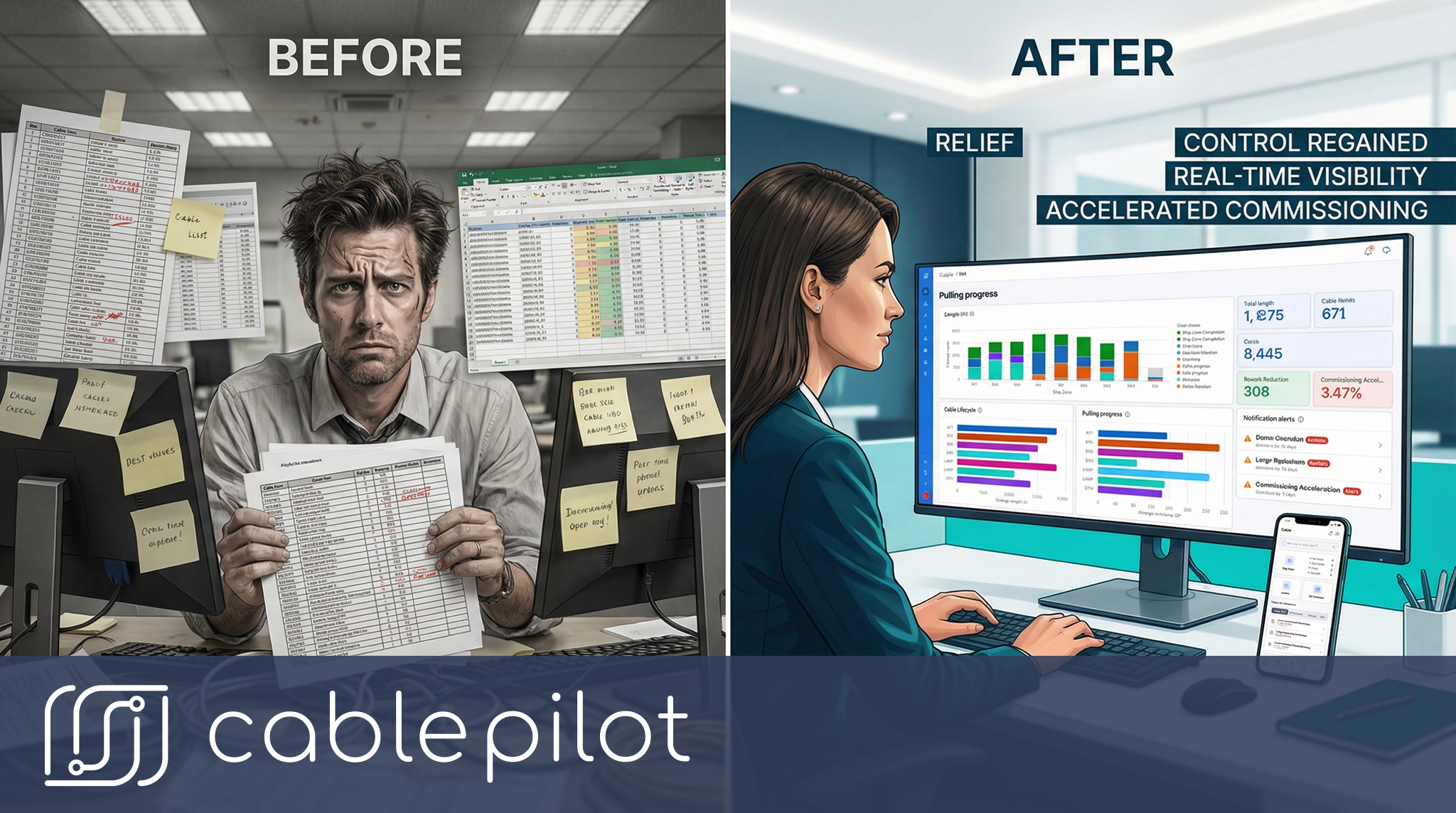
Traditional Excel-based tracking treats complexity as an inevitable burden to be endured through administrative labor and conservative scheduling. Cable Pilot reframes complexity as an opportunity for competitive advantage through superior lifecycle management.
By replacing fragmented spreadsheets with unified digital threads, Cable Pilot enables shipyards to achieve what traditional methods cannot: complete cable traceability from specification to commissioning, real-time visibility into installation status, automated compliance documentation, and defensible audit trails for quality disputes. These capabilities translate directly into measurable business outcomes—10-20% rework reduction, 40% faster commissioning, dramatically improved schedule confidence, and enhanced classification survey performance.
The shipyards achieving electrical installation excellence aren’t those with larger crews or longer schedules—they’re those who replaced Excel chaos with systematic lifecycle mastery. Cable Pilot provides the platform that makes this transformation achievable for shipyards of any size, on projects of any complexity.
For project managers, electrical supervisors, and shipyard executives seeking to eliminate cable tracking inefficiency, Cable Pilot offers more than software—it delivers a proven methodology for transforming electrical installation from a documentation nightmare into a competitive differentiator.
Transform your cable tracking from Excel chaos to lifecycle mastery. Contact Cable Pilot today to schedule a personalized demonstration showing how end-to-end cable lifecycle management can reduce rework, accelerate commissioning, and provide defensible documentation for your next shipbuilding project. Discover why leading shipyards worldwide are replacing spreadsheets with the platform purpose-built for maritime electrical installation excellence.