
Shipbuilding projects represent some of the most complex construction endeavors in modern engineering. With thousands of cables snaking through compartments, decks, and bulkheads—each requiring precise routing, installation, testing, and documentation—electrical installation stands as one of the most critical and challenging phases of vessel construction. Yet despite advances in digital technology, many shipyards still struggle with a persistent problem: the inability to see what’s actually happening on the vessel in real time.
Traditional approaches to shipbuilding monitoring rely on manual reporting, periodic walk-throughs, and paper-based documentation that arrives at the project office hours or even days after work is completed. This delayed visibility creates a cascade of problems: supervisors make decisions based on outdated information, quality issues go undetected until costly rework is required, bottleneck detection happens too late to prevent schedule slips, and coordinating multiple contractors becomes an exercise in reactive firefighting rather than proactive management.
Real-time dashboards are transforming this landscape. Cable Pilot’s analytics and Insights module delivers instant project visibility into every aspect of electrical installation, turning fragmented field data into actionable intelligence that empowers yard managers, project coordinators, and quality teams to make informed decisions the moment conditions change. This comprehensive guide explores how Cable Pilot’s dashboard technology revolutionizes shipbuilding project monitoring, enabling yards to achieve unprecedented levels of control, efficiency, and quality assurance.
The Data Chaos Challenge in Modern Shipbuilding
Before examining the solution, it’s essential to understand the magnitude of the challenge facing shipbuilders today. A typical commercial vessel or naval ship contains anywhere from 3,000 to over 100,000 individual cables, each with its own specifications, routing requirements, installation sequence, and testing protocols. Multiple contractors—often working simultaneously across different zones, decks, and systems—execute this work over months or years.
Why Traditional Monitoring Falls Short
Conventional project management tools were designed for office environments, not the harsh realities of shipyard electrical installation. Spreadsheets become outdated the moment they’re saved. Static reports represent snapshots that age rapidly in fast-moving construction environments. Paper-based systems create information silos where field teams, supervisors, quality inspectors, and project managers all maintain separate records that rarely synchronize.
The consequences are tangible and expensive. Without real-time visibility into installation workflows, supervisors waste hours walking the vessel to gather status updates manually. Bottlenecks—such as a contractor waiting for cable delivery or a congested routing path blocking progress—remain hidden until they’ve already delayed the schedule. Quality issues like incorrect cable installations or missing tests surface during final commissioning when correction costs multiply exponentially.
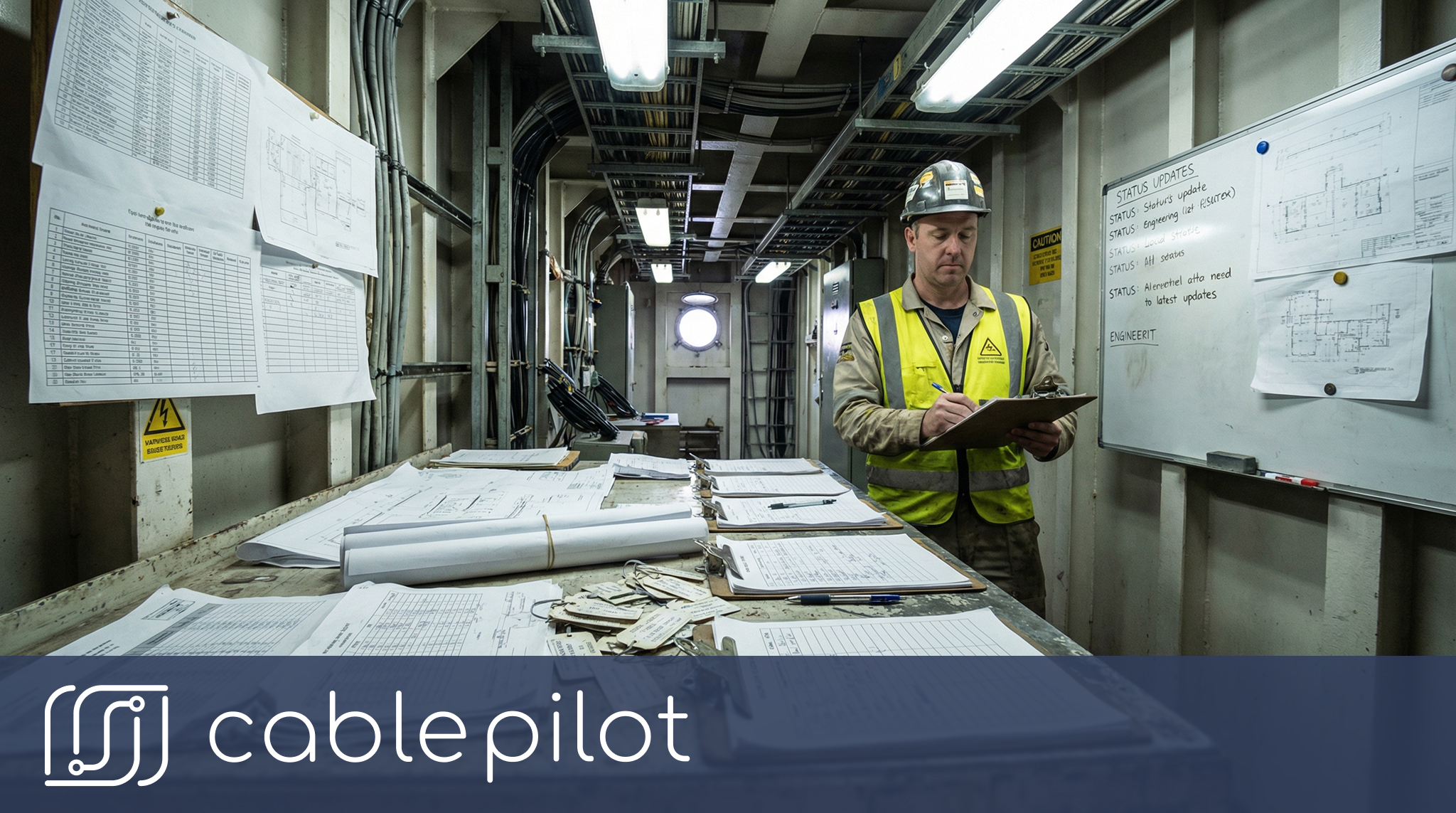
Data integration becomes nearly impossible when information exists in dozens of formats across multiple systems and teams. The cable list maintained by engineering, the installation records kept by contractors, the test results recorded by quality teams, and the progress reports compiled by project managers often contradict each other, creating confusion and eroding trust in project data.
Cable Pilot’s Solution: From Field Scan to Dashboard Insight
Cable Pilot fundamentally reimagines how electrical installation data flows from the vessel to decision-makers. The platform’s architecture creates a seamless connection between field execution and office visibility, built on three core components:
The QR Code Foundation
Every cable and equipment piece in the project receives a unique QR code label generated automatically from the cable list. These labels—printed and affixed to cables during preparation—become permanent identification tags that link physical cables to their digital records throughout the entire installation lifecycle.
Smartphone-Powered Field Data Capture
Rather than requiring specialized hardware or complex data entry, Cable Pilot enables electricians and installers to update cable status instantly using smartphones. A simple 1-Click QR scan captures the cable identity, timestamp, location, and user information, then transmits this data to the central platform in real time.
When an electrician pulls a cable through a routing path, they scan the QR code and tap “Pulled.” When testing is completed, another scan records “Tested.” When final connections are made, a scan marks “Connected.” Each interaction takes seconds but creates a permanent, timestamped record that feeds directly into the Insights module.
The Insights Module: Transforming Scans into Actionable Intelligence
This is where Cable Pilot’s real-time dashboards deliver their transformative value. Every field scan immediately updates the central database, and the Insights module processes this information to generate dynamic, interactive visualizations that reveal project status across multiple dimensions.
Key Dashboard Features That Empower Proactive Management
Cable Pilot’s dashboards are specifically designed for shipbuilding project monitoring, addressing the unique requirements of coordinating electrical installation across complex vessels.
Multi-Dimensional Progress Tracking
The platform displays installation progress simultaneously across several critical dimensions:
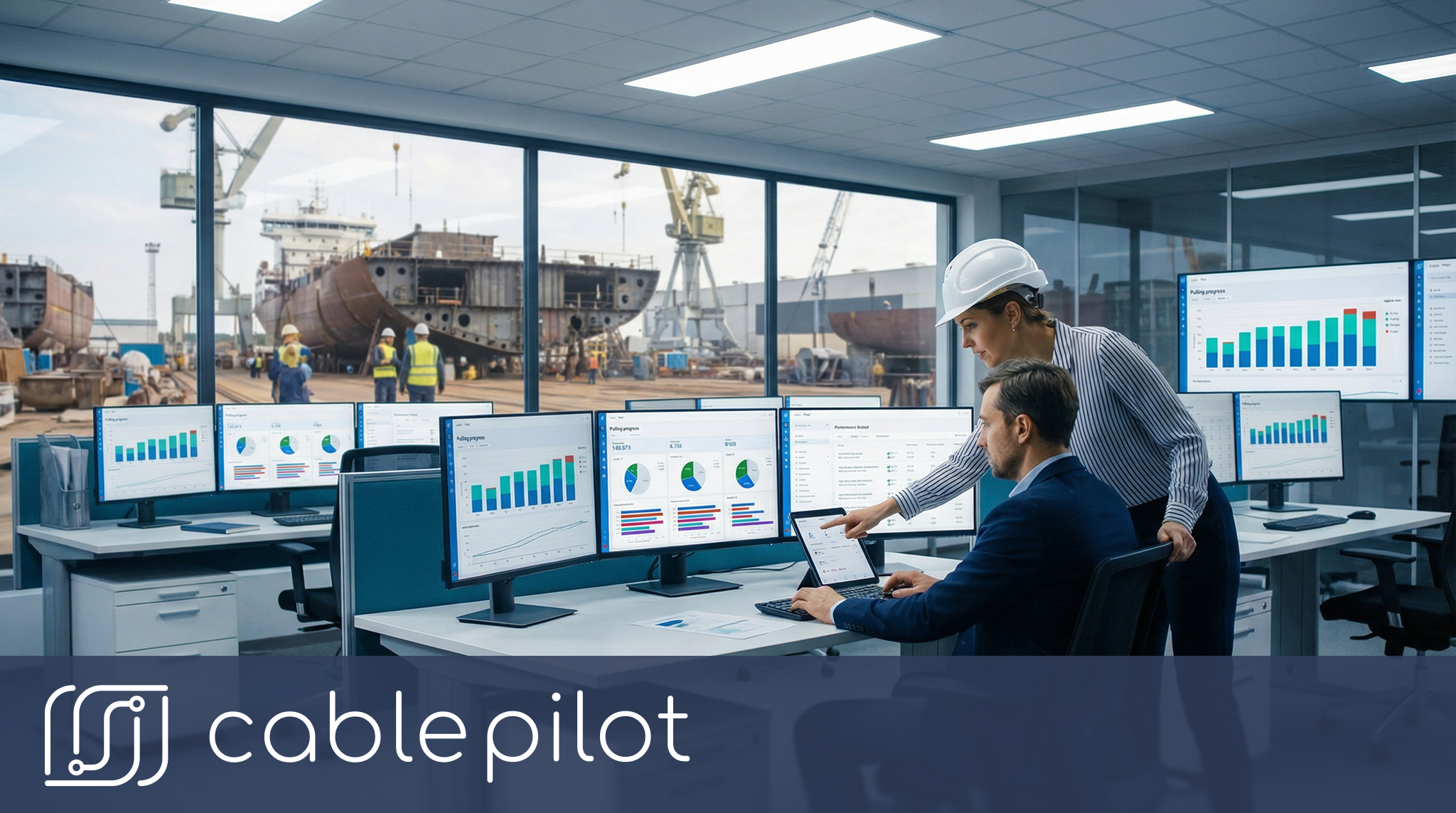
Progress by area shows completion status for each zone, deck, or compartment, enabling supervisors to identify which sections are on schedule and which require attention. Color-coded visual indicators make patterns immediately apparent.
Progress by system reveals how electrical, instrumentation, communication, machinery and other systems are advancing independently. This view proves invaluable when different engineering departments need visibility into their specific systems, or when commissioning teams need to verify that critical systems are ready for testing.
Progress by contractor provides transparent performance visibility when multiple subcontractors execute parallel work packages. Project managers can instantly compare contractor productivity, identify teams that may need additional resources or support, and ensure equitable workload distribution.
Status Indicators Across Installation Phases
Cable Pilot tracks cables through distinct phases—pulling, testing, and connecting—with dedicated status indicators for each stage. These granular markers enable quality assurance teams to verify that proper sequences are followed, ensuring cables aren’t tested before pulling is confirmed or marked complete before testing is documented.
Interactive charts present this multi-phase data visually. A stacked bar chart might show that Area 12 has 85% of cables pulled, but only 40% tested and 25% connected, immediately signaling where resources should be allocated to maintain balanced workflow progression.
Drill-Down Reporting for Root Cause Analysis
While high-level dashboards provide essential overview visibility, Cable Pilot’s analytics enable users to drill down from summary statistics to individual cable details. If a dashboard shows that System 4 is lagging behind schedule, managers can click through to see exactly which cables remain incomplete, who is assigned to them, when they were last scanned, and what obstacles might be delaying progress.
This capability transforms bottleneck detection from a guessing game into a data-driven process. Instead of assuming why work is delayed, supervisors access concrete information: specific cables, actual status, assigned personnel, and historical activity patterns that reveal the true causes of slowdowns.
Historical Log and Audit Trail
Every QR scan creates a permanent record including the cable identifier, status change, timestamp, user identity, and device location. This comprehensive audit trail serves multiple critical functions beyond real-time monitoring.
Troubleshooting scenario: During commissioning, a cable fails continuity testing. Rather than physically tracing the entire cable route looking for damage, the quality engineer opens the cable’s history in Cable Pilot. The log shows it was pulled on March 15 by Contractor A, tested on March 18 with passing results by the QA team, and connected on March 22 by Contractor B. This timeline immediately focuses investigation on recent connection work rather than the pulling or routing phases.
Compliance verification: For vessels requiring detailed documentation for classification societies or military specifications, Cable Pilot’s historical logs provide irrefutable evidence that proper installation sequences were followed, qualified personnel performed work, and required testing was completed with documented results.
Dispute resolution: When questions arise about contractor performance or work scope, the timestamped scan records provide objective evidence of who completed what work and when, eliminating ambiguity and supporting fair resolution.
Real-World Benefits: How Dashboards Drive ROI
The transition from delayed, fragmented information to real-time project visibility delivers measurable value across multiple operational dimensions.
Reduced Supervision Burden
Before implementing Cable Pilot’s dashboards, supervisors at modern shipyards typically spend 30-50% of their time physically walking vessels to gather status information, verify work completion, and update project records. This time-intensive process not only reduces supervisor availability for problem-solving and team support but also produces information that’s already outdated by the time it reaches decision-makers.
With real-time dashboards providing instant visibility from any location, supervision becomes more strategic and less administrative. Supervisors access current status from their office, the planning room, or even remote locations, then focus their vessel visits on areas where dashboard data indicates issues requiring personal attention. This shift from comprehensive data gathering to targeted intervention can reduce supervision time by 40-60% while actually improving oversight quality.
Faster Bottleneck Resolution
When bottleneck detection happens in real time rather than days later, intervention costs drop dramatically. Cable Pilot’s dashboards make slowdowns visible the moment they begin to emerge, enabling immediate corrective action.
Example: Dashboard analytics reveal that Contractor C’s installation rate in Zone 7 has dropped 60% over the past three days compared to their previous performance. The project manager immediately investigates and discovers that a cable delivery expected last week hasn’t arrived, leaving the team idle. A phone call to the warehouse confirms the shipment is sitting in receiving, awaiting inspection. The bottleneck is resolved within hours rather than festering for days or weeks until the schedule impact becomes critical.
This proactive approach to contractor coordination prevents minor issues from cascading into major delays. The financial impact is substantial—each day of avoided delay saves direct labor costs, reduces overhead, and protects schedule contingency buffers for truly unexpected problems.
Enhanced Quality Assurance and First-Time Yield
Quality assurance in electrical installation traditionally relies on periodic inspections that sample a percentage of completed work. This approach inevitably misses some defects, which then propagate through subsequent installation phases until they’re discovered during testing or commissioning when correction costs are highest.
Cable Pilot’s dashboards enable continuous quality monitoring by making anomalies immediately visible. If cables are being marked “Connected” without first showing “Tested” status, the dashboard highlights this sequence violation in real time, allowing quality teams to intervene before dozens or hundreds of cables are incorrectly installed.
Visual indicators also reveal patterns suggesting systemic quality issues. If a particular contractor shows unusually high rates of cables returning to “Pulled” status after being marked “Connected”—indicating rework—this pattern triggers investigation into whether improper techniques or inadequate training are creating preventable defects.
Higher first-time yield—the percentage of cables installed correctly without requiring rework—directly impacts project profitability. Industry studies consistently show that preventing defects costs 5-10 times less than correcting them after installation. By enabling early detection and intervention, Cable Pilot’s project visibility tools drive measurable improvements in first-time yield that translate to substantial cost savings.
Improved Cross-Functional Communication
Shipbuilding projects involve dozens of stakeholders: engineering teams who design systems, project managers who coordinate schedules, procurement specialists who ensure material availability, quality inspectors who verify compliance, and contractor personnel who execute the work. Each group needs different views of project status but benefits from working from a single source of truth.
Cable Pilot’s configurable dashboards provide role-specific views of shared data. Engineers focus on progress by system and can verify that design changes are being implemented correctly. Project managers monitor overall completion percentages and schedule adherence across zones. Quality teams examine testing compliance and sequence verification. Contractor supervisors track their team’s productivity and identify obstacles requiring yard support.
This unified data integration eliminates the confusion and conflict that arise when different teams work from incompatible datasets. Everyone sees the same underlying reality, presented in the format most relevant to their responsibilities, fostering collaboration rather than finger-pointing.

Data-Driven Planning and Continuous Improvement
Beyond managing current projects, Cable Pilot’s analytics create a valuable knowledge base for improving future performance. Historical data reveals which installation workflows proved most efficient, which contractors consistently delivered superior performance, which vessel areas presented unexpected challenges, and how actual installation rates compared to estimates.
This intelligence supports more accurate planning for subsequent vessels. If dashboard analysis shows that cable pulling in engine rooms consistently took 40% longer than comparable work in accommodation spaces—likely due to congestion, heat, and access challenges—estimators can adjust future schedules to reflect this reality rather than assuming uniform productivity across all areas.
Continuous improvement initiatives also benefit from objective performance data. When yards implement new installation techniques, revised workflows, or enhanced training programs, dashboard analytics provide measurable before-and-after comparisons that quantify improvement and justify investment.
Implementing Dashboard-Driven Monitoring: Practical Considerations
Realizing the full potential of Cable Pilot’s real-time dashboards requires thoughtful implementation that addresses both technical and organizational factors.
Ensuring Field Adoption
The value of dashboards depends entirely on the quality and timeliness of field data. If electricians don’t consistently scan cables and equipment as work is completed, dashboards will show inaccurate information that undermines trust in the system.
Successful yards approach this through a combination of training, workflow integration, and accountability. Training emphasizes that scanning takes seconds and eliminates duplicate manual paperwork, making it a time-saver rather than additional burden. Workflows are designed so scanning naturally fits into work sequences—for example, scanning occurs when retrieving cables from staging areas, making it a natural part of job preparation rather than a separate administrative task.
Accountability comes from supervisors using dashboard data daily for planning and coordination. When field teams see that supervisors rely on scan data for resource allocation and recognize productive performance visible in the analytics, scanning quickly becomes standard practice rather than optional compliance.
Configuring Meaningful KPIs
Cable Pilot’s dashboards can display dozens of metrics, but effective shipbuilding monitoring requires focusing on the key performance indicators most relevant to project goals. Common KPIs include:
- Overall completion percentage tracking cables completed through all phases versus total project scope
- Installation rate trends showing cables completed per day or week, with trend lines indicating acceleration or slowdown
- Contractor performance comparisons measuring productivity rates across teams to ensure equitable expectations and identify top performers
- Rework percentage tracking cables that revert to earlier status indicators, suggesting quality issues
- Schedule variance comparing actual progress to planned milestones across areas and systems
Effective dashboards present these KPIs with visual clarity—charts, graphs, and color-coded indicators that make patterns immediately apparent even to stakeholders who aren’t data analysts.
Balancing Detail and Usability
Dashboard design involves constant tension between comprehensive detail and intuitive usability. While analysts may appreciate screens packed with numerical data and complex multi-variable charts, field supervisors and executives typically prefer simplified views that answer key questions at a glance.
Cable Pilot addresses this through layered information architecture. Summary dashboards provide high-level status suitable for executive briefings and quick status checks. A single screen might show overall completion percentage, progress by major area, and current installation rate trend—enough to answer “Are we on track?” without overwhelming detail.
Users who need deeper analysis can drill down through successive layers: from overall progress to area-specific status, then to system-level detail within that area, and finally to individual cable lists with complete historical logs. This progressive disclosure ensures that information is available when needed without cluttering primary views.
Integration with Existing Project Systems
Most shipyards already use enterprise resource planning systems, project management software, and engineering data management platforms. Cable Pilot’s data integration capabilities enable the platform to complement rather than replace these existing investments.
The platform can import cable lists from engineering databases, eliminating duplicate data entry. Status updates can be exported to project management systems, ensuring schedule dashboards reflect actual field progress. Quality records can feed into compliance management systems, maintaining required documentation without parallel record-keeping.
This integration creates a unified digital ecosystem where Cable Pilot serves as the specialized electrical installation execution and monitoring tool, while sharing data bidirectionally with broader yard management systems.
The Competitive Advantage of Real-Time Visibility
In today’s competitive shipbuilding environment, where contracts are won or lost on slim margins and delivery delays trigger substantial penalties, operational excellence isn’t optional—it’s existential. Yards that can consistently deliver quality vessels on schedule and within budget win repeat business and build reputations that support premium pricing. Those that struggle with cost overruns, schedule slips, and quality issues face existential threats.
Real-time dashboards and the project visibility they enable represent a fundamental competitive advantage. Yards using Cable Pilot’s analytics complete electrical installation faster, with higher quality, and at lower cost than competitors relying on traditional monitoring approaches. These improvements compound across multiple vessels, creating sustained competitive differentiation.
Beyond the immediate project benefits, real-time monitoring capabilities increasingly influence customer purchasing decisions. Sophisticated vessel owners and naval procurement agencies recognize that yards with advanced digital project management tools carry less execution risk. During bid evaluation, the ability to demonstrate comprehensive installation workflows monitoring through platforms like Cable Pilot can provide the credibility that tips close competitions.
Conclusion: From Data Chaos to Confident Control
The transformation Cable Pilot’s dashboards enable extends far beyond technology adoption. It represents a fundamental shift from reactive firefighting to proactive project management, from fragmented information silos to integrated data intelligence, and from delayed visibility to real-time control.
When every cable or equipment scan instantly updates central dashboards accessible to all stakeholders, the entire project ecosystem becomes more transparent, collaborative, and efficient. Supervisors make better decisions based on current information. Quality teams catch issues before they cascade into expensive problems. Project managers detect and resolve bottlenecks while schedule contingencies remain intact. Contractors receive clearer expectations and faster support when obstacles arise.
The quantifiable benefits—reduced supervision time, faster bottleneck resolution, higher first-time yield, and improved schedule performance—deliver compelling return on investment. But perhaps equally valuable is the intangible shift in project confidence. Teams operating with comprehensive real-time insights into installation status approach challenges with data-driven certainty rather than educated guesses. This confidence permeates decision-making at every level, from daily work planning to strategic resource allocation.
For shipbuilders committed to operational excellence, Cable Pilot’s dashboard technology offers a clear path forward. The platform transforms the chaos of fragmented installation data into the clarity of unified project visibility, enabling the level of control that complex shipbuilding projects demand.
Experience the Power of Real-Time Project Visibility
Seeing is believing. While descriptions and examples illustrate Cable Pilot’s dashboard capabilities, experiencing the platform’s intuitive interface and powerful analytics firsthand provides the clearest picture of how it will transform your project monitoring.
We invite shipyard project managers, planning coordinators, quality directors, and operations leaders to schedule a personalized demonstration. Our team will configure dashboards showing exactly how Cable Pilot delivers real-time insights for your specific environment.
Contact Cable Pilot today to arrange your demonstration and take the first step toward revolutionizing your electrical installation monitoring with dashboards that turn data into decisive competitive advantage.