
Modern shipbuilding electrical projects generate thousands of data points across dozens of systems—cable lists in Excel, equipment specifications in PDFs, installation drawings in CAD, test records on paper forms, and change notices buried in email threads. This fragmentation creates a persistent problem: when critical information exists in multiple places without automatic synchronization, teams inevitably work from outdated data. The result is costly rework, delayed handovers, and documentation packages that require hundreds of person-hours to compile manually at project end.
Cable Pilot’s digital twin asset management architecture solves this fundamental challenge by transforming every cable, equipment item, and connection into a persistent, intelligent digital object within a unified platform. This single source of truth approach eliminates version conflicts, enables real-time electrical visibility across all project stakeholders, and compresses commissioning documentation cycles from weeks to days. For project managers overseeing multi-contractor installations, shipyard superintendents coordinating parallel work fronts, and classification surveyors verifying compliance, Cable Pilot replaces manual data reconciliation with automated, audit-ready intelligence.
This article explores how Cable Pilot’s digital twin architecture addresses the root causes of documentation chaos, examines the technical mechanisms that maintain data integrity throughout the installation lifecycle, and quantifies the handover acceleration benefits realized by forward-thinking shipyards and system integrators.
The Hidden Cost of Fragmented Electrical Documentation
Traditional electrical installation workflows distribute project data across multiple disconnected systems. Engineering teams maintain master cable lists in enterprise resource planning platforms or specialized electrical design software. Drawing offices issue installation diagrams through document control systems that version PDFs but don’t link content to physical assets. Installation supervisors track daily progress in site-specific spreadsheets. Quality inspectors record test results on paper forms that later require manual transcription. When design changes occur—a cable route modification, equipment relocation, or specification update—the change propagates through formal revision processes in some systems but not others.
This fragmentation creates predictable failure modes. Installers working from a superseded drawing waste labor pulling cables along an obsolete route, then must re-pull after discovering the conflict. Procurement orders materials based on an outdated specification, resulting in non-conforming parts that delay installation. Inspectors test cables that were subsequently deleted from scope, while actual installed cables remain unverified. Each mismatch consumes labor hours in detection, communication, and correction.
Industry experience confirms that these tracking failures directly cause ten to twenty percent of all electrical installation labor to be rework addressing information mismatches rather than productive first-time installation. At project handover, the accumulated documentation gaps force engineering teams into marathon reconciliation efforts, manually comparing cable lists against as-built drawings, cross-referencing test records to verify coverage, and compiling reports that classification societies and ship operators demand. These compilation efforts typically consume two hundred to four hundred person-hours per vessel, compressing the critical commissioning window and often delaying delivery.
The fundamental problem is architectural: when the same information exists in multiple places without automatic synchronization, those sources inevitably diverge over time, and no single location can be trusted as authoritative. Cable installation traceability breaks down not because individual systems fail, but because the integration between systems relies on manual human intervention that cannot scale to match the volume and velocity of changes in a dynamic shipbuilding environment.
Digital Twin Architecture: Every Cable as an Intelligent Object
Cable Pilot’s digital twin approach reimagines the electrical installation dataset not as a collection of documents and spreadsheets, but as a unified graph of interconnected digital objects, where each physical asset—cable, equipment item, junction box, penetration—exists as a single persistent entity with complete lifecycle metadata. This architectural shift creates a true single source of truth where updates made anywhere in the system immediately propagate to all views and reports.
At the core of this architecture is the concept of the intelligent cable object. Unlike a spreadsheet row that simply lists attributes in adjacent columns, each cable in Cable Pilot is a structured data entity that encapsulates:
- Physical specifications: Cable type, length, cross-section, insulation class, fire rating, and all technical parameters defined during engineering
- Spatial relationships: Origin and destination equipment, routing path through compartments, intermediate junction points, and deck penetrations
- Installation parameters: Installation method (tray, conduit, free routing), bending radius requirements, segregation class, and environmental constraints
- Lifecycle state: Current installation status (planned, in progress, pulled, terminated, tested, commissioned), responsible contractor, completion dates, and quality holds
- Documentation links: Direct references to applicable drawings (with specific revision), specifications, test procedures, inspection records, and change notices
- Audit trail: Complete history of every status change, field update, test result, photo attachment, and note, timestamped and attributed to specific users
This rich object model enables Cable Pilot to answer questions that are impossible in document-based systems. “Show me all cables on drawing E-1234 Rev C that are terminated at Panel A but not yet tested” becomes a simple filtered view rather than a manual cross-reference exercise across multiple spreadsheets. “Which cables are affected by change notice CN-087 and what is their current installation status?” returns instant, accurate results because change notices link directly to affected cable objects, and those objects carry real-time status from the field.
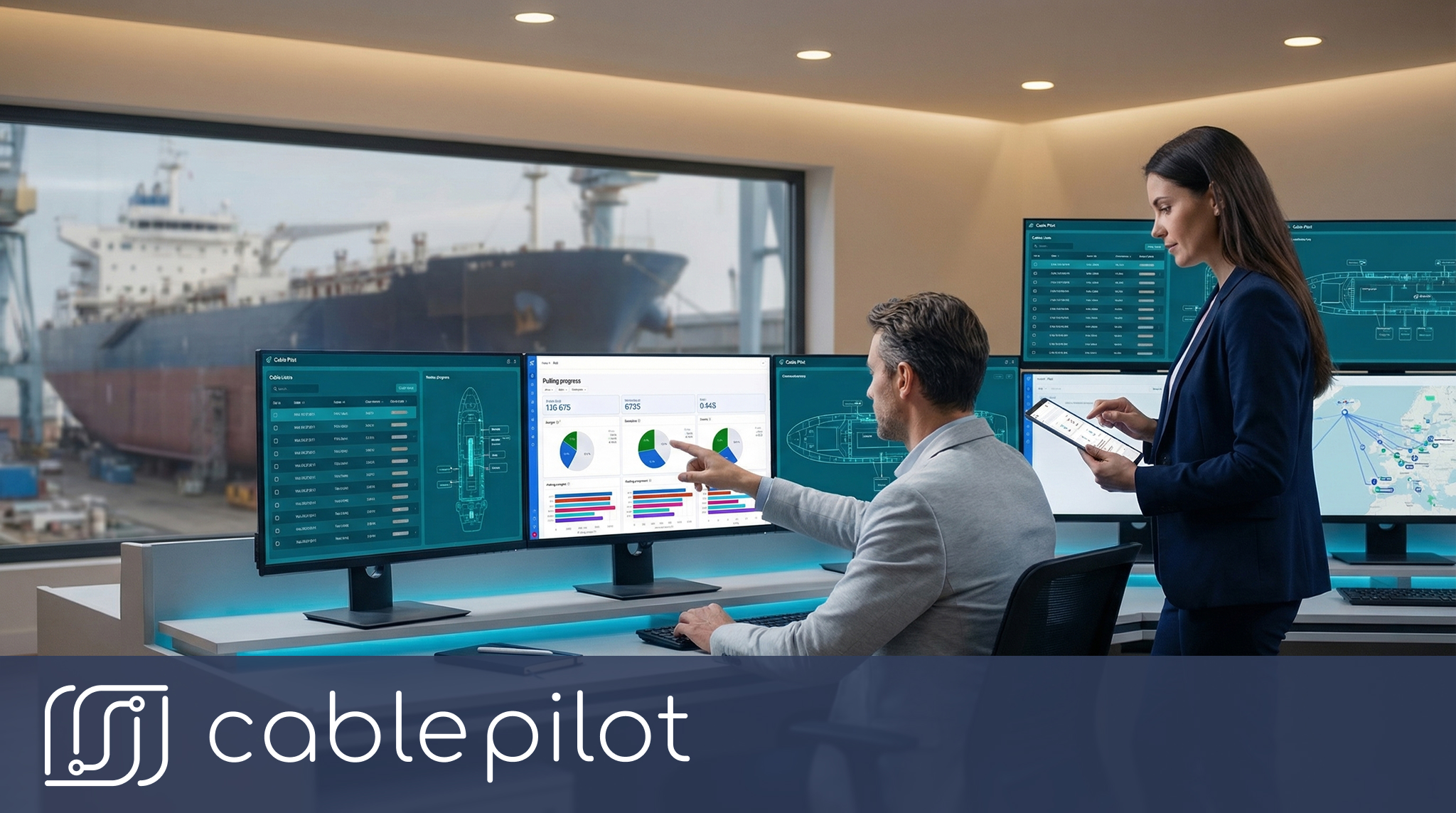
Equipment items receive equivalent treatment as intelligent objects with complete attribute sets, relationship maps, and audit trails. This allows Cable Pilot to display bidirectional connectivity—not just “where does this cable go?” but also “what cables are connected to this panel?” and “which uninstalled cables will I need when I’m ready to terminate this equipment?”
The vessel hierarchy—ship sections, decks, compartments—forms the spatial framework within which cables and equipment are positioned. This hierarchical organization enables filtered views scoped to specific work zones, supports multi-contractor access control based on physical boundaries, and facilitates progress tracking by location for earned value reporting.
AI-Powered Data Import: From Legacy Spreadsheets to Intelligent Objects
Most electrical installation projects begin with legacy data—cable lists generated by electrical design software and exported to Excel, equipment inventories maintained in ERP systems, or even historical project data from similar vessels. Manually recreating this information as digital twin objects would impose an unacceptable startup burden, potentially requiring weeks of data entry for large projects with ten thousand or more cables.
Cable Pilot’s AI-powered data import capabilities solve this cold-start problem by ingesting legacy Excel cable lists and rapidly transforming tabular data into structured digital objects. The import process employs intelligent mapping that recognizes common cable list structures, matching spreadsheet columns to Cable Pilot’s object fields based on header text, data patterns, and semantic analysis.
During import, the tool performs multiple validation and enrichment operations:
- Missing data detection: Identifies cables with incomplete specifications, undefined equipment references, or missing routing information, flagging these records for completion by field teams
- Hierarchy construction: Parses equipment identifiers and cable naming conventions to automatically construct the vessel compartment hierarchy and position cables within spatial zones
- Relationship inference: Analyzes origin and destination fields to establish equipment-to-cable connectivity, enabling instant “show all cables connected to this panel” queries immediately after import
- Duplicate detection: Identifies potential duplicate entries based on cable identifiers, preventing the creation of multiple objects for the same physical asset
- Consistency validation: Cross-checks cable specifications against equipment connection types, warns about mismatches (e.g., three-phase power cable with incorrect core count), and suggests corrections
Import results are presented in a detailed report showing successful object creation, validation warnings, and error records requiring manual review. This transparent, auditable import process gives project managers confidence that the digital twin accurately reflects engineering intent while highlighting areas requiring attention before installation begins.
For projects with existing Cable Pilot histories—refit work, series vessels, or follow-on phases—the platform can leverage historical object libraries, facilitating the transfer of installation notes, routing details, and lessons learned from previous installations of identical cable types. This organizational learning capability dramatically reduces rework on repeat projects.
Automated Drawing Synchronization: Eliminating “Which Revision?” Confusion
Installation drawings are living documents, revised frequently as design matures, procurement constraints drive substitutions, and field conditions necessitate routing adjustments. In traditional document-control workflows, each revision triggers a formal distribution process: drawings are issued through a document management system, revision notices are emailed to stakeholders, and teams are expected to replace superseded drawings with current versions.
Automated drawing synchronization in Cable Pilot eliminates these version conflicts by treating drawings not as standalone documents, but as visual representations linked to the underlying cable and equipment objects. When a new drawing is uploaded to Cable Pilot, the platform:
- Links the drawing to affected objects: AI-based PDF drawing indexing parses files to identify cable tags and equipment identifiers, creating direct associations between the document and the specific digital twin objects.
- Simplifies navigation: Finding the corresponding pages in the linked drawings is reduced to a single click directly from the cable or equipment profile.
- Notifies affected users: Teams with assigned work on cables shown in the updated drawing receive real-time notifications alerting them to the revision.
- Maintains a clear history: Previous drawing versions and associated updates are managed through robust change tracking.
- Flags potential issues: Through delays and blocker tracking tools, supervisors can review and flag potential conflicts between as-designed and as-built states.
This version control automation transforms drawing management from a compliance burden into a value-generating capability.
Mobile Field Truth: Capturing Reality at the Point of Work
The greatest threat to any single source of truth is the gap between digital records and physical reality. If field conditions change but digital records remain static, the “source of truth” becomes unreliable.
Cable Pilot’s mobile field application closes this gap by making the digital twin immediately updateable at the point of work using smartphones.
QR Code Asset Linking
Each cable and equipment item in Cable Pilot can generate a unique QR code. Scanning a cable tag opens that cable’s digital twin page with specifications, routing instructions, and drawings. Installers update status through simple taps such as pulling, pulled, or terminated, and updates become instantly visible across the platform.
Photo Documentation
Smartphone cameras capture installation evidence—routing conditions, termination configurations, or damage—and attach photos directly to cable objects. These images support inspection and compliance documentation.
Test Data Entry
Inspectors enter insulation resistance, continuity, or high-voltage test results directly through mobile forms, eliminating transcription from paper records.
Issues Reporting
When field conditions differ from engineering design, installers record the issue through the issues reporting tool, attaching photos and linking it to affected cables.
Voice Notes and Annotations
Installers can attach voice notes or text annotations capturing routing tips, access constraints, or coordination insights that help future crews.
Multi-Contractor Coordination: Scoped Visibility Without Commercial Exposure
Large shipbuilding projects involve multiple contractors installing interconnected systems simultaneously. Cable Pilot enables granular permission scoping based on system, location, or cable type.
Typical configuration examples:
- Hull contractor: Full access to structural penetrations and distribution cables; read-only visibility of equipment terminals.
- System integrator: Full access to cables within their system scope; read-only visibility of shared infrastructure.
- Shipyard superintendent: Full read access across all contractor work and shared infrastructure.
- Classification surveyor: Read-only access to cable data and test records with the ability to add inspection notes.
Dependency tracking allows teams to mark prerequisites and automatically notify dependent teams when tasks complete.
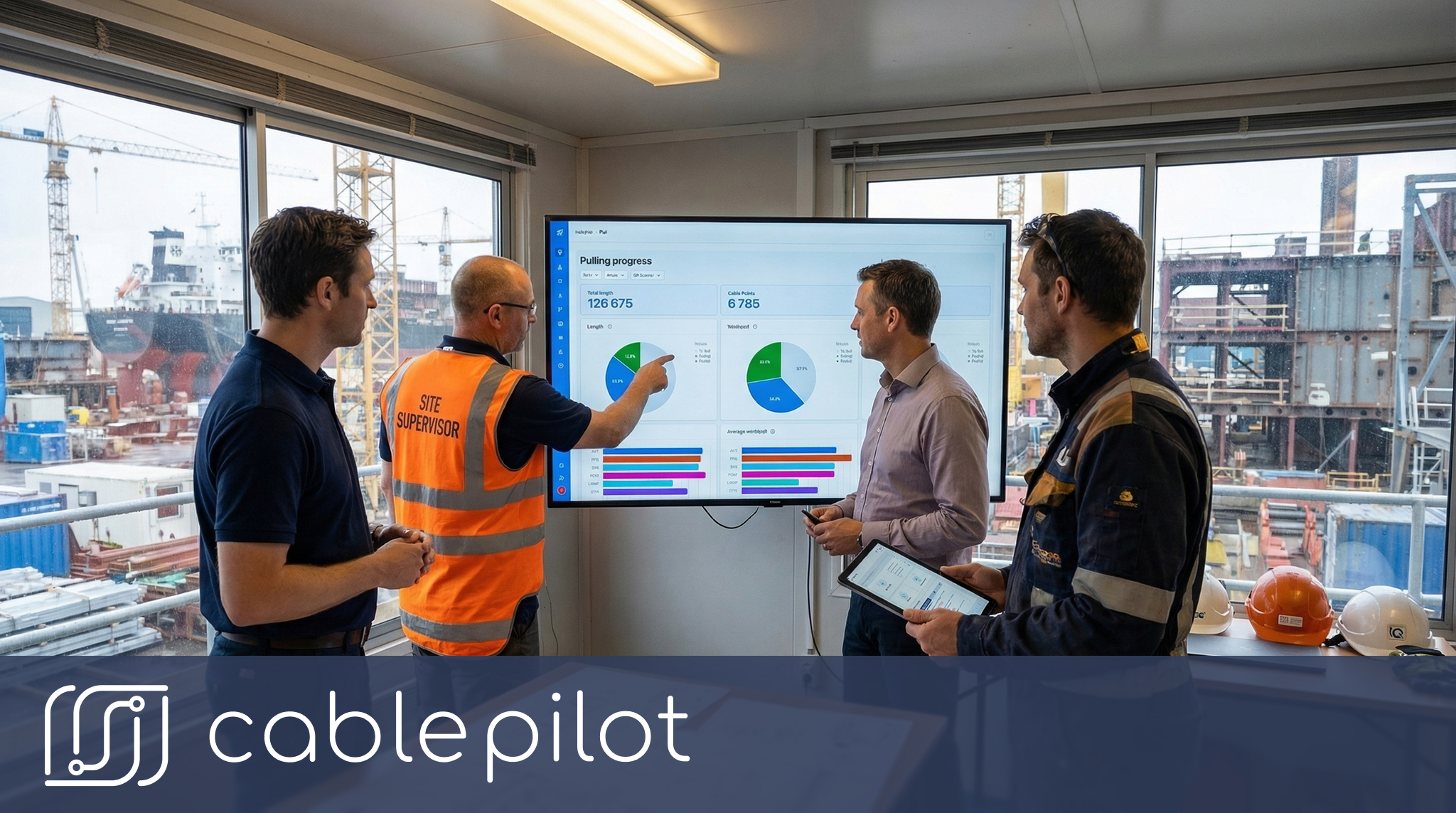
Handover Acceleration: From Weeks of Compilation to One-Click Reports
Traditional handover documentation requires manual compilation of cable lists, test records, drawings, and compliance evidence—often consuming hundreds of engineering hours.
Cable Pilot’s installation handover acceleration replaces this effort with automated report generation.
Automated Classification Reports
Customizable report templates support major classification society requirements such as DNV, Lloyd’s Register, ABS, and BV.
Reports can include:
- Complete cable lists with specifications and installation dates
- Test result summaries with coverage statistics
- As-installed equipment inventories
- Drawing registers with final revisions
- Change notice logs
- Photographic installation evidence
Progressive Handover Packages
Instead of waiting until project completion, teams can generate subsystem documentation packages as systems finish installation and testing.
Owner Operator Deliverables
Cable Pilot can export operational documentation compatible with computerized maintenance management systems (CMMS), allowing the digital twin to extend into vessel operations.
Audit Trail Transparency
Complete timestamped histories provide traceability for high-compliance projects such as naval vessels or offshore installations.
ROI: Quantifying Digital Twin Value
The return on investment from Cable Pilot derives from several value streams.
Eliminated Rework
Synchronized data reduces the 10–20% installation rework commonly caused by information mismatches.
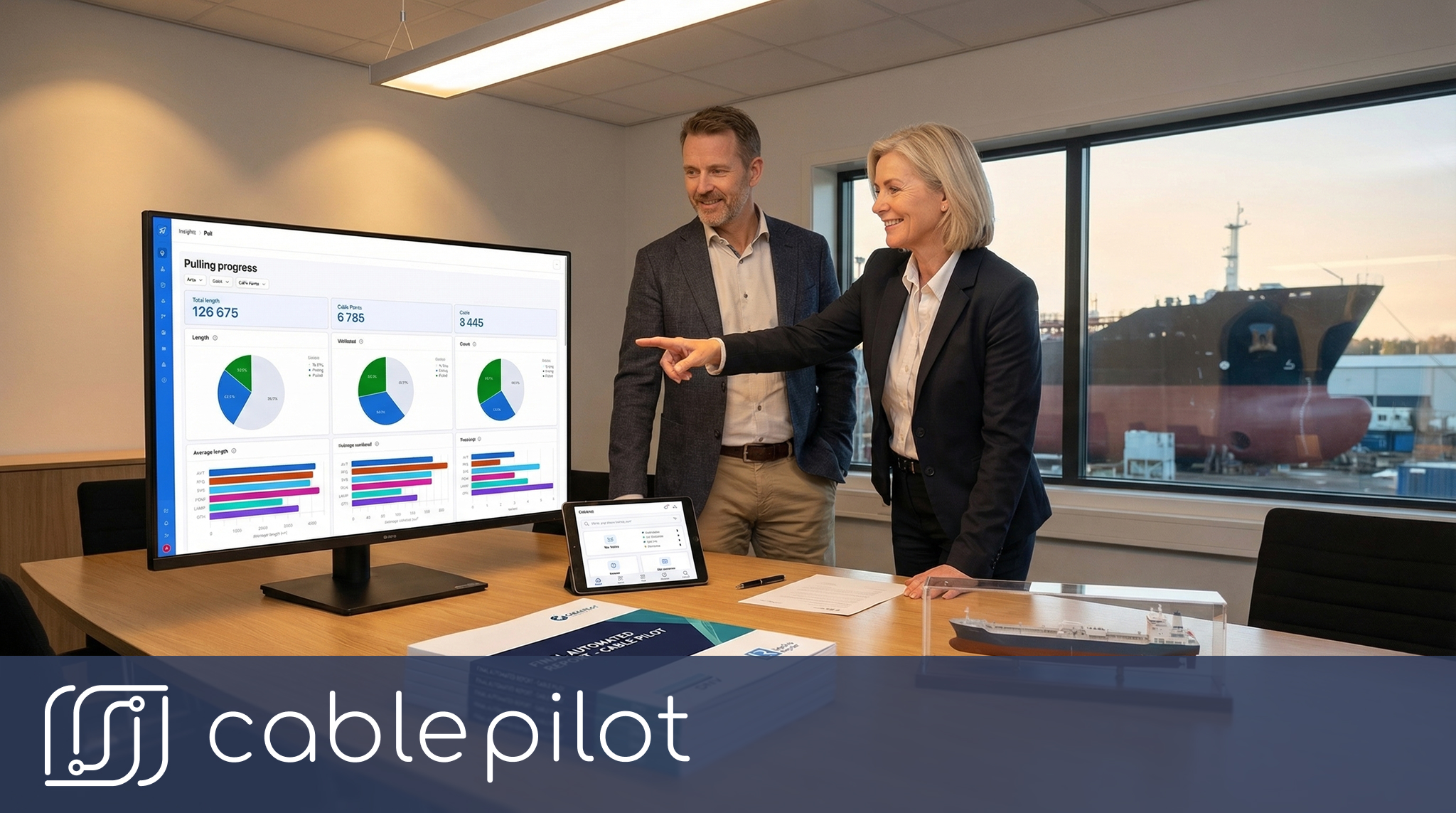
Handover Labor Reduction
Automated documentation eliminates hundreds of hours of manual compilation while shortening commissioning timelines.
Reduced Material Waste
Precise installation tracking prevents duplicate cable pulls and over-ordering.
Quality Improvement
Cable installation traceability improves accountability and reduces test failures and warranty claims.
Multi-Project Learning
Captured installation knowledge accelerates productivity on repeat vessel builds.
Implementation: From Legacy Chaos to Digital Clarity
Cable Pilot deployment typically follows a phased rollout.
Phase 1 – Pilot System (2–4 weeks) Import a single subsystem, configure roles, and deploy the mobile app to a small crew.
Phase 2 – Full Project Deployment (4–6 weeks) Import the full cable list, integrate drawings, train contractors, and activate reporting dashboards.
Phase 3 – Process Optimization (ongoing) Refine workflows, customize reports, and capture lessons learned for future projects.
Conclusion: The Competitive Advantage of Unified Data
As shipbuilding projects grow more complex, maintaining a reliable single source of truth becomes essential. Fragmented spreadsheets and manual documentation processes create growing risks.
Cable Pilot’s digital twin platform replaces document-centric workflows with object-centric data, delivering version control automation, AI-based drawing indexing, and real-time electrical visibility that supports faster, more reliable project execution.
For project managers, superintendents, and classification surveyors, Cable Pilot offers a clear path forward: one platform, one truth, and seamless data handovers.
Ready to eliminate version chaos and accelerate your next electrical handover? Contact Cable Pilot today for a personalized demonstration showing how digital twin asset management transforms electrical installation performance on projects like yours.