
Modern shipbuilding projects run on electrical complexity. A single vessel can carry tens of thousands of cables routed through hundreds of compartments, connecting systems that range from propulsion to navigation to fire safety. Yet the process of tracking installation progress across all of it has, for most shipyards, remained stubbornly paper-based. That gap between the sophistication of what gets built and the crudeness of how it gets recorded is where projects lose time, money, and control. Mobile electrical reporting with QR code tracking closes it.
Every day across shipyards, skilled electricians spend their shift filling out handwritten logs, supervisors spend their afternoons deciphering those notes, and project managers make critical decisions on information that is already 24 to 48 hours old. This “reporting tax” is not a minor inconvenience — it’s a chain of downstream problems that affects quality, coordination, and ultimately, project profitability. Cable Pilot’s smartphone-based mobile electrical reporting with integrated QR code tracking eliminates this friction entirely, replacing hour-long administrative burdens with a streamlined 10-second workflow that delivers real-time data capture at the point of work.
The Reporting Tax: How Manual Processes Drain Shipyard Resources
Before looking at the solution, it helps to understand the full scope of the problem. Traditional field reporting in electrical installation management follows a predictable and deeply flawed pattern. An electrician completes a cable pull deep in a vessel compartment. To document it, they must locate the correct paper cable list — likely one of several versions circulating on site — find the specific entry among hundreds of rows, and mark the status with a pencil that may not write reliably in humid conditions.
This seemingly simple act carries hidden costs that compound throughout the project. The installer must interrupt productive work to complete the paperwork. Handwriting degrades over long shifts, especially with protective gloves. Paper forms get damaged, stained, or lost outright, requiring progress data to be reconstructed from memory days later.
The downstream impacts multiply these initial losses. At shift end, supervisors collect paper reports from multiple crew members, often finding incomplete or conflicting entries requiring clarification. Someone then transcribes those handwritten notes into a digital system, introducing errors at rates that studies show can reach 4% for manual data entry. By the time consolidated progress data reaches project managers, the information reflects yesterday’s conditions — not what is happening now.
This information lag undermines electrical installation management at every level. Supervisors cannot identify problems until after they have already caused delays. Procurement teams order against outdated consumption data. Quality assurance gates get skipped or poorly documented because paper trails lack the granularity compliance review requires. Coordination between contractor teams breaks down when no one has a shared, current picture of what has actually been completed.
Research on manual processes in industrial construction environments quantifies the drain. Studies indicate that skilled workers in traditional reporting environments spend an average of 1.41 hours per day on administrative tasks related to progress documentation. For a 20-person electrical installation crew, that is over 28 hours of lost productive capacity every single working day.
Mobile Electrical Reporting: Reimagining Field Data Capture
Cable Pilot’s approach to mobile electrical reporting fundamentally changes how installation progress data flows from the field to project management. Rather than treating documentation as a separate administrative task performed after productive work, the platform integrates reporting directly into the installation workflow itself — making progress capture an almost effortless byproduct of completing each task.
The system begins with data preparation at project initialization. When project managers import the cable list into Cable Pilot — a process that takes minutes thanks to automated column mapping that interprets standard Excel and CSV exports from engineering platforms — the system automatically generates unique QR codes for every cable, piece of equipment, and location in the project database. Each QR code serves as a unique identifier that instantly retrieves the cable’s complete profile from the device’s local database, including its designation, routing, connection points, and current status.
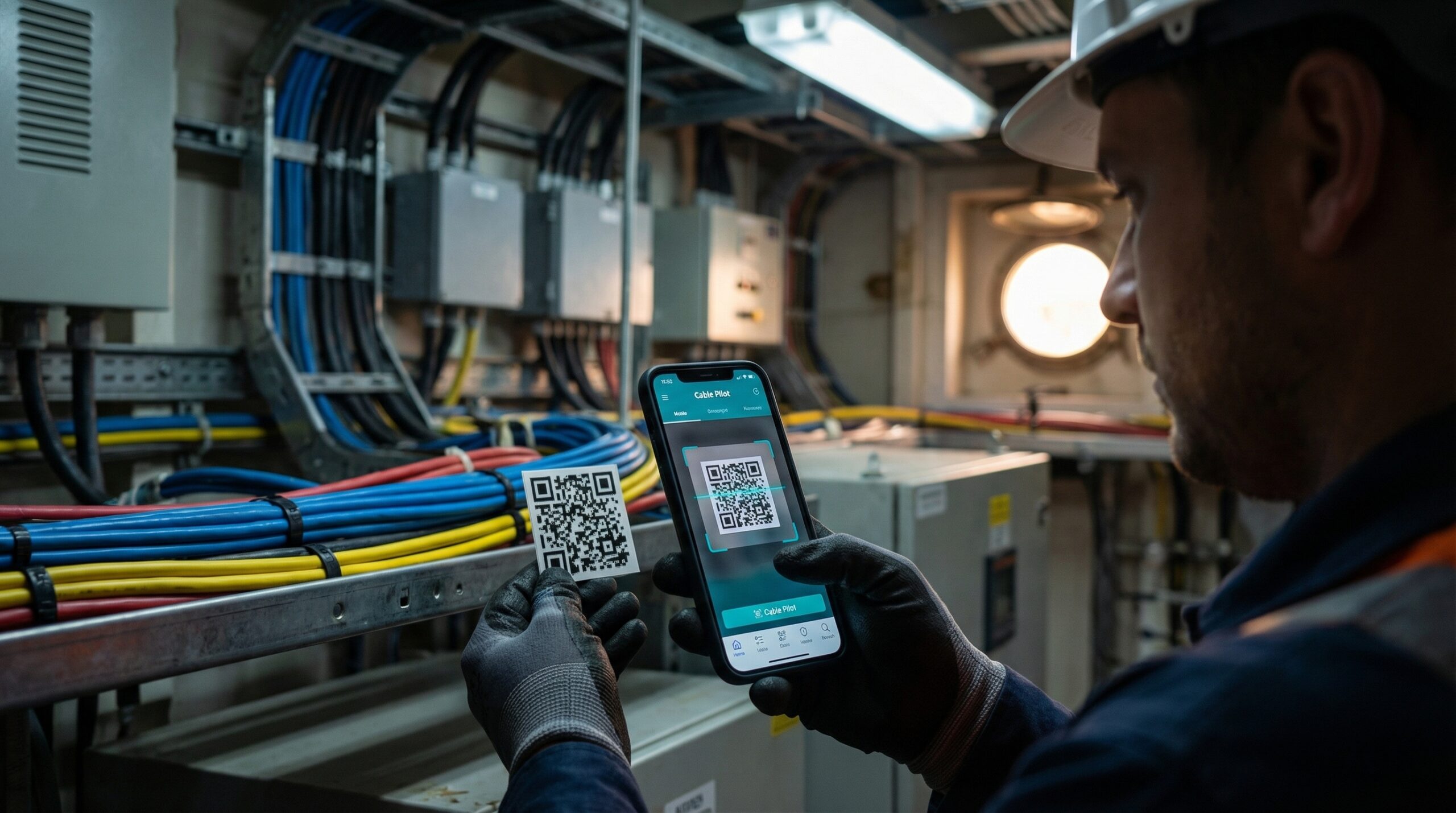
This automatic QR code generation removes one of the traditional barriers to digital tracking: the manual effort of creating and assigning identifiers. Cable Pilot generates print-ready PDF documents for different deployment scenarios. Shipyards can print adhesive labels for direct cable marking, create QR-coded checklists for zone-based installation tracking, or produce compartment-level location codes covering all cables in a given area. Standard office printers handle this entirely — no specialist label printers or expensive materials required.
The real change happens when installation begins. Rather than carrying bulky paper cable lists or navigating shared computers, each team member has Cable Pilot’s mobile application on their smartphone. The application is built for the connectivity realities of shipyard work, using an offline-first architecture that does not require a continuous network connection to function.
When an electrician finishes pulling a cable through its designated route, documenting the work takes three actions consuming roughly 10 seconds:
Scan: The installer opens Cable Pilot’s mobile app and points the smartphone camera at the QR code on the cable or installation checklist. Within a second, the system retrieves the cable’s full technical profile from the local device database.
Select: The app displays the cable’s current status and presents the logically appropriate next action. The workflow enforces the correct installation sequence: a cable in “To Pull” status shows the “Pulled” option; once pulled, the testing step becomes available before connection is permitted. This sequencing is not optional — the platform enforces it to protect quality.
Confirm: The app updates the cable’s status in the device’s local database instantly and, if network connectivity is available, synchronizes the change to the central system. If the device is offline, the update is queued for automatic synchronization when connectivity resumes.
This 10-second workflow replaces what previously consumed 5–10 minutes of searching through paper lists, handwriting notes, and later transcribing information. The time saving alone would justify adoption, but the benefits go considerably further.
Real-Time Data Capture: From Information Lag to Instant Visibility
The shift from end-of-shift paper reporting to instant mobile electrical reporting transforms what project management is actually possible. Traditional workflows create information lag — the delay between work completion and data availability. When progress updates happen once daily or weekly, project managers are operating on partial, outdated information that makes proactive problem-solving impossible. By the time issues appear in the data, they have already caused downstream delays.
Cable Pilot’s real-time data capture eliminates this lag directly. The moment an installer taps “Pulled” on their smartphone, that status change propagates through the system. If the device has network connectivity — typical in above-deck areas, near Wi-Fi access points, or on cellular data — the update reaches the central database within seconds. Supervisors monitoring the Cable Pilot dashboard from the site office see the progress update immediately.
The offline-first architecture keeps real-time data capture reliable even in the most challenging shipyard environments. Deep inside a vessel’s hull, within electrical cabinets, or in compartments surrounded by steel bulkheads that block radio signals, smartphones may have zero network connectivity. Cable Pilot’s mobile application continues functioning without interruption because all necessary project data is pre-synchronized to the device during morning briefings or whenever connectivity is available.
As installers scan cables and update statuses throughout the day in areas without signal, the changes accumulate in the smartphone’s local database. The app queues all updates with their precise timestamps so that, when the worker moves to an area with connectivity, the application automatically synchronizes without any manual action required.
This offline-to-online reliability is essential for workforce adoption. Installers never experience failures due to connectivity problems, never lose entered data, and never need to remember to sync manually. The system works regardless of network conditions, building the consistent usage that makes the data genuinely useful.
For project stakeholders, real-time data capture creates clear visibility into shipyard labor efficiency. The Cable Pilot dashboard shows colour-coded progress across compartments, cables, and systems. Supervisors can filter by installation team, cable type, priority, or any other attribute in the cable database — drilling down to specific bottlenecks or identifying where things are ahead of schedule.
Workflow Optimization: Multi-Role Access and Quality Gates
Effective electrical installation management requires coordinating multiple stakeholders with different information needs and different levels of access. Cable Pilot’s mobile electrical reporting system handles this through role-based access that gives each user exactly the information and capabilities relevant to their work.
Field installers work with the streamlined mobile interface built for rapid QR code tracking and status updates. Their view prioritises speed: scan a cable, see its current status and the next required action, tap to update, move on. The application guides workers through the correct installation sequence by presenting only the status options appropriate for each cable’s current state — a cable that has not yet been tested cannot be marked as connected, preventing the kind of sequence errors that surface later as non-conformances.
Supervisors and foremen access expanded capabilities through both mobile and web interfaces. Beyond updating cable statuses themselves, they can assign cables or zones to specific workers, review team progress metrics, and add notes or photos to document field conditions. The supervisor dashboard surfaces the issues that need attention: cables behind their planned completion dates, patterns of repeated status changes that may indicate rework, or crews running significantly behind the planned pace.
Project managers and coordinators work primarily with the web-based dashboard, which aggregates data from all mobile users into comprehensive analytics. This view supports strategic decisions through installation productivity gains tracking over time, resource reallocation analysis, and forecasting based on current completion rates. Managers can generate standardised progress reports, export data for integration with enterprise systems, and configure notifications for critical milestones.
Quality assurance and inspection teams benefit from the immutable audit trail that QR code tracking creates. Every status update in Cable Pilot is automatically timestamped and attributed to the specific user who performed it. The testing workflow is particularly rigorous: before a cable can advance to the connection phase, the electrician must log the resistance measurement and specify the testing instrument used. Inspectors at the final “Checked” stage can reject cables, attach photographic evidence of deficiencies, and push the cable back for rework — creating a verifiable quality record that satisfies classification society requirements. This traceability simplifies inspection handovers and removes the ambiguity that paper-based systems routinely allow.
Contractor management is another area where workflow optimization delivers practical value. Shipyards typically engage multiple specialist contractors covering different systems or vessel zones. Cable Pilot’s role-based access allows each contractor to see only their scope of work within the cable list, preventing unauthorized changes while giving the coordination team a unified view of progress across all contractors. When one contractor completes the cable pulls in a compartment that another needs for termination work, that completion is immediately visible in the relevant team’s filtered view — replacing the information delays that make multi-contractor coordination unnecessarily adversarial.
Supervisor Visibility Control: From Reactive to Proactive Management
The shift from reactive to proactive electrical installation management is one of Cable Pilot’s most practical impacts. Traditional reporting cycles run on daily or weekly rhythms: work happens, reports are filed, data is consolidated, adjustments are made for the next period. This batch approach to project management worked adequately when schedules were less compressed, but modern shipbuilding timelines demand faster response loops.
Cable Pilot’s real-time mobile electrical reporting enables continuous supervisor visibility control over installation activities. Rather than waiting for Friday’s progress meeting to learn that a critical cable pull fell behind on Monday, supervisors see the shortfall as it develops and can intervene immediately. Leading indicators replace lagging ones.
Consider a common scenario: the project schedule calls for completing all cable pulls in compartment 7G by Wednesday afternoon so the painting crew can access the space Thursday morning. By Wednesday noon, the Cable Pilot dashboard shows only 73% of those cables marked “Pulled” via QR code tracking — the commitment is at risk. The supervisor sees this shortfall in time to investigate the cause — a delivery delay, a routing obstacle — and can reallocate workers from compartments running ahead of schedule or negotiate a revised sequence with the painting crew.
In a paper-based reporting environment, that same shortfall would only emerge from Wednesday evening’s handwritten reports, by which point the painting crew is already scheduled and the cascade of downstream impacts is already in motion.
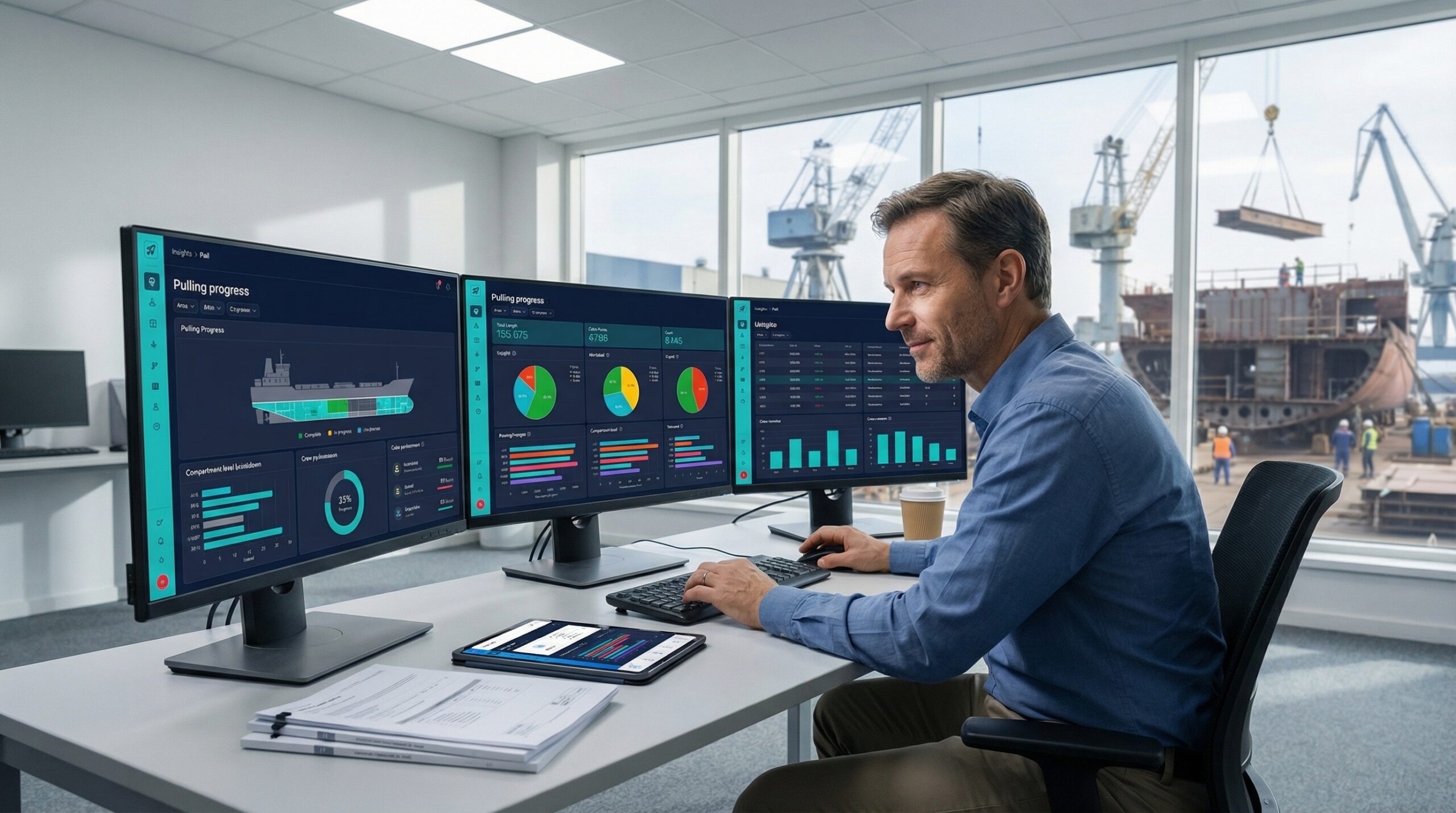
The granular visibility that mobile electrical reporting provides also surfaces systematic patterns that aggregate reports obscure. If a specific cable type consistently takes longer to install than estimated, Cable Pilot’s dashboard can display average installation time by cable type — making the outlier visible and prompting investigation into whether the specification is wrong, whether the labour estimate needs updating, or whether additional tooling would help.
Performance visibility across teams becomes equally actionable. If one installation crew consistently outperforms others, the techniques they are using are worth understanding. If another team shows a productivity decline over the course of the week, it may reflect increasingly difficult work areas or a resource constraint that deserves management attention. Real-time data turns these patterns from anecdote into evidence.
For shipyards managing multiple projects simultaneously, Cable Pilot’s cross-project dashboard aggregates real-time data capture from all active vessels. If one project is ahead of schedule while another encounters delays, resource decisions can be made from current data rather than from last week’s summary.
Installation Productivity Gains: Quantifying the Impact
The business case for Cable Pilot’s mobile electrical reporting rests on measurable returns across multiple dimensions. The most direct is the reclamation of productive labor hours previously consumed by administrative documentation.
As established, traditional paper-based reporting consumes an average of 1.41 hours per worker daily. Cable Pilot’s 10-second QR code tracking workflow reduces the time spent on per-cable reporting by approximately 94%. For an installer who updates 30 cable statuses throughout their workday — a realistic figure during active installation phases — total reporting time drops to under five minutes. That recovers roughly 1.35 productive hours per worker daily.
To make this concrete, consider an illustrative project scenario — a 20-person electrical installation crew over a six-month engagement (approximately 120 workdays). Using a representative fully-burdened labor rate of €45/hour for skilled electrical installers:
- Daily labor saving: 20 workers × 1.35 hours × €45/hour = €1,215
- Weekly saving: €1,215 × 5 days = €6,075
- Monthly saving: €6,075 × 4.33 weeks = €26,305
- Project-total direct labor saving: €26,305 × 6 months = €157,830
These are illustrative figures built on stated assumptions — actual results vary with crew size, project duration, labor rates, and the number of status updates per shift. The mechanism behind the saving is straightforward: 1.35 hours of administrative work per worker is replaced by under five minutes of QR scanning. The math scales directly with the crew.
Beyond direct labor reclamation, real-time data capture reduces several categories of work that traditional cost accounting tends to undercount. QR scanning eliminates the ambiguity of paper records — because every status is tied to a specific user, timestamp, and scanned identifier, there is no room for the “was this already done?” re-verification work that paper-based projects routinely require. Similarly, when supervisors know exactly which cables are installed, tested, and connected in real time, procurement decisions become data-driven rather than padded estimates, reducing excess inventory carrying costs.
Schedule protection may represent the most financially significant benefit, though it is also the hardest to put a single number on. Early detection of installation shortfalls — the kind of visibility that real-time supervisor oversight enables — means problems are identified while corrective action is still practical rather than after they have already impacted critical path activities. Preventing a single week of electrical installation delay on a mid-size vessel project produces savings that typically exceed the platform’s annual licensing cost.
Cable Pilot’s pricing is available at cablepilot.com/price, where current configurations and user-tier costs are listed. The return on the platform investment, measured simply against direct labor reclamation, is typically achieved within the first few weeks of active use.
Beyond Time Savings: Quality, Compliance, and Team Morale
While the financial returns justify adoption on economic grounds, Cable Pilot’s mobile electrical reporting also delivers qualitative benefits that compound over time.
Data quality improvements cascade through every downstream process that relies on installation records. When commissioning engineers review electrical installation documentation to verify system readiness, they work from complete, timestamped records rather than partially legible paper logs. Classification society inspections move faster when inspectors can access digital audit trails showing exactly when each quality checkpoint was completed and by whom — reducing inspection duration and the risk of non-conformance findings that trigger costly remediation.
Team morale is a real but undervalued benefit. Skilled electricians take professional pride in their craft — quality installations, proper terminations, systematic troubleshooting. They do not derive satisfaction from filling out forms in a cramped site office at the end of a long shift. When organizations give their teams tools that respect that expertise and eliminate administrative friction, the message is clear: the work itself is what matters. A team freed from a daily reporting ritual has more energy for the actual installation — and that translates into both productivity and retention.
The offline-first architecture matters particularly to workers who have experienced the frustration of connectivity-dependent systems that fail in exactly the locations where installation work happens. Cable Pilot’s guarantee that QR code tracking works regardless of network conditions builds the kind of user trust that drives genuine adoption rather than parallel paper workarounds.
Implementation: From Setup to Daily Operation
For shipyards and contractors evaluating Cable Pilot, understanding the implementation path is essential for planning. The platform is designed for rapid deployment with minimal disruption to ongoing operations, enabling crews to realise installation productivity gains within days.
Implementation begins with data preparation. Project managers export their existing cable list from engineering systems — typically AutoCAD Electrical, EPLAN, or similar platforms — into Excel or CSV format. This file imports into Cable Pilot through an interface with automated column mapping. Within minutes, the cable list populates the database and the system generates QR codes for every entry.
Cable Pilot exports these codes as print-ready PDFs in formats suited to the deployment approach: adhesive label sheets for direct cable marking, QR-coded zone checklists for compartment-based tracking, or equipment-level codes for panel and distribution board management. Standard office printers handle production entirely.
Smartphone distribution and application installation come next. Cable Pilot runs on standard iOS and Android devices, meaning shipyards can leverage existing smartphones without specialist hardware. Workers download the app, log in with project-specific credentials, and the application synchronises relevant project data to their device.
Training requirements are minimal because the interface is deliberately simplified. A brief team orientation — typically 15 minutes — is enough for supervisors to walk through the scan-select-confirm sequence. The context-aware presentation of status options guides workers through the correct workflow without requiring them to remember installation sequences. Most crew members are self-sufficient after a handful of real scans.
For the first few days, shipyards often run parallel tracking with both paper and mobile reporting, giving workers confidence in the new system. In practice, most crews prefer the mobile method quickly — it genuinely is faster and less tedious than paper workflows.
Take Control of Your Electrical Installation Workflow
The contrast between paper-based reporting and Cable Pilot’s mobile electrical reporting is not about replacing one tool with another. It is a practical shift in how installation progress is documented, monitored, and acted upon. The 10-second QR code tracking workflow eliminates the reporting tax that has burdened field teams, recovers over an hour of productive time per worker per day, and gives supervisors the visibility they need to manage proactively rather than reactively.
For shipyards still working from paper cable lists and end-of-shift documentation rituals, these losses accumulate every day. The information lag inherent in manual reporting prevents early intervention, forcing supervisors into reactive mode where problems are discovered only after cascading consequences are already underway. Transcription errors from paper systems undermine data quality throughout the project, creating compliance risk and eroding stakeholder confidence.
Cable Pilot provides a direct path forward. Implementation is measured in days, not months. The workflow fits how installation teams already operate, with QR codes printed from standard equipment and status updates that take less time than signing a timesheet. The financial returns — measured conservatively against direct labor reclamation alone — typically justify the investment within the first weeks of use.
The question facing forward-thinking shipyard and contractor leadership is not whether to digitize field reporting automation, but how quickly to act before the information lag advantage of competitors who already have becomes a structural disadvantage.
Ready to see how QR code tracking transforms your specific workflow? Cable Pilot offers personalized demonstrations that work through your actual cable list — importing your data, generating QR codes, and walking through the 10-second mobile update process from scan to dashboard. Discover how real-time data capture and supervisor visibility control can change how your teams work, starting with the next shift.
Contact Cable Pilot to schedule your demonstration.