
The Information Gap Killing Shipyard Schedules
In modern shipbuilding, electrical installation represents one of the most complex phases of vessel construction. Thousands of cables thread through hundreds of compartments. Multiple contractors work simultaneously across different systems. Project managers face a critical challenge: maintaining complete shipyard electrical oversight when traditional reporting methods provide data that’s already hours or days obsolete.
End-of-day spreadsheets and weekly progress meetings paint an incomplete picture. While teams debate yesterday’s numbers in coordination meetings, contractors encounter new bottlenecks in the field. Quality issues multiply undetected. Coordination gaps between electrical work and adjacent trades widen into costly delays. This reactive approach doesn’t just slow projects—it erodes margins and forces supervisors to constantly manage crises instead of leading proactively.
Cable Pilot’s Shipyard Electrical Oversight Dashboards fundamentally change this dynamic. By transforming fragmented field data into live visual intelligence, a modern shipyard electrical oversight dashboard delivers the visibility needed to turn guesswork into precision. Project managers gain instant electrical oversight across all contractors, compartments, and installation phases—enabling the proactive coordination that separates on-time, on-budget deliveries from expensive overruns.
Why Real-Time Progress Monitoring Matters More Than You Think
Consider the cascading failures that occur with delayed visibility. An electrician completes a cable termination in the engine room at 10 AM. The foreman records this on a paper checklist during lunch. Data entry staff transcribe notes into spreadsheets that evening. By tomorrow’s coordination meeting—nearly 24 hours later—managers finally learn about yesterday’s work.
In that time gap, multiple problems emerge:
Adjacent trades show up to compartments where prerequisite electrical work isn’t complete, forcing costly mobilization delays or rework
Quality assurance discovers installation errors weeks later during final testing, when corrections are exponentially more expensive
Procurement materials based on inaccurate progress forecasts, misrepresenting actual cable consumption rates
Contractor performance comparisons become subjective, making resource reallocation decisions unreliable
Without real-time installation monitoring, you’re making decisions on incomplete information. Problems identified within hours cost a fraction of issues discovered weeks later during commissioning. The business case for live progress monitoring isn’t about technological novelty—it’s about financial survival in an industry where margins leave no room for inefficiency.
How Cable Pilot’s Real-Time Dashboard Works
Cable Pilot’s real-time electrical oversight platform captures and displays installation data as it happens. The workflow is straightforward:
Field-to-Cloud Data Flow:
Electricians use smartphones to scan QR codes on cable tags as they complete each installation milestone—mounting supports, pulling cables, making terminations, or finishing testing. These scans flow to Cable Pilot’s cloud infrastructure in real-time, updating the project’s digital status within seconds.
The system validates incoming scans against the project’s cable list and installation procedures. When a termination scan arrives before the pulling scan, the system flags the sequence issue. If the same cable receives completion scans from two contractors, quality assurance receives immediate notification. This intelligent validation transforms raw scan data into trustworthy information for decision-making.
Dashboard Intelligence:
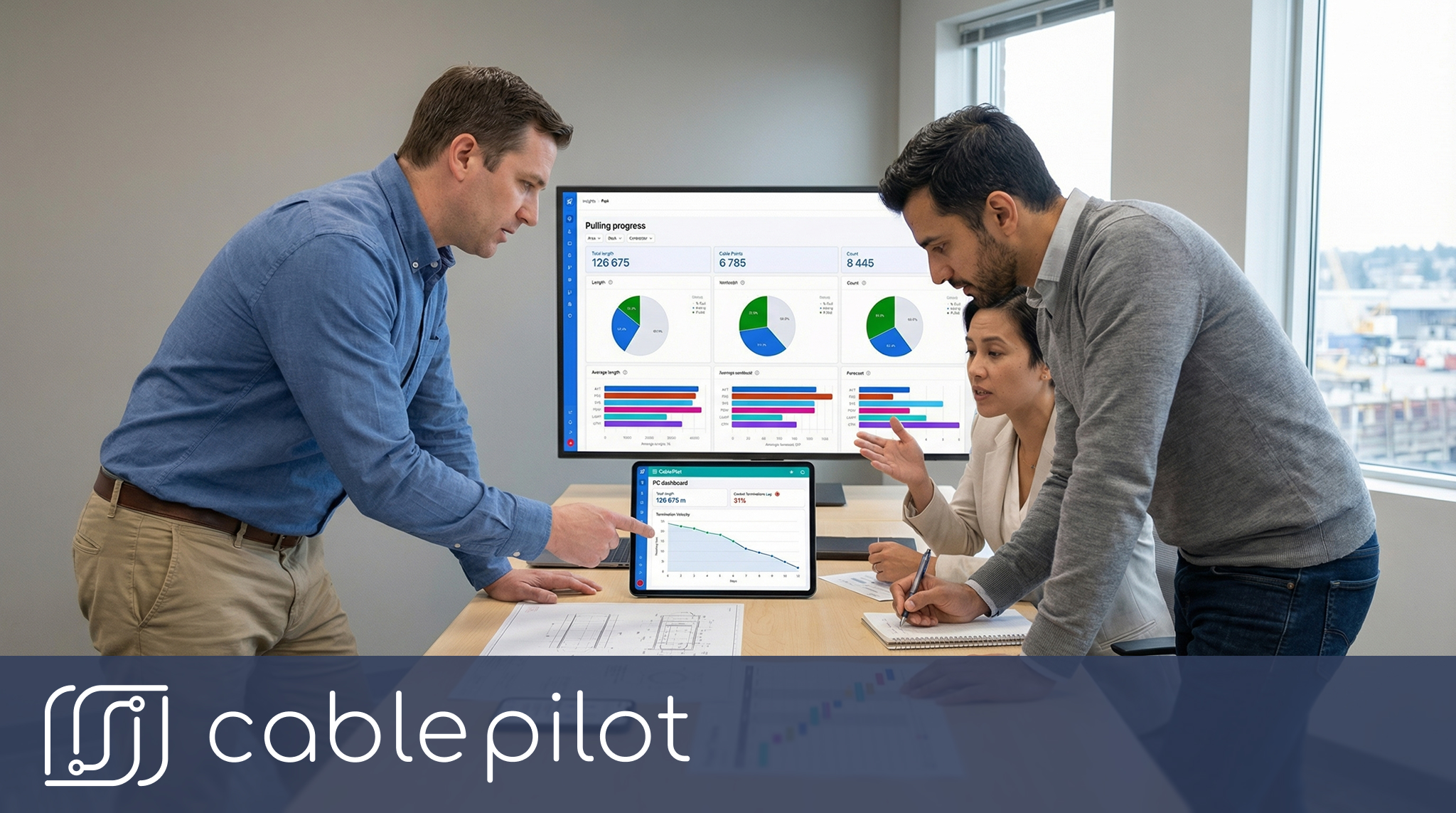
The main overview dashboard presents installation status in multiple dimensions:

Compartment-level progress: Engine room at 68% complete, main deck at 82%, navigation bridge at 45%
System breakdowns: Power distribution 71% complete, lighting circuits 89%, automation and control 52%
Contractor performance metrics: Contractor A averaging 47 cable completions daily; Contractor B at 38 completions with 12% rework rate
Phase-specific status: 2,347 cables pulled, 1,891 terminated, 1,204 tested and approved
This multi-dimensional view identifies exactly where bottlenecks exist. If pulling is at 95% but terminations lag at 60%, the constraint is clearly your connection crews, not routing teams. This level of precision makes contractor tracking dashboard data actionable for immediate resource reallocation.
Access Control:
Different stakeholders see tailored dashboards. Individual contractors view their own crew performance while seeing only summary progress for other teams—maintaining competitive confidentiality. Shipyard management accesses comprehensive cross-contractor analytics for resource planning. Clients receive simplified overall progress views that build confidence without overwhelming operational detail.
From Reactive to Proactive: A Practical Example
Thursday morning coordination meeting. The schedule shows compartment E-101 (engine room) should reach 85% completion this week. You need to confirm electrical readiness for commissioning to start Monday.
Without real-time monitoring: Collect reports from three contractors, cross-reference against last week’s data, make educated guesses. Typical result: “probably ready, but we’ll confirm Monday morning.”
With a real-time shipyard electrical oversight dashboard: Open the dashboard Thursday morning. E-101 shows 68% completion—well below the 85% target. The system-level breakdown reveals the real issue: main power at 89%, lighting at 92%, but automation and control at just 31%. Drilling deeper, you discover Contractor C completed pulling all control cables but only finished 22% of terminations. Historical trend analysis shows termination velocity declining from 14 connections daily to 6 yesterday.
With precise visibility, you make three immediate decisions:
Resource reallocation: Contractor C reassigns four electricians from ahead-of-schedule power systems to control terminations Friday
Schedule adjustment: Postpone E-101 commissioning testing three days; redirect crew to compartment E-204 where electrical work is complete
Bottleneck verification: Confirm control panel components are adequately supplied
By Wednesday, revised crew allocation drives E-101 to necessary electrical readiness for commissioning. The three-day schedule slip is manageable. Critically, the problem was identified and addressed Thursday rather than discovered Monday when the test crew arrived—preventing a week-long crisis.
This demonstrates how project coordination transforms with live progress monitoring. Decisions shift from reactive crisis management to proactive optimization. Problems are quantified precisely. Corrective actions target actual bottlenecks.
Strategic Advantages of Electrical Project Visibility
Beyond operational improvements, real-time dashboards create competitive advantages that differentiate leading shipyards. As clients grow more sophisticated, they increasingly select builders based on demonstrated delivery reliability. The ability to offer shared dashboard access provides transparent electrical project visibility throughout construction—building confidence that separates trusted partners from commodity vendors.
This transparency advantage proves particularly valuable when inevitable problems arise. When a client sees through shared dashboards that external steel delays pushed electrical start dates but installation velocity remains strong, they understand schedule pressure results from factors outside shipyard control. Transparency preserves the trust necessary to solve problems collaboratively.
Internally, the data-driven culture fostered by continuous real-time oversight reshapes how teams approach coordination. When performance is visible and measured objectively, accountability improves organically. Contractors recognize that excellence is documented and rewarded. Poor performance cannot be hidden. This meritocratic environment naturally elevates standards.
The quality assurance dimension extends to regulatory compliance. Classification societies increasingly expect robust quality management systems with auditable installation documentation. Cable Pilot’s dashboards, backed by timestamped scan records and photo documentation, provide exactly the evidence trail surveyors require—enabling faster classification reviews and earlier delivery.
Conclusion: Mastery Over Electrical Oversight
The fundamental challenge of shipbuilding project management remains unchanged: deliver complex vessels on schedule, within budget, and to demanding quality standards while coordinating hundreds of stakeholders across months of dynamic construction. What has changed is the information infrastructure available to meet that challenge.

Cable Pilot’s real-time dashboards transform shipyard electrical oversight from a perpetual struggle against information lag into a proactive management capability grounded in instant visibility. Every bottleneck detected days earlier, every quality issue caught before propagating, and every contractor coordination conflict resolved through shared transparency directly protects project margins and schedule commitments.
In an industry where delivery reliability increasingly determines competitive success, this shift from reactive crisis response to proactive optimization translates directly to competitive advantage. When you can see problems forming rather than discovering them after damage occurs, when you can compare contractor performance objectively, and when you can forecast completion dates based on actual velocity, you fundamentally change the nature of project coordination.
If you’re managing electrical installation across multiple contractors and looking to eliminate information gaps, our team can walk you through how real-time dashboards deliver the visibility your project needs.