
Choosing the right shipyard cable management solution can mean the difference between on-time vessel delivery and costly delays. Electrical installation delays cascade through shipbuilding schedules like dominoes, eroding profit margins and straining relationships with clients and contractors. Project managers juggle paper binders, fragmented spreadsheets, and communication gaps that transform manageable challenges into expensive crises. The fundamental problem is not complexity itself—shipyard electrical projects have always been intricate—but rather the outdated tools used to manage them. Traditional paper-based processes create information black holes where critical data disappears for hours or days between the field and the project office.
As a purpose-built shipyard cable management solution, Cable Pilot transforms this chaotic landscape into a transparent, controlled environment. By replacing binders with a smartphone app and consolidating project data into a single source of truth, Cable Pilot delivers real-time visibility, enforced workflows, and objective metrics that boost shipyard efficiency, elevate quality, and strengthen contractor accountability. This article explores seven key cable installation tracking benefits that establish Cable Pilot as a command center for modern shipyard electrical installations.
The Broken Workflow: Why Paper-Based Tracking Fails Shipyards
Before examining Cable Pilot’s benefits, we must understand why traditional methods consistently underperform. In conventional workflows, electricians receive assignments from paper work orders or static PDF cable lists. They walk to remote vessel compartments carrying printed drawings, locate cables using handwritten tags, and perform installation tasks. At shift end—or sometimes days later—they fill out paper progress reports documenting completed work. Supervisors collect these forms, manually transcribe data into spreadsheets, and email updates to project managers who consolidate information from multiple contractors.
This fragmented process generates predictable failures. Data arrives too late to prevent problems, transcription errors corrupt information, version conflicts proliferate across teams, and accountability evaporates when disputes arise. Project managers make decisions based on yesterday’s reality while today’s problems multiply unseen. The administrative burden consumes productive labor hours, forcing skilled electricians to spend time on administrative tasks instead of installation work.
Cable Pilot’s shipyard cable management solution dismantles this broken workflow entirely. The platform digitizes every step, from project setup through commissioning handover, creating a unified ecosystem where field crews, supervisors, project managers, and clients share the same live data. Installers access all project information through an intuitive smartphone app, scanning QR codes to instantly retrieve cable specifications, routing instructions, and connection diagrams. Every status update synchronizes immediately to cloud-based dashboards, providing stakeholders with real-time shipbuilding progress monitoring. This shipyard electrical workflow digitization unlocks seven transformative benefits.
Benefit 1: Smartphone Updates Reclaim Productive Time Daily
The first and most immediate benefit of this shipyard cable management solution is time savings through simplified field reporting. Traditional documentation workflows force electricians to interrupt productive work, locate paper forms, write detailed progress notes, and submit reports at shift end. This administrative burden consumes time that adds no value to the vessel under construction.
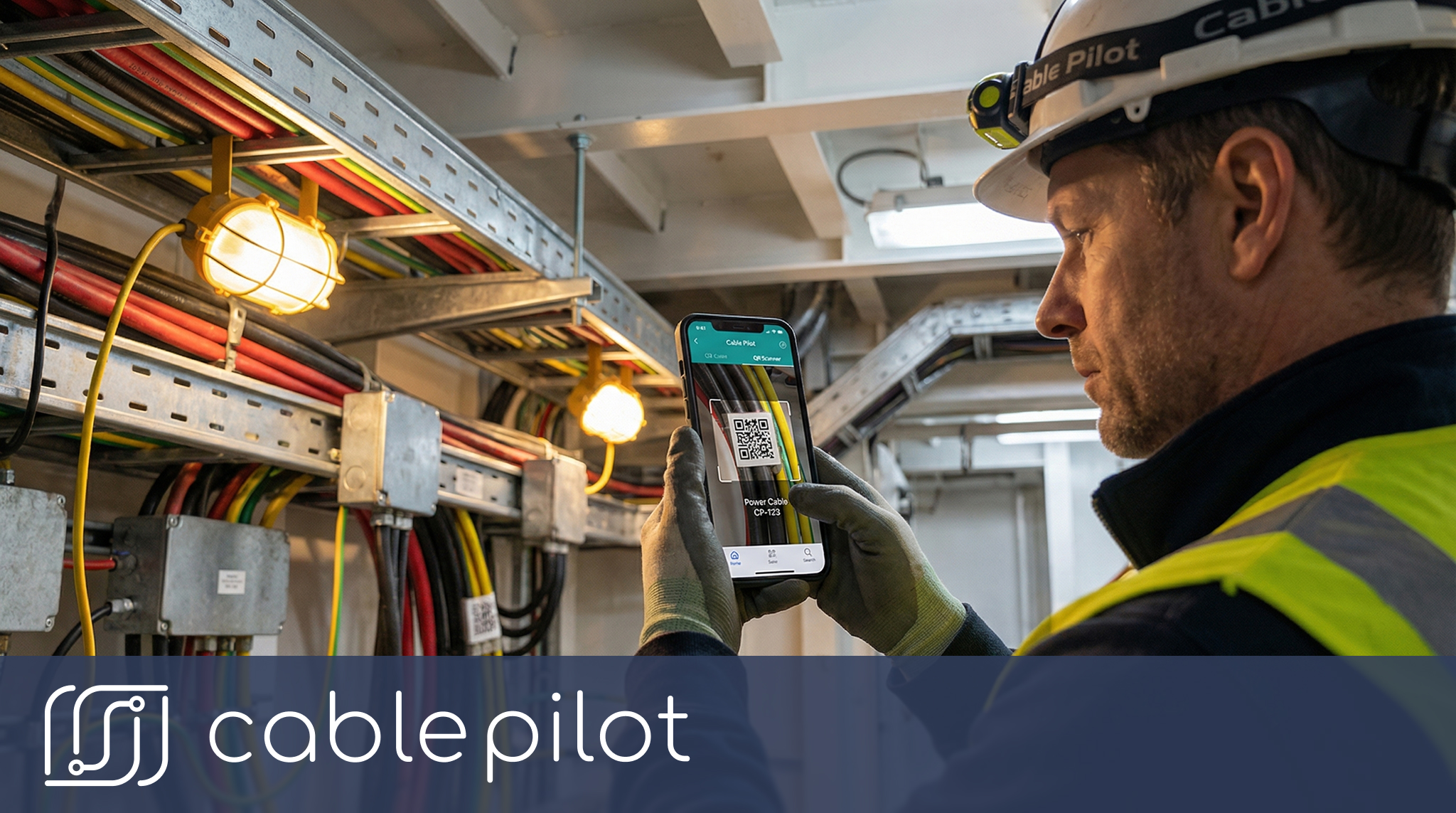
Cable Pilot compresses reporting through QR code workflows optimized for shipyard conditions. When an installer completes pulling a cable through a compartment, they scan the cable’s unique QR code label using their smartphone camera. The Cable Pilot app instantly identifies the asset, displays its complete technical context, and presents large, glove-friendly buttons for status updates. The worker selects the appropriate status, and the system records the action with precise timestamps and user attribution. The entire process is rapid and minimizes paperwork.
This workflow acceleration delivers measurable labor savings by reducing time spent on manual documentation. Project teams can redirect labor hours previously consumed by administrative tasks to productive installation work. Beyond raw cost reduction, eliminating documentation burden improves workforce morale and retention. Skilled electricians joined the trade to perform technical installation work, not to fill out redundant forms. By respecting their expertise and minimizing administrative friction, Cable Pilot creates a work environment where professionals focus on craftsmanship rather than paperwork. This cultural shift enhances productivity, reduces errors, and strengthens the shipyard’s ability to attract and retain top talent in competitive labor markets.
Benefit 2: Single Source of Truth Eliminates Version Conflicts
The second transformative benefit addresses one of the most destructive problems in multi-contractor shipbuilding projects: data fragmentation and version conflicts. When different electrical contractors maintain separate spreadsheets, and when supervisors email static progress reports that become outdated within hours, the project team operates without a shared understanding of reality. Project managers receive conflicting information about which cables are installed, supervisors duplicate work assignments, and quality inspectors cannot verify completion status without time-consuming physical verification.
As a shipyard cable management solution, Cable Pilot establishes a single source of truth by consolidating all project data into one unified digital twin of the vessel’s electrical installation. Every cable, equipment item, compartment, transit point, and test result exists as a structured digital object within the centralized database. When an installer updates a cable status through the smartphone app, that change immediately propagates to all stakeholders viewing the web-based dashboard. There are no conflicting versions, no email chains with outdated attachments, and no ambiguity about current project state.
This architectural approach to real-time updates delivers profound operational benefits. Project managers viewing the dashboard at any moment see the absolute current state of installation progress, filtered by vessel area, functional system, contractor, or lifecycle stage. They can drill down from high-level overview metrics showing overall completion percentages to granular task-level details showing which specific cables were connected by which electrician at which timestamp. Supervisors planning tomorrow’s work assignments query the system to identify available tasks, ensuring no duplication or missed assignments. Quality inspectors generate compliance reports directly from the digital twin, confident that data reflects verified field reality rather than optimistic spreadsheet projections.
The single source of truth architecture also transforms multi-contractor coordination. Large shipbuilding projects frequently engage multiple electrical subcontractors working simultaneously across different vessel zones. Cable Pilot provides role-based access control, allowing each contractor’s crews to view and update only their assigned scope while project managers maintain visibility across all contractors. This neutral collaboration platform eliminates the communication barriers and data silos that plague projects where each contractor uses proprietary tools. When contractors complete their scope and hand off systems to the next trade, the digital handover is instant and complete, with full historical traceability and zero information loss.
Benefit 3: Enforced Lifecycle Stages Reduce Rework Through Quality Gates
The third key benefit of Cable Pilot as a shipyard cable management solution is rework reduction through automated quality gates and enforced workflow sequences. Electrical installation follows a logical progression: cables must be pulled before they can be connected, connections must be completed before circuits can be tested, and tests must pass before systems can be commissioned. This sequence reflects physical dependencies that cannot be circumvented without creating defects and safety hazards.
Yet paper-based tracking systems lack mechanisms to enforce these sequences. An installer might mark a cable as connected in a paper report without first documenting the pulling operation. A test technician might record results before terminations are actually complete, creating false confidence that cascades into commissioning failures. These sequence violations generate expensive rework discovered only during later inspection or testing phases, when corrections require disassembly, reinstallation, and schedule delays.
Cable Pilot functions as a cable lifecycle tracking system, embedding physical dependency logic directly into the mobile workflow and preventing sequence violations at the point of work. The system defines mandatory lifecycle stages for every cable: planned, pulled, connected, and tested. When an installer scans a cable’s QR code, the smartphone app displays status update buttons contextually based on current state. If the cable is still in “planned” status, the app presents only the “pulled” action—the installer physically cannot mark the cable as connected until the pulling operation is logged. Similarly, the testing workflow cannot be initiated until connection points are documented as complete.
This proactive quality enforcement acts as a digital safety net, catching errors before they propagate through the project. The approach is non-intrusive and requires no additional worker effort—the system simply guides installers through the correct sequence while blocking impossible or illogical actions. The result is measurable rework reduction compared to paper-based systems where sequence violations go undetected until inspection phases.
Beyond preventing sequence errors, these electrical installation quality gates enforce mandatory documentation at critical milestones. For high-voltage cables requiring special termination procedures, the system can require photographic evidence before allowing status progression. For cables passing through fire-rated bulkhead transits, the app prompts installers to document transit sealing and fire-stopping compliance. These configurable quality gates ensure that regulatory and contractual requirements are satisfied in real time rather than discovered as gaps during final classification society surveys. The immutable audit trail created by timestamped photos, status updates, and user attributions provides verifiable proof of compliance that protects both contractors and shipyards from disputes and liability.
Benefit 4: Photo-Verified Blockers Trigger Instant Resolution
The fourth critical benefit addresses the inevitable obstacles and exceptions that arise during complex shipbuilding projects. Even with perfect planning, field crews encounter unexpected conditions: missing cable specifications, blocked access routes, damaged equipment mounting points, or incomplete work by preceding trades. In traditional paper-based workflows, these blockers generate frustrating delays. An installer encounters a problem, verbally reports it to a supervisor, who emails the project manager, who investigates and coordinates a solution. This communication chain consumes hours or days while crews remain idle or redirect to less-efficient alternative tasks.
Cable Pilot’s smartphone app transforms blocker management through instant, context-rich issue reporting. When an installer encounters an obstacle preventing task completion, they use the QR code reporting function to log the blocker directly within the app. They scan the affected cable or location, select the issue type from a predefined taxonomy—such as missing drawing, access blocked, equipment not installed, or specification error—add a brief text description, and attach a photograph documenting the problem. This rich, structured blocker record is created quickly and immediately visible to project stakeholders.
The system routes blocker notifications intelligently based on configurable rules. A missing drawing might trigger an automated alert to the engineering team, an access obstruction might notify the production coordinator responsible for trade sequencing, and a damaged mounting bracket might create a work order for the steel fabrication shop. Because blockers include photographs and precise location data, recipients receive complete context without time-consuming clarification cycles. They can assess the problem immediately and coordinate solutions based on visual evidence rather than secondhand verbal descriptions.
This instant blocker visibility enables resolution cycles measured in hours instead of days. Project managers viewing the dashboard see all active blockers in a prioritized queue, can assign ownership and track resolution progress, and can analyze blocker patterns to identify systemic issues requiring corrective action. For example, if multiple crews report blocked access to the same compartment, the project manager can coordinate with other trades to establish a clear access schedule, preventing recurrence. If a particular cable type repeatedly appears in missing-specification blockers, engineering can prioritize resolving that documentation gap across the entire project scope.
The impact on contractor accountability and schedule adherence is substantial. When blockers are documented with photographs and timestamps, disputes about responsibility and delay causes become straightforward to resolve. A contractor cannot claim they were idle due to shipyard-caused delays without verifiable blocker records, and shipyards cannot dispute legitimate obstacles when photographic evidence exists. This transparency creates an objective foundation for fair schedule adjustments, change orders, and performance evaluation, reducing conflicts and strengthening professional relationships across the project ecosystem.

Benefit 5: Objective Cable Points Metrics Ensure Fair Workload Allocation
The fifth transformative benefit introduces a sophisticated measurement system that solves one of the most challenging problems in electrical project management: accurately quantifying installation complexity and effort. Traditional tracking systems measure progress using simple volume metrics such as cable count or total meters installed. These metrics are dangerously misleading because they treat all cables as equivalent when reality is far more nuanced.
Pulling fifty meters of flexible multicore signal cable through an open cable tray requires vastly different labor effort than routing fifty meters of rigid, heavy-gauge, armored power cable through multiple watertight bulkhead transits and around tight bends in congested compartments. Yet conventional progress reports show both as equal contributions to completion percentage, creating distorted visibility that misleads project managers about actual schedule progress and resource consumption.
Cable Pilot’s shipyard cable management solution solves this measurement challenge through Cable Points metrics, a weighted scoring system that calculates objective labor effort for every cable based on its physical characteristics and installation complexity. The algorithm reflects the true complexity of each task through analysis of cable attributes. These weighted values provide project managers with accurate visibility into true work completion rather than misleading volume counts.
The Cable Points approach delivers multiple strategic benefits. First, it enables accurate progress tracking. When the dashboard reports completion measured in Cable Points, project managers know with confidence that actual labor budget consumption matches the reported progress—unlike volume-based metrics that might show inflated completion percentages. This honest visibility supports reliable schedule forecasting and early identification of productivity issues requiring corrective action.
Second, Cable Points enable fair performance comparison and workload allocation across multiple contractors. When different electrical subcontractors work on different vessel systems, comparing their productivity using simple cable counts produces meaningless or misleading conclusions. One contractor installing hundreds of simple lighting circuits appears highly productive, while another installing fewer but far more complex high-voltage distribution cables appears to lag behind. Cable Points neutralize this distortion by measuring actual labor contribution, allowing project managers to compare contractor performance objectively and allocate future work packages equitably based on demonstrated capability.
Third, Cable Points support accurate cost estimation and competitive bidding for future projects. Shipyards and contractors accumulating historical data measured in Cable Points develop precise benchmarks for labor productivity rates across different vessel types, system categories, and installation conditions. This empirical foundation enables more accurate bid pricing, reducing the risk of underbidding that erodes margins or overbidding that loses contracts to competitors. The transition from intuition-based estimating to data-driven cost modeling represents a strategic competitive advantage in the highly competitive shipbuilding market.
Benefit 6: Auditable Handover Packages Accelerate Commissioning
The sixth critical benefit addresses the final phase of shipbuilding electrical projects: commissioning and handover to the vessel owner or operator. This phase is notoriously chaotic under traditional management methods. Classification society surveyors arrive to verify compliance, only to discover missing test records, unsigned inspection reports, or incomplete as-built documentation. Commissioning engineers scramble to recreate documentation from fragmented sources, delaying vessel delivery and final payment. The administrative burden of compiling handover packages can consume significant engineering time in the final project phase when schedule pressure is most intense.
As a comprehensive shipyard cable management solution, Cable Pilot eliminates this handover scramble through continuous documentation capture that produces audit-ready handover packages automatically. Because every installation action—status updates, test results, inspection sign-offs, and photographic evidence—is captured in real time at the point of work and stored in the centralized digital twin, the compliance documentation is inherently complete and organized throughout project execution. There is no separate “documentation phase” where teams reconstruct history from paper notes and memory.
When commissioning begins, project managers use Cable Pilot’s reporting engine to generate comprehensive handover packages filtered by vessel system, compartment, or equipment category. These reports include complete cable lists with as-installed specifications, connection diagrams cross-referenced to physical assets, test certificates with recorded measurements and pass/fail status, photographic evidence of critical installation steps and fire transit sealing, and timestamped audit trails showing who performed each task and when. The entire package is generated quickly, and because data was captured systematically throughout the project, completeness and accuracy are guaranteed.
This capability transforms the relationship with classification society surveyors and vessel owners. Instead of defensive documentation reviews where contractors hope inspectors do not discover gaps, Cable Pilot enables confident, transparent handovers where all required evidence is immediately accessible and verifiable. Surveyors can query the digital twin to review any specific cable or system, drill down into test results and inspection records, and verify traceability from design specifications through field installation to final commissioning. This level of transparency accelerates survey approval, reduces findings requiring correction, and strengthens the shipyard’s reputation for quality and professionalism.
The financial impact extends beyond time savings. Delayed vessel delivery due to incomplete documentation can trigger contractual penalties. Discovering missing compliance evidence during surveys requires expensive emergency rework, expedited re-testing, and potential design modifications to satisfy regulatory requirements. By ensuring documentation completeness throughout the project lifecycle, Cable Pilot eliminates these late-stage risks and protects profit margins during the critical handover phase.
Benefit 7: Historical Data Powers Continuous Improvement and Competitive Bidding
The seventh and most strategically significant benefit leverages the comprehensive project data captured by Cable Pilot to drive continuous improvement and competitive advantage over multiple project cycles. Every cable installation tracking action—status update, timestamp, user identification, blocker report, test result, and rework incident—generates structured data that accumulates in the platform’s historical database. This rich dataset becomes an organizational knowledge asset that transcends individual projects, enabling analytical insights impossible with paper-based or fragmented digital systems.
Shipyards and contractors mining this historical data can identify productivity patterns, benchmark performance across vessel types and system categories, and quantify the impact of process improvements with empirical rigor. For example, analysis might reveal that a particular cable routing method reduces installation time compared to traditional approaches, or that a specific subcontractor consistently outperforms peers in complex high-voltage installations. These insights inform training programs, work method standardization, and strategic decisions about contractor selection and partnership development.
The most immediate competitive benefit emerges in project bidding and cost estimation. Traditional estimating relies heavily on intuition, rules of thumb, and broad historical averages that often prove inaccurate when applied to specific projects with unique characteristics. Cable Pilot’s Cable Points metrics and granular installation data enable analysis and predictive modeling that improves estimation accuracy. Estimators can query historical databases to identify comparable projects by vessel type, size, system complexity, and installation environment, then calculate empirical productivity rates and resource requirements with greater confidence than intuition-based methods.
This data-driven approach to bidding produces two strategic advantages. First, it reduces financial risk by improving estimation accuracy. Underbidding due to overly optimistic assumptions erodes profit margins or generates losses on fixed-price contracts, while overbidding loses contracts to more accurate competitors. Historical data from cable installation tracking enables more balanced positioning: competitive pricing that wins contracts while protecting margins through realistic resource allocation. Second, objective historical performance data strengthens credibility with clients during proposal evaluations. A shipyard that can demonstrate through verifiable digital records that their previous comparable projects performed reliably gains decisive advantage over competitors making unsupported claims.

Beyond bidding accuracy, historical data supports root cause analysis and targeted performance improvement. When a project experiences cost overruns or schedule delays, project managers can analyze detailed Cable Pilot records to identify specific causes: Were productivity rates lower than benchmarks in certain vessel areas? Did blocker resolution cycles exceed typical durations? Did rework rates spike for particular cable types or installation crews? This forensic capability transforms post-project reviews from subjective exercises into objective, data-driven improvement initiatives that prevent recurrence on future projects.
The compound effect of these continuous improvement cycles is a sustainable competitive advantage. Shipyards and contractors that systematically capture, analyze, and act upon cable installation tracking data steadily improve productivity, quality, and cost performance across successive projects. They build institutional knowledge that persists even when individual engineers or project managers move to other roles. They develop reputations for predictable, reliable delivery that attracts clients willing to pay premiums for reduced project risk. In highly competitive markets where margins are thin and client expectations are demanding, this data-driven excellence separates industry leaders from struggling followers.
Conclusion: Cable Pilot as the Shipyard Command Center
Electrical installation complexity is inherent to modern shipbuilding and will only intensify as vessels incorporate more sophisticated systems and tighter integration between mechanical, electrical, and digital infrastructure. Project managers cannot eliminate this complexity, but they can master it through tools purpose-built for the unique demands of maritime construction.
Cable Pilot’s shipyard cable management solution represents such a tool—not a generic project management system adapted awkwardly to shipyard workflows, but a specialized solution architected from the ground up to address the specific pain points of electrical installation in vessel environments. The seven key benefits explored in this article—time reclamation through smartphone updates, elimination of version conflicts via single source of truth, rework reduction through enforced quality gates, instant blocker resolution with photo verification, fair workload allocation via Cable Points metrics, automated audit-ready handover packages, and continuous improvement powered by historical data—combine to transform project execution from reactive firefighting to proactive control.
For shipyard executives evaluating digital transformation investments, this shipyard cable management solution delivers measurable ROI through direct cost reduction and schedule certainty. For project managers drowning in spreadsheets and communication chaos, the platform provides the unified visibility and proactive coordination capability required to deliver complex projects successfully. For electrical contractors competing in demanding markets, Cable Pilot’s contractor accountability features and historical performance data support competitive bidding, protect margins, and strengthen client relationships.
The transition from paper binders to pocket apps, from end-of-shift reports to real-time updates, and from intuition-based management to data-driven decisions is increasingly essential for shipyards serious about operational excellence and competitive positioning. This shipyard cable management solution makes this transition practical, affordable, and immediately valuable—positioning your organization as a shipyard efficiency leader capable of executing the most challenging electrical installations with confidence and proven results.