
The Tuesday morning meeting is a familiar scene on nearly every large shipyard project. The electrical coordinator calls a progress review with the contractor superintendent and poses a straightforward question: how many metres of power cable have actually been pulled on Deck 4 this week?
Three people immediately reach for three different spreadsheets. The numbers disagree by roughly 400 metres. Nobody can explain why. The meeting extends 45 minutes past its scheduled end time, resolves nothing concrete, and closes with an action item to “reconcile the data.”
If you manage cable work on complex vessels, this scenario probably hits close to home. The frustration stems not from bad data—each spreadsheet most likely reflects what its owner genuinely believes. The problem is structural. When the cable list exists in multiple files that people update independently, disagreement becomes the default outcome, not an exception.
Cable Pilot solves this problem through a single architectural decision that eliminates the scenario entirely: one record per cable, one place where it lives, and one version that every team member reads. This approach transforms cable management in shipbuilding from a coordination nightmare into a coordinated workflow where the electrical coordinator, field electrician, site supervisor, and project director in the head office are all working from the same source of truth.
The case for unified cable management in shipbuilding goes far beyond convenience. On a complex vessel, the cost of cable list errors includes rework, schedule delays, misallocated labor, and safety oversights. When three different people are maintaining three different numbers, somebody is wrong, and nobody knows which person it is until a critical deadline forces a confrontation.
One Record per Cable, One Source of Truth
Before any work starts on deck, the coordinator needs confidence that every cable in the engineering package has a structured home in the system. This is not a row in a file that a contractor might save locally and update in isolation. It is a permanent digital record with fixed fields, a designated owner, and no possibility of a competing copy existing elsewhere.
In Cable Pilot, the cable is the primary entity around which the entire workflow is organized. Each cable record carries its own specification link that contains the type, brand, and complete physical characteristics—including per-metre mass and electrical resistance—drawn from a managed catalogue. These physical attributes are far more than decorative details. They feed downstream calculations, including labour intensity metrics and material forecasting. When the engineering package changes and a cable type is substituted, the update flows automatically from the catalogue through every linked cable record rather than requiring a manual find-and-replace across multiple spreadsheet columns.
Every cable is also assigned to a specific ship discipline and a specific ship system. These are not free-text labels that people can type however they prefer. They are structured references to managed lists, which means the coordinator can filter the entire cable list by discipline—HVAC, power distribution, fire detection, or any other system—and receive a clean, consistent result every time. The same structured approach applies at the system level. Every cable belongs to one system, and the system view immediately displays all cables within that system alongside their current status and progress metrics.
The data itself does not require typing from scratch. Cable records can be imported directly from engineering tables using Cable Pilot’s cable import engineering data capability, which removes one of the most persistent sources of transcription error in electrical installation projects. A coordinator who has spent weeks re-entering 2,000 cable names from a PDF document knows exactly what that risk looks like. AI-powered data import eliminates it entirely. From the moment the cable list enters Cable Pilot, every team member—the site electrician, the site supervisor, the project director in the head office—is looking at the same record. There is no second spreadsheet that might contradict it.
Understanding Eight Distinct Cable Length Fields
That 400-metre discrepancy from the Tuesday morning meeting usually traces back to a single unasked question: which specific length are we talking about? Designed length? Routed length? What has physically been pulled from the drum? What is already terminated at both ends?
On a typical project, each of these questions gets answered by a different person using a different column in a different file. When those files are compared, the numbers simply do not align—not because anyone made a careless error, but because they were measuring fundamentally different things. This is where cable length tracking vessel work becomes complex. The system must distinguish between multiple valid measurements, and accurate cable length tracking vessel data is the only way to keep the project on schedule.
Cable Pilot eliminates this confusion by separating cable length into eight distinct, individually tracked fields per cable. These are calculated length, route length, tara length at the cable start, tara length at the cable end, total length (route plus both tara values combined), pulled length, installed length, and connected length. Each field carries a precise meaning and a precise moment in the project lifecycle when it becomes relevant to the work.
Tara length deserves particular attention because it is the value most commonly collapsed into a blanket assumption or ignored entirely. The extra cable needed at each termination point—to reach the terminal, allow for dressing and service loops, accommodate physical constraints of the compartment—varies by equipment location and compartment configuration. Cable Pilot captures tara values explicitly at both ends of each cable, rather than applying a single blanket factor across all cables of a given type. That granularity matters significantly when calculating total material requirements or verifying that a pulled drum length will actually complete a full run from source to termination.
The system calculates total length from its component parts rather than relying on a single user entry point. This is critically important: it means the total cannot drift out of sync with the route and tara values that produced it. Because the fields displayed on any given screen depend on the cable’s current lifecycle stage, the connected length field does not appear until the cable has actually been pulled. An electrician cannot accidentally enter a termination length for a cable that has not yet left the drum. The validation is structural, not a warning that someone can dismiss or ignore.
For cables that are never individually routed in engineering—lighting loops, speaker runs, short sensor leads—Cable Pilot handles them as expendable cable, ordered by total type-length rather than individually traced. These cables exist in the project record but do not carry the same per-record granularity as individually traced power or instrumentation cables. The system accommodates both approaches without forcing one model onto the other.
All eight length values feed directly into the statistics, progress calculations, and forecasting that the coordinator sees on the web platform. The length fields are not a data-entry exercise that provides marginal value. They are the foundation of every metric above them, supporting cable status gate workflow calculations throughout the project lifecycle.
Cable Status Gate Workflow and Real-Time Field Reporting
Knowing a cable’s lengths tells the coordinator how much work exists. Knowing its status tells them how much has been done and whether it passed validation when completed. Cable Pilot structures cable progress through two complementary calculation methods that anchor cable management in shipbuilding to live field data: length-based tracking for the pulling stage, and connection status at the cable’s start and end for the termination stage. These are not redundant approaches. They answer different questions at different points in the lifecycle.
The mobile app gives field teams a stepper interface showing each lifecycle stage as they work. When a pulling crew finishes a run, the electrician opens the app on their smartphone, navigates to the cable—or simply scans its QR code label on the drum—and the correct cable record appears with the next stage already proposed. The worker confirms completion and enters the pulled length directly from their smartphone. That entry does not sit in a queue waiting for an end-of-shift upload. It flows immediately to the web platform, where the coordinator’s dashboard reflects the change in real time.

The QR-code scan eliminates significant friction on high-complexity projects. On a vessel with thousands of cables across dozens of compartments, locating the correct record in a list takes considerable time. Scanning a physical label on a cable or tray brings up the cable record directly and proposes the next logical action. The electrician confirms rather than navigates through menus. Field crews report cable status in seconds via smartphone scan instead of end-of-shift paper transcription, which eliminates both the delay and the transcription errors that come from writing a cable number on a paper form and entering it into a system later.
Stage-appropriate field validation enforces proper sequence throughout the cable status gate workflow. The fields available for editing at any given stage correspond only to the work that should be happening at that stage. Connected length does not appear before pulling is complete. Approval fields do not appear before connection is confirmed. This is not a user-interface convenience feature. It is a data-integrity mechanism that prevents out-of-sequence entries from corrupting the progress figures that everyone upstream is reading and relying upon.
The cable detail screen on mobile organises information into tabs: overview, route, penetrations, documents, and issues. All of these tabs are linked to the same underlying cable record. A site supervisor checking a cable’s penetration status, a coordinator reviewing the attached test protocol, and a field electrician logging a blocker issue are all working within one object, not emailing attachments between systems or maintaining separate records.
When blockers do occur—equipment delays, material shortages, design clarifications—the system captures them with role-based access control that ensures only authorised users can mark a blocker as resolved. The blocker lifecycle is New, Assigned, and Resolved. This creates accountability and prevents blockers from disappearing from visibility. A blocker cannot simply vanish from the project record; it must be formally resolved by someone with authority to do so.
Progress Visibility by Discipline, System, Deck, and Cable Category
Individual cable status is the raw material. What cable management in shipbuilding actually needs from the coordinator and project manager is aggregation—the ability to answer “how is the HVAC system progressing?” or “what is the pulling completion rate on Deck 3?” without building a pivot table from scratch at 7 a.m. every Monday morning.
Cable Pilot’s cable progress by discipline capability shows cable count broken down by status—total, in-progress, tested, connected, and completed—alongside cable length in each of those states: calculated, pulled, installed, in-progress, and completed. These are not summary cards that flatten the data into a single percentage number. They are structured breakdowns that let the coordinator ask precise questions about what the number represents: how much length is currently in-progress versus how much has been verified and completed? The same multi-status breakdown is available at the system level, with the addition of forecasting against the planned schedule.
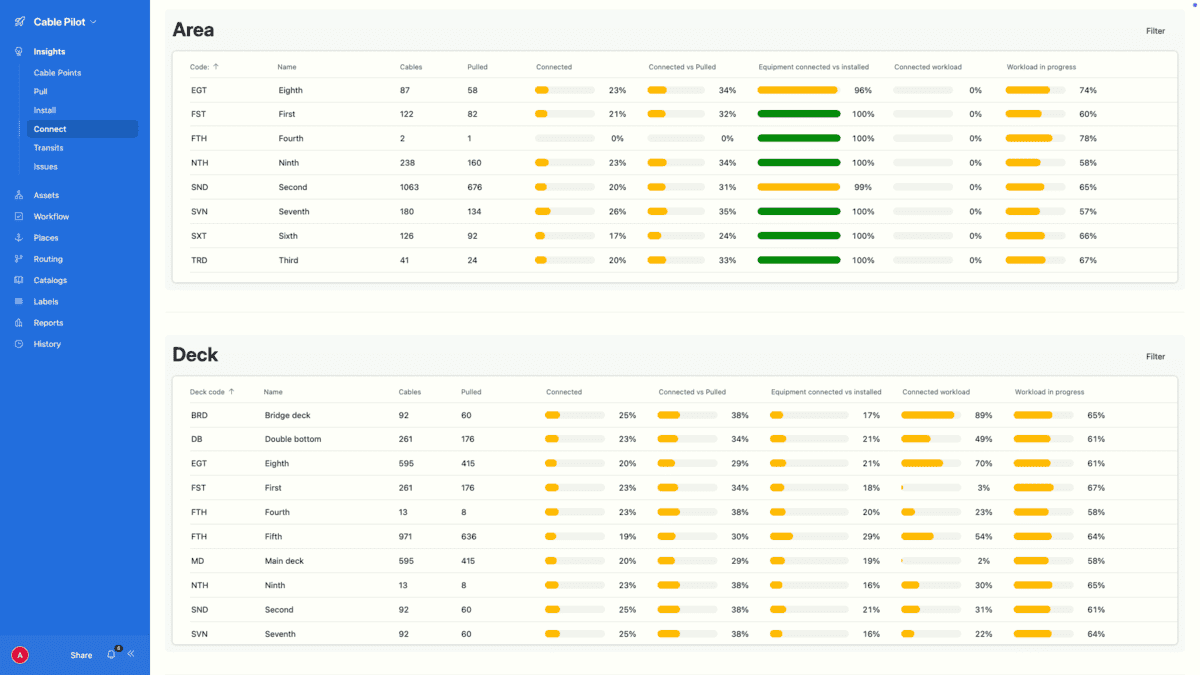
Progress history across both cable progress by discipline and system views is dynamic and interactive. The coordinator can select daily, weekly, or monthly granularity and see how completion has evolved over any period of the project. A flat curve in week 11 followed by a steep rise in week 12 tells a story that a single current-status figure never could. That progression becomes evidence for the conversations the coordinator needs to have about scheduling, resource allocation, and risk.
Deck-level progress introduces a distinction that is particularly useful on vessels where cable runs span multiple decks. Cable Pilot separates cables that originate and terminate on the same deck from transit cables that pass through a deck, tracking each group independently by count, length, and status. A coordinator who sees that Deck 3’s own cables are 80 percent pulled but that transit cable progress is at 40 percent knows immediately where to direct the next planning conversation and which crews need additional support.
Category-level progress mirrors the discipline and system breakdowns, giving the coordinator a view organized by cable type rather than by functional grouping. If armoured power cables in a specific category are lagging while instrumentation cables in the same zone are ahead, that breakdown surfaces the problem before it becomes a schedule risk.
Cable Points: Labor-Weighted Progress That Reflects Real Workload
Progress bars that count individual cables treat a three-metre sensor lead the same as a 200-metre armoured power cable. A coordinator who relies on piece-count percentages for cable management in shipbuilding will consistently over-report progress in the early weeks of a project—when the short, accessible cables get done quickly—and face an uncomfortable conversation in the final month when the complex, high-density runs remain incomplete. The numbers looked fine right up until they did not.
Cable Pilot addresses this through Cable Points, a workload-weighted metric for connection labour that is calculated automatically from each cable’s specification data. Cable Points do not require manual estimates or additional data entry once the cable list has been imported. The specification record already contains the cable’s type, diameter, core count, and termination characteristics—the attributes that determine how much labour a connection actually requires. Cable Points are derived from those attributes directly.
The system tracks five Cable Points values per discipline: CP according to the specification, total CP, in-progress CP, connected CP, and completed CP. A coordinator comparing two contractors or two vessel zones using Cable Points is comparing actual workload completed, not raw counts that ignore complexity. The discipline reporting the higher cable count may still be behind on workload if its remaining cables are heavier, larger-diameter runs with more cores to terminate.
Cable Points appear as a KPI card on the Insights dashboard alongside total length and cable count—three metrics that together give a much more honest picture of where the project actually stands than any one of them alone. The metric does not replace length-based tracking. It adds a dimension that piece-count reporting structurally cannot provide. For the coordinator preparing a weekly report to the project director, the ability to say “we are 67 percent complete by Cable Points” carries significantly more credibility than “we have pulled 71 percent of cables by count”—because Cable Points account for what is left, not just what is done.
From the Tuesday Meeting to Instant Answers
Return to that Tuesday morning scene. The same coordinator, the same contractor superintendent, the same question about Deck 4. The difference is that this time, the coordinator opens a laptop, pulls up the web platform, and the answer is already there.
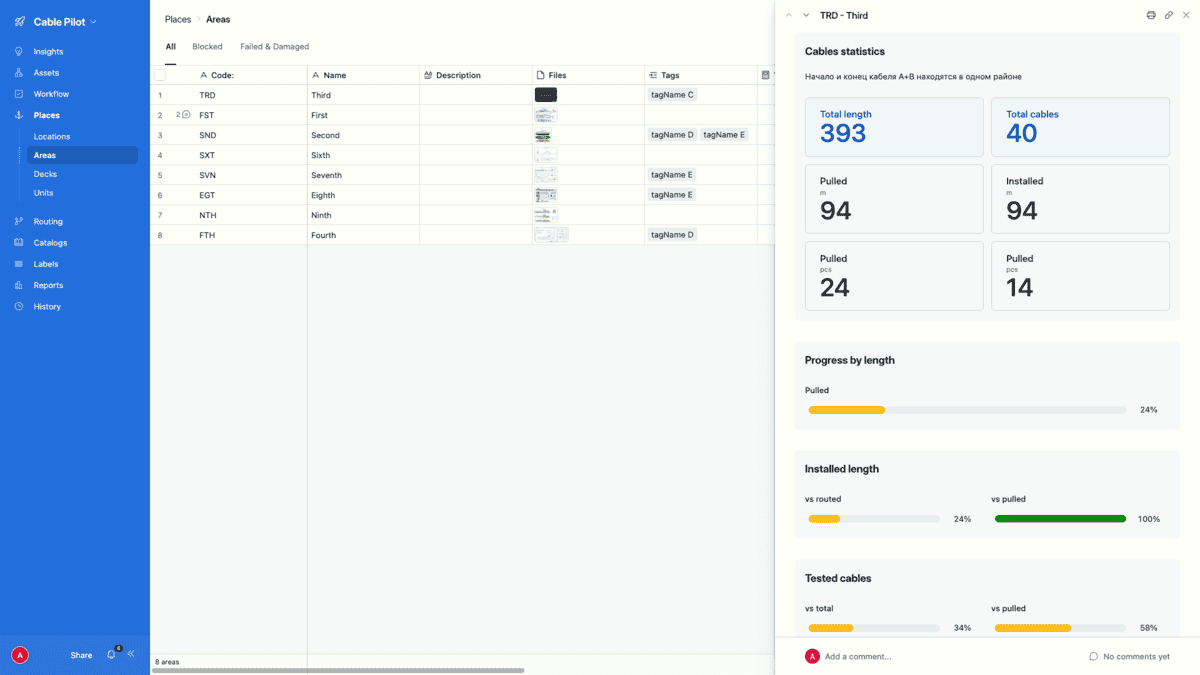
Because every field status update flows immediately to the central platform, the dashboard reflects actual site progress at the moment of the meeting—not last Thursday’s reconciled file. The area-level detail panel shows pulled metres, installed metres, and piece counts with horizontal progress bars, giving zone-by-zone answers without any manual pivot work. Deck 4 is not an aggregation someone ran last night. It is a live view of what the crews reported from the field this morning.
The field supervisor standing on Deck 4 sees the same data on their smartphone. The route-level cable list shows each cable’s individual status—Created, Started, Pulled, Connected, Approved—without the supervisor needing to call the office or wait for a printed update. What they see in the corridor is the same record the coordinator is looking at in the meeting room. This synchronisation prevents the discrepancies that plague traditional project management.
The 400-metre discrepancy cannot occur in this environment because there is no second spreadsheet to disagree with the first. There is one record per cable, updated by the person doing the work, visible to every authorised user the moment the update is confirmed. The question “which length are we talking about?” has a structured answer: pulled length, installed length, or connected length—each tracked separately, each drawn from the same single record.
Real Cable Import and Classification Society Compliance
For many shipyards, the most time-consuming part of starting a cable management in shipbuilding workflow is building the initial cable list. When engineering provides a list of thousands of cables in a spreadsheet or database export, manually transcribing them into a new system becomes months of work.
Cable Pilot’s cable import engineering data feature uses AI-powered import from Excel spreadsheets and structured engineering tables. Rather than manually recreating the list, the coordinator can upload the engineering package directly. The system maps common column headers, validates the data, and creates cable records in bulk. Where ambiguities exist, the system prompts for clarification rather than guessing.
This matters particularly for projects subject to classification society requirements. The system maintains full audit trails showing when each cable record was created, who modified it, and what changed. This documentation flow is essential when a classification society audits the project. The audit trail becomes evidence that the cable management process was controlled and documented throughout.
For shipyards managing multiple vessel classes and classification societies, Cable Pilot stores discipline and system hierarchies that conform to each classification society’s structural requirements. When an engineer marks a cable as belonging to the “Main Switchboard” system, the system validates that this assignment conforms to the applicable classification society rules. This validation happens at data entry time, not during a pre-delivery audit when corrections become costly.
Practical Implementation: What Project Managers Should Know
The transition from spreadsheet management to Cable Pilot typically happens in three stages. First, the coordinator creates the core cable list through cable import engineering data. This is not a months-long process. Most cable lists load in days. Second, field crews begin using the smartphone app to report cable status. This usually starts with a pilot on a single deck or area, then expands across the project. Third, the coordinator begins using the dashboard reports to inform planning decisions rather than relying on reconciled spreadsheets.
The most successful implementations use Cable Points from the beginning. Rather than treating Cable Points as a nice-to-have metric added later, coordinators who integrate Cable Points into their weekly reporting immediately get more accurate progress visibility. This changes how conversations happen in planning meetings. Instead of debating whether 71 percent of cables by count represents real progress, the discussion focuses on actual workload completed.

Role-based access control means different users see different capabilities. A field electrician sees the cable record for the cables they are assigned to pull. A site supervisor sees all cables on their assigned deck. A project coordinator sees the entire vessel. A classification society auditor sees read-only access to audit trail information without the ability to modify any records. This structure protects data integrity while still allowing the flexibility that different roles require.
Handover and Project Closure
As a vessel approaches final stages, the focus of cable management in shipbuilding shifts from tracking pulling progress to generating handover documentation. Cable Pilot generates handover packages that consolidate all cable information: final status, test records, as-built lengths, penetration documentation, and photo records. This package becomes part of the permanent vessel documentation.
Segregation statistics—the tracking of power, instrumentation, and signal cables against fire zones and other separation requirements—are calculated automatically as cables are marked as installed. The coordinator does not need to build a spreadsheet to verify compliance. The system shows segregation status continuously throughout the project.
For future surveys and maintenance, the cable list and all associated documentation become a reference baseline. When a surveyor needs to understand the cable configuration years later, they can reference the documented as-built record from Cable Pilot rather than reconstructing the configuration from paper archives or outdated drawings.
Making Cable Management in Shipbuilding Efficient
If your current progress meetings still depend on reconciling three different spreadsheets, if your cable list sprawls across multiple files updated independently, or if you cannot answer “how many metres pulled?” without 30 minutes of data collection, then Cable Pilot’s cable management in shipbuilding solution is worth an hour of your time.
The platform is specifically built for the complexity of modern vessel projects: thousands of cables, multiple disciplines, distributed teams across the shipyard and contractor offices, and the need for both real-time field visibility and long-term project control. Request a demo at cablepilot.com and the team will walk through the system using a real vessel dataset. You will test the logic against the kind of project complexity you actually manage, not against a simplified demonstration scenario.
Cable management in shipbuilding does not have to depend on reconciling spreadsheets and hoping the numbers agree. One record per cable, one place it lives, and one version that everyone reads. That principle transforms how electrical projects operate.