
You’re in the final round of construction bidding for a major shipbuilding project. You know your team can deliver superior quality. You know your processes are solid. But then the news comes in: your competitor has underbid you by 10%.
How do you respond? How do you turn your project estimation into a competitive advantage to convince the client that your slightly higher price is actually the lower-risk, higher-value proposition?
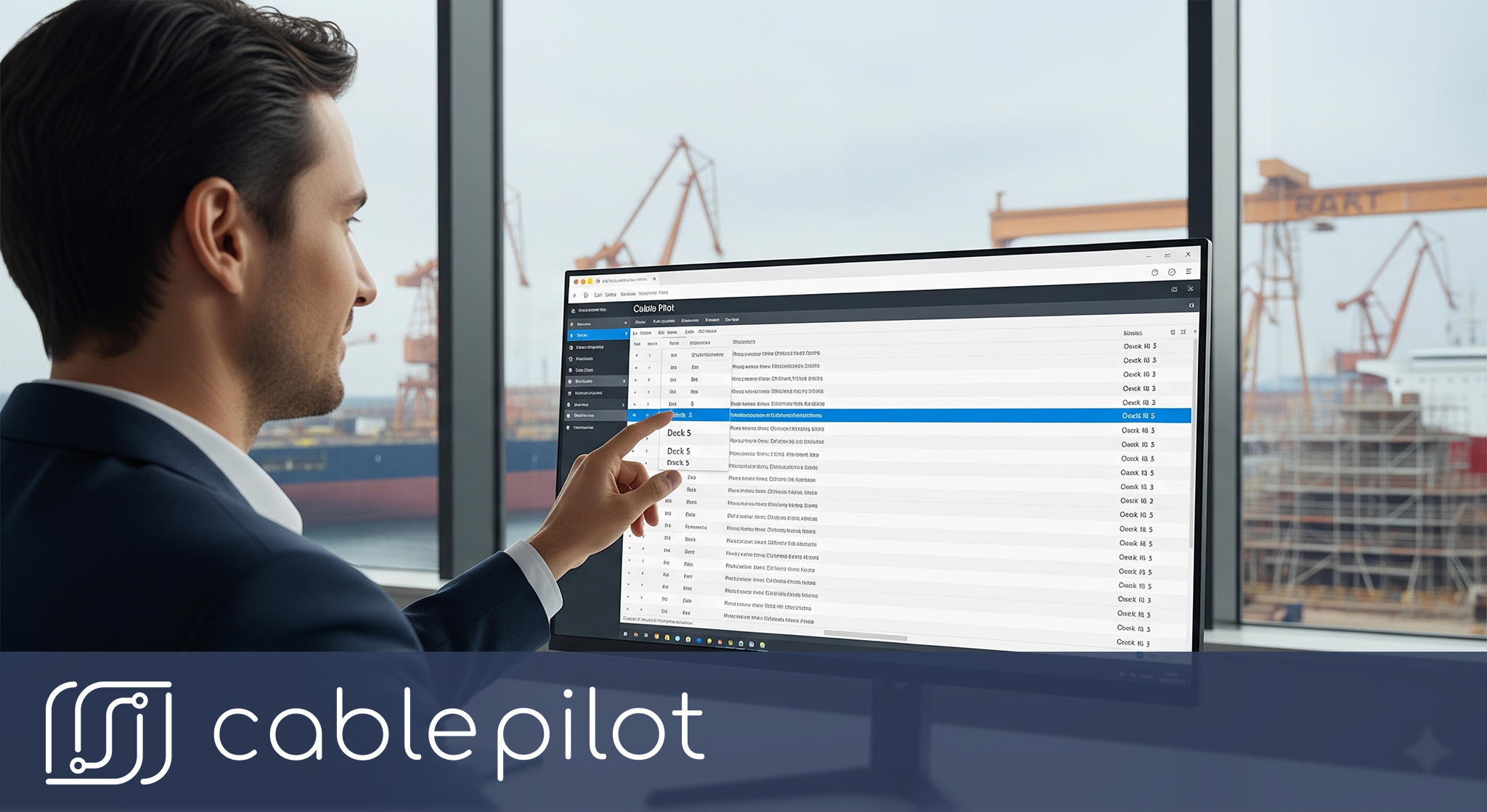
For most companies, this is where the battle in construction bidding is lost. When your project estimation is built on industry averages, educated guesses, and intuition, it’s just a number on a page. It’s a “magic number” that is indistinguishable from your competitor’s, except for the price tag. You are forced to compete on price alone, a race to the bottom that squeezes margins and rewards unrealistic promises.
But what if your construction bidding wasn’t just a number? What if it was data-driven tendering, a verifiable proof of your company’s competence, predictability, and professionalism?
In this case study, we will show you how to stop selling a price and start selling predictability. We will demonstrate how historical project data captured in a platform like Cable Pilot becomes your most powerful competitive advantage, allowing you to build bids through data-driven tendering that are not just competitive, but compellingly convincing.
The Problem: The Battle of Magic Numbers
A traditional bid is a house of cards. It’s built on a fragile foundation of assumptions:
- “A project of this size usually takes about 12 months.”
- “Our gut feeling is that we’ll need a team of 15 electricians.”
- “The market rate for this kind of work is ‘X’, so we’ll bid slightly below that.”
When a client receives two proposals like this, they have no objective way to evaluate them beyond the final number. They cannot see the methodology, verify the assumptions, or gauge the realism of the plan. In this scenario, choosing the cheaper option is the only logical path, even if it’s the riskier one. The company with the most realistic plan often loses to the company with the most optimistic (or reckless) price.
The Turning Point: Selling Predictability, Not Just a Price
To win in construction bidding and create a competitive advantage, you must change the conversation. You need to shift the client’s focus from “Who is the cheapest?” to “Who is the most reliable?”
This is impossible without evidence. You need to move from making promises to presenting proof. Historical project data from every project you’ve completed is a library of that proof. A system like Cable Pilot, which captures granular data on every single task, turns that history into a powerful asset for construction bidding.
It allows you to build your project estimation not on assumptions, but on a foundation of hard, historical project data.
From Data to Deal: Building an Unbeatable Proposal
Let’s walk through how a Project Manager uses historical project data from Cable Pilot to construct a construction bidding proposal that is nearly impossible for a competitor to beat on value.
1. Start with an Objective Scope
Instead of giving a subjective estimate, you begin with a verifiable calculation.
- The Pitch: “Based on the cable list you provided, we’ve calculated the total project workload to be 720,000 Cable Points (CP). This isn’t an estimate; it’s a mathematical calculation of the effort required, based on the specific properties of every cable in your project.”
- The Advantage: You have immediately established a baseline of objectivity. You are discussing the project’s true “size” in a standardized unit, moving beyond vague comparisons.
2. Prove Your Performance
Next, you connect that objective scope to your team’s proven performance using historical project data.
- The Pitch: “Our data from three recent, similar projects shows that our teams’ average productivity is 12,000 CP per week. Therefore, we can confidently project a timeline of 60 weeks. We can even share anonymized weekly performance reports from those projects to validate this.”
- The Advantage: You have replaced a “gut feeling” timeline with a data-driven forecast. You are showing the client your exact math, building a powerful case for your reliability.
3. Justify Your Price
Your pricing is no longer a “magic number,” but a transparent calculation based on real-world costs.
- The Pitch: “Our bid is based on our historical, verified cost per CP. This rate reflects our true cost of delivering quality work with our skilled teams. We can walk you through this calculation.”
- The Advantage: This transparency is disarming. While competitors present a single, opaque number, you are opening your books (figuratively) and showing the client that your price is fair, realistic, and based on proven efficiency, not arbitrary market rates.
4. Sell Proactive Risk Management
You can use historical project data to show that you don’t just react to problems—you anticipate them.
- The Pitch: “Our analysis of past projects shows that the most common blockers on this type of vessel are related to obstructed cable paths in the engine room. Our project plan includes a dedicated pre-inspection phase for these areas to mitigate this specific risk before it can cause a delay.”
- The Advantage: You are demonstrating a level of operational maturity that your competitors cannot match. You are selling experience, not just labor.
5. Offer Radical Transparency
Finally, you make an offer that no competitor relying on spreadsheets can match.
- The Pitch: “And to ensure complete alignment, from day one you will have a read-only ‘Guest’ account with access to the same live project dashboard we use. You will see the same progress we see, in real-time.”
- The Advantage: This is the ultimate trust-builder. You are removing any possibility of doubt or suspicion. You are not just promising transparency; you are delivering it as a core feature of your service.
Conclusion: Your History is Your Future
In a competitive bidding environment, the company with the best data wins. While your competitors are selling a price based on hope and assumptions, you are selling a predictable outcome based on history and facts.
By leveraging the rich data captured in a system like Cable Pilot, you transform your past performance into your most powerful sales tool. You shift the conversation from price to value, from risk to reliability, and from promises to proof. This is how you stop competing in a race to the bottom and start winning the projects you deserve.
Ready to turn your project data into a competitive advantage? Learn how Cable Pilot’s analytics can help you build winning bids.