
The maritime industry is witnessing an unprecedented surge in AI marketing promises, with every software solution claiming revolutionary artificial intelligence capabilities. Yet amid this technological noise, Cable Pilot takes a fundamentally different approach – positioning AI not as the main attraction, but as a sophisticated digital assistant designed to solve real engineering challenges in electrical installation management.
Important Note: The AI features described in this article represent Cable Pilot’s planned development roadmap and are not currently implemented in the platform. These capabilities are being designed and developed based on extensive research into shipbuilding electrical installation challenges and user feedback from our current platform users.

The Reality Behind AI Hype
Today’s market is saturated with AI solutions that promise to transform entire industries overnight. However, many of these applications focus on impressive demonstrations rather than addressing the daily operational challenges that engineers and project managers actually face. In shipbuilding, where precision, documentation accuracy, and timeline adherence are critical, flashy AI features without practical substance can become costly distractions.
The maritime sector has seen numerous software vendors rush to market with “AI-powered” solutions that amount to little more than basic pattern recognition or simple automation wrapped in artificial intelligence marketing language. These solutions often create more complexity than they solve, requiring extensive training periods and producing results that still need significant human verification and correction.
As Albert Einstein once observed, “A tool is only as good as the person using it, and a person is only as good as the tools they have.” This wisdom perfectly captures Cable Pilot’s philosophy – AI should enhance human expertise, not replace it or exist for its own sake.
Understanding Shipbuilding’s Unique Challenges
Electrical installation in modern shipbuilding presents extraordinary complexity that generic AI solutions simply cannot address. A single vessel might contain thousands of cables, hundreds of electrical panels, and countless connection points, all of which must be precisely documented, tested, and validated according to stringent maritime regulations and classification society requirements.
Industry studies indicate that electrical engineers typically spend 40-60% of their project time on documentation validation and cross-referencing tasks rather than actual engineering problem-solving. This administrative burden not only reduces productivity but also increases the likelihood of errors when engineers rush through routine validation tasks to focus on more critical work.
The coordination between multiple contractors, system integrators, and shipyard personnel creates additional layers of complexity. Each stakeholder works with different documentation formats, follows distinct procedures, and operates under varying schedules. Traditional project management tools struggle with this multi-faceted environment, leading to communication gaps, documentation inconsistencies, and costly rework that can extend project timelines by 15-25%.

Engineering-Focused AI Applications
Cable Pilot’s planned artificial intelligence functionality is being purpose-built around the specific pain points that plague electrical installation projects in shipbuilding. Rather than generic AI features, the platform will incorporate intelligent automation for tasks that traditionally consume hours of engineering time:
Document Cross-Referencing and Validation The planned AI will continuously monitor project documentation, automatically cross-checking electrical drawings against equipment and cable names and types, cable connections, and installation requirements. When discrepancies arise – such as cable types that don’t match in two documents – the system will immediately flag these issues for engineer review.
Intelligent List Management Cable and equipment lists require constant updates as projects evolve. Cable Pilot’s future AI will track changes across all project documents, automatically updating lists when new equipment is added or specifications change, while maintaining version control and change history.
Incomplete Information Detection One of the most time-consuming aspects of electrical installation management involves identifying missing or incomplete connection information. The planned AI will scan through technical documentation, identifying gaps in connection details, missing cable information, or incomplete equipment connection specifications before they cause delays on the installation floor.
The Digital Assistant Approach
Rather than positioning AI as a replacement for engineering judgment, Cable Pilot is designing it as what it should be – an intelligent assistant that handles routine, time-consuming tasks so engineers can focus on complex problem-solving and decision-making. This approach recognizes that in shipbuilding electrical installations, human expertise remains irreplaceable for critical engineering decisions.
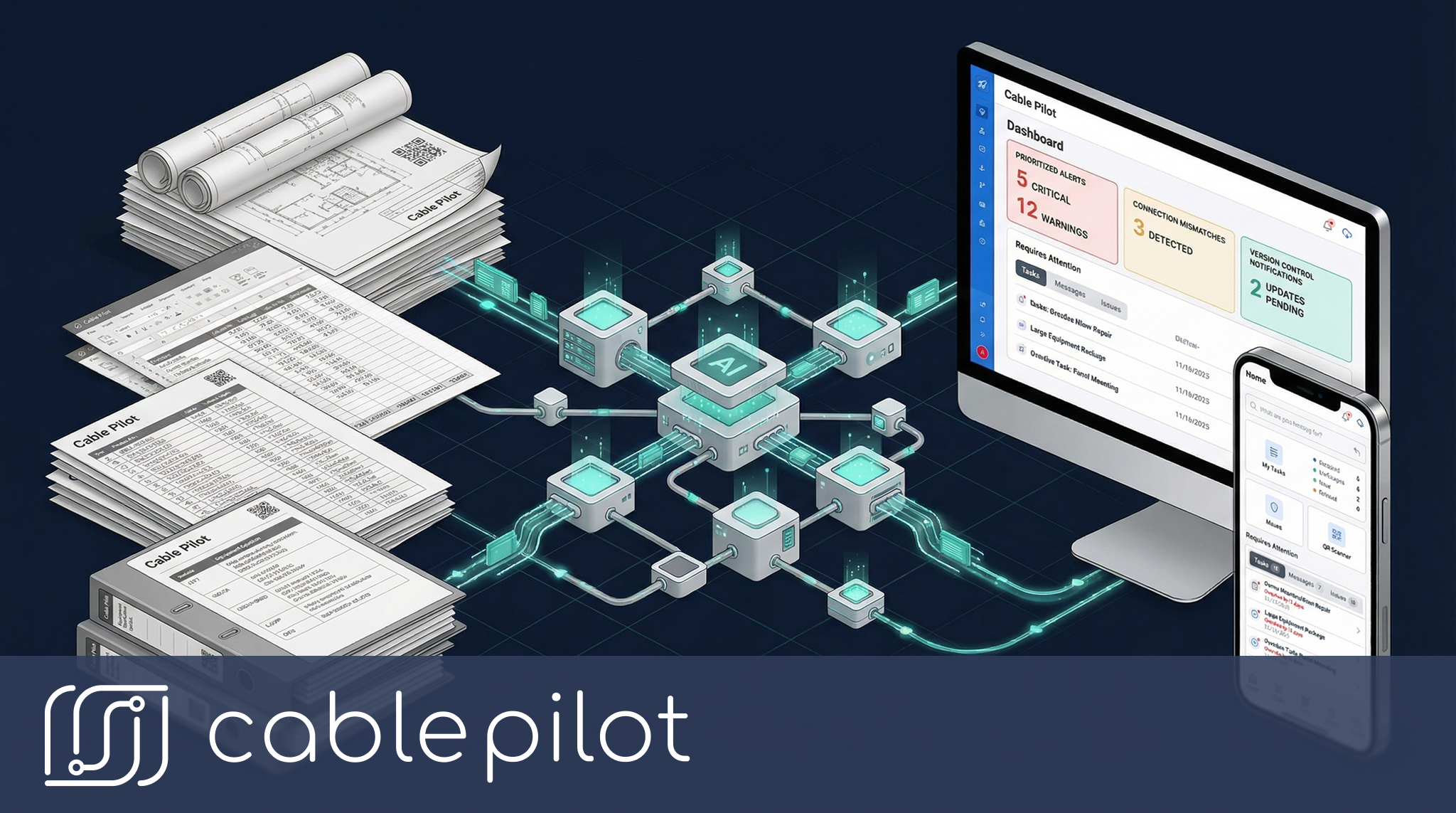
The platform’s planned AI will work behind the scenes, processing vast amounts of project data while presenting engineers with clear, actionable insights. When the system identifies potential issues, it won’t make decisions – it will present findings to qualified professionals who can apply their experience and judgment to determine the appropriate response.
Practical Implementation Over Theoretical Promises
Cable Pilot’s AI development focuses on measurable improvements in project efficiency rather than impressive but impractical capabilities. The system is being designed to learn from project patterns, helping predict potential bottlenecks in electrical installation schedules and identifying recurring documentation issues that could be prevented through improved processes.
As management consultant Peter Drucker noted, “Efficiency is doing things right; effectiveness is doing the right things.” Cable Pilot’s planned AI prioritizes both – efficiently automating routine tasks while ensuring engineers can effectively focus on the strategic aspects of electrical installation management.
Real-World Impact
This practical approach to AI implementation is designed to deliver tangible benefits that project managers can measure: reduced time spent on document validation, fewer installation delays due to incomplete information, and improved coordination between contractors and shipyard teams. The AI won’t create flashy reports or generate impressive visualizations – it will quietly ensure that the foundational data and documentation supporting electrical installations remain accurate and complete.

The result will be a digital ecosystem where artificial intelligence serves its proper role: augmenting human capabilities rather than attempting to replace them, solving specific operational challenges rather than pursuing technological novelty, and delivering measurable value rather than impressive demonstrations.
Would you like me to adjust the tone to be more technical or include specific metrics about anticipated time savings and efficiency improvements?