
In shipyards across the globe, a silent productivity drain siphons away thousands of skilled labor hours from every major electrical installation project. Electricians, whose expertise lies in pulling cables through complex vessel structures and connecting sophisticated electrical systems, spend 30 to 60 minutes each day performing an entirely different task: filling out paper logs, transcribing serial numbers into spreadsheets, and waiting for supervisors to manually consolidate their reports. This administrative burden—known in the industry as the “reporting tax”—transforms highly paid craftspeople into data entry clerks, creating a cascade of delays, miscommunication, and expensive rework that threatens project timelines and profit margins.
The financial impact is staggering. A crew of 20 electricians losing just 45 minutes daily to manual reporting burns through 150 labor hours per week. Over a 12-month vessel project, that compounds to 7,800 hours at a fully loaded cost of approximately $65 per hour—more than $500,000 consumed by paperwork instead of productive installation work. This calculation doesn’t include downstream costs: supervisors spending additional hours consolidating fragmented reports, Project Managers making critical decisions based on day-old data, and rework triggered when paper-based tracking fails to reflect installation reality.
Cable Pilot’s QR-coded cables and mobile reporting system eliminate this waste entirely. By compressing installation updates from a multi-step, end-of-shift process into a single 10-second scan, the platform revolutionizes how electrical work is tracked, coordinated, and completed in modern shipbuilding. This isn’t simply digitizing an analog workflow—it’s fundamentally redesigning field data capture around the reality of electrical installation, where real-time updates, blocker logging, and accurate status visibility determine whether projects finish on time or spiral into costly delays.
The Hidden Reporting Tax: How Manual Data Entry Sabotages Shipyard Efficiency
Traditional electrical installation reporting in shipbuilding follows a pattern unchanged for decades. Electricians receive printed cable lists at morning briefings, work through their assignments throughout the shift, and make pencil marks on paper—checkmarks, dates, notes about obstacles encountered. At shift’s end, they transcribe this information onto formal reporting sheets or hand marked-up papers to supervisors.
Supervisors then face their own administrative marathon: collecting reports from multiple crew members, deciphering handwriting, consolidating conflicting information, and entering it into project tracking systems—typically Excel spreadsheets or email threads. By the time this data reaches Project Managers who need it for resource allocation and schedule decisions, it’s 12 to 24 hours old at best. During that lag, the installation landscape has already shifted: new obstacles discovered, priorities changed, contractors waiting on information that sits in someone’s notebook.
This information lag creates cascading inefficiencies throughout electrical workflow. When a supervisor needs to know whether a cable bundle is ready for testing, they can’t check a dashboard—they must call a supervisor who consults yesterday’s reports or physically walk the deck to verify. When coordinating electrical contractors with mechanical trades closing out a compartment, there’s no reliable way to confirm completion without physical inspections. When discrepancies arise between reported status and actual installation reality, tracking down the source requires digging through paper trails and often re-inspecting everything to be certain.

The financial costs compound rapidly across multiple vectors:
Direct labor waste: Each electrician spending 30 to 60 minutes daily on reporting represents 6 to 12 percent of productive time consumed by administration rather than installation work.
Supervision overhead: Supervisors dedicating 2 to 3 hours daily to consolidating and entering data that should already be digital, diverting attention from proactive management.
Coordination delays: Teams waiting hours or days for status information that should be instantaneous, creating idle time that compresses schedules and inflates costs.
Rework from stale data: Decisions made on outdated information lead to misaligned work, duplicate efforts, and missed dependencies that require expensive corrections.
Quality defects: Gaps between documented and actual installation status, discovered only during commissioning when corrections carry maximum cost.
For Project Managers overseeing electrical installation across complex vessels—coordinating multiple contractors, thousands of cables, and tight commissioning deadlines—this fog of delayed, fragmented information makes proactive management nearly impossible. Instead of preventing installation delays, they’re constantly reacting to problems that should have been visible and addressable hours earlier.
QR Magic: Auto-Generated Codes and Context-Aware Mobile Reporting
Cable Pilot eliminates the reporting tax by redesigning the electrical workflow around tools electricians already carry and actions they already perform. The system replaces multi-step end-of-shift paperwork with immediate, on-site field data capture that takes seconds and requires minimal training.
Automatic QR Code Generation: Print Once, Track Forever
When cable lists and equipment inventories are imported into Cable Pilot—either via the AI-powered importer that processes Excel files or through direct integration with electrical design systems—the platform automatically generates unique QR codes for every cable, equipment item, and compartment. These QR-coded cables can be printed on standard industrial label stock using any commercial label printer, creating physical tags that electricians affix to cables, terminal blocks, junction boxes, or equipment panels before installation begins.
Each QR code contains a unique identifier linking directly to that specific item’s record in Cable Pilot’s central database, including cable number, origin and destination points, cable type specifications, assigned compartment, system affiliation, and complete installation status history. For projects with thousands of cables, this initial labeling is typically completed in one to two days by installation prep teams—a one-time investment that enables instant mobile reporting for the entire project duration.
The labels are engineered for harsh shipyard environments: waterproof, oil-resistant, and durable enough to survive welding sparks, paint overspray, and constant handling throughout installation and commissioning. Many yards print labels in batches corresponding to specific compartments or installation packages, organizing them for efficient distribution to electricians as work progresses through the vessel.
Field Data Capture in 10 Seconds: Scan, Tap, Done
The actual reporting workflow—the part that previously consumed 30 to 60 minutes of each electrician’s day—is reduced to three actions totaling approximately 10 seconds:
- Scan the QR code using Cable Pilot’s smartphone app, which works on standard iOS and Android devices that electricians already carry or contractors provide.
- Tap the status button to indicate the action just completed: “Pulled,” “Connected,” or “Tested.”
- Optionally add a note or photo if there’s an issue, deviation, or blocker logging requirement that supervisors need to address immediately.
That’s the complete workflow. The update is recorded instantly with automatic timestamp and user identification. If the electrician is working in a vessel compartment without cellular or WiFi signal, Cable Pilot’s offline-first technology stores the update locally and automatically synchronizes when connectivity is restored—meaning the mobile reporting workflow never requires waiting, finding WiFi hotspots, or logging into computers to submit reports.
This simplicity is deliberate. Cable Pilot’s interface is optimized for installation reality: electricians wearing gloves, working in poorly lit spaces, needing to update dozens of QR-coded cables per day without interrupting work rhythm. Large status buttons can be tapped accurately even with work gloves. The app’s offline capability means dead zones in vessel interiors don’t create reporting backlogs. And because field data capture happens immediately—right when work is completed—there’s no end-of-shift memory exercise trying to recall which cables were finished hours ago.

For cables requiring more detailed information such as test results with specific voltage readings or continuity measurements, Cable Pilot supports quick data entry fields that appear based on the cable’s lifecycle status. An electrician completing a megger test can scan the QR code, tap “Tested,” enter the resistance value, and optionally photograph the test equipment display—all in under 30 seconds. This structured blocker logging ensures critical commissioning information is captured accurately and completely, eliminating the ambiguity of handwritten test logs.
Instant Visibility: From Scan to Dashboard in Real-Time
The moment an electrician taps “Connected” on their smartphone, that update becomes visible across Cable Pilot’s entire system. Supervisors see the status change on their dashboard within seconds. Project Managers monitoring overall compartment completion percentages see progress metrics update in real-time. Automated notifications trigger instantly if the update reveals an installation delay such as a cable marked “Cannot Pull” due to an obstruction. And the digital twin—Cable Pilot’s synchronized virtual representation of the electrical installation—reflects the new reality immediately.
This real-time updates capability transforms coordination dynamics throughout shipyard efficiency workflows. When a mechanical contractor asks whether electrical work is complete in a compartment they need to close out, the supervisor can check Cable Pilot’s dashboard and provide a definitive answer in seconds rather than waiting for end-of-day reports. When an inspection is scheduled, QA teams can filter the system to show only QR-coded cables marked “Tested” and verify that all required documentation including photos of test equipment readings is attached to each record.
For shipyards coordinating multiple electrical contractors working in parallel across different vessel sections, this single source of truth prevents the duplication and confusion that arise when each contractor maintains separate tracking systems. All parties—the yard’s Project Managers, individual contractors, and the vessel’s commissioning team—see the same real-time data, eliminating version control issues and disputes about actual completion status.
Cable Pilot’s notification engine adds another layer of shipyard efficiency. When a cable update reveals a problem such as a length discrepancy preventing pulling or a failed continuity test indicating damage, the platform immediately notifies the relevant supervisor via push notification, or email. This instant blocker logging and escalation means installation delays are addressed within hours rather than discovered days later during formal progress reviews, minimizing schedule impact.
Offline-First Technology: Dead Zones Don’t Stop Progress
One of the most significant barriers to mobile reporting adoption in shipbuilding is connectivity. Vessel interiors—especially engine rooms, tank spaces, and deep compartments—create wireless dead zones where cellular signals and WiFi networks can’t penetrate. Traditional cloud-based reporting systems become unusable in these environments, forcing workers to either wait until they return to areas with signal or revert to paper logs.
Cable Pilot solves this with offline-first technology specifically engineered for shipyard electrical workflow. The smartphone app synchronizes complete cable list data to each device, including all cable specifications, compartment assignments, and current status. Electricians can scan QR-coded cables and record status updates throughout their shift while working in signal-free compartments. The app queues these updates locally on the device.
The moment the electrician emerges to an area with cellular or WiFi connectivity—or even returns to their vehicle or the shipyard office at shift end—Cable Pilot automatically synchronizes queued updates to the central database. This synchronization typically completes within seconds and requires no manual intervention. From the electrician’s perspective, the workflow is identical whether they’re working with or without connectivity: scan QR code, tap status, move to next cable.
For supervisors and Project Managers, offline-first technology provides confidence that field data capture is comprehensive. Real-time updates appear on dashboards as soon as connectivity enables synchronization, but there’s no risk of missing data from dead zones. The system’s automatic sync ensures every status change reaches the central database, maintaining complete installation history even when crews work in the most challenging vessel environments.
This architecture distinguishes Cable Pilot from generic task management or inventory apps that assume constant connectivity. Shipbuilding reality demands offline capability, and Cable Pilot’s engineering reflects that requirement from the ground up.
Blocker Logging with Full Context: Resolve Issues in Hours, Not Days
Installation delays in electrical projects rarely stem from lack of worker effort—they result from unresolved obstacles that prevent progress. A missing cable terminator. An inaccessible compartment blocked by mechanical equipment. A design discrepancy where specified cable length is too short for the actual route. These blockers stop work cold, and in traditional paper-based workflows, they often remain invisible to management for 12 to 24 hours or longer.
Cable Pilot’s mobile reporting includes integrated blocker logging that captures obstacles with full context the moment they’re discovered. When an electrician encounters a problem preventing cable installation, they tap the “Blocker” button in the app, select the issue type from a predefined list—missing material, access restricted, design error, damaged cable, and others—and add a brief note explaining the specific situation. The app prompts them to capture a photo of the affected location or equipment, providing visual evidence that eliminates ambiguity.
This blocker report synchronizes to Cable Pilot’s central database immediately if connectivity is available, or as soon as the worker returns to a signal area if working in offline-first mode. The system instantly triggers notifications to relevant supervisors and coordinators based on blocker type: material issues notify procurement, access problems alert yard coordinators, design discrepancies route to engineering.

The supervisor receives the blocker notification on their smartphone or desktop within seconds or minutes of the field discovery. They see not just a vague complaint, but complete context: which cable is affected, exact location via compartment assignment, photo evidence, installer’s notes, and the worker’s contact information for immediate follow-up if clarification is needed. This rich field data capture enables rapid decision-making.
Contrast this with traditional workflows where an electrician notes “can’t pull cable P-327” on a paper list, that note gets transcribed into a supervisor’s report at shift end, the supervisor mentions it in a morning meeting the following day, and engineering finally receives a request for clarification 24 hours after the initial discovery. During that entire period, the affected cable—and possibly dependent work—remains stalled, and the electrician has moved on to other tasks, making real-time clarification impossible.
Cable Pilot compresses this resolution cycle from days to hours or even minutes. Blocker logging happens at the point of discovery. Notifications reach decision-makers instantly. Supervisors can coordinate solutions while the affected worker is still on site, often redirecting them to alternative work while the blocker is resolved. This rapid-cycle problem-solving prevents the idle time and schedule compression that drive installation delays.
Real-world data demonstrates the impact. Implementations tracking “time from blocker discovery to resolution” show average reduction from 2.3 days pre-Cable Pilot to 0.4 days post-implementation—an 83 percent improvement. This faster resolution directly translates to reduced crew idle time, fewer schedule disruptions, and improved overall shipyard efficiency.
Subcontractor Gains: Scoped Views and Performance Accountability
Shipbuilding electrical installations frequently involve multiple contractors working in parallel across different vessel sections or systems. This multi-party structure creates coordination challenges: each contractor needs visibility into their assigned work without being overwhelmed by other contractors’ tasks, while the shipyard needs aggregate oversight across all parties. Traditional paper-based or spreadsheet tracking systems struggle with this requirement, leading to fragmented visibility and finger-pointing when installation delays occur.
Cable Pilot’s role-based permission system elegantly solves this challenge. Each contractor’s electricians log into the mobile reporting app and see only their assigned QR-coded cables and compartments. They can scan, update status, and log blockers for their scope of work, but other contractors’ assignments remain invisible. This scoping prevents information overload while ensuring each party focuses on their responsibilities.
Simultaneously, the shipyard’s Project Managers and coordinators maintain system-wide visibility. Their dashboards display real-time updates across all contractors, compartments, and systems, enabling holistic oversight. They can filter views to examine individual contractor performance—completion rates, blocker frequency, quality metrics—or aggregate data to assess overall project status.
This transparency creates natural accountability. When a contractor reports that their assigned compartment is 100 percent complete, the yard can instantly verify via Cable Pilot’s records, which include timestamped status updates and photo documentation for every cable. There’s no need for trust-but-verify inspections or disputes about completion definitions—the data provides objective evidence.
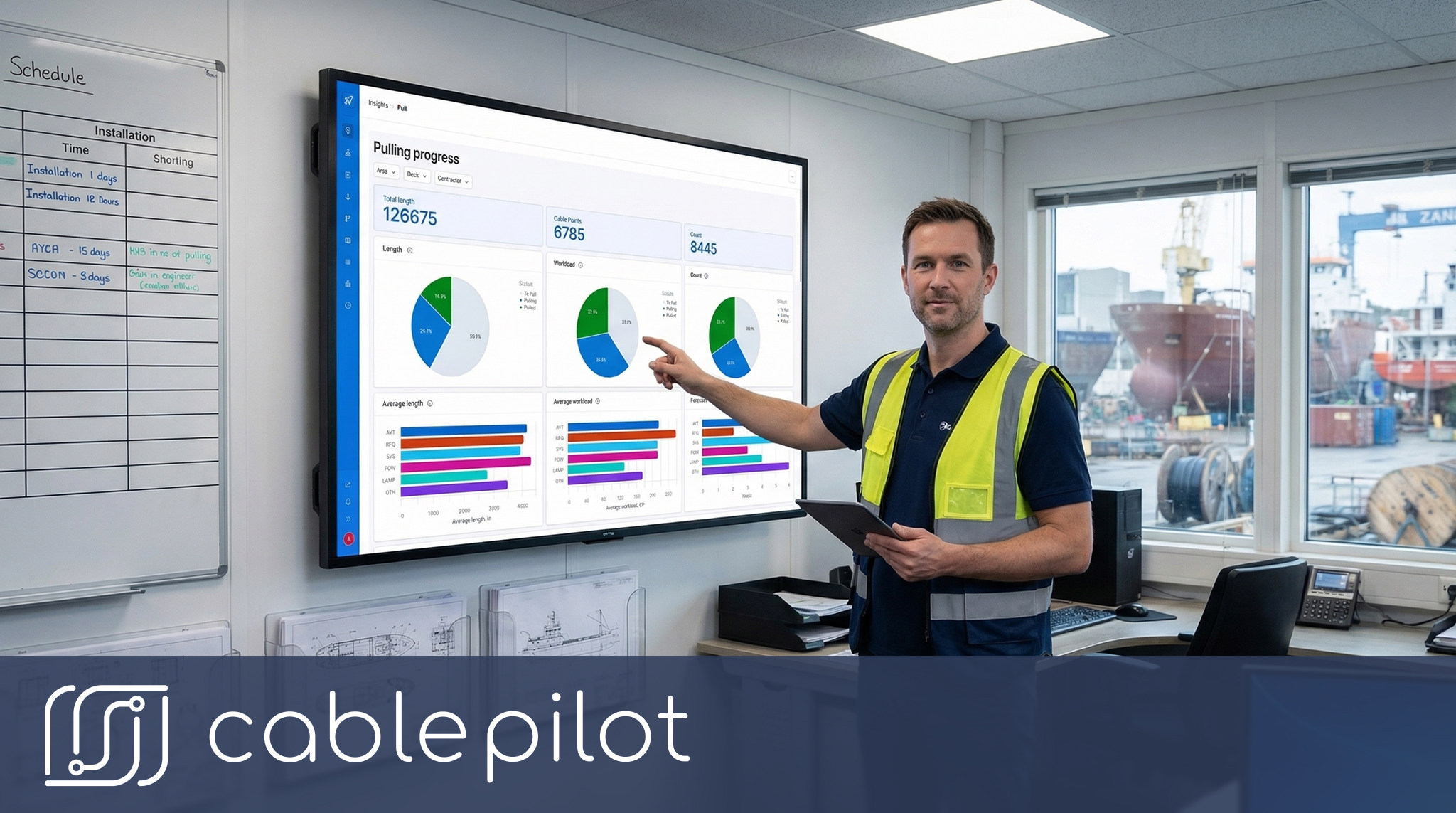
Cable Pilot’s Cable Points metric adds another layer of performance insight. Rather than simply counting cables completed—which treats a 5-meter jumper cable and a 200-meter multi-conductor main distribution cable as equivalent—Cable Points weight each cable by installation complexity, length, and labor effort. Contractor dashboards display Cable Points earned, providing fair recognition of work difficulty. Yard managers use Cable Points to compare contractor productivity on an effort-normalized basis, supporting objective performance evaluations.
For contractors, this accountability framework is advantageous. Their real-time updates with comprehensive field data capture provide documented evidence of work completion, supporting faster invoicing and payment processing. When disputes arise about schedule responsibility, Cable Pilot’s audit trail shows exactly when each contractor completed their tasks and what installation delays they encountered, enabling fair resolution based on facts rather than conflicting recollections.
The net result is smoother multi-contractor coordination, reduced disputes, and clearer accountability—all contributing to improved shipyard efficiency and reduced project risk.
ROI Proof: 94% Reporting Cut and 1.41 Hours Reclaimed Per Worker Daily
The business case for Cable Pilot’s QR workflow rests on measurable outcomes across multiple financial dimensions: direct labor savings, supervision efficiency, and downstream rework reduction.
Direct Labor Savings: Converting Reporting Time to Installation Time
Consider a typical electrical installation crew of 20 workers. Under traditional paper-based workflows:
- Each electrician spends 45 minutes daily on manual reporting and documentation
- 20 workers × 45 minutes = 900 minutes (15 hours) of labor consumed daily
- 15 hours per day × 250 working days per year = 3,750 hours annually
- 3,750 hours × $65 average loaded labor cost = $243,750 in annual reporting tax
With Cable Pilot’s QR-coded cables and 10-second mobile reporting:
- Reporting time drops to approximately 10 seconds per cable × 30 cables per day = 5 minutes daily
- 20 workers × 5 minutes = 100 minutes (1.67 hours) per day
- 1.67 hours per day × 250 working days = 417 hours annually
- 417 hours × $65 = $27,105 in annual reporting time
Net annual savings: $216,645 in reclaimed productive labor—equivalent to adding 1.6 full-time electricians to the crew at zero additional cost.
That’s a 94 percent reduction in time spent on reporting administration, with those hours redirected to actual cable pulling, connecting, and testing. For contractors operating on thin margins, this efficiency gain directly impacts profitability. For shipyards managing tight schedules, it accelerates project timelines without increasing headcount.
Supervision Efficiency: Eliminating the Consolidation Bottleneck
Labor savings extend beyond field workers to supervisory staff. Under traditional electrical workflow, supervisors typically spend 2 to 3 hours per day collecting, reviewing, and consolidating reports from their crews. For a project with four supervisors:
- 4 supervisors × 2.5 hours daily × 250 days × $85 loaded cost = $212,500 annually
Cable Pilot’s real-time updates eliminate consolidation work entirely because field data capture flows directly into the system without manual intervention. Supervisors still review progress—but via real-time dashboards rather than by processing paper. This shifts their role from administrative data entry to proactive management: identifying bottlenecks, addressing blocker logging escalations, and coordinating with other trades based on actual installation status.
Net annual savings: approximately $180,000 in supervisor time, assuming 15 percent still spent on progress review via dashboard rather than paper consolidation.
Combined direct and supervisory savings: $396,645 annually for a 20-person crew. For larger projects with 50 to 100 electricians, these savings scale proportionally, easily exceeding $1 million annually in reclaimed labor.
Downstream Benefits: Rework Reduction and Schedule Reliability
The less obvious but often more impactful savings come from better decision-making enabled by real-time data. When Project Managers make daily decisions based on accurate, current installation status rather than day-old reports containing errors or omissions, several expensive failure modes are prevented:
Rework from miscommunication: Paper-based tracking creates opportunities for cables to be missed, double-reported, or incorrectly documented as complete. When commissioning teams discover discrepancies during testing, the cost of correction is high: electricians must return to work they thought was finished, inspectors must re-verify, and schedules slip. Industry data suggests 3 to 5 percent of electrical installation labor hours are consumed by rework traceable to documentation issues. For a 75,000-hour project, preventing even half of this rework saves approximately $97,500.
Coordination delay elimination: Real-time updates enable tighter coordination between electrical contractors and other trades. When mechanical systems need compartment access or painting schedules depend on electrical completion, instant status information prevents the idle time that occurs when teams arrive expecting work to be ready but find it’s not. Reducing coordination-related delays by just 2 percent across a project timeline can save weeks of schedule time, with corresponding cost avoidance measured in hundreds of thousands of dollars.
Commissioning efficiency: Accurate, complete test documentation attached to each cable record via mobile reporting eliminates the back-and-forth typical during commissioning: “Where are test records for cables P401 through P425?” “Who signed off on this continuity test?” “The megger reading isn’t documented.” With Cable Pilot, test data flows directly from smartphone to cable record, complete with timestamps, photos, and tester identity. This reduces commissioning duration and prevents scenarios where vessels remain dockside while documentation issues are resolved.
Conservative estimates suggest these downstream benefits add $150,000 to $300,000 in value for a mid-sized vessel project, primarily through schedule acceleration and reduced rework.
Total annual value for a 20-person electrical crew: $500,000 to $700,000 in combined labor savings, supervision efficiency, and downstream quality improvements—all from eliminating the reporting tax through QR workflow and real-time updates.
Easy Rollout: From Cable List Import to Full Adoption in Days
One of Cable Pilot’s most compelling advantages is rapid implementation. Unlike enterprise software requiring months of configuration, electrical contractors and shipyards typically reach full productivity within one to two weeks.
Phase 1: Data Import and QR Code Generation (1 to 3 Days)
Implementation begins by importing cable lists into Cable Pilot. The platform’s AI-powered importer accepts Excel spreadsheets, CSV files, or even scanned PDFs containing cable schedules. The system automatically extracts cable identifiers, origin and destination points, cable type specifications, assigned compartments, systems, and installation parameters.
For most vessel projects with 5,000 to 15,000 QR-coded cables, this import and validation process takes 4 to 8 hours of effort. Once imported, Cable Pilot generates unique QR codes for each cable,equipment, unit, location which are then printed on durable, waterproof label stock using standard industrial label printers. Label printing for a large vessel can be completed in one to two days, producing batches organized by compartment or system for efficient distribution to installation crews.
Phase 2: User Onboarding and App Setup (1 Day)
Cable Pilot’s smartphone app is available via standard iOS and Android app stores. Electricians download the app, log in with credentials provided by supervisors, and the system automatically synchronizes their assigned cable lists to the device—typically completing in minutes even for lists containing hundreds of cables.
Formal training is minimal because the mobile reporting interface is intentionally simple: scan QR code, tap status button, optionally add note or photo. Most electricians become fully proficient within their first hour of use. For supervisors and Project Managers, a 30 to 60 minute orientation covers dashboard navigation, filtering, notification setup, and report generation.
Many contractors conduct training during morning toolbox meetings, with electricians using the app on real QR-coded cables that same afternoon.
Phase 3: Parallel Operation and Transition (Optional, 1 Week)
For organizations concerned about adoption risk, Cable Pilot supports parallel operation: electricians can continue existing paper reporting while also scanning QR codes, allowing supervisors to compare data accuracy and build confidence in the system. Typically, teams discover that Cable Pilot’s field data capture is more accurate and timely than paper reports, enabling rapid full transition.
Most projects skip parallel operation entirely, switching directly from paper to QR-coded digital mobile reporting—a testament to the system’s simplicity, reliability, and offline-first technology that ensures uninterrupted workflow even in connectivity-challenged vessel environments.
Within days of starting implementation, crews are capturing real-time updates, supervisors are monitoring dashboards, and Project Managers are making decisions based on current installation status rather than stale paper reports. The reporting tax is eliminated, installation delays are identified and resolved faster, and shipyard efficiency improves measurably.
Stop Paying the Reporting Tax: Start with Your First QR Batch
Every day that electrical installation teams spend filling out paper logs and consolidating reports is a day of unnecessary cost, delayed visibility, and preventable installation delays. The reporting tax—30 to 60 minutes per worker per day consumed by administrative overhead instead of productive work—drains hundreds of thousands of dollars annually from every major shipbuilding project while creating the information fog that prevents proactive management.
Cable Pilot’s QR-coded cables and mobile reporting eliminate this waste completely. By compressing installation updates from a multi-step, end-of-shift burden into a single 10-second scan, the platform transforms electrical workflow from paper-based reaction to real-time proactive coordination. Electricians reclaim 1.41 hours per day of productive time. Supervisors shift from data consolidation to exception management. Project Managers make decisions based on current reality instead of day-old reports. And blocker logging with full context enables issue resolution in hours instead of days.
The ROI is immediate and measurable: $500,000 to $700,000 in annual value for a typical 20-person crew through direct labor savings, supervision efficiency, rework reduction, and schedule acceleration. Implementation takes days rather than months, with offline-first technology ensuring the system works reliably even in the most challenging vessel environments where connectivity is limited.
For contractors, Cable Pilot delivers competitive advantage through faster project cycles, higher quality handovers, and documented accountability that supports rapid invoicing. For shipyards, the platform provides the single source of truth needed to coordinate multiple contractors efficiently, preventing the miscommunication and installation delays that arise from fragmented, outdated data.
The transition from paper to real-time is no longer optional. As vessel designs grow more complex, schedules compress, and quality standards tighten, the information lag created by manual reporting becomes increasingly untenable. Cable Pilot’s QR workflow demonstrates that real-time updates are achievable without exotic technology or prohibitive costs—just standard smartphones, cloud synchronization, intuitive interfaces, and engineering purpose-built for shipyard electrical workflow.
Ready to eliminate your reporting tax and gain real-time visibility into every cable, every compartment, every contractor? Visit cablepilot.com to request your trial setup and generate your first batch of QR-coded cables, or contact our implementation team for a 20-minute workflow consultation tailored to your specific vessel type and project structure. The reporting tax is optional—stop paying it today.