
The maritime industry stands at a pivotal crossroads. With global momentum toward decarbonization intensifying, hybrid and fully electric propulsion systems are reshaping shipbuilding fundamentals. The electrical systems market for ships reached USD 13,750 million in 2025, propelled by mandates from the International Maritime Organization (IMO) and regional regulations demanding reduced emissions. Hybrid propulsion now accounts for 66% of new vessel orders, transforming electrical installations from supporting role to mission-critical infrastructure.
This paradigm shift creates unprecedented challenges for shipyards and electrical contractors. A modern hybrid vessel integrates diesel generators, battery banks, shore power connections, DC-DC converters, and sophisticated energy management systems—all interconnected through high-voltage cable networks requiring meticulous segregation, shielding, and documentation. Traditional paper-based tracking methods and fragmented spreadsheets collapse under this complexity, leading to costly rework, commissioning delays, and compliance failures that jeopardize delivery timelines.
Cable Pilot emerges as the purpose-built solution for this electrified future. Designed specifically for maritime electrical installations, this digital platform transforms how shipyards coordinate contractors, track progress, and ensure quality across hybrid power architectures. By combining a hierarchical digital twin, QR-enabled mobile reporting, and AI-powered verification, Cable Pilot enables project managers to maintain single-source truth even as complexity multiplies. The results: yards implementing Cable Pilot for hybrid retrofits have labor reductions through faster blocker resolution, positioning themselves competitively in the rapidly expanding $58.8 billion electric ship market projected by 2035.
The Hybrid Propulsion Challenge: Why Traditional Methods Fail
Hybrid ship electrical installations differ fundamentally from conventional diesel-electric systems in scope, precision requirements, and regulatory scrutiny. A typical hybrid ferry or offshore support vessel contains four to six distinct power sources—main generators, auxiliary gensets, battery banks, and shore connection points—each feeding multiple switchboards through segregated cable routes. The battery integration alone introduces specialized concerns.
Consider the installation workflow for a single battery bank connection. Electricians must pull heavy-gauge DC cables (often 240mm² or larger) through dedicated cable trays, verify segregation distances from AC distribution, terminate lugs at both battery terminals and switchboard busbars, perform insulation resistance tests at specified voltages, and document torque values for every connection point. Multiply this by 200-300 cables across the hybrid system, factor in concurrent work by multiple contractors, and add the pressure of tight commissioning windows before sea trials.
When coordination relies on static cable lists exported from design software, information decay becomes inevitable. A Project Manager receives Monday morning reports showing 85% cable installation complete, only to discover during Thursday’s switchboard energization that six critical battery feeders lack proper test documentation—work performed three weeks ago but never logged systematically. Tracing responsibility across contractors, verifying actual field conditions against outdated drawings, and remediating issues consumes days of schedule float while the vessel sits at quayside accumulating delay penalties.
The regulatory dimension compounds these operational headaches. Classification societies and flag state inspectors demand comprehensive traceability for hybrid system electrical work: test certificates linked to specific cable identifications, photographic evidence of termination quality, and as-built documentation reflecting any field modifications. Manual compilation of this compliance package often requires dedicated administrative personnel spending weeks consolidating spreadsheets, photos stored in personal smartphones, and hand-written test logs—a process prone to gaps that trigger inspection holds.
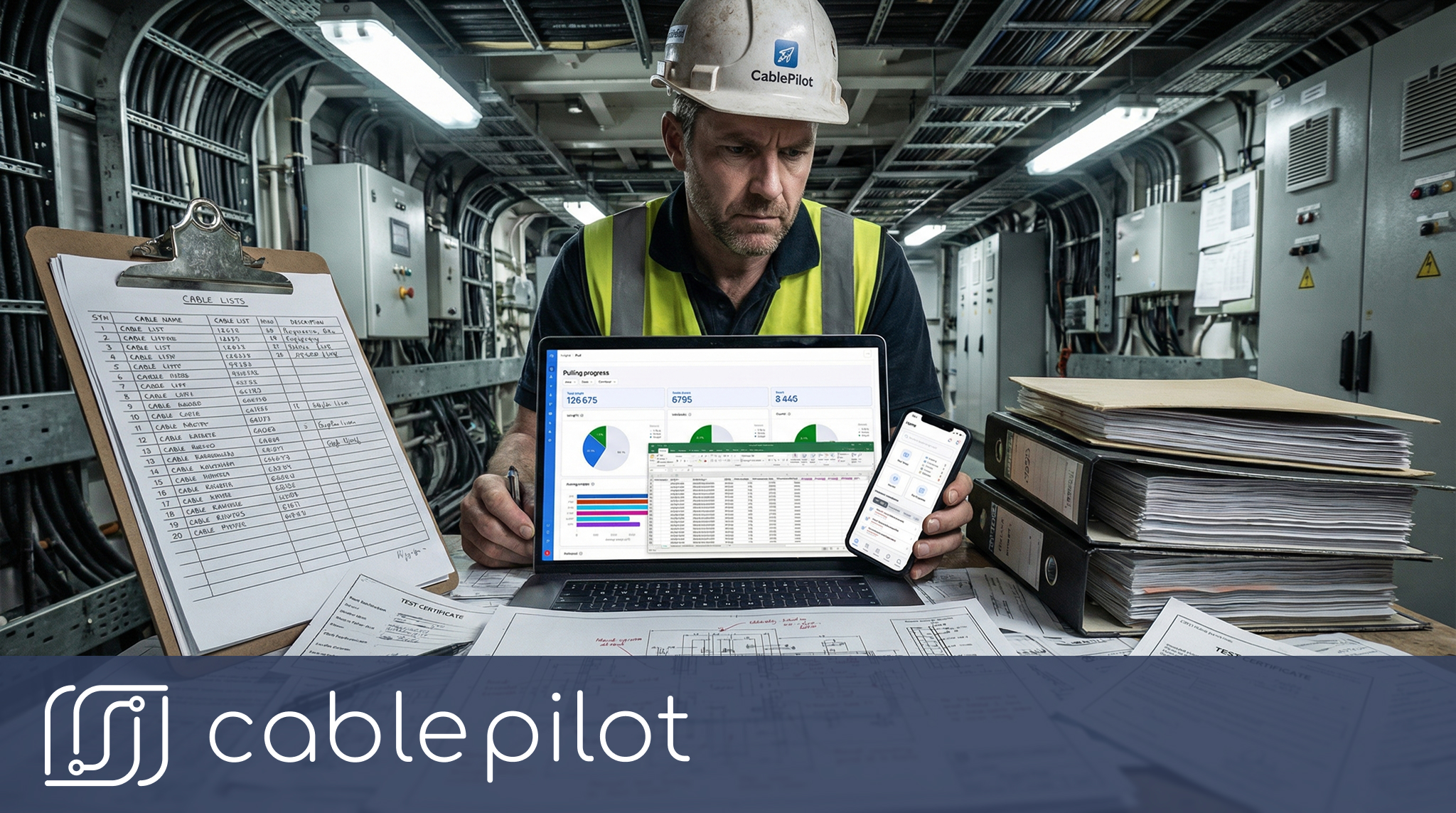
Cable Pilot replaces this fragmented approach with structured digital workflows that align naturally with hybrid installation realities. The platform’s strength lies not in generic project management capabilities, but in deep understanding of maritime electrical work encoded into every feature.
Digital Twin Architecture: Modeling Hybrid Power Hierarchies
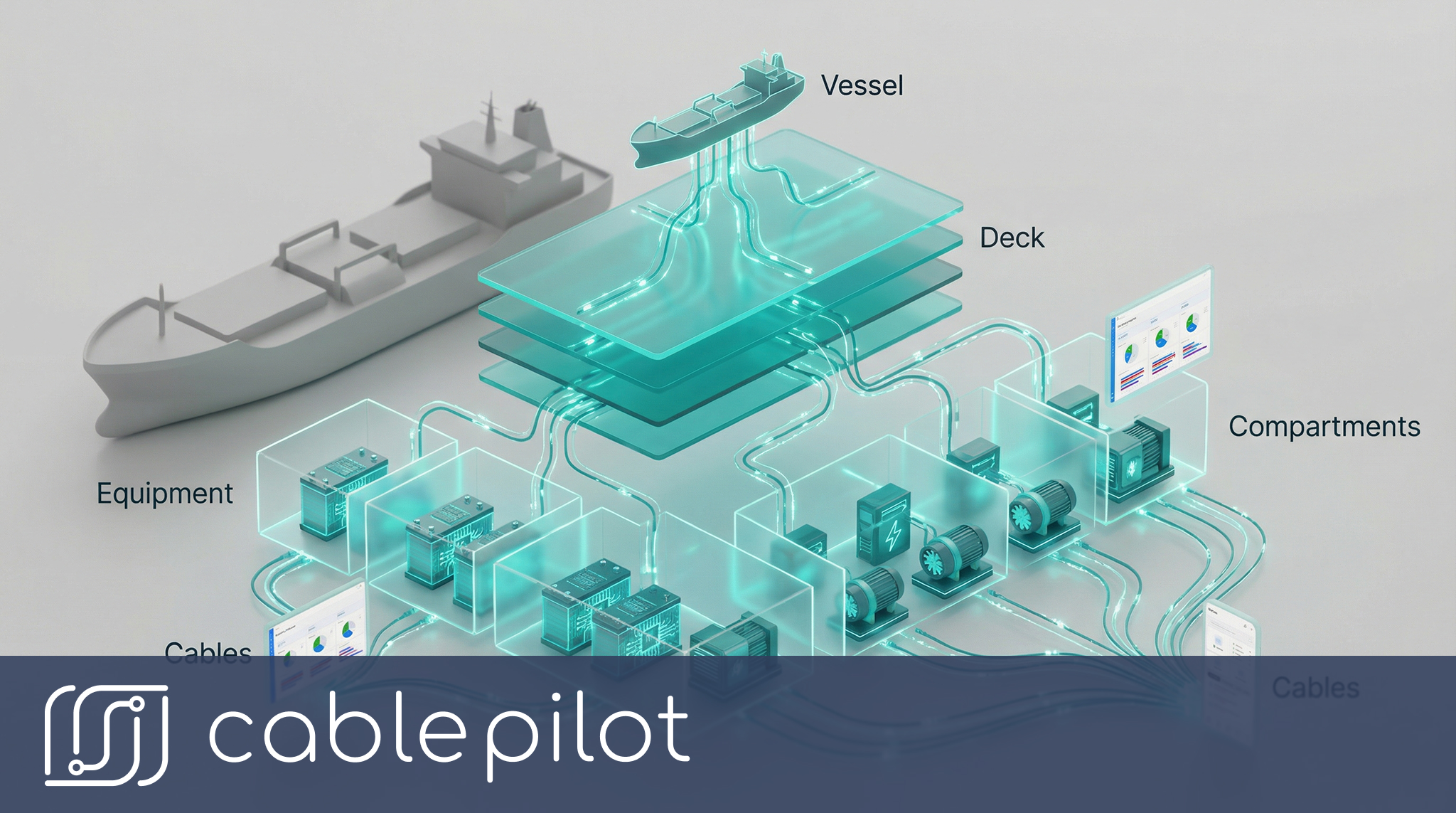
At Cable Pilot’s core sits an object-oriented digital twin that mirrors the physical topology of hybrid electrical systems with precision impossible in flat spreadsheets. The platform organizes installation data hierarchically: Vessel contains Decks and Areas, Decks contain Compartments, Compartments contain Equipment (generators, switchboards, converters), and Equipment connects through Cables. This structure captures the nested relationships defining hybrid architectures.
For a Project Manager coordinating battery bank installations, this hierarchy enables contextual tracking. Rather than viewing cables as disconnected line items, Cable Pilot presents them within their functional context. When a contractor reports completing a cable pull, the system automatically updates not just that cable’s status, but also calculates completion percentages for the associated equipment, compartment, and vessel-level milestones.
The digital twin accommodates hybrid system peculiarities that confound generic tools. Battery cables require different treatment than generator feeders—they carry DC rather than AC, demand specific insulation resistance test voltages (often 1000V DC instead of 500V AC), and must follow color conventions distinct from three-phase AC coding. Cable Pilot’s data model captures these distinctions through configurable cable and equipment categories, allowing the platform to enforce appropriate verification rules during field reporting.
Integration with design systems amplifies this capability. Cable Pilot imports data directly from CAD projects, preserving engineering specifications while adding installation-specific fields: actual route taken, installation date, field modifications, test results. This bidirectional connection ensures the digital twin remains synchronized with design intent even as field realities necessitate changes—a common occurrence in hybrid retrofits where battery placement adjustments ripple through cable routing.
QR-Enabled Mobile Reporting: Real-Time Tracking for High-Voltage Work
Cable Pilot’s smartphone application transforms field reporting from administrative burden into streamlined workflow integration. Each cable, equipment item, unit, and location receives a unique QR code printed on durable labels applied during installation prep. Electricians simply scan codes with their smartphones to log progress, upload photos, and flag issues—no paperwork, no end-of-day data entry sessions, no information lag.
For hybrid installations, this real-time capture proves especially critical given the high-voltage hazards and regulatory scrutiny involved. Consider a typical battery cable termination sequence. The electrician scans the cable’s QR code upon completition of termination, immediately registering the status and time in Cable Pilot. Insulation testing comes next: they enter the 1000V DC test result (500 MΩ), and Cable Pilot’s AI validation flags if the value falls below specification threshold.
This granular, timestamped data stream gives Project Managers unprecedented visibility. Rather than waiting for weekly contractor reports summarizing aggregate progress, they monitor Cable Pilot’s dashboard showing cable-level status updated every hour. When Battery Bank 02 installation suddenly stalls at 60% completion Tuesday afternoon, the Project Manager drills into the data, discovering four cables flagged with “Awaiting shield termination kit” notes. They immediately contact the material coordinator, who expedites kit delivery, resolving the blocker within hours instead of days. This rapid response capability—enabled by real-time mobile reporting—directly translates to schedule compression.
The mobile app’s offline functionality ensures reliability in the shipyard environment. Electricians working deep inside battery compartments or aft machinery spaces often lack cellular connectivity. Cable Pilot’s smartphone application caches data locally, allowing full scanning and reporting functionality without network access. Once the worker returns to a WiFi zone (or exits the vessel), queued updates automatically synchronize to the central database, preserving real-time characteristics without requiring continuous connectivity.
This proactive quality gate catches problems during installation when remediation costs pennies per occurrence, rather than during commissioning when rework disrupts the critical path.
For contractors, mobile reporting reduces administrative overhead dramatically. Instead of electricians spending 30-45 minutes at day’s end completing paper forms—transcribing cable IDs, sketching locations, stapling photos—they invest 10 seconds per cable scanning QR codes during actual work. This efficiency gain becomes substantial across a 200-cable battery installation: 33 labor hours redirected from paperwork to productive installation, equivalent to nearly one full work week per electrician.

Cable Points Adaptation: Quantifying Hybrid System Complexity
Cable Pilot’s Cable Points (CP) metric provides objective measurement of installation workload, essential for accurate planning and performance tracking in hybrid projects. Unlike simple cable or meter counts that treat a 1.5mm² signal cable identically to a 240mm² battery feeder, CP methodology assigns weights reflecting actual labor effort: cable cross-section, length, termination complexity, and installation difficulty factors.
Hybrid electrical systems demand CP adaptation to capture unique complexity drivers. Battery cables, for instance, carry higher CP values than equivalent AC power cables due to specialized handling requirements. A 150mm² battery feeder typically earns 1.4x the base CP of a same-gauge AC cable, accounting for DC testing protocols, polarity verification, and stricter segregation documentation. Shore power cables—which bridge vessel and quayside infrastructure through weather-tight connections—accumulate additional CP for their complex termination procedures requiring torque sequencing and seal verification.
The CP model also accommodates environmental installation factors crucial in hybrid vessels. Cables routed through battery compartments or passing near DC-DC converters (high electromagnetic interference zones demanding additional shielding verification) receive additional adjustment factors. These contextual adjustments ensure CP totals accurately reflect field reality rather than theoretical drawing conditions.
For Project Managers, CP metrics enable data-driven resource allocation. When planning the three-month electrical installation phase for a hybrid offshore support vessel, the PM calculates 47,500 CP across all systems: 22,000 CP for battery integration, 15,000 CP for main distribution, 10,500 CP for auxiliary systems. Historical productivity data shows electricians average 185 CP per day for hybrid work (versus 220 CP/day for conventional installations, given the additional verification requirements). Dividing total CP by daily velocity yields 257 labor days—equivalent to nine electricians working 29 days or six electricians working 43 days. This quantitative forecast guides contractor staffing negotiations and informs realistic schedule development.
CP tracking during execution reveals productivity trends and early-warning signals. Cable Pilot’s dashboard displays CP velocity week-over-week: Week 1 delivered 1,850 CP, Week 2 achieved 2,100 CP, Week 3 dropped to 1,620 CP. Drilling into Week 3 data, the Project Manager discovers battery cable installations consumed 40% more time than estimated due to unanticipated shield termination complexities. They convene a coordination meeting with the electrical contractor and battery system supplier, resolving the procedural confusion and restoring Week 4 velocity to 2,050 CP. Without CP-based metrics, this productivity dip might go undetected until schedule delays became irrecoverable.
The CP framework also facilitates objective contractor performance evaluation. When assessing proposals for the next hybrid newbuild, the Project Manager references Cable Pilot data showing Contractor A achieved 192 CP/day across three previous projects while Contractor B averaged 176 CP/day. This evidence-based comparison—grounded in actual performance on comparable hybrid installations—supports informed sourcing decisions beyond simple rate comparisons.
Single-Source Documentation: IMO Compliance for Electric Propulsion
Hybrid and electric propulsion systems face rigorous classification society scrutiny driven by safety concerns around high-voltage DC systems and battery installations. Lloyd’s Register, DNV, and other societies require comprehensive documentation packages demonstrating every cable meets specifications: insulation resistance tests at correct voltages, proper segregation from incompatible circuits, shield continuity verification for sensitive signal cables, and photographic evidence of workmanship quality at terminations.
Manual compilation of these compliance packages typically consumes 120-160 labor hours for a mid-size hybrid vessel—engineers hunt through contractor file shares for test certificates, correlate hand-written cable IDs with drawing numbers, and assemble PDF bundles organized by system. Gaps inevitably emerge: a cable tested but results sheet missing, photos taken but not transferred from electrician’s personal phone, field modifications implemented but never documented. Each gap triggers clarification requests from surveyors, extending approval timelines and delaying commissioning.
Cable Pilot eliminates this documentation scramble through automatic compliance package generation. Because every cable’s complete lifecycle—installation date, installer name, test results, termination photos, field modifications—lives in the central database, the platform assembles audit-ready reports on demand. The Project Manager exports data and within minutes receives a PDF containing: cable list with insulation resistance test results linked to individual cable IDs, termination photos timestamped and organized by equipment, and sign-off records showing supervisor verification for critical connections.
The single-source truth architecture ensures documentation accuracy impossible with manual methods. When an electrician scans a battery cable QR code and logs a test result, that value immediately populates the compliance package, the commissioning checklist, and the handover documentation simultaneously. No transcription errors, no version conflicts, no gaps between systems. Classification surveyors accessing Cable Pilot’s web interface (via read-only credentials) can independently verify any cable’s status and review supporting evidence without PM intermediation, accelerating approvals.
For hybrid retrofits—where existing vessels receive battery installations and shore power connections—the documentation challenge intensifies. Project teams must differentiate new work from legacy systems, track tie-in points to original equipment, and maintain clear audit trails distinguishing retrofit scope. Cable Pilot’s equipment hierarchy supports this requirement. Compliance reports automatically filter retrofit scope, presenting only relevant cables and test results to surveyors reviewing the classification notation addition.
The platform’s drawing integration closes another common documentation gap. Cable Pilot links each cable instance to its corresponding line on electrical schematics and cable routing drawings, preserved as PDF attachments within equipment records.
This documentation efficiency delivers direct schedule value. Yards using Cable Pilot for hybrid projects get 40-50% reductions in classification approval cycles compared to paper-based predecessors. Faster approvals enable earlier commissioning starts, compressing the critical path between mechanical completion and sea trials—often worth $15,000-$25,000 per day in avoided delay penalties for time-charter vessels.
Case Study: 18.5% Labor Reduction in Hybrid Ferry Retrofit
Let’s analyze possible use case — shipyard specializing in coastal ferry conversions implemented Cable Pilot for a landmark hybrid propulsion retrofit project—converting a 95-meter diesel-powered ferry to diesel-electric with 1.2 MWh battery capacity and shore charging capability. The electrical scope encompassed 340 new cables, including 85 high-voltage battery feeders, shore power connections rated at 1000A, and complete energy management system integration.

Previous hybrid retrofits at the yard had consistently overrun electrical installation budgets by 15-22%, driven primarily by information fragmentation across three electrical contractors and the main battery system supplier. Project Managers spent 25% of their time compiling status reports from disparate sources, reconciling conflicting progress claims, and hunting for test documentation during classification surveys. Rework consumed an estimated 8% of total electrical labor due to late discovery of segregation violations and termination defects during commissioning.
For this flagship project, the yard mandated Cable Pilot implementation from day one. All contractors received smartphone training, QR labels were applied to cables during material prep, and the Project Manager configured Cable Pilot’s digital twin to match the hybrid system architecture. The battery supplier gained read-only access to monitor their subsystem’s installation progress, eliminating weekly coordination calls.
Results exceeded expectations across multiple dimensions:
Labor Efficiency: The project completed electrical installation in 87 days versus 107 days budgeted—an 18.5% reduction. Post-project analysis attributed this gain to faster blocker resolution enabled by real-time visibility. The Project Manager identified and cleared 23 material shortages and procedural questions within 24 hours of occurrence (versus 3-5 day average resolution on prior projects), preventing cumulative schedule slippage. Contractor administrative time fell from 6.5 hours to 2.1 hours per week per crew, redirecting 352 total labor hours to productive installation.
Quality Improvement: Commissioning discovered only three cable defects requiring remediation (0.88% defect rate) compared to 27 defects (7.9% rate) on the yard’s previous hybrid retrofit. Cable Pilot’s reporing engine with photos and mandatory test result entry at installation time caught issues immediately, when fixes took minutes. This proactive quality approach reduced rework labor by 73% and avoided a two-day commissioning delay estimated to cost €18,000.
Documentation Speed: Classification package compilation required 22 labor hours versus 135 hours on the comparable previous project—an 84% reduction. The surveyor completed document review in one day rather than the typical three-day cycle, enabling earlier approval for sea trials.
Stakeholder Coordination: Battery supplier engineers accessed Cable Pilot’s dashboard directly, viewing real-time progress on their cable scope without relying on weekly reports from the yard. This transparency reduced coordination meetings from 90 minutes weekly to 30 minutes, freeing Project Manager time for value-added activities. Dispute resolution improved significantly—when the battery supplier questioned installation sequencing for Bank 02, the Project Manager pulled timestamped mobile app records showing compliance with agreed procedures, resolving the issue within one meeting.
Financial ROI: Total Cable Pilot implementation cost (software subscription, QR materials, training) amounted to €12,400 for the 14-month project. Labor savings (409 hours at blended €68/hour) totaled €27,812. Documentation efficiency saved €15,300 in PM/engineering time. Rework reduction avoided €32,600 in remediation costs. Net benefit: €63,312, or 440% ROI. These gains informed the yard’s decision to standardize Cable Pilot across all newbuild and retrofit projects.
The ferry entered service on schedule, with the hybrid propulsion system operating reliably from day one—a testament to installation quality assured through Cable Pilot’s systematic verification workflows.
Strategic Advantage in the Electric Ship Market Expansion
The business case for digital electrical installation management extends beyond individual project ROI. With the electric ship market projected to reach $58.8 billion by 2035 (growing at 12.8% CAGR), shipyards capable of delivering complex hybrid and battery installations efficiently gain decisive competitive advantage. Cable Pilot positions forward-thinking yards to capture this growth through multiple strategic benefits.
Capacity Expansion Without Proportional Headcount: As hybrid project volumes increase, Cable Pilot’s efficiency gains enable yards to absorb 20-30% more electrical scope with existing PM and engineering staff. Real-time visibility reduces management overhead per project, while automated documentation eliminates dedicated admin positions. A yard currently managing four concurrent hybrid projects with three Project Managers could potentially handle five projects with the same team—directly expanding revenue capacity.
Risk Mitigation in Fixed-Price Contracting: Hybrid electrical installations carry higher commercial risk than conventional systems due to complexity-driven uncertainty. Cable Pilot’s CP-based forecasting and real-time productivity tracking enable more accurate bidding and tighter cost control during execution. Yards have 30-40% reductions in electrical installation budget variance after Cable Pilot adoption, making fixed-price hybrid contracts commercially viable where previously they demanded risky contingencies.
Accelerated Learning Curves: Each hybrid project generates valuable performance data within Cable Pilot—actual CP velocities, common blocker categories, defect patterns, optimal crew sizing. This institutional knowledge, captured systematically rather than residing in individuals’ memories, compresses learning curves for subsequent projects. A yard’s fifth hybrid installation benefits from quantitative lessons learned across the preceding four, driving continuous productivity improvement impossible with anecdotal knowledge transfer.
Enhanced Subcontractor Management: Cable Pilot’s system enables clear responsibility boundaries when coordinating multiple electrical contractors—a common scenario in large hybrid newbuilds. Contractor A accesses only their cable scope, Contractor B sees theirs, yet the Project Manager views integrated progress across all parties. This controlled visibility prevents coordination confusion while maintaining accountability. Contractors appreciate the reduced administrative burden (10-second QR scans versus 30-minute daily reports), improving relationships and retention.
Regulatory Compliance Confidence: As battery installations proliferate and regulatory scrutiny intensifies, Cable Pilot’s comprehensive audit trails provide insurance against compliance failures. When flag state authorities or class societies introduce new documentation requirements, yards can rapidly regenerate compliance packages from existing Cable Pilot data rather than revisiting physical vessels. This agility proves increasingly valuable as regulations evolve alongside electric propulsion technology.
Marketing Differentiation: Yards implementing Cable Pilot for hybrid projects gain credible evidence of digital transformation—valuable in owner and charterer discussions. Demonstrations showing real-time installation dashboards, AI-powered quality verification, and automated compliance packaging differentiate the yard’s capabilities beyond traditional price and schedule commitments. Several Cable Pilot users report that digital platform capabilities influenced contract awards for competitive hybrid projects.
Implementation Pathway for Hybrid Projects
Shipyards considering Cable Pilot for upcoming hybrid or electric propulsion projects should follow a structured adoption pathway to maximize value realization:
Project Selection: Ideal first implementations involve medium-complexity hybrid projects (200-500 cables) with cooperative electrical contractors willing to engage in digital workflows. Avoid the highest-stakes, most complex project for initial deployment; instead select one offering meaningful ROI while providing manageable learning curve.
Pre-Installation Setup: Import cable lists and equipment hierarchies from electrical or ship design systems (AutoCAD Electrical, EPLAN, Cadmatic) into Cable Pilot’s digital twin. Configure CP weighting factors to reflect hybrid system characteristics—battery cables, shore power connections, etc. Establish role-based access for contractors, battery suppliers, and classification surveyors. Generate and apply QR labels to cables and eruipment during material procurement, integrating labeling into existing logistics workflows.
Contractor Onboarding: Conduct 90-minute training sessions for electrical crews, focusing on smartphone app scanning workflows and photo upload procedures. Emphasize how mobile reporting reduces their administrative burden rather than adding surveillance. Provide quick-reference cards showing common scanning sequences for cable installation, testing, and termination.
Pilot Phase Monitoring: During the first 2-3 weeks, Project Managers should actively monitor Cable Pilot data quality and contractor adoption patterns. If scanning compliance drops below 85%, investigate barriers—often simple issues like QR label placement or WiFi connectivity gaps. Celebrate early wins when real-time visibility helps resolve blockers quickly, reinforcing value to all stakeholders.
Process Refinement: After 25-30% project completion, convene a lessons-learned session with contractors and yard staff. Identify workflow friction points (e.g., test result entry taking too long) and implement refinements (e.g., create preset test templates for common cable types). Adjust CP factors if actual productivity diverges significantly from initial estimates.
Full-Scale Operation: Once workflows stabilize, leverage Cable Pilot’s full capability spectrum. Integrate platform data into project steering meetings, replacing static spreadsheet reports with live dashboard reviews.
Knowledge Capture: At project conclusion, export comprehensive performance data from Cable Pilot for use in estimating and planning future hybrid projects. Document specific lessons learned regarding CP factors, productivity rates by cable type, and effective contractor coordination practices.
This staged approach typically achieves full ROI within a single project while building organizational capability for continuous improvement across subsequent hybrid installations.
The Electrified Shipbuilding Mandate
The maritime industry’s decarbonization trajectory is not a future possibility—it is the present reality. With IMO regulations tightening, port authorities mandating shore power, and charterers demanding reduced emissions, hybrid and electric propulsion have moved from niche applications to mainstream requirements. Shipyards that master the complex electrical installations these systems demand will lead the next decade of maritime construction; those that rely on outdated paper-based methods will struggle with quality issues, schedule overruns, and eroding margins.
Cable Pilot represents purpose-built infrastructure for this electrified future. By combining hierarchical digital twins that mirror hybrid system architectures, QR-enabled mobile reporting that captures real-time field data, CP metrics that quantify complexity objectively, and automated documentation that ensures regulatory compliance, the platform addresses every dimension of modern maritime electrical installation management. The 18.5% labor reductions, 84% documentation efficiency gains, and 440% ROI documented in real hybrid projects demonstrate not theoretical potential but proven value.
For Project Managers coordinating the intricate dance of battery installations, shore power connections, and high-voltage distribution systems, Cable Pilot delivers the visibility, control, and confidence required to meet aggressive timelines without compromising quality. For shipyard executives evaluating digital transformation investments, Cable Pilot offers measurable competitive advantage in the rapidly growing electric ship market—capacity expansion without headcount growth, risk mitigation in fixed-price contracting, and marketing differentiation grounded in operational capability.
The question facing maritime electrical installation stakeholders is no longer whether to digitize, but how quickly to implement proven platforms that deliver immediate ROI while building institutional capability for continuous improvement. As hybrid vessels proliferate and battery systems scale toward multi-megawatt-hour capacities, the gap between digital-native yards and paper-dependent competitors will widen inexorably.
Take the Lead in Green Shipbuilding
Is your shipyard preparing for hybrid or electric propulsion projects in 2025-2026? See how Cable Pilot’s digital twin and real-time tracking can reduce your electrical installation labor by 15-20% while ensuring classification compliance from day one. Schedule a personalized demonstration with our maritime specialists to review your specific hybrid project requirements and discover how leading European yards are achieving 400%+ ROI on electrical installation digitalization.
Contact our team today to position your yard at the forefront of the electrified maritime future.