
If you had to bet your job on whether your design, procurement, and installation teams are using the same cable list right now, would you take that bet?
If you hesitated, even for a second, you know the reality of data fragmentation in shipbuilding project management. Data fragmentation shipbuilding creates a world of information chaos where disconnected systems undermine project success. In modern shipbuilding project management, this disconnect between teams represents one of the most costly operational challenges. The official cable list lives on the engineering department’s server, creating dangerous information silos maritime that threaten project success.
The procurement team works from an exported Excel version that’s already two days old. The installation supervisor on the deck has a printed copy from last week stuffed in his back pocket. This data fragmentation shipbuilding scenario repeats daily across maritime projects worldwide. Each of these documents tells a slightly different story, and these information silos maritime prevent teams from accessing consistent data. It’s your job to find the truth somewhere in the middle of these conflicting narratives—a challenge that plagues every shipbuilding project management professional.

This isn’t just an operational headache. These information silos in the maritime industry are a direct and measurable financial threat. Information silos maritime create disconnected workflows that undermine project coordination. They are the root cause of incorrect orders, unnecessary rework, and catastrophic delays. They force you and your most valuable people to spend countless hours manually cross-referencing data instead of driving the project forward.
In this article, we will expose the hidden costs of data fragmentation shipbuilding and demonstrate how these information silos maritime systematically destroy your budget and timeline. We’ll examine real-world scenarios where inadequate shipbuilding project management led to costly failures, and we’ll show why creating a single source of truth is the most critical step you can take towards de-risking your projects and securing their profitability. Understanding these challenges in modern shipbuilding project management is essential for avoiding the devastating consequences of disconnected systems.
The Domino Effect: How Data Fragmentation in Shipbuilding Project Management Creates Financial Calamity
Information silos maritime are separate, disconnected pockets of data that plague modern shipbuilding operations. The design department has its CAD models and schematics. Procurement has its ERP system and supplier spreadsheets. Quality control has its non-conformance reports. Production has its work-to-do lists. None of these systems talk to each other effectively, creating devastating data fragmentation shipbuilding scenarios. This disconnect in shipbuilding project management creates a series of predictable, costly failures that systematically undermine project success.
Scenario 1: The Wrong Order
It starts with a small design change. An engineer updates a cable specification in the master design file to meet a new client requirement, changing the required shielding. But this change is not automatically communicated to the procurement department. The procurement manager, working from their separate Excel spreadsheet, orders 5,000 meters of the original, now incorrect, cable.
The error isn’t discovered for weeks, until the cable arrives at the shipyard and the installation team flags the discrepancy. Now the project is bleeding money from multiple wounds:
- Direct Cost: The cost of the useless cable that must now be returned (often with a restocking fee) or scrapped.
- Expediting Fees: The premium you have to pay to rush the order for the correct cable.
- Schedule Delays: The entire critical path that depended on that cable is now on hold, potentially for weeks, causing a cascade of downtime for other teams.
Now you’re the one who has to explain a six-figure mistake to management—a mistake that was caused by a simple failure of data to flow from one silo to another.
Scenario 2: The Needless Rework
An installer is tasked with routing a cable through a series of compartments. Their printed drawing is from last Tuesday. They don’t know that on Wednesday, the HVAC team’s plan was updated, and a large ventilation duct is now blocking their planned route.
They spend two days pulling the cable, only to have the supervisor for the next trade point out the conflict. All of that work must now be undone. This isn’t the installer’s fault. It’s the fault of a system where critical spatial and planning data is not integrated and accessible in real-time. The cost is measured in wasted labor, materials, and, most importantly, a loss of morale and trust in the project plan.
Scenario 3: The Audit Nightmare
Months after delivery, the client or a regulatory body requests the full “as-built” documentation for the fire detection system. Now begins the painful process of digital archaeology. You have to hunt down the final schematics from the design team, cross-reference them with the procurement records for the installed components, and match them against the quality team’s final inspection reports.
It’s a time-consuming, manual process fraught with the risk of error. If you can’t produce a clean, auditable data trail, you face potential compliance issues and a significant loss of credibility with your client. This is a direct consequence of not maintaining a unified data record throughout the project lifecycle.
These scenarios aren’t outliers; they are the standard operating procedure in a world of information silos. They create a system defined by friction, inefficiency, and constant, avoidable risk.
The Foundational Shift: Overcoming Information Silos Maritime Through Single Source of Truth
The only way to cure the disease of data fragmentation shipbuilding is to eliminate these destructive information silos maritime through effective shipbuilding project management.
This means creating a single source of truth (SSoT).
Think of it less as a database and more as a ‘digital twin’ of every component. Instead of project data being scattered across dozens of files, every piece of information about a single cable—its design spec, purchase order, installation status, and QC report—is magnetically pulled to one central, living object. It’s a fundamental shift in how information flows through the organization.
- From: “The cable schedule is in engineering’s folder, the purchase order is in procurement’s system, and the installation status is in the supervisor’s spreadsheet.”
- To: “There is only one object representing Cable ‘NAV-01-C101’. Let’s look at it.”
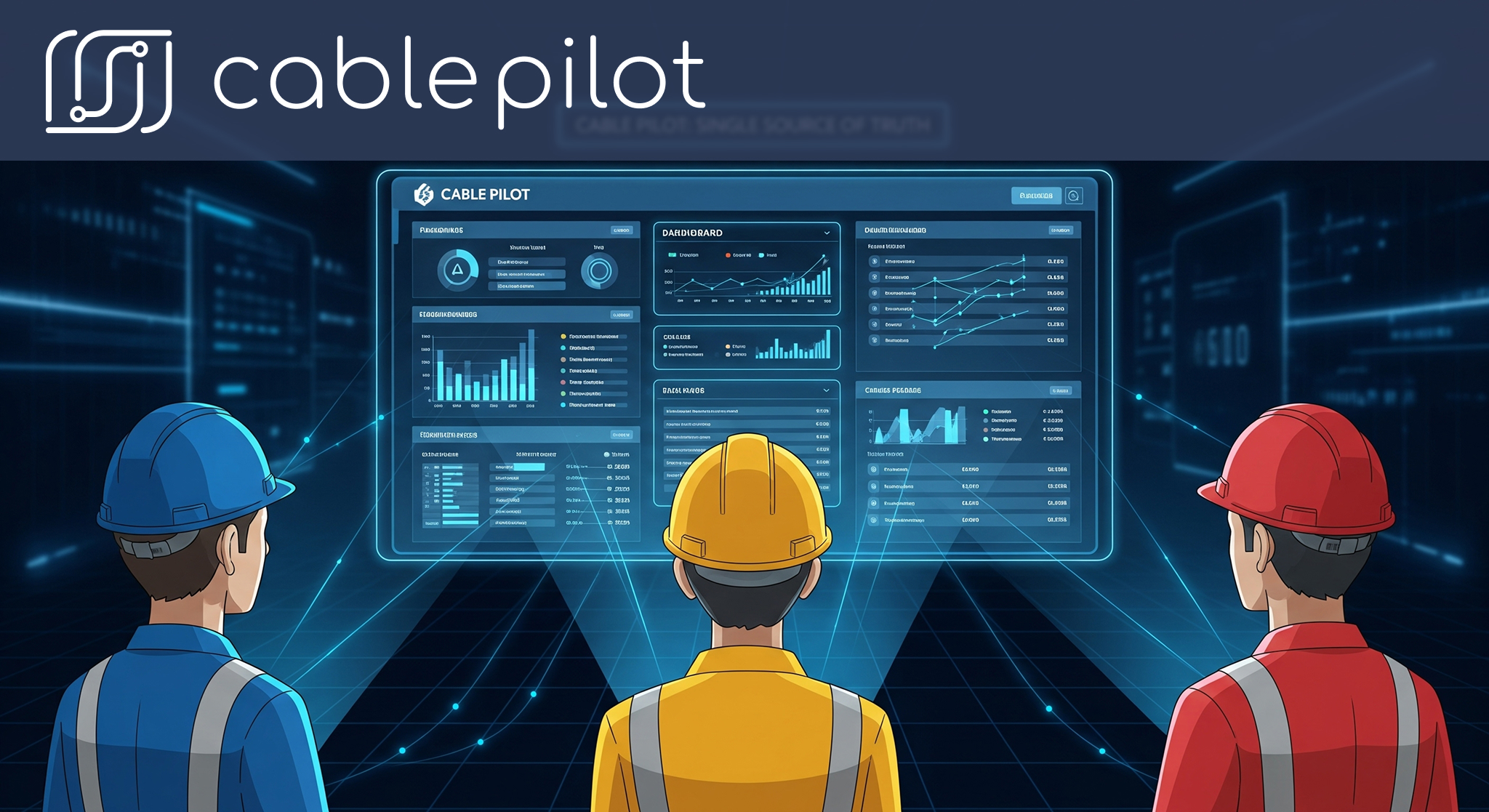
When you view this object on the platform, you see everything about it, all on one screen:
- Its full specification, pulled directly from the design database.
- Its procurement status, linked live to the purchasing system.
- Its physical location in the warehouse.
- Its planned installation route and dependencies.
- Its current installation status, updated from the field via a mobile device.
- Any associated quality flags, non-conformance reports, or attached documents.
This is the end of data archaeology. There is only one version of the truth, and everyone—from the PM in the office to the installer on the deck—has access to it.
The Power of Frictionless Data in Action
When you establish a single source of truth, you don’t just fix a process; you unlock new capabilities and eliminate entire categories of risk.
Before (In the Silo):
To check the status of a system, a Project Manager had to:
- Email the design lead to confirm the latest component list.
- Call the procurement manager to see what had been ordered and delivered.
- Walk down to the shipyard to ask the area supervisor what had been installed.
- Manually synthesize this conflicting information into a rough percentage of completion.
This frantic, manual chase could take half a day, and the resulting ‘status report’ was likely obsolete before it even hit your manager’s inbox—a colossal waste of your most valuable resource: time.
After (With an SSoT):
The Project Manager opens a dashboard. They filter for the “Fire Detection System.” The platform instantly queries all the interconnected data and presents a real-time status:
- 88% of components procured.
- 75% of components received at warehouse.
- 60% of components installed.
- 30% of cables pulled
- 3 open non-conformance reports.
What took half a day of manual effort now takes 30 seconds. This transformation in shipbuilding project management eliminates data fragmentation shipbuilding challenges completely. The PM can now spend their time managing the project and mitigating the actual risks revealed by the data, not wasting time trying to find the data in the first place. This elimination of information silos maritime represents the essence of effective, modern shipbuilding project management practices.
This seamless data flow transforms inter-departmental relationships. When the design team, procurement team, and installation team are all looking at and updating the exact same digital object, the opportunity for miscommunication disappears. The process becomes collaborative instead of adversarial. Trust is built into the system because the data is verifiable and universal.
Conclusion: From Information Chaos to Competitive Advantage
Data fragmentation shipbuilding is a quiet but relentless killer of profitability. Modern shipbuilding project management requires integrated systems to eliminate these costly inefficiencies. It creates a constant state of low-grade chaos that grinds down your teams, introduces unacceptable risk, and makes accurate forecasting impossible. Every manual data reconciliation, every email chain seeking clarification, every decision made on outdated information is a hidden tax on your project’s bottom line. For more insights on information sharing in maritime logistics, see this comprehensive study from the International Transport Forum.
Choosing to operate with information silos is choosing to accept this tax.

Implementing a single source of truth is the most powerful strategic decision you can make to fight back. Recent research on digital transformation in maritime industries emphasizes the importance of integrated data systems for project success (see this comprehensive study on maritime digital transformation). It eradicates the systemic friction that slows your project down. It provides a solid, data-driven foundation for all your planning, execution, and reporting. It empowers your team to make faster, smarter decisions with confidence, transforming your shipyard from a place of organized chaos into an engine of efficiency and profitability.
In today’s competitive landscape, successful shipbuilding project management and advanced information systems are essential. The shipyard that can master its data will win. By moving from information chaos to a unified digital environment, you don’t just build better ships; you build a more resilient, more profitable, and more successful business.
Tired of chasing down data? Read our other articles on risk management and learn how to build a solid data foundation for your projects.