
In the world of complex, large-scale shipbuilding, there is a dangerous misconception: the myth of the “small issue.”
A project manager might hear of a “small problem” with a cable tray. A supervisor might note a “minor discrepancy” in a drawing. An installer might flag an “insignificant blocker” on-site. In an environment where multi-ton steel blocks are being lifted and highly complex propulsion systems are being integrated, these “small” issues seem like mere footnotes.
This perspective is fundamentally wrong. And it is costing shipyards and electrical integrators millions.
In shipbuilding electrical installation—a discipline involving thousands of kilometers of cable, tens of thousands of components, and hundreds of workers operating in parallel—there is no such thing as a “small” issue. There are only instantaneously-resolved issues and compounding issues.
An unresolved minor blocker does not remain minor. It is a seed. When planted in the fertile soil of fragmented communication and manual processes, it grows, compounds, and inevitably blossoms into a full-blown crisis, causing ripple effects that derail schedules, inflate labor effort, and create massive cost overruns. This article explores the anatomy of this phenomenon and charts a clear path to solving it.
The Anatomy of a 1-Day Lag: A 5-Day Failure in Practice
To understand the true cost of communication delays, let’s trace the journey of a single, “small” issue.

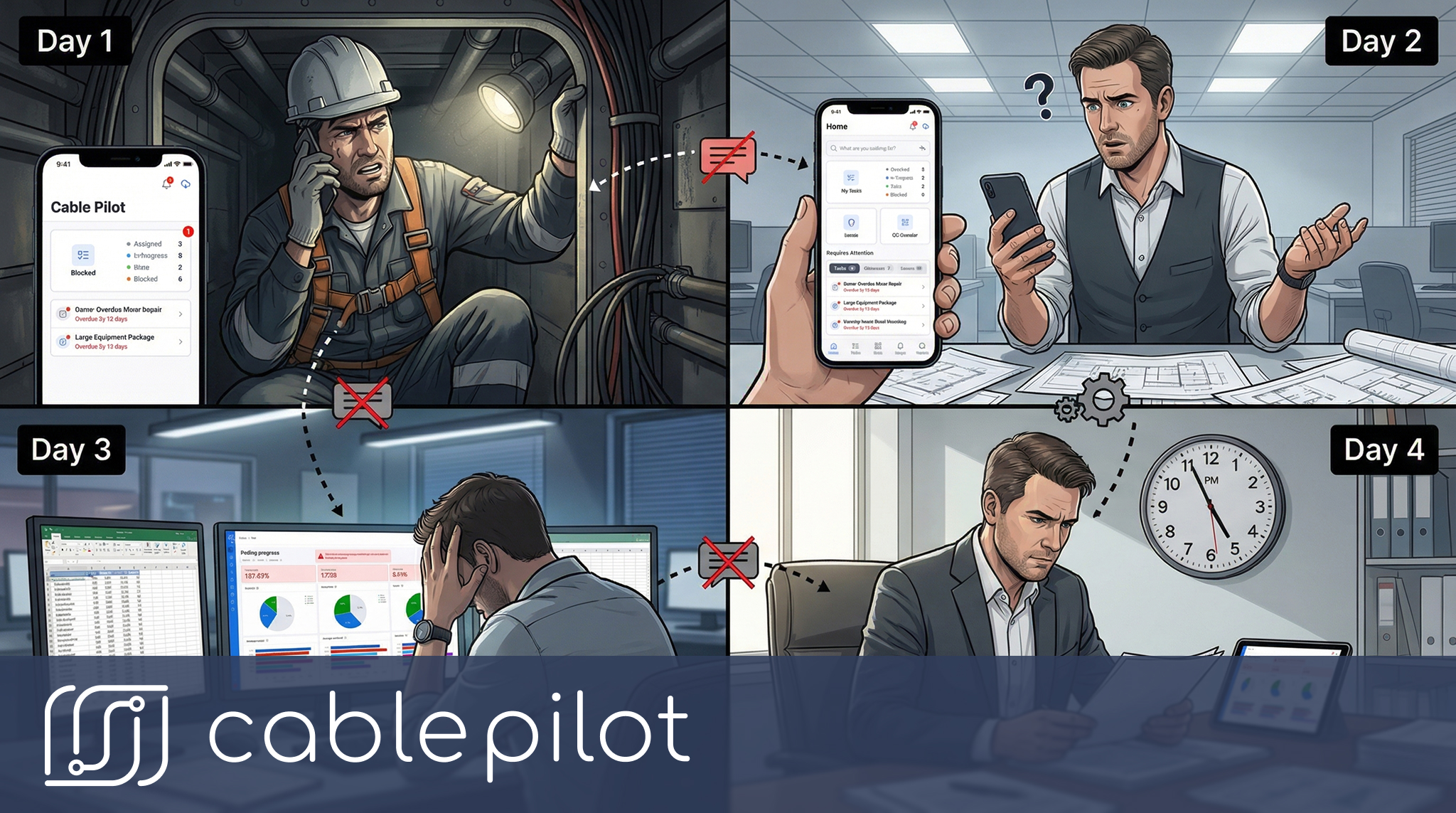
Day 1, 10:00 AM: An electrical installer is on deck, tasked with pulling ten high-priority cables. He consults his paper drawing and the printed cable list. He immediately spots a problem: the designated cable tray is already 95% full. The ten new cables, critical for a navigation system, will not fit without violating fill-and-bend-radius regulations.
This is Blocker #1.
The installer stops work. He pulls out his smartphone, not to use an app, but to call his supervisor. The supervisor is in a meeting on the other side of the vessel. The call goes to voicemail. The installer leaves a message, waits, and then goes to find another task he can work on, fragmenting his workflow and losing productive time.
Day 1, 4:00 PM: The supervisor finally gets a chance to walk the compartment. He sees the issue and confirms the installer’s report. He takes a photo on his personal phone and makes a note on his clipboard. He knows he needs to engage the engineering office.
Day 2, 9:00 AM: The supervisor, after handling his morning priorities, drafts an email to the engineering department. He attaches the photo and writes, “Tray full in compartment C-204, need solution for nav cables.”
Day 3, 11:00 AM: An engineer, inundated with hundreds of similar emails, opens the message. The email lacks critical context. Which specific cables from the cable list? What is the exact tray ID? Which design package does this relate to? The photo is unclear.
The engineer must now become a detective. He spends the next two hours cross-referencing the ship’s general arrangement, the electrical diagrams, and the master cable list spreadsheet. He finally identifies the tray and the cables in question. He sees the design called for a 300mm tray, but a 200mm tray was installed.
Day 3, 4:00 PM: The engineer identifies a potential solution: reroute the ten cables through an adjacent, but longer, path. This requires updating the cable list, calculating new cable lengths, and getting approval from the project manager, as it impacts material cost and labor effort.
Day 4, 3:00 PM: The rerouting is finally approved by management. The engineer updates the cable list spreadsheet (Rev F) and emails the new drawings and list back to the supervisor.
Day 5, 10:00 AM: The supervisor, who was busy with commissioning support, finally opens the email. He now has the solution. He must find an installation team to execute it. The original installer, however, was reassigned to a different block two days ago. The supervisor must now pull a new team, brief them on the change (which is now “rush” work), and ensure they have the new drawings.
This “small issue” was resolved. But it took five full days.
Quantifying the “Small” Issue: From Man-Hours to Contract Penalties
Let’s calculate the tangible cost of this five-day communication lag.
- Lost Labor (Installer): 1-2 hours of initial downtime and context-switching on Day 1.
- Management Overhead (Supervisor): 1 hour on Day 1 (inspecting, calling) + 1 hour on Day 2 (emailing) + 1 hour on Day 5 (re-briefing new team). Total: 3 hours.
- Engineering Overhead (Engineer): 3-4 hours on Day 3 (investigating, solving) + 1 hour on Day 4 (revising, seeking approval). Total: 4-5 hours.
- Project Management Overhead: 1 hour on Day 4 (reviewing, approving).
- Re-Briefing Labor (New Team): 1-2 hours on Day 5 (stopping their current task, context-switching, understanding the new plan).
For one “small” issue, the project absorbed 10-13 man-hours of non-productive, high-cost labor. Now, multiply this by the hundreds of similar issues (clashing components, incorrect drawings, missing materials) that occur during any large-scale shipbuilding project. The number becomes staggering.
This direct labor cost, however, is only the beginning. The true damage lies in the “snowball effect.”
The Compounding Catastrophe: When “Small” Becomes “Critical”
That five-day delay on ten cables was not an isolated event. It was a domino.
- Dependency Delay: The navigation system those cables feed is on the critical path. Because they were 5 days late, the termination team is now 5 days behind.
- Commissioning Conflict: The navigation system vendor was scheduled to fly in on Day 7 for commissioning. When their technician arrives, the system is not terminated. The shipyard must now pay the vendor’s expensive day rate for standby time.
- Schedule Slippage: This single delay creates a “bow wave” that pushes back subsequent tasks. The insulation team, the fire-stopping team, and the compartment close-out team are all impacted.
- Resource Re-allocation: The project manager must now “crash” the schedule, pulling resources from other areas to get the navigation system back on track, creating new delays in those areas.
The “small” cable tray issue, born from a 1-day communication lag, has now directly resulted in thousands of dollars in vendor standby fees, a critical path schedule delay, and a significant risk to the project’s overall timeline.
This is the reality of shipbuilding project management. The problem is not the installer, the supervisor, or the engineer. The problem is the system they are forced to use.
The Root Cause: A System Built on Fragments
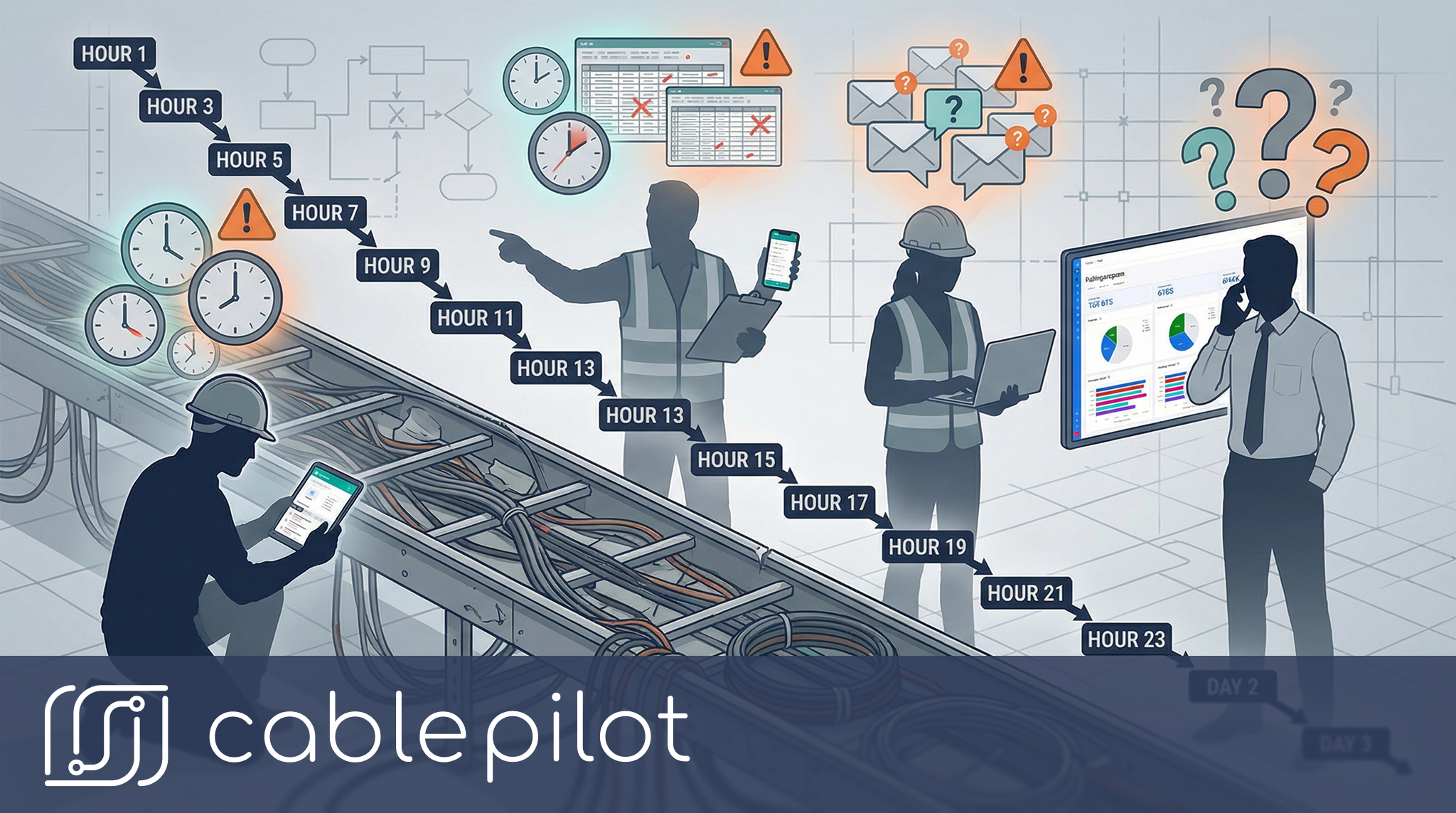
The catastrophe we just described was inevitable. It was caused by a complete breakdown of data integrity and communication flow. The project is being run on a collection of disconnected, high-latency, and manually-updated tools:
- Fragmented Data: The installer has a paper drawing (Rev D). The engineer is looking at a CAD model (Rev E). The cable list is an Excel file (Rev F) on a shared drive that the field team can’t access. There is no single source of truth.
- Asynchronous Communication: The primary tools for issue resolution are voicemail, text messages, and email. These are “fire and forget” methods that dump unstructured data into inboxes, where it can be lost, ignored, or misunderstood.
- Manual Progress Tracking: How does the project manager know the true status of the electrical installation? By waiting for the supervisor to manually compile a report from his clipboard notes and emails. This data is, at best, 24-48 hours old. It’s not project management; it’s project archaeology.
- Lack of Context: The engineer, the person most qualified to solve the problem, is data-starved. They are “blind” to the real-time conditions on the ship. They lack the one thing they need most: instant, context-rich information from the field.
This system guarantees failure. It introduces catastrophic levels of data lag into a process that demands real-time decisions.
The Alternative: A 1-Hour Resolution with a Unified Digital Platform
Now, let’s replay the exact same scenario using a modern, unified platform for electrical installation tracking, like Cable Pilot.
Day 1, 10:00 AM: The electrical installer encounters the full cable tray. He opens the Cable Pilot application on his rugged smartphone.
Day 1, 10:02 AM: He taps the “Issues” function. The app already knows his location via the compartment he’s checked into. He:
- Takes a high-resolution photo of the full tray within the app.
- Taps the ten cables from the digital, up-to-date cable list on his screen and links them to the issue.
- Types a short note: “Tray full. Cannot pull.”
- Selects “Engineering” as the recipient and hits “Submit.”
Day 1, 10:03 AM: The engineer sitting in the office receives an instant notification on her desktop. She clicks it and opens the Cable Pilot web application. She sees everything in one clean dashboard:
- The installer’s name.
- The exact compartment and tray ID.
- The crystal-clear photo of the problem.
- A direct link to the ten specific cables in the master cable list.
There is no ambiguity. No missing data. No detective work required.
Day 1, 10:30 AM: The engineer analyzes the problem. She sees the as-built data shows a smaller tray was used. She identifies the same reroute. The status of the ten cables in the platform is set to “On Hold,” preventing anyone else from trying to install them. She proposes the new route, attaches the updated drawing snippet, and re-assigns the issue to the project manager for approval.
Day 1, 10:45 AM: The project manager gets a notification on his smartphone, reviews the solution and its minimal impact (which is now tracked), and taps “Approve.”
Day 1, 10:50 AM: The supervisor and the original installer both receive a notification: “Issue resolved. New route approved.” The installer, who has been working on a nearby task, sees the clear instructions and the new drawing on his smartphone.
Day 1, 11:15 AM: The installer begins pulling the cables via the new, approved route.
A five-day, 13-man-hour crisis that threatened the project schedule was fully identified, analyzed, solved, and executed in just over one hour.
How a Unified Platform Eliminates Communication Lag
This isn’t magic. It’s the result of replacing a fragmented, manual system with a single, unified Cable Pilot digital platform. The solution is built on four key pillars that directly attack the root causes of delay.

1. Instant, Context-Rich Field Reporting
Instead of relying on voicemails and emails, field workers are empowered with a simple smartphone application. This tool is not just a “form”; it is a direct, context-aware link to the entire project database. Issues are submitted with the relevant photos, compartment IDs, and cable list data attached, eliminating all ambiguity.
2. A Real-Time Single Source of Truth (SSoT)
There is no longer a “paper” cable list and a “spreadsheet” cable list. There is only one cable list. When an engineer updates a cable’s route in the web application, the installer on the deck sees that change on his smartphone immediately. This eradicates version control errors and ensures everyone is working from the same, correct data.
3. Automated Notifications and Traceability
The platform manages the workflow. Instead of an engineer having to remember to email a supervisor, the system automatically notifies the right people at the right time. This creates a complete, time-stamped digital record of the entire issue resolution process. Who reported it, who saw it, who solved it, and when.
4. A Connected Digital Twin
All this data—the cable list, the installation progress, the open issues—is connected to the ship’s 3D model or 2D drawings in the web application. A project manager can look at a compartment and instantly see its true progress, including any open issues, linked materials, and planned labor.
The Outcomes: From Cost Overruns to Controllable Projects
Adopting a unified platform for electrical installation tracking moves a shipyard from a state of reactive firefighting to one of proactive control.
- Massive Reduction in Cost Overruns: The 10-13 man-hours of waste per issue is reduced to 1-2 hours of productive work. Multiply this by hundreds of issues, and the savings in labor effort alone are transformative.
- Eradication of “Finger-Pointing”: The digital, time-stamped trail of an issue’s life cycle ends the “blame game” between subcontractors, the shipyard, and the design office. The data is transparent, holding all parties accountable and fostering a more collaborative environment.
- Higher First-Time Quality and Safety: When issues are resolved in hours, not days, there is no need to “rush” a fix at the last minute. This leads to higher-quality installations, fewer errors, and a safer working environment.
- Data-Driven Shipbuilding Project Management: For the first time, project managers can see leading indicators of problems. The dashboard might reveal that “25% of all field issues are related to cable tray data.” This is no longer just a problem to solve; it’s a systemic bottleneck that can be fixed at the source, preventing thousands of future issues.
Conclusion: No Room for “Small” Issues
In shipbuilding, the margins are too thin and the schedules too tight to accept “small issues” as a cost of doing business. A “small issue” that lasts more than an hour is not a problem; it is a symptom of a deeply flawed, high-latency communication system.
The cost overruns, schedule delays, and commissioning failures that plague complex electrical installations are not inevitable. They are the direct, predictable result of relying on paper, spreadsheets, and email in a real-time environment.
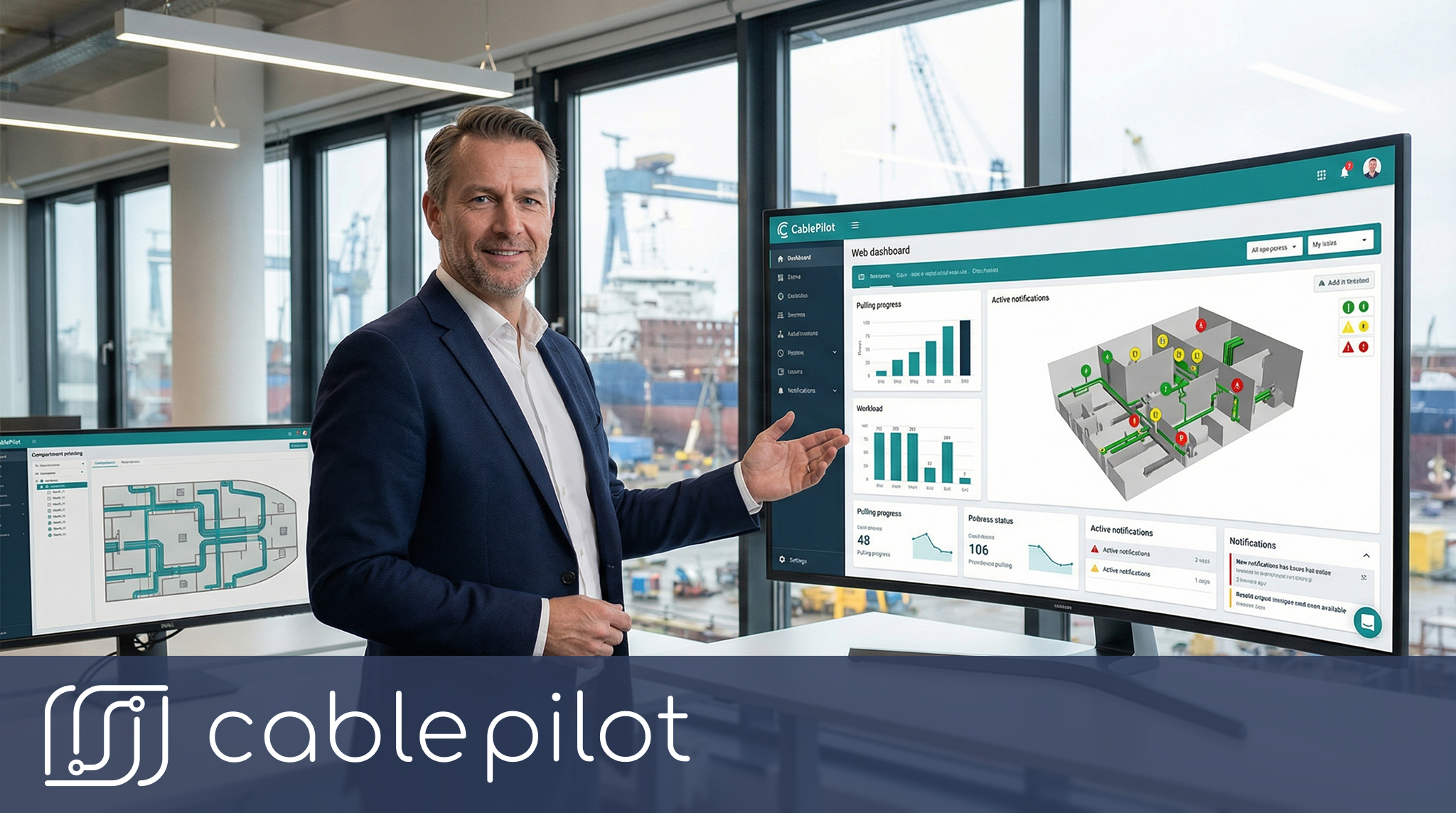
To win in the modern shipbuilding era, project managers must close the gap between the field and the office. They must arm their teams—from the installer on the deck to the engineer in the office—with a single, real-time platform for communication and electrical installation tracking. Only then can you transform a “small issue” from a 5-day compounding catastrophe into a 1-hour problem solved.
Stop managing delays. Start preventing them.
Ready to eliminate communication lag and take control of your shipbuilding projects?
See how Cable Pilot creates a single source of truth for your electrical installation, from the first cable pull to final commissioning. Schedule a personalized demo with our experts today and learn how you can turn 5-day delays into 1-hour solutions.