
Somewhere on your vessel right now, two contractors are working from different revisions of the same cable list. One crew is pulling cables specified in revision two. The engineering office issued revision three last week, changing cable types for fire safety compliance. Nobody knows this yet. The rework bill will surface during inspection.
This is not a fringe scenario. It is Tuesday morning at most shipyards running electrical installation projects on spreadsheets and emailed PDFs.
Effective cable documentation management is the difference between a project that delivers on schedule and one that hemorrhages labor hours to rework, disputes, and last-minute handover scrambles. Yet the tools most shipyards rely on — Excel workbooks, shared drives, paper checksheets — were never designed for the multi-party, multi-month, revision-heavy reality of modern electrical installation.
This article examines why shipyard data fragmentation persists despite everyone recognizing the problem, and how a unified cable data platform resolves the root causes rather than treating symptoms.
Why Electrical Installation Version Control Fails on Spreadsheets
The cable list for a modern vessel contains thousands of entries. Each cable carries attributes: type, gauge, length, voltage rating, origin compartment, destination equipment, system assignment, and routing path. This data originates in engineering software, gets exported to Excel for distribution, and immediately begins diverging.

Every Stakeholder Creates a Fork
The procurement team adds supplier codes and delivery dates to their copy. The installation contractor imports data into their scheduling tool, appending crew assignments and field notes. The quality department maintains a separate checklist correlating cables to test results. The commissioning team builds another spreadsheet mapping cables to system functional tests.
Each party believes their version reflects current reality. When engineering issues a revised specification — changing a cable type from standard to fire-retardant, for example — the update reaches procurement within hours. But it may not propagate to the contractor’s field database for days or weeks. Crews continue pulling cables to the old specification. The error only surfaces during inspection, triggering rework across multiple trades.
This electrical installation version control failure compounds with project scale. A single cable type change can ripple across hundreds of circuits. Coordinating that change across every stakeholder’s private spreadsheet through email attachments and meeting minutes is a manual reconciliation exercise that fails more often than it succeeds.
Spreadsheets Cannot Represent Dynamic Workflows
A cable list exported from design software captures planned specifications with precision. It tells you nothing about what has actually been installed. Which cables were physically pulled this week? Which terminations await testing? Which systems have completed their commissioning prerequisites?
Project managers fill this gap through daily stand-up reports, email updates, and periodic walkdowns. The lag between field reality and management visibility ranges from days to weeks. By the time progress data reaches a decision-maker, the situation on the vessel has already changed.
This visibility gap prevents schedule optimization. Installation supervisors cannot reliably identify bottlenecks because they lack current data on actual completions. Resource allocation decisions — which crews go where tomorrow — rely on estimates and assumptions rather than factual status. Opportunities to compress the schedule by redeploying idle crews go unrecognized until formal progress reviews, by which point the window has closed.
The Cost of Shipyard Data Fragmentation
Fragmented electrical project documentation imposes costs that accumulate quietly and surface violently at the worst moments.
Rework From Specification Drift
When field crews work from outdated cable specifications, the resulting installation must be corrected. Rework means unpulling cables, sourcing replacement material, reassigning labor, and re-sequencing dependent work. The direct labor cost is compounded by cascading schedule delays to adjacent trades waiting for the same compartment or routing path.
Coordination Overhead
Shipbuilding electrical projects typically involve multiple specialized contractors: one handling power distribution, another managing communication systems, a third installing navigation equipment. Each contractor maintains their own cable specification tracking system, optimized for internal use but isolated from the broader project ecosystem.
Project managers become manual integration points, spending hours in weekly coordination meetings collecting status fragments from each contractor and attempting to synthesize a coherent picture. The effort produces incomplete understanding because no system captures the interdependent reality of shared compartments, common routing paths, and sequential installation prerequisites. Multi-contractor cable coordination through meetings and email chains cannot keep pace with the velocity of changes on an active vessel.
The Handover Crisis
All preceding fragmentation culminates in the cable handover documentation crisis that strikes every project’s final phase. Classification society approval and owner acceptance require comprehensive packages: complete cable lists with as-built specifications, test certificates for every circuit, termination records, and system commissioning reports.
Teams discover that the data required for handover resides across dozens of disconnected sources: Excel files on individual engineers’ laptops, test results in the quality department’s database, scanned field checksheets, photos on electricians’ smartphones, and paper binders in site offices. Assembling this into structured documentation packages becomes a multi-week effort that frequently reveals gaps — cables pulled but never formally tested, tests performed but results not recorded, changes implemented in the field but never documented.
The retrospective investigation required to fill these gaps delays vessel delivery and erodes client confidence.
From Scattered Files to a Unified Cable Data Platform
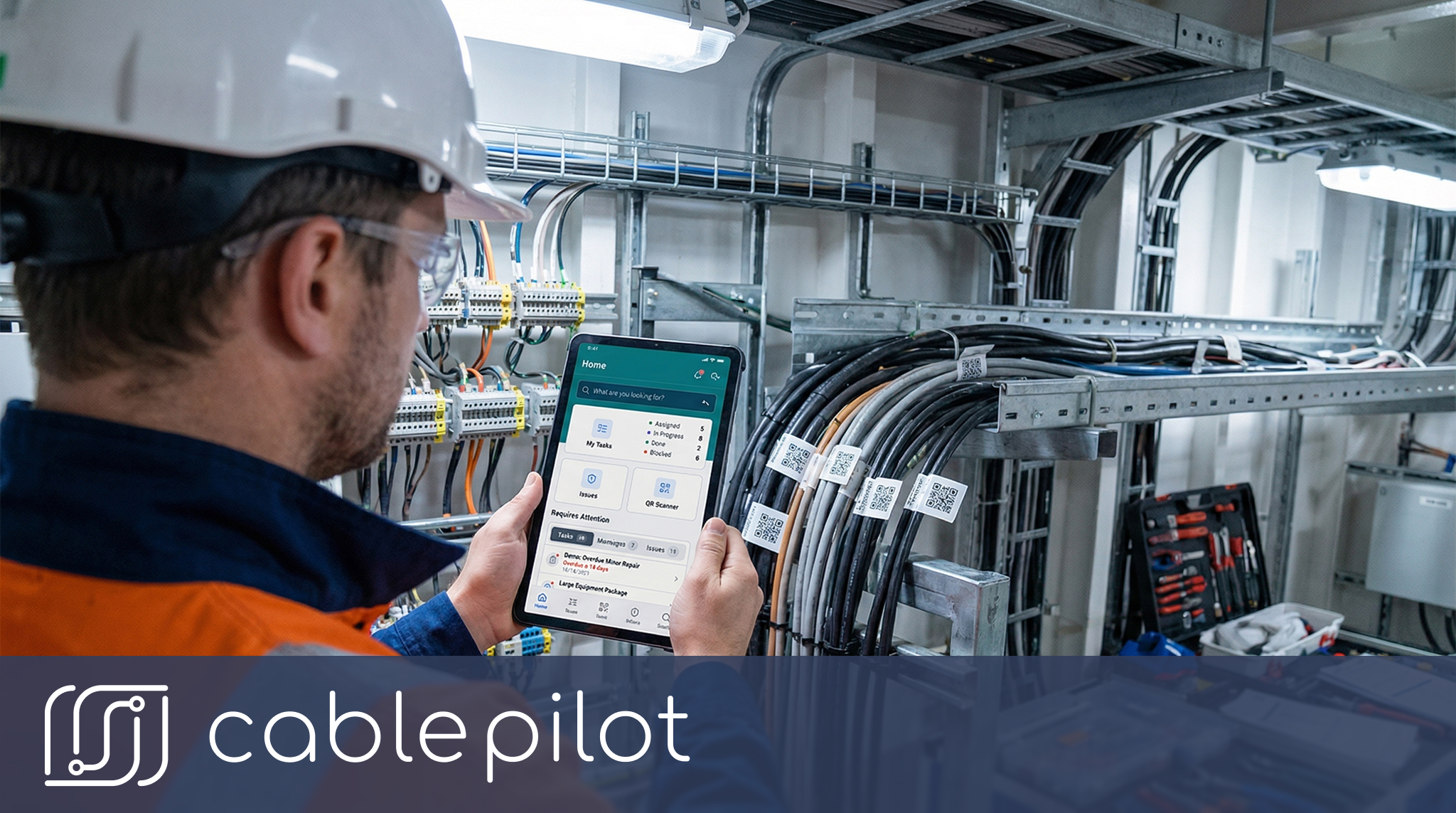
Solving shipyard data fragmentation requires more than better file sharing. It requires replacing the document-centric approach — where cables exist as rows in various spreadsheets — with an object-centric approach where each cable is a persistent digital record that all stakeholders reference simultaneously.
Cable Pilot implements this approach by treating every cable as a unique entity within a unified data model. Each cable links to comprehensive attributes: technical specification, physical location, system assignment, lifecycle status, and revision history. When engineering updates a specification, every authorized user sees the change immediately. There are no versions to conflict because only one record exists per cable, updated continuously.
Installation Workflow Automation Through Defined States
Cable Pilot models the electrical installation lifecycle through defined workflow states. The platform tracks pulling statuses (To Pull, Pulling, Pulled), connection statuses (To Connect, Connecting, Connected), and testing statuses (to test, testing, tested, failed). Equipment mounting progresses through its own states (To Mount, In Progress, Mounted).
Field crews advance cables through these states using the smartphone app. An electrician scans a QR code on a cable identifier, confirms the action, and the status updates across the entire platform within seconds. The system validates prerequisites before allowing state changes — you cannot mark a cable as connected before it shows as pulled, for instance — preventing the documentation of impossible sequences that create inspection failures and rework.
This installation workflow automation delivers operational visibility impossible with static files. Project managers see exactly how many cables reached each state today, identify compartments where work accumulates without advancing, and forecast completion dates based on actual progression rates rather than contractor estimates. The smartphone interface replaces end-of-shift paper forms with real-time field reporting that takes seconds per cable.
Multi-Contractor Cable Coordination Without Commercial Leakage
Multiple contractors working on the same vessel create tension between the visibility required for coordination and the commercial confidentiality contractors legitimately demand. Sharing a single platform risks exposing productivity data, crew allocation details, or commercial pricing to competitors.
Cable Pilot resolves this through role-based access controls. Each contractor sees only cables within their assigned scope plus shared dependencies necessary for coordination. A power distribution contractor can see that communication cables in a shared compartment have been pulled and tested — information needed for safe routing — without accessing the communication contractor’s productivity metrics or cost data.
Project managers and owner representatives receive elevated access spanning all contractors, providing comprehensive oversight without forcing contractors to expose sensitive information to each other. The platform becomes a trusted intermediary for multi-contractor cable coordination: aggregating contributions into a coherent project picture while maintaining appropriate confidentiality boundaries.
Dependency relationships make constraints explicit. When one contractor’s termination work depends on another contractor’s conduit installation, Cable Pilot shows both parties the dependency status. Crews arriving at a compartment know in advance whether prerequisite work is complete, preventing wasted mobilization and the frustration of discovering blocked work on arrival.
Digital Cable Records With Complete Traceability
Every action within Cable Pilot — status changes, specification updates, test result entries, document attachments — generates an automatic audit trail entry. The system records who performed each action, when, and precisely what changed. This traceability occurs in the background without requiring additional effort from field workers.

The contrast with spreadsheet-based cable specification tracking is stark. Excel theoretically supports change tracking through file properties or version comments, but this depends on every user enabling tracking, saving intermediate versions, and documenting their changes consistently. In practice, spreadsheets circulated through email lose revision history rapidly. When a design change raises questions — “When did the cable type specification change, and who approved it?” — the spreadsheet trail offers no definitive answer.
Cable Pilot’s digital cable records provide definitive answers with timestamps and user identities. When installation disputes arise, the audit trail settles questions factually. When classification society inspectors require proof that work followed approved procedures, teams export comprehensive audit reports directly from the platform rather than manually assembling evidence from scattered files.
From Archaeological Dig to Instant Export: Cable Handover Documentation
The transformation of cable handover documentation preparation may be the most tangible operational benefit. Traditional projects require weeks of retrospective data assembly at the end — locating test certificates, reconciling as-built specifications against design intent, filling documentation gaps discovered only during the compilation effort.
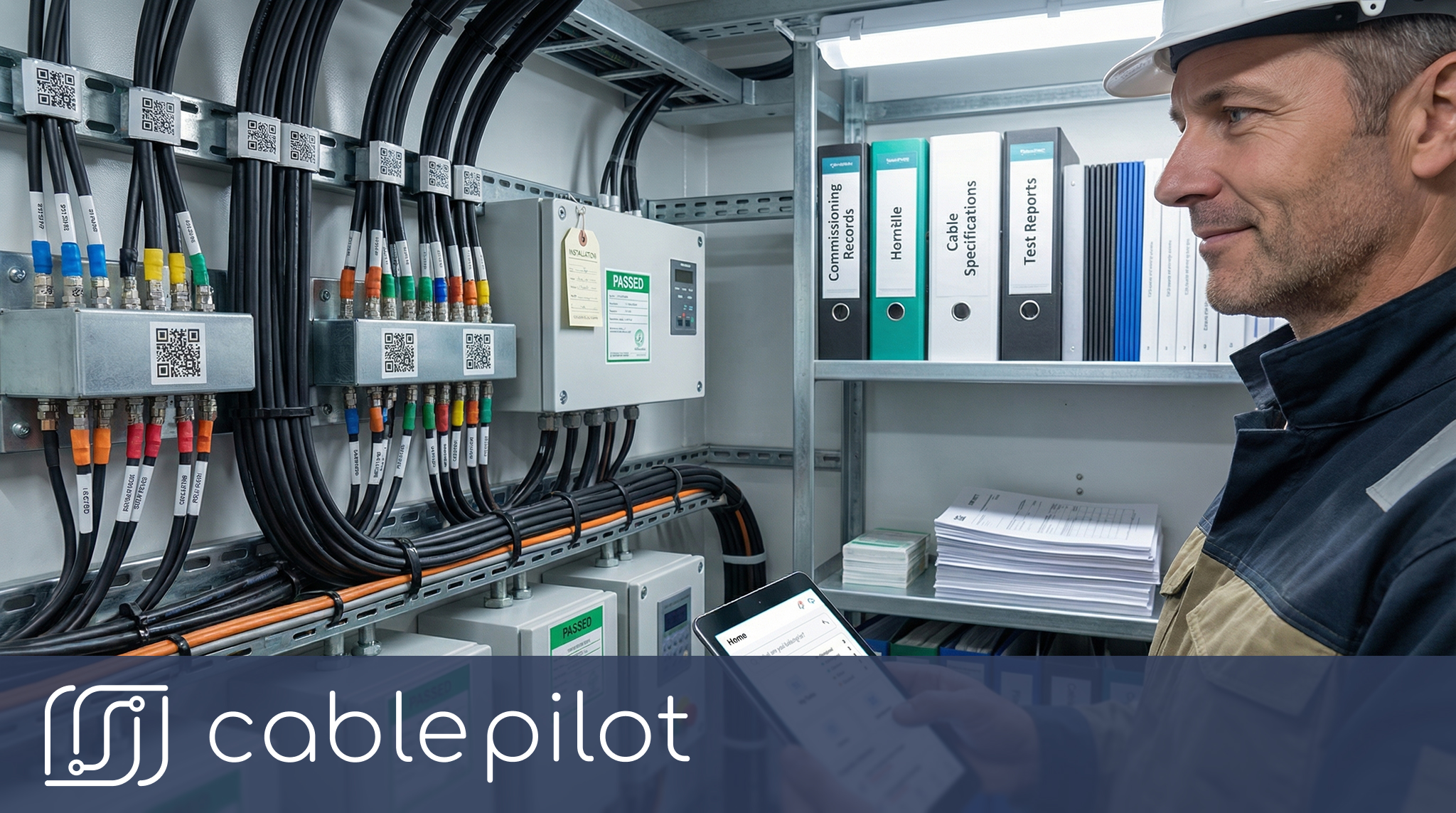
When the complete installation history already exists within a unified platform, handover preparation becomes a structured export rather than an archaeological expedition. Cable Pilot generates complete cable lists with as-built specifications, test certificates linked to each cable’s record, timestamped completion records from the audit trail, and system commissioning reports aggregated from constituent cable data. Electrical project documentation that previously consumed weeks of compilation effort becomes available through structured report generation.
Implementing the Transition
Organizations recognize that scattered spreadsheets cause problems but hesitate to transition because migration seems overwhelming: thousands of cable records to convert, workflows to redesign, users to retrain. Three practical approaches reduce this friction.
Start With One Scope
Cable Pilot implementations typically begin with a defined pilot — a single vessel’s electrical installation or a specific system package. Select a scope where documentation fragmentation currently creates visible pain: perhaps a complex system involving multiple contractors and frequent change orders, or a project phase where handover documentation historically proves problematic. Demonstrated success within a constrained scope builds confidence for broader rollout.
Migrate Without Manual Rekeying
Cable Pilot’s AI-powered import analyzes uploaded cable lists — regardless of Excel format — and identifies field meanings automatically. The system recognizes that “From” and “Origin” refer to the same attribute, handles various date formats, and detects cable type nomenclature. Teams review the suggested mappings, correct any misinterpretations, and approve. Thousands of cable records are created in minutes, ready for lifecycle tracking, rather than requiring weeks of manual data entry. This import capability proves particularly valuable for projects transitioning mid-execution, allowing teams to migrate work in progress and gain immediate visibility into remaining phases.
Address the Human Dimension
Field crews adopt new tools when the tools make their daily work easier. Cable Pilot’s smartphone interface simplifies status reporting compared to paper checksheets and end-of-shift verbal updates. Quality inspectors benefit from automatic test certificate linkage. Project managers gain factual status monitoring instead of estimate-based guesswork. Training that emphasizes these role-specific benefits rather than generic platform features accelerates adoption and reduces resistance.
Key Takeaways
Cable documentation management determines whether shipyard electrical projects deliver predictably or descend into rework, disputes, and handover delays. The core problems — version conflicts, contractor data isolation, and retrospective documentation assembly — stem from spreadsheet-based approaches that fragment data across disconnected files.
A unified cable data platform that treats each cable as a persistent, traceable record eliminates version conflicts at their root, enforces installation workflow consistency through defined states, enables multi-contractor coordination without compromising commercial confidentiality, and transforms cable handover documentation from a weeks-long scramble into a structured export.
The transition from fragmented files to a unified platform does not require disrupting active projects. Start with a defined scope, leverage AI-powered import to eliminate migration friction, and expand based on demonstrated results.
Ready to Unify Your Cable Documentation?
Discover how Cable Pilot consolidates cable specification tracking, installation workflow automation, and handover documentation into one platform purpose-built for shipbuilding electrical installation. Contact our team to schedule a demonstration and assess how a unified approach addresses your specific documentation challenges.