

Master Your Labor Budget With Cable Points Workload Calculation
Stop Counting Cables. Start Measuring Real Effort.
Managing a modern vessel construction project requires absolute precision, but traditional reporting methods often leave managers blind to the actual effort consumed on the deck. Relying on simple item counts or linear length measurements creates a dangerous illusion of progress. You need a system that reflects the true physical complexity of your daily operations.
The Cable Pilot web platform introduces the Cable Points workload metric to solve this exact problem. It replaces subjective guesswork with objective, calculated data. The web application aggregates real-time updates from mobile devices in the field and instantly translates them into standardized units of effort. Understanding your Cable Points workload turns chaotic electrical coordination into a transparent, manageable, and highly predictable process.
The Danger of Traditional Electrical Installation Metrics
The greatest source of schedule overruns in maritime construction is the reliance on flawed progress indicators. When your project plan measures progress by counting pulled cables, you treat every task as equal. A fifty-meter lighting wire routed through an open corridor is counted as one item. A fifty-meter armored power line navigated through multiple sealed bulkheads is also counted as one item. This false equivalence destroys schedule predictability entirely.
When you use these outdated electrical installation metrics, your dashboard might show ninety percent completion, but your remaining tasks contain the highest physical complexity. This creates a scenario where the final ten percent of your project consumes fifty percent of your schedule. You need a measurement system that weighs the elephant and the mouse on different scales. You need a metric that measures actual effort rather than simple inventory.
How the Cable Points Workload Metric Works
To escape the progress trap, the industry requires standardization. The Cable Pilot platform utilizes a calculated, composite value that represents the total effort required to install and terminate a single asset. This is your Cable Points workload. It is not a subjective number entered by a supervisor. It is an objective score calculated algorithmically by the web platform based on the physical attributes of the engineering design.
The system evaluates pulling complexity by analyzing the cross-section, the number of cores, the overall weight, and the armor type. It then evaluates termination complexity by counting the specific wires that must be stripped, crimped, and connected. A simple communication line might represent ten points, while a heavy main switchboard feeder might represent three hundred points. Measuring your Cable Points workload ensures you track actual labor consumption accurately.
The Web Platform Calculation Engine
Implementing this standardized metric does not require weeks of manual data entry. The web application features an intelligent import engine designed for rapid onboarding. You simply upload your native engineering spreadsheets directly into the system. The platform analyzes your column headers and automatically maps technical specifications like wire cross-section and core counts.
Once the data is imported, the rules engine instantly applies the labor effort calculation across your entire database. Within minutes, your thousands of cable routes are assigned their baseline values. This baseline Cable Points workload becomes the undeniable foundation for your entire project schedule and budget.
Adjusting for Reality with Environmental Factors
A standardized baseline is essential, but shipbuilding occurs in dynamic, highly variable environments. The physical effort required to route a wire through a spacious accommodation deck is vastly different from routing that same wire through a congested engine room. A rigid system that ignores these environmental realities will eventually drift away from the truth on the deck.
The web platform provides the flexibility needed to manage this complexity. Supervisors can apply specific adjustment factors directly within the web interface. These multipliers account for hazardous zones, cramped spaces, or required work at heights. Applying these factors ensures your Cable Points workload reflects the harsh realities of the shipyard environment perfectly.
Fine-Tuning Your Cable Points Workload
The adjustment process is straightforward and highly visible within the system. A site manager knows that a specific routing path will be forty percent more difficult due to intersecting pipework. They select the affected tasks in the web application and apply a multiplier of 1.4 to the baseline value. The platform instantly recalculates the required effort.
The planned Cable Points workload for that specific zone increases immediately. This adjusted number is then used for all future progress tracking and forecasting for those tasks. It prevents teams working in difficult areas from appearing unproductive. It ensures your labor effort calculation remains both highly accurate and completely fair to the personnel executing the physical work.
Centralized Dashboards for Complete Visibility
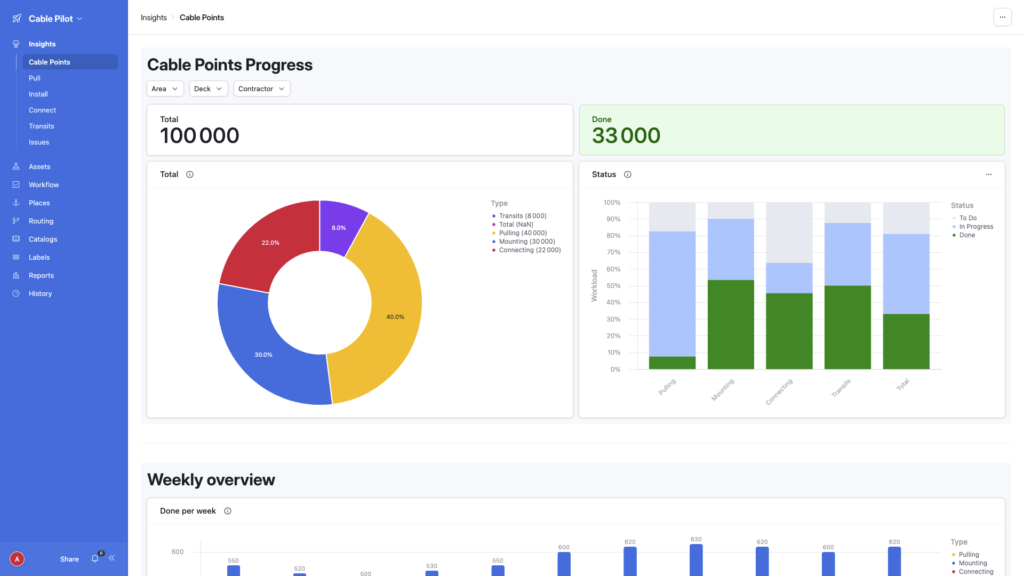
Information only creates value when it is presented clearly. The web application features a dedicated Insights module designed for strategic oversight. The primary dashboard translates the continuous stream of mobile field updates into intuitive visual charts. You can view your total project progress measured entirely in completed effort rather than misleading item counts.
The dashboard displays dynamic donut charts showing your overall Cable Points workload distribution. It breaks down the total effort into distinct operational phases: Pulling, Mounting, Connecting, and Transits. You see exactly how much effort is consumed and how much remains in each specific category. This comprehensive visibility prevents critical imbalances, ensuring that your termination teams do not outpace your pulling crews.
From 90% Complete to Genuinely 90% Complete — Know the Difference.
Granular Visibility Across All Installation Phases
Effective shipbuilding project management requires the ability to drill down into specific details instantly. The web platform features specialized tabs for every major workflow phase. The Pulling dashboard displays the total volume of routing work required. The Install dashboard tracks the effort required to physically secure equipment and junction boxes.
The Connect dashboard monitors the intricate labor required for Side A and Side B terminations. Every single view operates on the same standardized metric. When you view the Transits dashboard, you see the effort required to pack and seal fire boundaries. Tracking your Cable Points workload across these distinct phases ensures that no critical task is overlooked during the chaotic execution phase.
Filtering the Cable Points Workload by Zone and Contractor
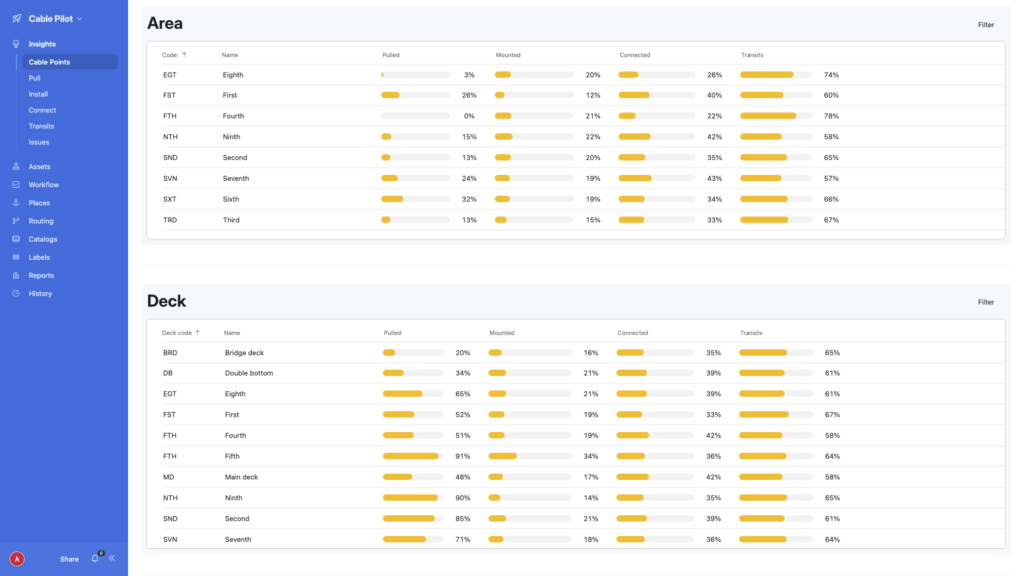
A massive vessel cannot be managed as a single flat list. The web platform understands the complex three-dimensional hierarchy of your ship. You can filter the dashboard data across multiple dimensions instantly — by specific areas, individual decks, functional systems, or assigned contractors.
If you filter the view to the Bridge Deck, the system recalculates all charts instantly. You see the specific Cable Points workload remaining for that exact physical location. You can identify exactly which functional systems are lagging behind in that zone. This targeted visibility allows you to direct your resources exactly where they are needed most.
Accurate Plan-vs-Fact Analysis in Real Time
Traditional progress reports create a dangerous illusion of security. They report the quantity of completed items, creating mathematically correct but operationally false percentages. The web application eliminates this self-deception entirely. It enables a true plan-versus-fact analysis based on verified physical effort.
When your project requires fifty thousand points of effort, and your dashboard shows twenty-five thousand points completed, you know the absolute truth. You have consumed exactly half of your required physical labor. Your Cable Points workload provides an objective measurement that cannot be manipulated. You transition from an art of guessing to a science of knowing.
Transforming Your Weekly Coordination Meetings
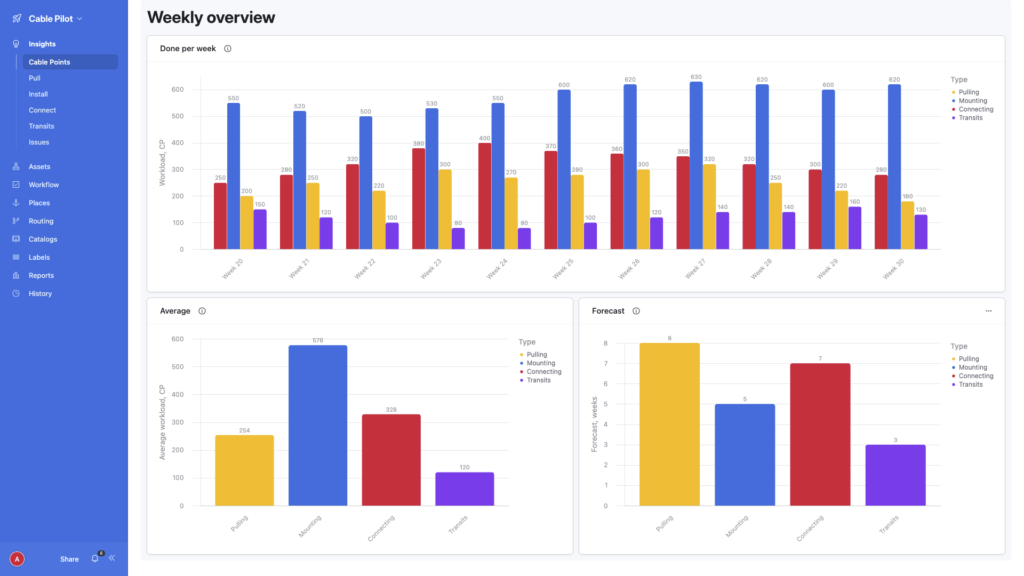
This objective data transforms your weekly coordination meetings completely. You no longer debate subjective completion percentages with your supervisors. You project the web application dashboard onto the screen and review the actual Cable Points workload consumed over the previous seven days.
The bar charts display your exact weekly velocity. If the planned consumption was five thousand points, and the actual was only three thousand, the bottleneck is undeniable. You stop arguing about whether the project is delayed. You start analyzing the data to find the root cause. Reliable electrical installation metrics drive immediate, factual problem-solving.
Predictive Forecasting Based on Historical Data
Managing the present is essential for survival, but predicting the future provides a massive competitive advantage. Predicting a completion date with traditional metrics is merely educated guesswork. With the Cable Pilot platform, it becomes a simple, reliable mathematical calculation. The web application constantly analyzes your historical performance data to predict future outcomes.
The system knows your exact remaining Cable Points workload automatically. It calculates your team’s average weekly velocity based on their actual performance over previous weeks. By dividing the remaining effort by your proven velocity, the platform generates a statistical forecast. You see exactly how many weeks remain until the project is definitively completed.
Forecasting with Cable Points Workload Data
The Insights module features a dedicated Forecast widget that updates dynamically. It displays the projected weeks required to finish pulling, mounting, connecting, and transit sealing independently. If the forecast predicts a missed deadline for the termination phase, you can act early.
You can authorize targeted overtime or assign additional personnel immediately. Monitoring your projected Cable Points workload allows you to navigate around delays before they impact your critical path. You solve massive scheduling conflicts weeks before they actually manifest on the deck.
Objective Contractor Performance Analysis
Large projects frequently utilize multiple specialized subcontractors simultaneously. Coordinating these distinct teams requires absolute transparency and strict accountability. Subjective performance reviews breed resentment and inevitably lead to commercial disputes. You need hard, undeniable data to manage external teams effectively.
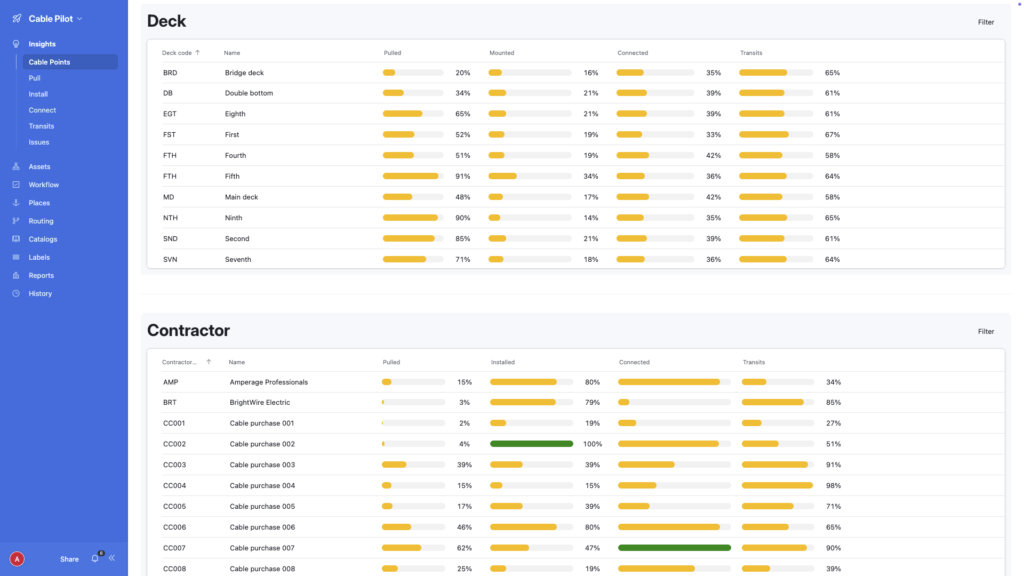
The web platform tracks progress independently for every assigned company. You view their specific completion rates on a dedicated contractor dashboard. You execute true contractor performance analysis by measuring their output in standardized units. You know exactly which team is driving the project forward and which team is holding it back.
Exposing the True Workload Value
Traditional metrics create a dangerous illusion of equal performance. Contractor A might pull twelve hundred meters of heavy power cable. Contractor B might pull eleven hundred meters of lightweight signal cable. On a standard report, their performance looks identical. The Cable Pilot platform shatters this illusion instantly.
The system calculates the actual effort consumed. Contractor A completed eighteen thousand points of effort, while Contractor B completed only fourteen thousand. When you evaluate teams using their verified Cable Points workload, you see their true productivity. This factual approach removes emotion from vendor management completely. You allocate future resources based on proven, documented capabilities.
Transforming Budgeting from Art to Science
When you build your budget on traditional man-hour estimates, you are defending a plan you do not fully trust. Subjective estimates lack transparency and cannot be accurately compared across different vendors. You need a financial framework built on solid, quantifiable data.
The Cable Pilot platform connects your financial planning directly to your operational reality. You establish a standard cost per unit of effort based on your historical data. You multiply this rate by your total project effort. Budgeting with your Cable Points workload provides a clear, defensible financial plan that your executive team can trust completely.
Securing Your Financial Future With Cable Points Workload
This standardized approach secures your long-term profitability. Every completed project builds a powerful historical archive within the platform. You accumulate a deep understanding of your actual installation costs and true project timelines.
When bidding on future tenders, you consult this rich digital archive. You know exactly how much effort a specific system configuration requires. Utilizing the Cable Points workload ensures your future bids are highly competitive and mathematically safe. You stop gambling on vague estimates and start engineering your financial success with absolute certainty.
Engineer Your Financial Success with Objective Workload Data.
Take Complete Control of Your Labor Budget
Managing shipyard electrical work requires absolute precision. Outdated measurement tools create a false picture of progress that drains your budget and extends your schedules. You need a solution built specifically for the complexity of maritime construction — one that translates physical installation work into a transparent, objective language your entire organization can act on.
Cable Pilot transforms your entire operation. It assigns every cable task a calculated effort value, aggregates real-time field updates into actionable dashboards, and enables honest forecasting based on your team’s proven velocity. Stop gambling on subjective estimates and start engineering your project delivery with the precision your clients and your margins demand.