

Master Shipyard Execution With Digital Electrical Work Packages
Assign, track, and close every electrical work package from your desk to the deck.
Shipyards are dynamic, unforgiving environments where thousands of activities happen simultaneously. Managing this sheer volume of activity requires strict control over daily execution. Traditional methods rely on printed lists, highlighted drawings, and verbal instructions to guide field crews. This analog approach creates massive confusion on the deck. It also leaves project managers completely blind to actual progress until end-of-shift reports are filed.
You need a system that translates a massive project scope into manageable, trackable daily actions. Digital electrical work packages deliver this exact capability. They bridge the critical gap between high-level engineering plans and physical installation on the vessel.
The Cable Pilot platform replaces chaotic spreadsheets with structured, hierarchical execution. It gives your field crews an intuitive smartphone application designed for harsh conditions. It gives your project managers powerful web-based dashboards for strategic oversight. Together, these unified tools eliminate ambiguity and prevent costly rework. Effective management of electrical work packages turns your unpredictable workflow into a highly controlled, predictable production engine.
The Failure of Flat Task Lists in Shipbuilding
Generic project tools treat every job as a flat list of isolated tasks. They view pulling a heavy power line exactly the same as connecting a simple communication sensor. This task-centric worldview works well for software development, but it fails completely in maritime construction. A ship is a complex, three-dimensional physical structure. Your daily tasks are inextricably linked to specific compartments, heavy equipment, and strict structural boundaries.
When supervisors attempt shipbuilding task management using generic spreadsheets, they lose this critical physical context immediately. An electrician receives a printed list of one hundred cables to pull. They spend their first hour simply hunting for locations and deciphering handwritten routing notes. This administrative friction destroys labor efficiency before the physical work even begins.
Moving Beyond Generic Project Tools
The maritime industry requires an object-centric approach to data. Cable Pilot treats every physical asset as an intelligent digital object within a comprehensive digital twin. A single cable knows its exact origin, its destination, and its authorized routing path. However, you do not hand a raw list of thousands of cables directly to an installer. You must group them logically.
This is the core function of our advanced electrical work packages. They serve as the vital organizational layer between your massive project database and the atomic actions required on the deck. A package groups logical tasks together based entirely on physical reality. You can generate a package containing all termination tasks within a specific engine room compartment. You can group all cable pulls required for the fire detection system into one executable unit.
Structuring Reality With Intelligent Electrical Work Packages
This structured approach gives your skilled labor force clear, achievable daily goals. It prevents crews from wandering between different decks to complete isolated tasks. By clustering work physically and logically, you eliminate thousands of hours of wasted transit time across the lifespan of a vessel build.
Effective execution relies on absolute clarity. When an electrician opens their assignment, they do not need to guess what is prioritized. The system tells them exactly what to do, where to do it, and what materials are required. This level of precision is the defining hallmark of modern electrical work packages.
The Hierarchy of the Digital Twin
The Cable Pilot platform mirrors the actual physical structure of the vessel. The database hierarchy flows logically from the Ship to the Area, down to the Deck, and finally to the specific Compartment. Every asset and task is mapped to these specific coordinates.
This spatial accountability ensures that your electrical work packages are always contextually relevant. You manage the physical reality of the ship, rather than just managing a list of abstract tasks. This spatial awareness prevents contractors from clashing in tight spaces and optimizes your overall production flow significantly.
Centralized Control Through the Web Application
The creation and strategic oversight of these packages happen within the Cable Pilot web platform. This interface acts as your master control tower. Project managers and site supervisors use the web application to orchestrate the daily flow of labor intelligently. You stop managing your crews by intuition and start deploying resources based on verified digital data.
Building targeted assignments takes only minutes in the web interface. You can filter your entire digital twin database by specific areas, decks, or functional systems. You select the relevant cables or equipment and group them instantly. You assign this group directly to a specific contractor or an individual crew leader.
Creating Data-Driven Electrical Work Packages
This establishes immediate, undeniable accountability for the execution of the work. Superior shipbuilding task management means there is never any confusion about who is responsible for a specific compartment. You dictate the exact sequence of events from your desk, and that sequence translates perfectly to the deck.
This centralized control is vital when orchestrating complex retrofits or massive new builds. You can plan your execution strategy weeks in advance. You can build a comprehensive queue of digital task assignment modules that are ready to deploy the moment a compartment becomes available.
Measuring Effort With Cable Points Workload
Assigning tasks is only effective if the workload is balanced fairly across your teams. Counting the raw number of cables in an assignment provides a dangerously inaccurate measure of the required effort. Ten heavy, armored power cables require vastly more physical labor than ten lightweight communication wires. Treating them equally destroys your schedule predictability.
Our system solves this by calculating the Cable Points workload for every package automatically. Cable Points represent the true, objective labor effort required, based on physical specifications like cross-section and core count. When a project manager builds electrical work packages, the web platform displays the total calculated effort budget instantly.
Executing Tasks in the Field With Mobile Task Assignment
You can balance the daily workload across multiple crews using this data. You assign tasks based on actual physical effort rather than misleading volume metrics. This ensures your teams are consistently productive without suffering from burnout caused by unrealistic expectations.
A perfect plan in the office is entirely useless if it does not reach the deck efficiently. Traditional workflows rely on printing daily spreadsheets and handing them to foremen during morning meetings. These paper lists become completely obsolete the moment an engineering change occurs. Cable Pilot eliminates this wasteful paper trail completely.
Seamless Digital Task Assignment for Installers
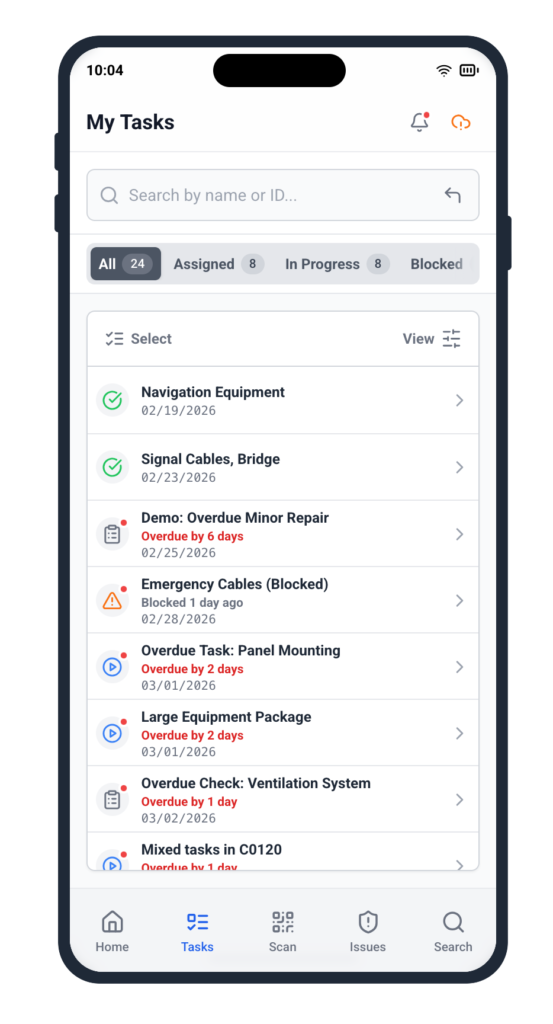
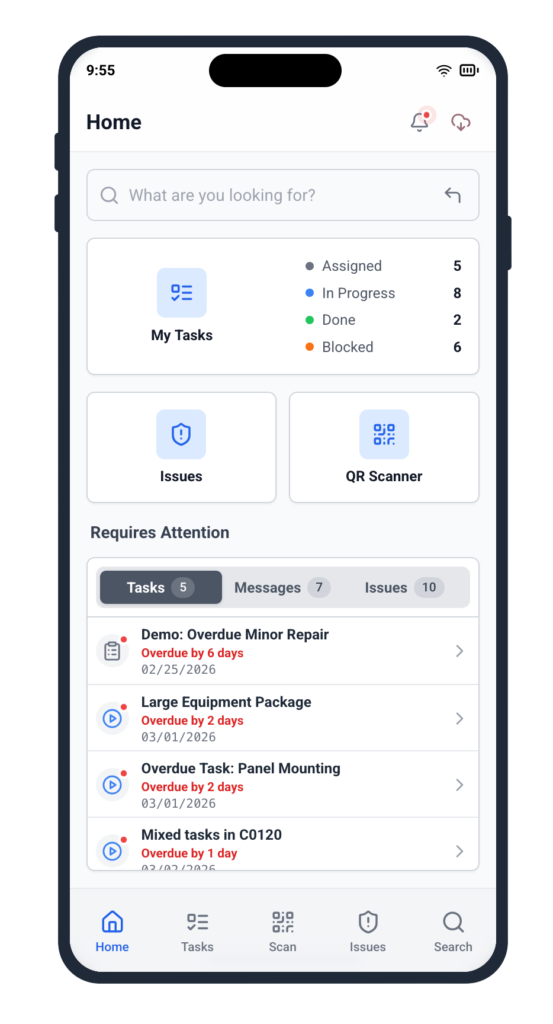
Through digital task assignment, installers carry their authorized instructions directly in their pockets. They log into the Cable Pilot smartphone application and view their specific queue of work instantly. The home screen displays a “My Tasks” summary widget that shows live status counts — how many packages are Assigned, In Progress, Done, and Blocked — giving each field worker an immediate read of their personal workload at a glance. Quick-access tiles for the QR Scanner and Issues are positioned directly below, and a “Requires Attention” section surfaces overdue tasks so installers can prioritize without any manual triage.
Cable pull task cards display the task number, deadline, and the full list of cables to be pulled. Equipment task cards show the task number, deadline, and the corresponding equipment items to be installed or connected. Installers see exactly what they need to accomplish during their shift without any administrative confusion.
Contextual Scanning and Electrical Work Packages
The mobile workflow is built entirely around rapid, error-free physical identification. Unique QR code labels are affixed to every cable, compartment, and equipment panel during project preparation. When an installer arrives at a designated compartment, they simply point their smartphone camera at the location’s QR code label.
The application instantly recognizes the task card. It displays the full cable or equipment list for that assignment, filtered to only the work relevant to that physical space. The installer does not scroll through hundreds of rows of data on a small screen. They see the specific connections they must execute right there.
Seamless Updates for Electrical Work Packages
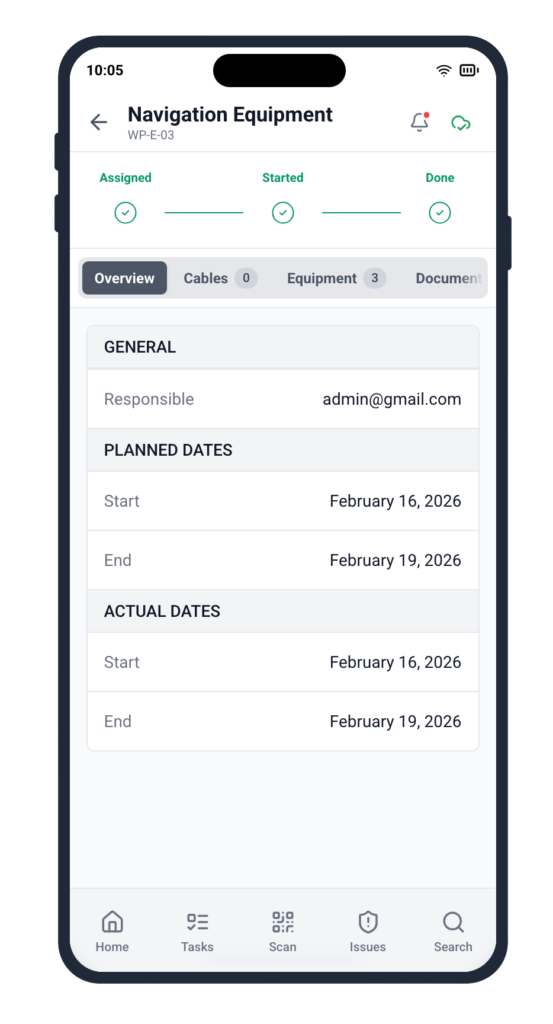
Recording progress must be an effortless byproduct of the physical work, not a separate administrative chore. Traditional reporting forces installers to stop working and manually transcribe data onto paper forms. Cable Pilot compresses this entire reporting cycle to mere seconds. Each update is timestamped and permanently recorded in the central database.
After terminating a wire, the installer simply taps the completion button on their smartphone screen. This single action updates the status of the atomic task instantly. Simultaneously, the system automatically recalculates the overall completion percentage of their assigned electrical work packages, keeping every dashboard in the project office perfectly current.
Stop chasing crews with paper lists. Start executing electrical work packages from a smartphone.
Group Actions for Rapid Progress Reporting
In many scenarios, crews complete multiple similar tasks simultaneously. Updating them one by one is inefficient. The smartphone application allows for powerful group actions within any active package. An installer can select multiple pulled cables from their list and update all their statuses simultaneously with a single tap.
This batch processing capability is designed specifically for harsh shipyard conditions. It minimizes the time skilled workers spend interacting with screens while wearing heavy gloves. Fast, low-friction data entry ensures that the progress of your electrical work packages is always perfectly synchronized with reality.
Real-Time Visibility and Shipyard Contractor Coordination
The exact moment an installer updates a status on the deck, that data flows instantly into the central cloud database. This live data stream powers the web application dashboards in the project office. Superintendents gain real-time visibility into the execution of every assigned package across the entire vessel.
Tracking Electrical Work Packages on Live Dashboards
This operational transparency transforms shipyard contractor coordination. Large vessels frequently require multiple specialized electrical subcontractors working in parallel. Managing these distinct teams with disconnected spreadsheets guarantees schedule conflicts and territorial disputes over shared spaces. Cable Pilot acts as a neutral, factual collaboration hub.
Through role-based access control, each external contractor only sees their specific electrical work packages. They cannot view competitor pricing or unrelated engineering data. However, the shipyard project manager sees the aggregated performance of everyone simultaneously. You manage your vendors based on undeniable facts, not optimistic promises.
Resolving Blockers in Electrical Work Packages
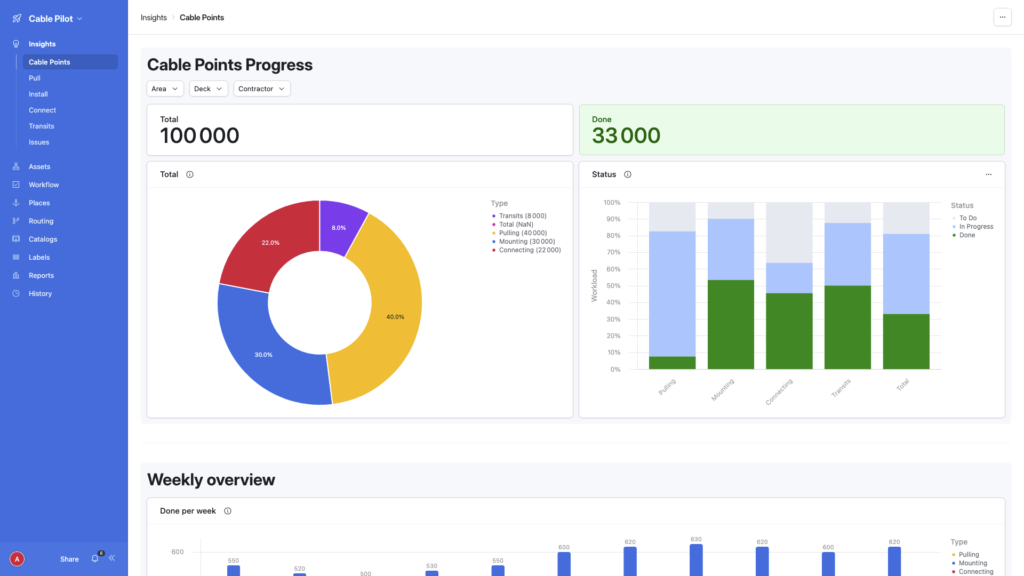
The web platform features a dedicated Insights module for strategic oversight. Project managers view objective metrics based entirely on live field data. The dashboards cover Cable Points, cable pulls, equipment installations, connections, and transits — all filterable by area, deck, and contractor.
You can monitor the exact completion percentage of specific electrical work packages in real time. The system calculates this progress objectively using consumed Cable Points workload data. If a critical task package in the engine room is falling behind its planned schedule, the data surfaces the delay immediately.
Rapid Issue Resolution on the Deck
Construction environments are incredibly dynamic, and unforeseen obstacles will inevitably impact your planned tasks. A compartment might be locked by the welding team. A specific sensor might arrive damaged from the supplier. The speed at which you resolve these field blockers dictates the ultimate profitability of your project.
You identify emerging bottlenecks as they develop. This allows you to redeploy your resources proactively before the master construction schedule is compromised. You transition from a reactive historian into a proactive, data-driven leader who controls outcomes rather than simply recording them.
Mobile Blocker Reporting for Rapid Problem Solving
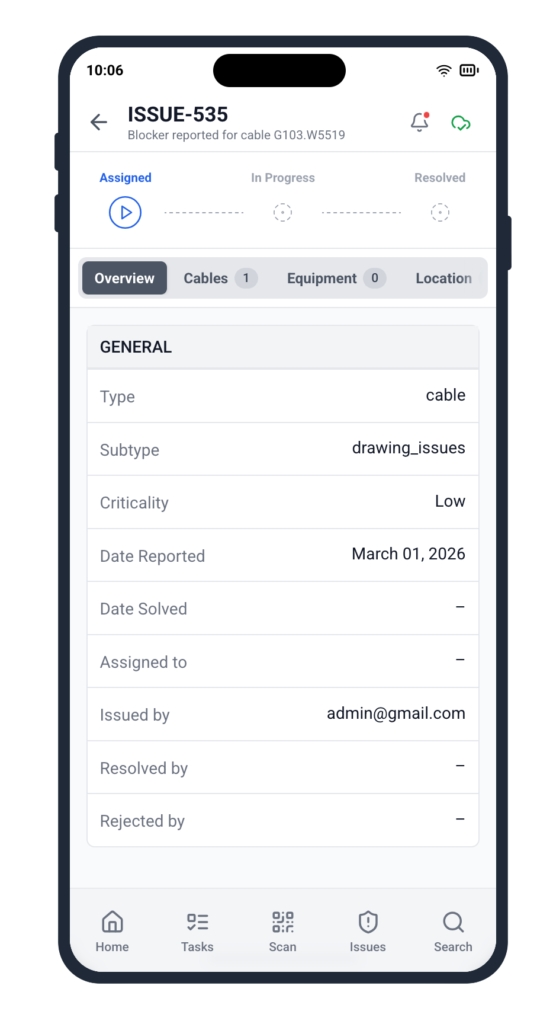
When an installer cannot complete their assigned electrical work packages due to a physical obstruction, they do not wait for a supervisor to walk by. They use the smartphone application to log a blocker instantly. They select the issue type, type a brief note, and attach photographic evidence using their device’s camera.
The system immediately tags the specific package as blocked and alerts management. This digital blocker report bypasses slow, traditional communication channels completely. The responsible team sees the exact physical context, the linked electrical work packages, and the high-resolution photo, and can issue a resolution without waiting for the installer to find a supervisor.
Automating the Handoff Between Trades
A missing material report is visible to the procurement team before the end of the shift. A drawing discrepancy reaches the design engineer with the full photographic and location context attached. They can issue a technical resolution in minutes rather than days. Field workers resume their physical installation work immediately, protecting your valuable labor budget.
Clear Accountability in Electrical Work Packages
A major source of shipyard idle time is the inefficient transfer of work fronts between different specialized teams. The cable pulling crew finishes their scope, but the termination specialists are not notified for two days. This structured downtime bleeds project budgets dry and extends delivery timelines unnecessarily.
Our platform redesigns this broken process into a structured, self-directing workflow. Technical dependencies are mapped directly into the system architecture. You can configure sequential electrical work packages that reflect the real-world dependency between pulling and termination crews, ensuring the next team has clear visibility when their prerequisite work is complete.
When the pulling crew marks the final cable in their package as complete, the status is immediately visible to the termination crew’s supervisor in the web application. This structured flow of responsibility eliminates the classic shipyard blame game entirely. If a termination team claims they could not start working, you check the system logs. You see exactly when the prerequisite electrical work packages were completed and when the updated status became visible to the next team. The data is objective, undeniable, and permanent.
Offline Functionality for Deep Vessel Environments
Shipyards present extreme connectivity challenges. Deep inside a steel hull or a heavily shielded machinery space, cellular networks simply do not exist. A digital tool that requires a constant internet connection will fail exactly when your field crews need it most, forcing them back to paper.
The Cable Pilot smartphone app is architected specifically for robust offline operation. Installers synchronize their assigned electrical work packages while in areas with network coverage. They then proceed into the deepest compartments of the vessel to execute their tasks without interruption. Every scan, status update, and blocker report is stored locally on the device until connectivity resumes.
Replace disconnected spreadsheets with live digital electrical work packages for every trade.
Automatic Background Synchronization
Field workers continue to scan QR codes, update statuses, and log photographic blocker reports without any network signal. The application stores all field data safely on the local device memory. The moment the worker returns to a connected zone, the application takes over automatically.
It synchronizes all pending updates in the background without requiring any action from the field worker. It pushes the completed task data to the central cloud server instantly. Uninterrupted execution of your electrical work packages is guaranteed, regardless of the severe physical constraints of the maritime environment. Your dashboards in the project office always reflect the true state of the vessel, never a stale snapshot.
Achieving Total Control Over Your Production
Integrating your massive engineering plans with the gritty reality of deck operations requires a specialized approach. Generic task trackers fail because they do not understand the spatial and logical complexity of maritime construction. Managing thousands of raw cables in a disconnected spreadsheet guarantees administrative failure. The gaps between planning and execution widen until they swallow your schedule entirely.
You need a platform that groups complex tasks into manageable, highly trackable units. You need a system that delivers those units directly to the smartphones of your skilled labor force. You need dashboards that translate live field data into actionable decisions for your supervisors. Cable Pilot provides this exact infrastructure, bridging the fatal gap between the office and the vessel.
The result is a production environment where nothing falls through the cracks. Every cable has an owner. Every work package has a deadline and a current status. Every blocker has a digital record and a clear resolution path. Your project managers spend their time making strategic decisions rather than chasing verbal status updates from foremen.
Predictable Production Through Electrical Work Packages
The shipbuilding industry faces relentless pressure to reduce costs, accelerate schedules, and improve first-time quality. Meeting these demands requires more than skilled workers — it requires a digital backbone that coordinates those skills precisely. Electrical installation represents one of the most complex and labor-intensive phases of any vessel build.
Cable Pilot was purpose-built for this reality. Our electrical work packages are not a generic feature adapted from a construction app. They are a specialized execution layer designed specifically for the physical and organizational demands of maritime construction. Every design decision reflects the actual conditions on the deck.
Transform your chaotic shipyard into a predictable production engine. Give your field teams clear, mobile instructions and low-friction QR code reporting. Give your managers live dashboards that surface problems before they become delays. Take complete control of your vessel construction schedule with the industry’s most advanced platform for executing and monitoring electrical work packages.