
The shipbuilding industry faces a persistent challenge that quietly erodes project timelines and inflates costs: slow, error-prone field reporting in electrical installation work. While modern ships incorporate increasingly sophisticated electrical systems with thousands of cables, the process of tracking their installation progress often remains trapped in analog workflows. Engineers walk the decks with clipboards, electricians scribble notes on paper lists, and by day’s end, someone must manually transcribe this information into spreadsheets or legacy systems. This data entry bottleneck doesn’t just waste time; it creates dangerous information gaps that cascade into coordination failures, rework, and schedule slips. To address these issues, QR scanning technology has emerged as a critical solution.
Cable Pilot addresses this fundamental workflow problem with a deceptively simple innovation: QR-coded cables, equipment, and installation lists that enable 10-second status updates from any smartphone. By eliminating the friction between field work and digital record-keeping, this feature transforms electrical installation tracking from a burdensome administrative task into an effortless byproduct of the installation process itself. The result is a real-time single source of truth that synchronizes everyone from deck-level installers to project managers in shore offices, reclaiming an average of 1.41 productive hours per worker daily while simultaneously eliminating the data accuracy issues that plague traditional reporting methods. The integration of QR scanning into this workflow exemplifies its efficiency.
The Hidden Cost of Manual Electrical Installation Reporting
Before examining how QR scanning technology solves the reporting problem, it’s essential to understand why this challenge is so significant in shipbuilding contexts. Unlike construction projects on land, electrical installation aboard ships occurs in constrained spaces with limited connectivity, often while other trades work simultaneously in adjacent compartments. The electrical installation process follows a specific sequence: cables must be pulled through designated routes, then connected at termination points, and finally tested for continuity and insulation resistance before the system can be energized.
Traditional tracking methods require installers to note each completed step on paper cable lists, which are then collected by supervisors who must reconcile multiple handwritten documents and enter the consolidated data into project management systems. This process introduces multiple points of failure. Field workers may forget to mark completed work, leading to double-checking and wasted labor effort. Handwriting can be illegible, especially in challenging shipyard conditions. Paper documents get lost, damaged by weather, or become outdated when design changes occur. Most critically, there is often a 24-48 hour lag between work completion and data availability, meaning project managers lack visibility into actual progress until long after problems have compounded. Incorporating QR scanning can drastically reduce these lags.
Research on manual data collection in industrial settings confirms these observations. Studies show that manual transcription introduces error rates of 2-4%, which translates to dozens of incorrect records in a typical cable list containing 2,000 entries. These errors aren’t merely statistical noise; they trigger real consequences. An incorrectly marked cable might be tested twice, wasting labor effort, or worse, an untested cable might be recorded as complete, creating safety risks. The administrative burden is equally significant. Data entry clerks in shipyards report spending 3-4 hours daily just transcribing field reports into digital systems, time that could be redirected to value-adding coordination activities. The implementation of QR scanning technology can mitigate these issues significantly.
The connectivity constraints of shipyard environments exacerbate these challenges. Deep within a ship’s hull, cellular signals are weak or nonexistent. Wi-Fi networks, if available, rarely penetrate into all work areas. This means that even when organizations attempt to use digital tools, field workers often cannot access the system while performing actual installation work. They resort to hybrid approaches: taking notes on paper, then entering data when they return to areas with connectivity. This defeats the purpose of digital tracking and reintroduces all the delays and errors of manual methods.

QR-Coded Cables: From Import to Installation in Minutes
Cable Pilot’s approach begins with automatic QR code generation during the data import phase. When a project manager imports the cable list, the system immediately generates unique QR codes for every cable in the database. These codes aren’t generic identifiers; they contain the cable’s specific attributes from the engineering documentation, including cable number, origin and destination compartments, cable type specifications, and installation route. This encoding means that scanning a cable’s QR code instantly retrieves its complete technical profile without requiring manual data entry or dropdown menu navigation.
The system supports multiple QR code deployment strategies to accommodate different shipyard workflows – export with templates for purchasing cables, primting labels and printing cable lists with QR-codes. This flexibility is particularly valuable in retrofit projects or when working with contractors who have established cable marking standards.
The QR code generation process requires no specialized equipment beyond a standard office printer. Cable Pilot’s export function produces print-ready PDF documents with optimal QR code density, ensuring that codes scan reliably even when printed on non-premium paper or when labels become slightly worn during installation. The system also supports batch printing, allowing supervisors to prepare QR-coded materials for specific zones or installation phases, distributing only the relevant codes to each installation team and reducing clutter.
What distinguishes Cable Pilot’s QR implementation from generic QR code systems is the deep integration with the electrical installation workflow. The codes don’t merely identify cables; they provide a direct interface to Cable Pilot’s status tracking engine. When a worker scans a code, the application doesn’t just display information, it presents context-aware action options based on the cable’s current status and the user’s role, creating an intuitive workflow that requires minimal training.
The 10-Second Workflow: Scan, Tap, Sync
The actual field reporting process using Cable Pilot’s QR scanning reduces what was once a multi-step administrative task to a simple gesture repeated throughout the workday. An installer pulls out their smartphone, opens the Cable Pilot mobile application, and taps the scan button. The phone’s camera activates, and the worker points it at the QR code on the cable or checklist. Within one second, the system recognizes the code and displays the cable’s information on screen: cable number, origin, destination, and current installation status.
From this screen, the installer sees clearly labeled status buttons corresponding to the electrical installation workflow stages: “Pulled,” “Connected,” and “Tested.” If the cable has just been pulled through its designated route, the worker taps “Pulled.” The application immediately updates the cable’s status in the local database on the smartphone, and if connectivity is available, synchronizes this change to the cloud-based central database. The entire sequence, from initiating the scan to confirming the status update, takes approximately 10 seconds, even for users unfamiliar with the system.
This brevity is not accidental but the result of deliberate design choices informed by shipyard realities. Cable Pilot’s mobile interface prioritizes large, finger-friendly buttons because installers often work wearing gloves. The application eliminates unnecessary confirmation dialogs, recognizing that in industrial environments, workers need to complete digital tasks quickly to return focus to physical work. The status options are limited to the essential stages that matter for project coordination, avoiding the feature bloat that makes enterprise software cumbersome in field conditions.
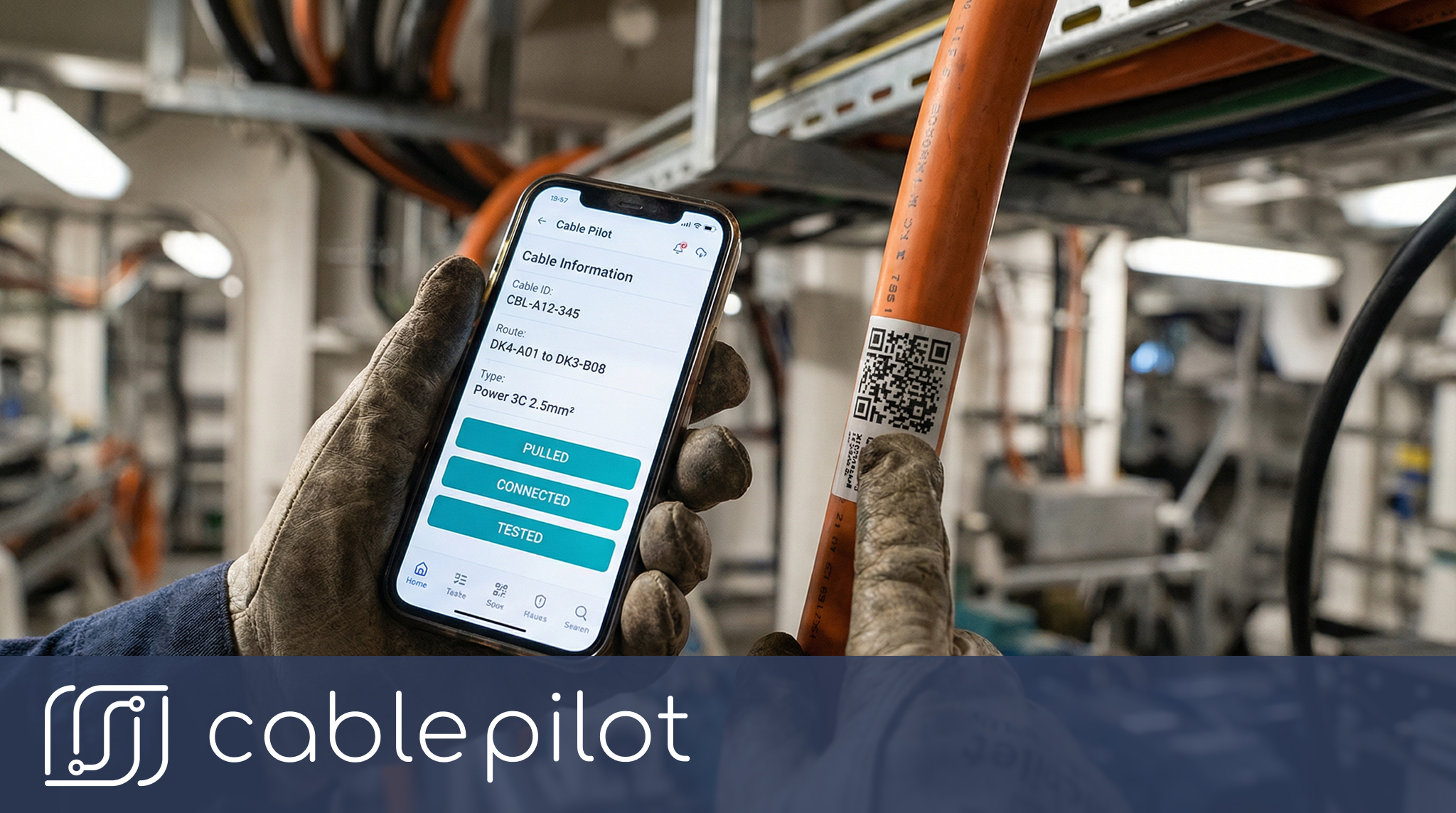
The offline-first architecture is critical to the 10-second promise. Cable Pilot’s smartphone application does not require an active internet connection to function. All data needed for a worker’s current assignments, including cable details, engineering drawings, and installation instructions, is synchronized to the smartphone during the morning briefing when connectivity is available. Throughout the workday, as the installer scans cables and updates statuses, these changes are stored locally on the device. When the worker moves to an area with Wi-Fi or cellular coverage, or when they return to the office at day’s end, the application automatically synchronizes accumulated updates to the central database without requiring any manual intervention.
This offline capability transforms how electrical installation work is reported in the most challenging shipyard environments. Deep within a ship’s engine room, inside a confined electrical cabinet space, or on scaffolding high above the deck where signal is weak, installers can still scan and update cable statuses with the same 10-second workflow. There’s no need to remember cable numbers for later entry, no paper forms to carry and protect from damage, and no risk of losing work due to connectivity dropouts. The data is captured immediately, at the point of work, ensuring accuracy and completeness.
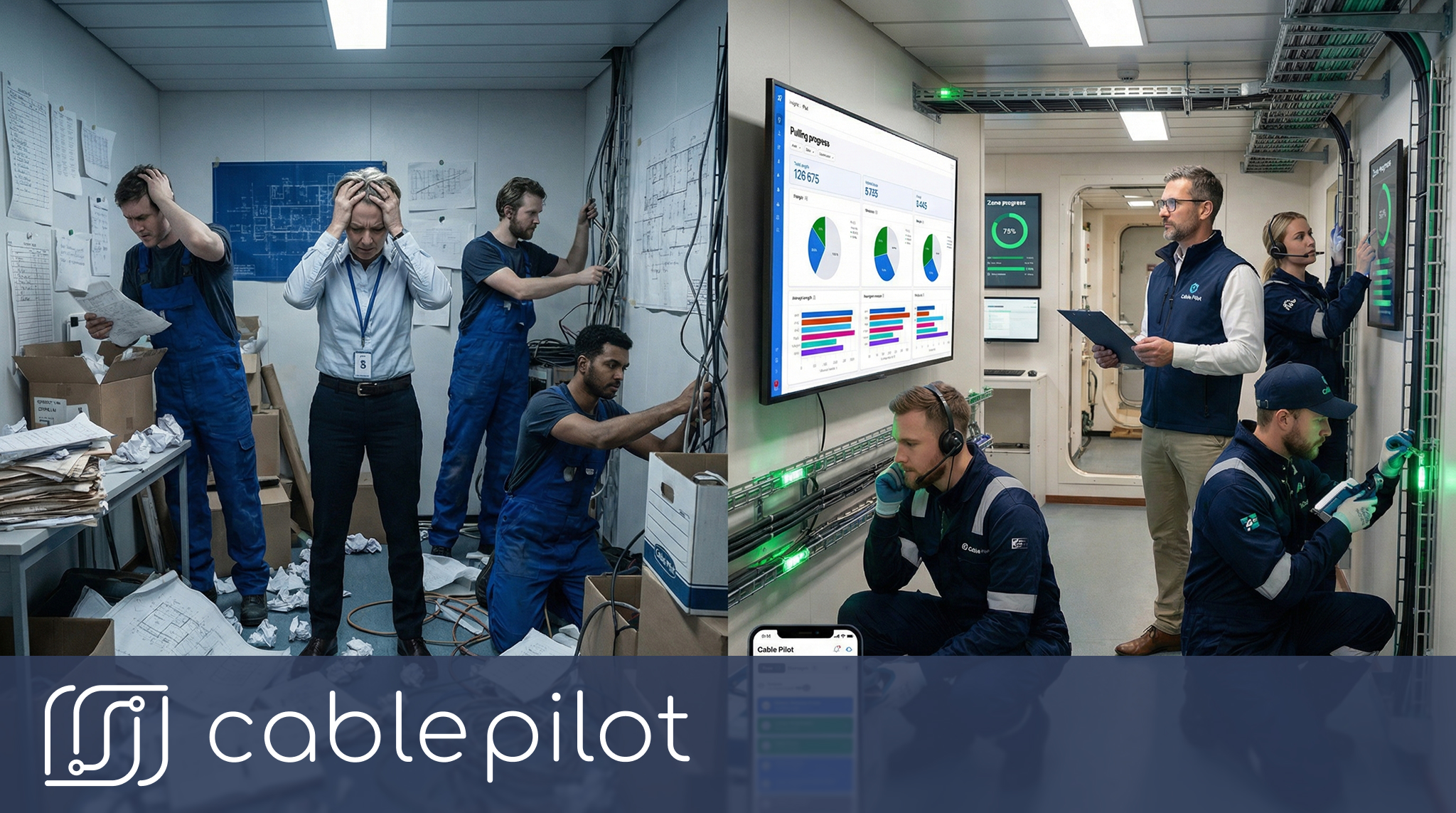
For supervisors and project managers, this immediate capture creates unprecedented visibility. Rather than waiting until the end of a shift to learn what was accomplished, they can monitor progress in near real-time as installers’ smartphones sync their updates. The Cable Pilot dashboard refreshes to show newly pulled cables, completed connections, and finished testing, providing a live pulse of project activity. This visibility enables proactive management: if a particular zone shows slower progress than planned, resources can be reallocated before the delay compounds. If a specific cable type consistently takes longer to install than estimated, project schedules can be adjusted before downstream activities are impacted.
Eliminating Paper Trails and Building Single Source of Truth
The transition from paper-based reporting to QR-enabled digital tracking yields benefits that extend far beyond time savings. Paper cable lists, while familiar and seemingly simple, introduce systemic problems that QR scanning eliminates entirely. Paper documents proliferate in shipyard projects: each shift team receives printouts, design changes generate updated versions, and by mid-project, multiple incompatible versions circulate simultaneously. An installer working from an outdated list might mark a cable as complete, unaware that engineering changes have relocated that cable’s destination. The resulting confusion triggers rework, disputes about what was actually completed, and erosion of trust between shipyard coordination teams and contractors.
Cable Pilot’s QR system establishes a single source of truth because every scan references the same centralized database. When engineering updates a cable’s routing in the system, that change immediately affects what installers see when they scan the cable’s QR code. There are no version conflicts, no outdated printouts to recall, and no ambiguity about which information is authoritative. This synchronization is particularly valuable in the complex multi-party environment of shipbuilding, where design offices, installation contractors, testing specialists, and classification society inspectors all need access to consistent, current data.
The elimination of paper trails also improves data quality in subtle but significant ways. Paper lists invite shortcuts: an installer might mark multiple cables complete at once based on memory rather than checking each one, or might mark a cable “tested” before the actual test occurs, intending to perform the work shortly but then getting called to another task. QR scanning imposes a gentle discipline because updating status requires physically locating and scanning each cable. This doesn’t slow the workflow (it still takes only 10 seconds), but it ensures that reported progress accurately reflects completed work.
From a compliance and audit perspective, digital QR-based tracking creates verifiable history that paper cannot match. Every status update in Cable Pilot is automatically timestamped and attributed to the specific user who performed it. This creates an auditable trail showing exactly who reported that a particular cable was pulled, when it was connected, and when testing was completed. For classification society inspections or warranty verification, this digital provenance is far more reliable than a paper form with handwritten signatures that could have been filled out in batch long after the actual work.
The single source of truth also transforms communication between shipyard coordination roles and installation contractors. In traditional arrangements, contractors submit progress reports based on their internal records, which the shipyard must then verify against their own tracking systems. Discrepancies lead to disputes, payment delays, and adversarial relationships. When both parties use Cable Pilot and rely on QR-scanned updates, they’re literally looking at the same data. Progress discussions shift from arguing about what was completed to collaborative problem-solving about how to maintain or accelerate pace. This transparency tends to improve contractor accountability as well; when progress is visible in real-time, there’s less opportunity for misrepresentation and greater incentive to maintain steady productivity.

Real-Time Progress Tracking Transforms Shipyard Coordination
The transformation from delayed, uncertain progress data to real-time visibility fundamentally changes how shipyards coordinate electrical installation work. Traditional project management in shipbuilding operates on a weekly or bi-weekly reporting cycle: contractors submit progress updates, the shipyard consolidates and analyzes the data, and adjustments are made for the following period. This cadence worked adequately when schedules were less aggressive and project complexity was lower, but modern shipbuilding timelines demand more responsive management.
Cable Pilot’s QR scanning enables daily, or even hourly, progress visibility. Project managers accessing the Cable Pilot dashboard can see color-coded status maps showing which cables in each ship zone have been pulled, connected, and tested. This granular view reveals patterns that would be invisible in weekly summaries. Perhaps one installation team is progressing faster than others, suggesting that their approach could be shared. Perhaps a specific cable type shows unusually low completion rates, indicating a supply issue or technical problem that needs immediate attention. Perhaps a critical path cable remains unpulled despite being scheduled for completion yesterday, signaling the need for urgent intervention.
This real-time visibility is especially valuable for managing dependencies in the electrical installation sequence. Certain cables must be pulled before others due to routing constraints. Testing cannot begin until all cables in a circuit are connected. Energization of a system requires approval from classification societies after reviewing test records. Cable Pilot’s QR-based status tracking ensures that these dependencies are visible immediately. When a blocking cable is finally pulled and scanned, downstream activities automatically become actionable, and the responsible teams can be notified without delay.
The impact on coordination between multiple contractors is similarly significant. Large shipbuilding projects typically involve several electrical installation contractors working in different zones or on different systems. Coordinating their activities to avoid conflicts and maximize productivity is a constant challenge. With paper-based reporting, understanding which zones are actually available for work, versus which are still occupied by incomplete prior activities, requires extensive communication and often results in teams arriving to find their work area not yet ready. Cable Pilot’s real-time dashboard shows exactly which compartments have completed their prerequisite electrical work, allowing planners to direct teams to genuinely available locations and reducing idle time.
For shipyard project managers who must report progress to shipowners and senior leadership, QR-enabled real-time tracking provides both confidence and precision. Rather than extrapolating from incomplete data or relying on contractor assurances, project status reports can reflect actual completed work as of the reporting moment. The data granularity also enables more sophisticated analytics: completion rates by cable type, productivity trends over time, and predictive forecasts based on current pace. These insights support data-driven decision-making about resource allocation, schedule adjustments, and risk mitigation.
Quantifiable ROI: Reclaiming Productive Hours
The efficiency gains from Cable Pilot’s QR scanning translate directly into measurable labor effort savings. Research on manual versus digital data collection in industrial settings indicates that paper-based reporting consumes 1.41 hours per worker daily when accounting for all related activities: recording work on paper forms, organizing and transporting documents, manual data entry, correction of errors, and handling of lost or damaged forms. For a typical electrical installation team of 50 workers, this represents 70.5 hours of lost productivity every single day, or approximately 1,410 hours per month.
By reducing status updates to a 10-second scan performed immediately upon work completion, Cable Pilot reclaims nearly all of this lost time. Assuming an installer updates 30 cable statuses throughout a workday (a realistic figure in active installation phases), the total time spent on progress reporting is approximately 5 minutes, compared to the 1.41 hours consumed by paper-based methods. This represents a 94% reduction in reporting overhead, freeing 1.35 hours per worker for actual productive electrical installation work.
The financial impact of this time reclamation is substantial. If we assume a fully burdened labor cost of 45 EUR per hour for skilled electrical installers, recovering 1.35 hours per worker daily equals 60.75 EUR in regained productivity per person per day. For a 50-person installation crew working for six months (approximately 120 workdays), the total recovered labor value is 364,500 EUR. This figure represents pure productivity gain, the equivalent of adding 8.5 full-time workers to the project without incurring any additional salary, benefits, or overhead costs.
Beyond the direct labor savings, QR scanning prevents several categories of waste that are harder to quantify but equally significant. Rework due to incorrect status information costs an estimated 2-5% of total electrical installation labor effort in projects using manual tracking. When a cable is incorrectly marked as tested, and inspectors later discover it wasn’t, the entire test sequence must be repeated, along with associated documentation. When a cable’s connection status is uncertain, workers may spend time verifying work that was already completed. By providing immediate, accurate status information, Cable Pilot eliminates ambiguity and the rework it triggers, capturing an additional 2-5% labor efficiency that compounds with the direct time savings.
The prevention of schedule delays represents another major ROI component. Electrical installation delays ripple through shipbuilding schedules, postponing downstream activities like interior outfitting, system commissioning, and sea trials. Industry studies suggest that each week of electrical installation delay extends the overall project timeline by 3-5 days and incurs 50,000-100,000 EUR in extended overhead costs for a mid-size vessel project. By enabling early detection of installation problems through real-time progress visibility, Cable Pilot helps prevent minor issues from escalating into schedule-impacting delays, protecting project margins and delivery commitments.
Differentiating Cable Pilot’s QR Implementation from Generic Solutions
While QR codes themselves are not novel technology, Cable Pilot’s implementation is specifically architected for the unique demands of shipbuilding electrical installation, differentiating it from generic QR code scanning applications or general-purpose project management tools. Generic QR systems typically function as simple lookup tools: scan a code, retrieve information, end of interaction. They don’t understand the electrical installation workflow, don’t accommodate offline operation, and don’t integrate with engineering data sources like cable lists and electrical schematics.
Cable Pilot’s QR scanning is workflow-aware. The system knows that cables progress through specific stages (pulled, connected, tested) and presents options accordingly. If a cable has already been marked as pulled, the application doesn’t offer a “Pull” button again; instead, it highlights the next logical action: “Connected.” This contextual intelligence guides users through the correct sequence of operations, reducing training requirements and preventing procedural errors. New workers can become proficient with the system within minutes because the interface anticipates what they need to do next.
The integration with Cable Pilot’s broader digital twin platform is equally important. QR scanning isn’t an isolated feature; it feeds data into a comprehensive electrical installation management ecosystem. The status updates captured via QR scans automatically update dashboards, trigger notifications to relevant stakeholders, contribute to progress analytics, and inform the generation of completion reports required for classification society approval. This integration eliminates the data silos that plague projects using disconnected tools, where field data lives in one system, engineering data in another, and progress tracking in a third, requiring manual reconciliation that reintroduces errors and delays.
Cable Pilot’s offline-first architecture is another critical differentiator. Many digital tools assume constant connectivity, making them impractical in the metal-enclosed, signal-blocking environments of ship interiors. Cable Pilot was designed from the ground up for offline operation, with intelligent synchronization that handles network interruptions gracefully. Workers never experience system failures due to connectivity drops, never lose entered data, and never need to worry about whether their updates were saved. This reliability is essential for gaining user trust and ensuring consistent system usage across all project phases.
The scalability of Cable Pilot’s QR implementation also sets it apart. The system handles projects ranging from small patrol vessels with a few hundred cables to large cruise ships with 50,000+ cables without performance degradation. QR code generation remains instantaneous even for massive cable lists. The smartphone application remains responsive when searching through thousands of cables. The cloud synchronization architecture scales to support hundreds of simultaneous users without latency issues. This scalability means shipyards can standardize on Cable Pilot across their entire portfolio of projects, from simple to complex, without needing different tools for different vessel classes.
From Theory to Practice: Implementing QR Scanning in Your Shipyard
For shipyards and contractors considering the adoption of Cable Pilot’s QR scanning, the implementation process is straightforward and minimally disruptive to ongoing operations. The system is designed for rapid deployment, allowing project teams to realize efficiency benefits within days rather than months. The first step involves importing the project’s cable list into Cable Pilot, a process that takes minutes thanks to the AI-powered import tool that intelligently maps columns from Excel or CSV files to Cable Pilot’s data structure.
Once the cable list is imported, generating QR codes requires a single click. Cable Pilot exports a print-ready PDF document containing all the codes, organized in a sequence that matches the cable list order. For projects where labels will be applied directly to cables, this document can be printed on marine-grade adhesive label sheets available from standard office supply vendors. For projects using QR-coded checklists instead, standard paper printing is sufficient. The printing process requires no specialized equipment beyond a conventional office printer, making deployment accessible even for resource-constrained contractors.
Distributing smartphones to installation teams is the next implementation step. Cable Pilot’s mobile application runs on standard Android and iOS devices, meaning shipyards can use existing smartphones or purchase inexpensive models without requiring rugged specialist hardware. The application installation takes seconds via app store download, and login credentials can be configured to match the shipyard’s existing user directory if desired. During the initial team briefing, supervisors demonstrate the scan-and-update workflow, typically requiring only 5-10 minutes of instruction for workers to become proficient.
For the first few days of QR scanning usage, it’s advisable to run a parallel tracking approach where both paper and digital methods are used simultaneously. This transition period allows workers to build confidence with the new system while providing a fallback if issues arise. In practice, most teams quickly prefer the QR method because it’s genuinely faster and easier than paper, and the parallel tracking phase can often be shortened or eliminated entirely. By the end of the first week, most installation teams are exclusively using QR scanning and wondering why they tolerated paper-based methods for so long.
For project managers and coordinators, accessing the real-time data captured through QR scanning requires logging into the Cable Pilot web dashboard from any internet-connected computer. The dashboard presents intuitive visualizations of progress, filterable by zone, cable type, installation status, or any other attribute in the cable list. Managers can export progress reports for stakeholder communication, drill down into specific problem areas, and configure automated alerts for critical events like completion of prerequisite cables. The dashboard updates continuously as installation teams’ smartphones sync their QR scan data, providing a living picture of project status.
Taking the Next Step: Experience QR Scanning Efficiency
Cable Pilot’s QR scanning feature represents a fundamental reimagining of electrical installation progress tracking, eliminating the friction that has long separated field work from digital records. By reducing status updates from lengthy administrative tasks to effortless 10-second interactions, the system reclaims valuable productive hours, eliminates data accuracy issues, and provides the real-time visibility that modern shipbuilding schedules demand. The ROI is measurable, the implementation is straightforward, and the impact on project coordination is transformative.
If your shipyard or electrical installation team is still relying on paper-based reporting, you’re experiencing the hidden costs of delayed data and manual transcription every single day. Those costs compound over the life of a project, eroding margins, extending schedules, and creating unnecessary friction between contractors and coordination teams. Cable Pilot’s QR scanning provides an immediate path to eliminate these inefficiencies while simultaneously improving data quality and project visibility.
Ready to see how QR scanning can transform your electrical installation workflow? Contact Cable Pilot today to schedule a personalized demonstration. We’ll show you how to generate QR codes from your actual cable lists, walk through the 10-second field reporting process, and demonstrate the real-time dashboard visibility that empowers proactive project management. Discover how shipyards worldwide are reclaiming productive hours and accelerating electrical installation timelines with Cable Pilot’s QR scanning technology.
Pingback: 7 Key Benefits Of Dominate Real-time Dashboards In Shipbuilding