
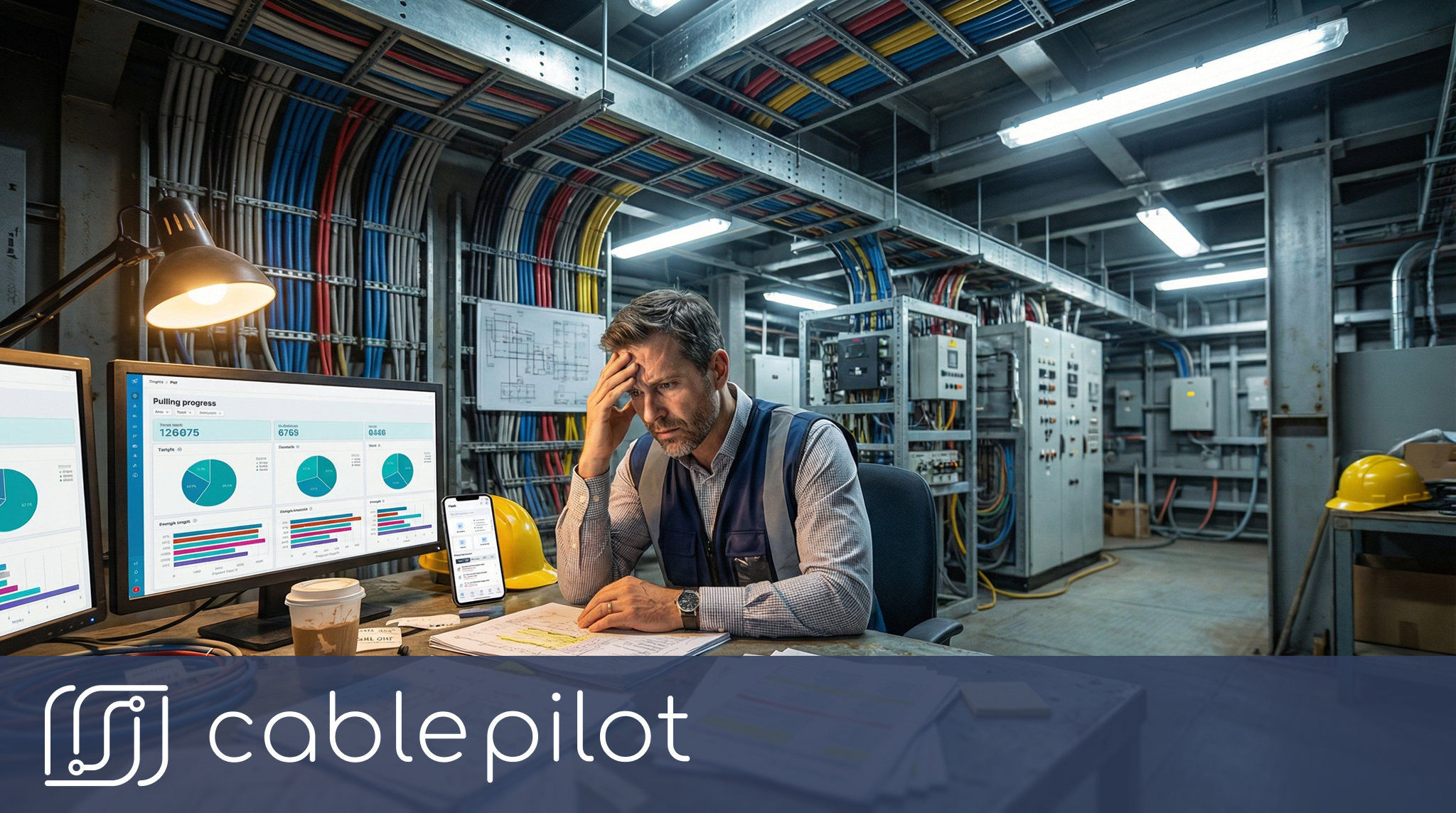
Modern shipbuilding electrical installations generate overwhelming amounts of data. Thousands of cables, hundreds of equipment connections, complex interdependencies across multiple systems, and parallel work streams managed by different contractors create an information landscape that traditional tools cannot handle. Excel spreadsheets multiply across departments. Paper cable lists become outdated the moment they’re printed. Status reports conflict with reality on deck. Project managers spend more time reconciling data than managing progress.
Achieving real-time visibility in shipbuilding processes is crucial for project success.
This data chaos doesn’t just slow projects—it obscures critical insights, triggers costly rework, delays commissioning, and erodes client confidence. The fundamental problem isn’t volume; it’s fragmentation. When installation intelligence exists in disconnected silos, no one possesses the complete picture necessary for confident decision-making.
Cable Pilot’s digital twin technology solves this challenge by transforming fragmented electrical installation data into a unified, living intelligence platform, providing real-time visibility. Unlike static documentation or passive tracking systems, Cable Pilot creates a real-time digital replica of every cable, its current status, complete history, and relationships within the vessel’s electrical architecture. This single source of truth eliminates version conflicts, accelerates problem resolution, and provides the project clarity essential for predictable, high-quality delivery.
Understanding the Digital Twin: More Than Visualization
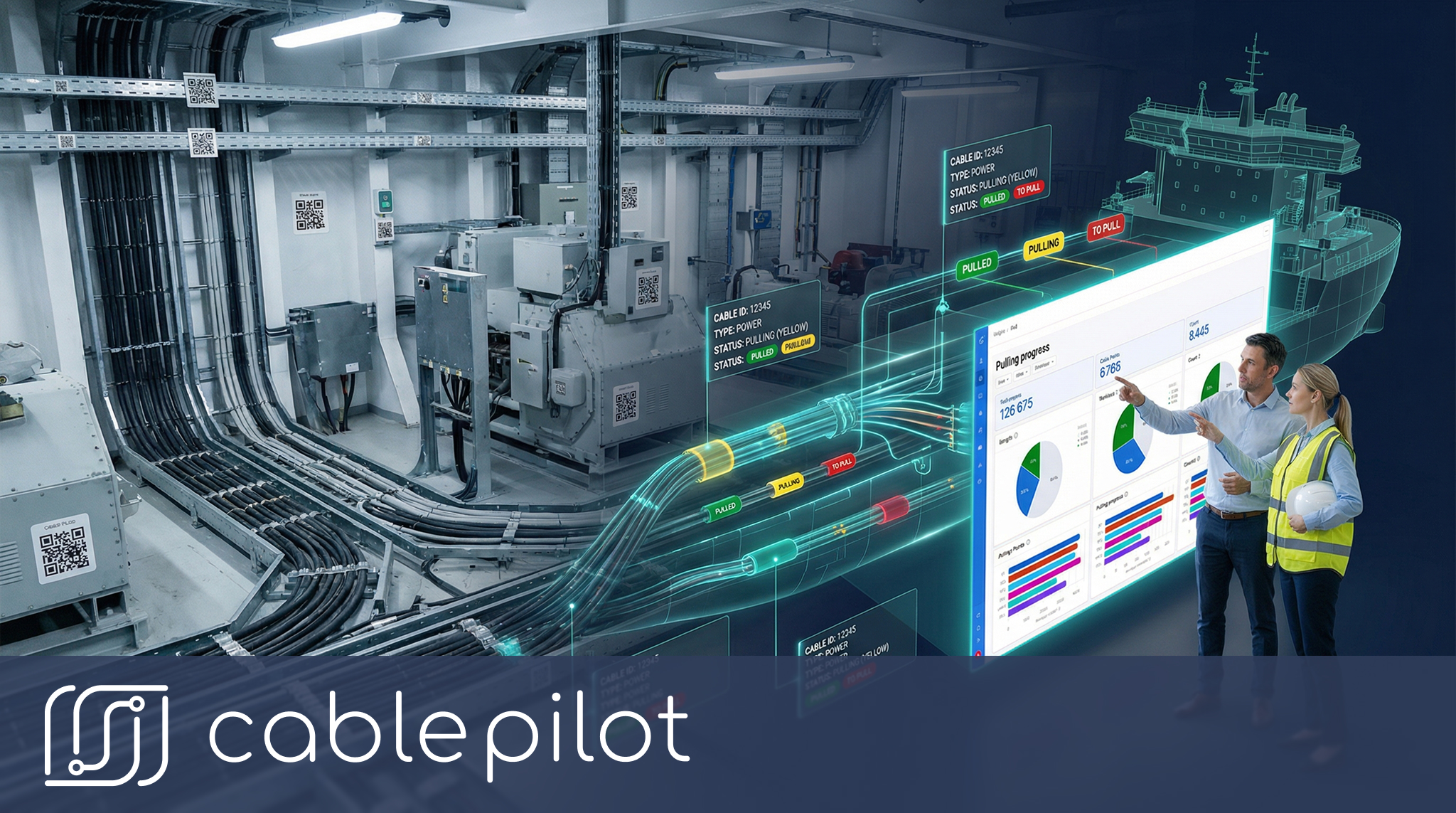
The term “digital twin” carries different meanings across industries. In shipbuilding electrical installation, Cable Pilot’s digital twin isn’t a 3D visualization or static CAD model—it’s a dynamic, data-connected replica of on-site electrical work that updates in real time as teams pull cables, complete terminations, conduct tests, and achieve handover milestones.
Each cable within Cable Pilot exists as an intelligent digital asset carrying comprehensive identity and lifecycle information. This includes its unique identifier, precise location within the vessel’s hierarchy (area, deck, compartment,zone), system affiliation (navigation, power distribution, automation), assigned contractor, current lifecycle stage, and complete history of status changes with timestamps and user attribution.
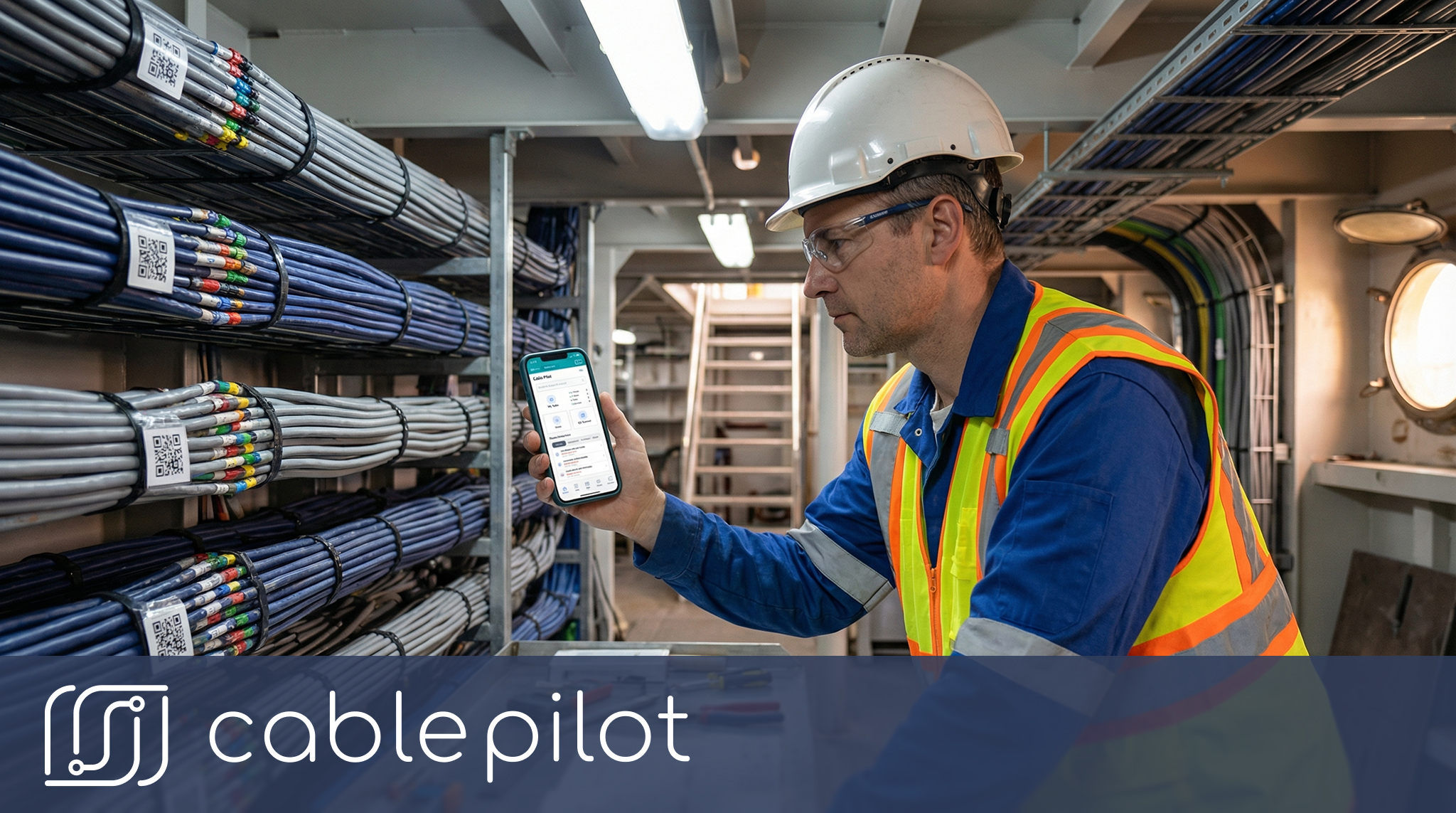
This digital twin technology transforms cables from line items in a spreadsheet into traceable, intelligent assets whose digital representations mirror physical reality. When an electrician marks a cable as pulled using their smartphone, the digital twin updates instantly. When a supervisor photographs a completed termination, that evidence attaches permanently to the cable’s digital record. When quality inspectors record test results, they become part of an immutable audit trail that survives project handover.
The power lies not in replicating information but in connecting it. Cable Pilot’s digital twin understands relationships: which cables share routes, which equipment depends on specific power feeds, which systems must achieve milestones before others can begin. This relational intelligence enables installation intelligence platform capabilities that passive documentation cannot match.
Every Cable as an Intelligent Asset
Traditional cable tracking treats cables as database entries—rows in a spreadsheet or items in a checklist. Cable Pilot elevates each cable to intelligent asset status by enriching it with context, relationships, and actionable metadata that drive better decisions.
Unique Identity and Context
Every cable receives a permanent digital identity linked to its engineering designation. This identity anchors comprehensive metadata including cable type specifications, length, routing path, origin and destination equipment, engineering drawing references, and installation priority. Project managers can instantly retrieve complete specifications without searching through documentation libraries or engineering databases.
Location Intelligence
Cable Pilot organizes cables within the vessel’s physical and logical hierarchy. A single cable exists simultaneously in multiple contexts: its physical compartment, its fire zone, its system affiliation, and its installation package. This multi-dimensional organization enables supervisors to view progress through different lenses—by location for workforce planning, by system for commissioning coordination, by contractor for performance management.
Lifecycle Status with History
Each cable progresses through defined lifecycle stages: scheduled, pulled, terminated from-side, terminated to-side, tested, documented, approved, handed over. Cable Pilot captures not just current status but complete transition history. Project managers see when each stage completed, which team member performed the work, how long each stage required, and whether deviations from expected timelines occurred.
This cable traceability system transforms quality management. Instead of asking “Is this cable installed?” teams ask sophisticated questions: “Which cables pulled last week still await termination? Which terminations lack photographic evidence? Which tests failed initial inspection and require rework?” The digital twin provides instant, accurate answers.
Relationship Mapping
Cables don’t exist in isolation. Cable Pilot captures their relationships to equipment, cable routes, installation packages, and dependent systems. When equipment modifications occur, project managers immediately identify affected cables. When route congestion emerges, planners see which cables share the constrained path. When system commissioning approaches, coordinators know precisely which cables must achieve readiness.
Granular Location-Based Visibility at a Glance
Information only creates value when presented in actionable form. Cable Pilot’s interactive dashboards transform the digital twin’s comprehensive data into real-time visibility that enables rapid, confident decision-making.
Color-Coded Status Intelligence
Visual encoding accelerates comprehension. Cable Pilot’s dashboards use intuitive color coding to communicate status instantly. Supervisors scanning the dashboard immediately identify which compartments, systems, or contractors need attention without reading detailed reports.
Multi-Dimensional Filtering
Project managers view progress through multiple lenses simultaneously. The same underlying digital twin data powers compartment-based views for location planning, system-based views for commissioning coordination, contractor-based views for performance management, and time-based views for schedule analysis. Switching perspectives requires seconds, not hours of data manipulation.
Drill-Down Analysis
Dashboard summaries provide entry points for deeper investigation. A project manager noticing low completion rates in a specific compartment can drill down to see individual cable status, identify common bottlenecks, review photographic evidence, and examine timeline history—all within the same interface. This layered information architecture supports both high-level monitoring and detailed problem-solving.
Exception-Based Management
Rather than reviewing hundreds of on-track items, Cable Pilot’s project clarity dashboard highlights exceptions that require attention: cables exceeding expected duration in specific stages, compartments falling behind schedule targets, quality checkpoints awaiting approval, or documentation packages missing required evidence. This exception-based approach focuses management attention where it creates maximum value.
Mobile Accessibility
Dashboards aren’t confined to desktop computers. Smartphone access enables supervisors to check progress while walking through compartments, compare actual conditions against digital status, and make informed decisions on deck. A shipyard director can scan current area completion versus schedule targets during a compartment walk-through and authorize workforce reallocation within minutes instead of waiting for weekly meetings.
Historical Traceability and Forensic Analysis
Quality assurance, regulatory compliance, and client confidence all depend on demonstrable traceability. Cable Pilot’s digital twin maintains a complete, tamper-proof record of every action, change, and milestone throughout the installation lifecycle.
Complete Audit Trail
Every status change generates a timestamped, user-attributed entry in Cable Pilot’s audit log. Project managers can reconstruct exactly when a cable transitioned between stages, which team member recorded the change, from which location they worked, and whether supporting evidence accompanied the update. This immutable audit trail provides defensible documentation for quality audits, client inspections, and warranty investigations.
Photographic Evidence Management
Visual documentation proves work quality and supports warranty defense. Cable Pilot embeds photographs directly into cable records, ensuring images remain permanently associated with specific assets. Supervisors reviewing termination quality see photos captured during installation, not disconnected files in shared folders. Clients inspecting completed work access visual evidence instantly without searching through archive systems.
Test Result Integration
Electrical testing generates critical quality data that traditional systems struggle to connect with specific cables. Cable Pilot links test results—insulation resistance, continuity checks, loop verifications—directly to cable records. When tests fail, engineers immediately identify affected cables, review installation history, and determine whether rework involves pulling, termination, or testing procedures.
Root-Cause Analysis Acceleration
When problems emerge, Cable Pilot’s forensic capabilities compress investigation cycles. A commissioning delay traced to incorrect cable routing can be analyzed instantly: Which cables were affected? When were they installed? Which crew performed the work? Were there earlier warning signs in status transition patterns? This rapid root-cause diagnosis enables corrective action before minor issues cascade into major delays.
Regulatory Compliance Documentation
Maritime classification societies and flag state authorities require comprehensive installation records. Cable Pilot’s digital twin generates compliance documentation in several clicks Rather than manually compiling test results, photographs, and status reports from disconnected systems, project managers export complete, auditable installation histories directly from the platform. This quality compliance tracking reduces documentation burden while improving accuracy.
Shared Visibility Driving Faster, Better Decisions
Information silos don’t just slow projects—they create conflicting narratives that trigger blame cycles instead of collaborative problem-solving. Cable Pilot’s single source of truth eliminates version conflicts and aligns all stakeholders around identical, up-to-the-minute reality.
Unified Data Foundation
When project managers, shipyard supervisors, contractors, and client representatives all access the same digital twin, questions about “whose data is correct” disappear. Status disputes resolve instantly: Cable Pilot shows what happened, when, and who recorded it. This shared foundation transforms contentious status meetings into productive planning sessions focused on forward action rather than backward reconciliation.
Cross-Functional Coordination
Modern electrical installations involve multiple specialized contractors working in parallel. Cable Pilot’s shared visibility coordinates these interdependent work streams. Installation teams see which cables quality inspectors flagged for attention. Commissioning engineers know which systems achieved installation completion and await testing. This cross-functional transparency eliminates coordination delays and reduces rework from miscommunication.
Client Confidence Building
Shipowners and operators invest millions in vessels whose electrical systems determine operational reliability. Cable Pilot’s transparent, auditable digital twin builds client confidence by providing direct visibility into installation progress and quality. Clients access real-time dashboards showing completion status, review photographic evidence of installation quality, and verify that contractual milestones align with on-deck reality. This transparency converts clients from skeptical inspectors into collaborative partners invested in project success.
Subcontractor Performance Management
Managing multiple electrical contractors requires objective performance data. Cable Pilot’s electrical asset management capabilities provide factual productivity metrics: cables installed per week,workload, quality checkpoint passage rates, average duration by installation stage, and trend analysis across time periods. These metrics support constructive performance discussions based on data rather than subjective impressions, helping high-performing contractors excel while identifying teams needing additional support.
Remote Management Enablement
Shipbuilding projects increasingly involve distributed teams—engineering in one country, construction in another, oversight from corporate headquarters. Cable Pilot’s cloud-based digital twin enables remote stakeholders to monitor progress, review quality evidence, and participate in decision-making without traveling to the shipyard. This remote visibility proved especially valuable during pandemic restrictions and remains essential for organizations managing multi-site portfolios.

Mobile Dashboard Access Compresses Decision Cycles
Traditional project management tools confine critical information to desktop computers, creating delays while managers return to offices, log into systems, and generate reports. Cable Pilot’s mobile-first architecture places real-time visibility in supervisors’ pockets, compressing decision cycles from days to minutes.
On-Deck Information Access
When a shipyard supervisor encounters unexpected conditions during compartment inspection, they don’t need to return to the office for information. Cable Pilot’s smartphone interface provides instant access to cable specifications, installation history, test results, and photographic evidence. The supervisor compares digital records against physical conditions on the spot, identifies discrepancies immediately, and initiates corrective action before leaving the compartment.
Rapid Status Updates
Mobile access isn’t just consumption—it’s contribution. Electricians update cable status directly from installation locations using smartphones. Quality inspectors photograph terminations and attach images to cable records in real time. Test technicians record results immediately after measurements complete. This mobile data capture eliminates transcription delays, reduces errors from manual data entry, and keeps the digital twin synchronized with physical reality.
Field-Based Decision Making
Project managers often make critical resource allocation decisions while walking through compartments or attending on-deck coordination meetings. Cable Pilot’s mobile dashboards provide the project clarity necessary for confident field decisions. A manager can compare current compartment completion rates against schedule targets, identify available workforce capacity, and authorize crew reallocation—all before leaving the area. This compressed decision cycle prevents delays from waiting for weekly planning meetings or office-based analysis.
Alert and Notification Management
Cable Pilot pushes critical alerts to mobile devices, ensuring urgent issues receive immediate attention. When quality checkpoints fail, assigned supervisors receive instant notifications. When schedule milestones approach without expected progress, project managers get early warnings. When documentation packages await approval, responsible parties receive reminders. This proactive alerting prevents problems from hiding in dashboards until they become crises.
Operational Benefits Compound Across Serial Production
Shipyards building series of similar vessels—patrol boats, ferries, offshore service vessels—gain compounding advantages from Cable Pilot’s digital twin technology. Lessons learned and process optimizations from early hulls transfer seamlessly to later units, accelerating return on investment as teams build proficiency.
Process Standardization Across Hulls
Cable Pilot enforces consistent workflows regardless of which hull number is under construction. The same status definitions, quality checkpoints, documentation requirements, and approval processes apply to the first and twentieth vessel. This standardization eliminates variation that causes rework and quality escapes while building organizational muscle memory that improves with repetition.
Performance Benchmarking
When each hull follows identical digital processes, shipyards gain objective performance data across the series. Project managers compare installation productivity between hulls, identify which units achieved superior efficiency, and analyze what factors—crew experience, material availability, design improvements—drove better performance. These insights guide continuous improvement initiatives that compound across remaining hulls.
Knowledge Transfer Between Teams
Experienced crews eventually rotate to new projects. Cable Pilot’s digital twin preserves their knowledge within the system. New teams inherit comprehensive installation histories showing how predecessors addressed similar challenges, which approaches succeeded, and what pitfalls to avoid. This institutional knowledge transfer prevents each hull from relearning lessons the hard way.
Design Feedback Integration
Serial production provides opportunities for design refinement between hulls. Cable Pilot’s installation intelligence reveals patterns invisible in traditional documentation: cable routes experiencing repeated congestion, equipment locations triggering difficult terminations, systems requiring disproportionate rework. Engineering teams use these insights to refine designs for subsequent hulls, reducing installation labor and improving quality with each iteration.
Compressed Learning Curves
First-of-class installations always involve learning. Cable Pilot’s shipyard automation solution accelerates this learning by making patterns visible earlier. Rather than waiting until project completion to analyze what went well and what didn’t, teams gain insights during construction. Process improvements implemented on hull one benefit hull two from day one. By hull three or four, optimized workflows and proven practices drive predictable, efficient execution.
Client Relationship Continuity
Clients ordering multiple vessels value consistency and transparency. Cable Pilot provides identical reporting, quality evidence, and commissioning documentation across all hulls in a series. Clients review progress using familiar dashboards, verify quality against established benchmarks, and develop confidence in the builder’s systematic approach. This consistency strengthens long-term client relationships and supports repeat business.
From Chaos to Clarity: The Path Forward
The journey from data chaos to project clarity doesn’t require abandoning existing tools or redesigning entire workflows overnight. Cable Pilot’s installation intelligence platform integrates with current processes, starting where complexity concentrates and expanding as teams experience value.
Focused Initial Deployment
Successful digital twin adoption often begins with a single compartment, system, or vessel within a larger program. This focused approach allows teams to master Cable Pilot’s capabilities, validate benefits in realistic conditions, and build confidence before broader deployment. Early successes create champions who drive adoption across the organization.
Progressive Workflow Integration
Cable Pilot doesn’t demand immediate perfection. Teams start with basic status tracking, add photographic documentation as comfort grows, incorporate test result management when value becomes clear, and expand to advanced analytics as proficiency develops. This progressive integration respects learning curves while delivering incremental value at each stage.
Measurable Value Realization
Cable Pilot’s impact becomes measurable quickly. Projects track reductions in status meeting duration, fewer installation errors requiring rework, compressed commissioning cycles, and improved client satisfaction scores. These concrete metrics justify continued investment and expansion while providing data for continuous improvement initiatives.
Cultural Transformation
Beyond process efficiency, Cable Pilot’s real-time visibility and single source of truth drive cultural change. Blame-focused status meetings transform into collaborative problem-solving sessions. Information hoarding gives way to transparent sharing. Reactive crisis management evolves into proactive risk mitigation. This cultural transformation often proves more valuable than the immediate operational benefits.
The complexity of modern shipbuilding electrical installations will only increase. More systems, tighter integration, higher quality expectations, and compressed schedules demand better intelligence than spreadsheets and paper can provide. Cable Pilot’s digital twin technology transforms overwhelming data chaos into actionable project clarity, enabling the predictable, high-quality delivery that builds competitive advantage and client confidence.
Take Control of Installation Intelligence
Data chaos doesn’t have to be inevitable. Cable Pilot’s digital twin transforms fragmented electrical installation information into unified intelligence that drives better decisions, eliminates costly rework, and accelerates commissioning.
Discover how Cable Pilot delivers real-time visibility and project clarity for your shipbuilding electrical installations. Visit cablepilot.com to explore the platform, review case studies from similar projects, and schedule a personalized demonstration showing how the digital twin adapts to your specific workflows and challenges.
The path from chaos to clarity starts with a single step. Take it today.