
Every evening in shipyards globally, skilled electrical installers transition from hands-on work to transcribing notes into logbooks, deciphering illegible entries, and reconstructing the day’s progress from memory, consuming 30 to 60 minutes. Supervisors then spend an additional 2-3 hours consolidating and verifying this information before entering it into spreadsheets or legacy systems, resulting in data that is 12-24 hours outdated. This lag delays decision-making, leading to discussions based on stale information rather than current progress, highlighting the urgent need for real-time reporting.
The administrative overhead in multi-month electrical installation projects results in a significant waste of skilled labor, averaging 1.41 productive hours lost per electrician daily due to paper-based reporting, manual data entry, and documentation issues. For a typical 20-person crew, this amounts to 28 wasted hours each day, equivalent to the loss of 3.5 full-time workers. Financially, this waste costs shipyards between €200,000 and €400,000 annually in direct labor, not including additional repercussions like delays and rework from inaccurate information.
Cable Pilot’s smartphone app and QR-code workflow streamline reporting by allowing installers to update cable statuses in just 10 seconds using their smartphones instead of transcribing notes later. By scanning a cable’s QR code and selecting a status—Pulled, Connected, or Tested—updates sync instantly to a central platform, enabling real-time access for supervisors and project managers. This innovative design transforms the reporting process, making data capture effortless and improving data quality while facilitating real-time reporting and coordination that traditional methods could not achieve.
The Hidden Tax: Quantifying Traditional Reporting Waste
To appreciate the magnitude of improvement that Cable Pilot’s smartphone app delivers, it’s essential to understand the full scope of reporting waste embedded in conventional electrical installation workflows. The problem begins with paper logs that installers carry as they move through a vessel’s compartments. Each time a cable is pulled or a connection is completed, the installer must pause their physical work, locate the correct entry on their paper cable list, and make a handwritten notation. This seems simple in theory, but in the harsh realities of shipyard environments—working in cramped spaces, wearing gloves, dealing with poor lighting and environmental contaminants—maintaining legible, accurate paper records is consistently challenging.
The administrative overhead escalates as the work progresses. Paper forms proliferate as different shifts, contractors, and work crews each maintain separate documentation. By mid-project, multiple versions of cable lists circulate simultaneously, creating version control nightmares. An installer working from last week’s printout might mark cables as complete that engineering has since relocated or removed entirely. These discrepancies don’t surface until someone attempts to reconcile the conflicting records, triggering rework and disputes about what was actually accomplished.
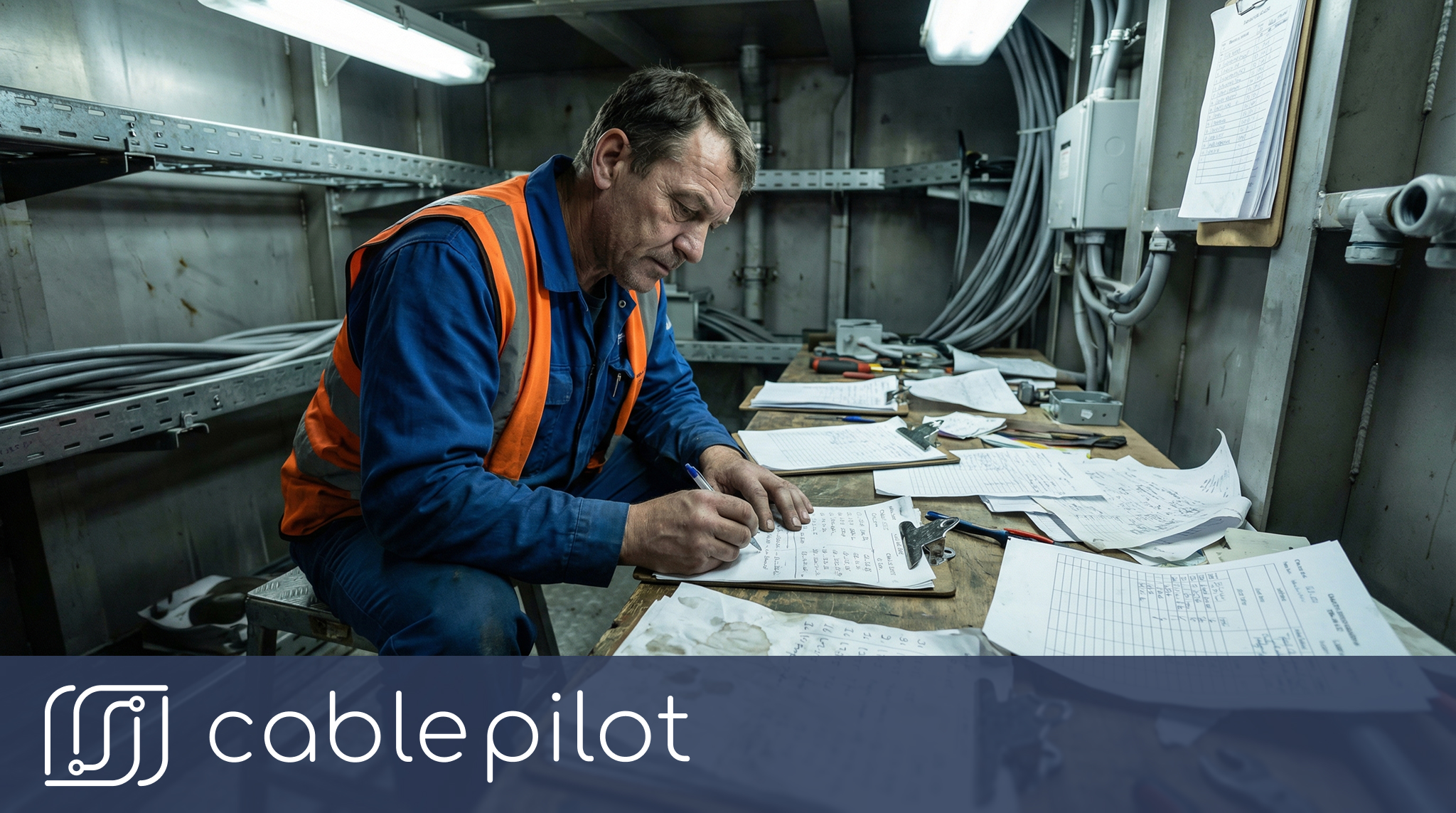
The end-of-shift transcription ritual represents the most visible component of reporting waste. Installers must set aside their tools and spend 30-60 minutes converting their handwritten field notes into digital records or cleaner paper forms that supervisors can read. This transcription process introduces a documented error rate of 2-4% according to studies of manual data entry in industrial settings. For a typical cable list containing 2,000 entries, this translates to 40-80 incorrect records—cables marked as tested that weren’t, connections recorded at wrong locations, or work attributed to incorrect dates. These aren’t harmless statistical anomalies; each error can trigger inspection failures, safety incidents, or costly rework when the discrepancies eventually surface during commissioning.
For supervisors and project coordinators, the reporting waste continues. They must collect paper forms from multiple installation teams, manually consolidate the information, resolve conflicts between contradictory records, and ultimately enter the verified data into project management systems. This consolidation typically consumes 2-3 hours of supervisor time daily—time that could otherwise be invested in proactive planning, crew coordination, or resolving technical issues. Even after this effort, the resulting data carries a 24-48 hour lag from when work actually occurred, meaning project dashboards and status reports perpetually describe yesterday’s progress rather than providing real-time visibility into current conditions.
The downstream costs of this reporting waste extend beyond direct labor hours. Stale data prevents early detection of problems—a cable route that’s blocking adjacent work, a testing bottleneck that will delay system commissioning, or a material shortage that will idle crews tomorrow. By the time these issues surface in delayed manual reports, they’ve already cascaded into schedule impacts that are exponentially more expensive to resolve. Industry estimates suggest that each week of electrical installation delay extends overall project timelines by 3-5 days and incurs €50,000-€100,000 in extended overhead costs for mid-size vessel projects. When reporting waste prevents early problem detection, these delays become inevitable rather than preventable.
Cable Pilot’s Field-First Design: Architecture for Effortless Data Capture
Cable Pilot’s solution to reporting waste begins with a fundamental design principle: field data collection must be so fast and intuitive that installers prefer it over paper. Any system that adds friction to daily workflows—requiring complex navigation, extensive typing, or specialized hardware—will face resistance and low adoption, ultimately failing to deliver on its efficiency promises. Cable Pilot achieves effortless adoption through three architectural innovations: universal smartphone compatibility, QR-code identification, and intelligent offline-first operation.
The universal smartphone foundation means installers use devices they already own and understand, eliminating hardware procurement costs and training barriers. The Cable Pilot mobile application runs on standard iOS and Android devices, requiring no specialized industrial-grade equipment. This “bring your own device” approach accelerates deployment—a new crew member can download the app, log in with provided credentials, and become productive within minutes rather than waiting for specialized hardware allocation and training. For contractors working across multiple shipyards or projects, this flexibility means their teams use consistent tools regardless of location, building expertise that transfers across all assignments.
The QR-code workflow forms the second pillar of Cable Pilot’s field-first design. During project setup, Cable Pilot automatically generates unique QR codes for every cable, and equipment piece in the imported cable list. These codes aren’t generic identifiers; they encode the cable’s complete technical profile including cable number, origin and destination compartments, specifications, and routing information. When printed on adhesive labels or paper checklists, these codes create a physical-digital bridge that connects every cable in the ship to its digital twin in Cable Pilot’s central database.
The QR-code workflow streamlines reporting for installers by allowing them to quickly scan a cable’s QR code with their smartphone, instantly retrieving information and action buttons without navigating complex menus or typing. This process enables installers to update cable statuses, such as Pulled or Connected, in about 10 seconds, achieving a 95% time reduction compared to traditional paper-based methods that involve multiple steps of finding, writing, and transcribing information.
The offline-first architecture represents Cable Pilot’s third critical innovation, addressing the harsh connectivity realities of shipyard environments. Deep within a vessel’s hull, cellular signals rarely penetrate the multiple layers of steel bulkheads and decking. Wi-Fi networks, when available, don’t reach into every compartment where installation work occurs. Many digital tools assume constant connectivity, rendering them useless in exactly the environments where field reporting is most needed. Cable Pilot was architected from the ground up for offline operation.
The smartphone app features a local database of cables, equipment, and installation instructions for installers’ current tasks, synchronizing with a central server during briefings or when connected to the internet. Throughout the day, installers update statuses and scan QR codes, with all changes stored locally. Once the device reconnects to Wi-Fi or cellular networks, it automatically syncs updates to the central database, ensuring reliable data capture regardless of connectivity, which boosts installer confidence in report accuracy.
Speed of Capture: From Minutes to Seconds
The transformation in data quality and timeliness that Cable Pilot delivers stems directly from the dramatic acceleration of individual reporting actions. Traditional paper-based reporting imposed multiple sequential steps for each status update: locate the relevant cable in a multi-page printed list, verify you’ve found the correct entry by cross-referencing cable numbers, write the status update legibly, add your initials and timestamp, and later transcribe this information into a digital system during end-of-shift reporting sessions. Even when executed efficiently, this process consumed 2-3 minutes per cable—and that assumes the paper list is at hand, legible, and hasn’t been damaged by the work environment.
Cable Pilot’s QR-code workflow compresses these sequential steps into a single fluid motion. The installer activates their smartphone’s camera via the Cable Pilot app, points it at the QR code attached to the cable or listed on their work checklist, waits one second for code recognition, and taps the appropriate status button. The entire interaction completes in approximately 10 seconds, including the time to pull the smartphone from a pocket and return it afterward. This represents a 12-18x acceleration compared to traditional methods—and more importantly, eliminates the end-of-shift transcription session entirely since updates are captured digitally at the point of work.
This speed advantage compounds throughout a typical workday. An installer working on active cable pulling might update 25-30 cable statuses throughout their shift. Under traditional paper methods, these updates would consume 50-90 minutes of cumulative time plus another 30-60 minutes of end-of-shift transcription, totaling 80-150 minutes of reporting overhead. With Cable Pilot’s smartphone app, the same 30 updates require just 5 minutes of cumulative scan-and-tap interactions, and end-of-shift transcription simply doesn’t exist. The installer reclaims 75-145 minutes—more than two productive hours—that can be redirected to actual installation work.
The field data collection efficiency extends beyond individual time savings. By capturing updates immediately when work completes rather than reconstructing the day’s activities from memory and notes hours later, Cable Pilot dramatically improves data accuracy. Installers don’t need to remember which cables were pulled before lunch versus after, which connection was completed at 10:00 AM versus 2:00 PM, or whether a particular test passed or requires follow-up. The smartphone app timestamps each update automatically with precision that manual note-taking cannot match, creating a reliable chronological record that supports both project coordination and audit requirements.
The speed and ease of Cable Pilot’s reporting mechanism also encourages more granular data capture. Under paper-based systems, installers often batch their reporting—pulling multiple cables before pausing to update paperwork, or waiting until several connections are complete before recording any of them. This batching makes sense from a time management perspective when each reporting action is time-consuming, but it degrades data timeliness and introduces errors when installers must reconstruct sequences from memory. When reporting takes only 10 seconds, batching loses its appeal. Installers naturally fall into a pattern of scanning and updating each cable immediately upon completion, creating a nearly continuous stream of real-time status updates that flow into Cable Pilot’s central platform throughout the workday.
Seamless Integration: From Field Scan to Dashboard Insight
The true power of Cable Pilot’s smartphone app emerges not merely from fast field data collection but from its seamless integration with the broader digital platform that transforms scattered individual updates into coordinated project intelligence. Every QR scan and status tap performed by installers across a vessel feeds into a unified data ecosystem that provides unprecedented visibility to supervisors, project managers, and stakeholders at every organizational level.
The integration begins with automatic synchronization. As smartphones regain connectivity—whether by moving to areas with Wi-Fi coverage during breaks, switching between compartments, or at shift end—the Cable Pilot app transparently uploads accumulated status updates to the central cloud platform. This synchronization is intelligent and efficient, transmitting only the changes that have occurred since the last sync rather than redundantly uploading the entire local database. For users, the process is entirely transparent; there are no manual “sync” buttons to remember, no uploads to initiate, and no confirmations required. The data simply flows from field to cloud automatically, reliably, and continuously.
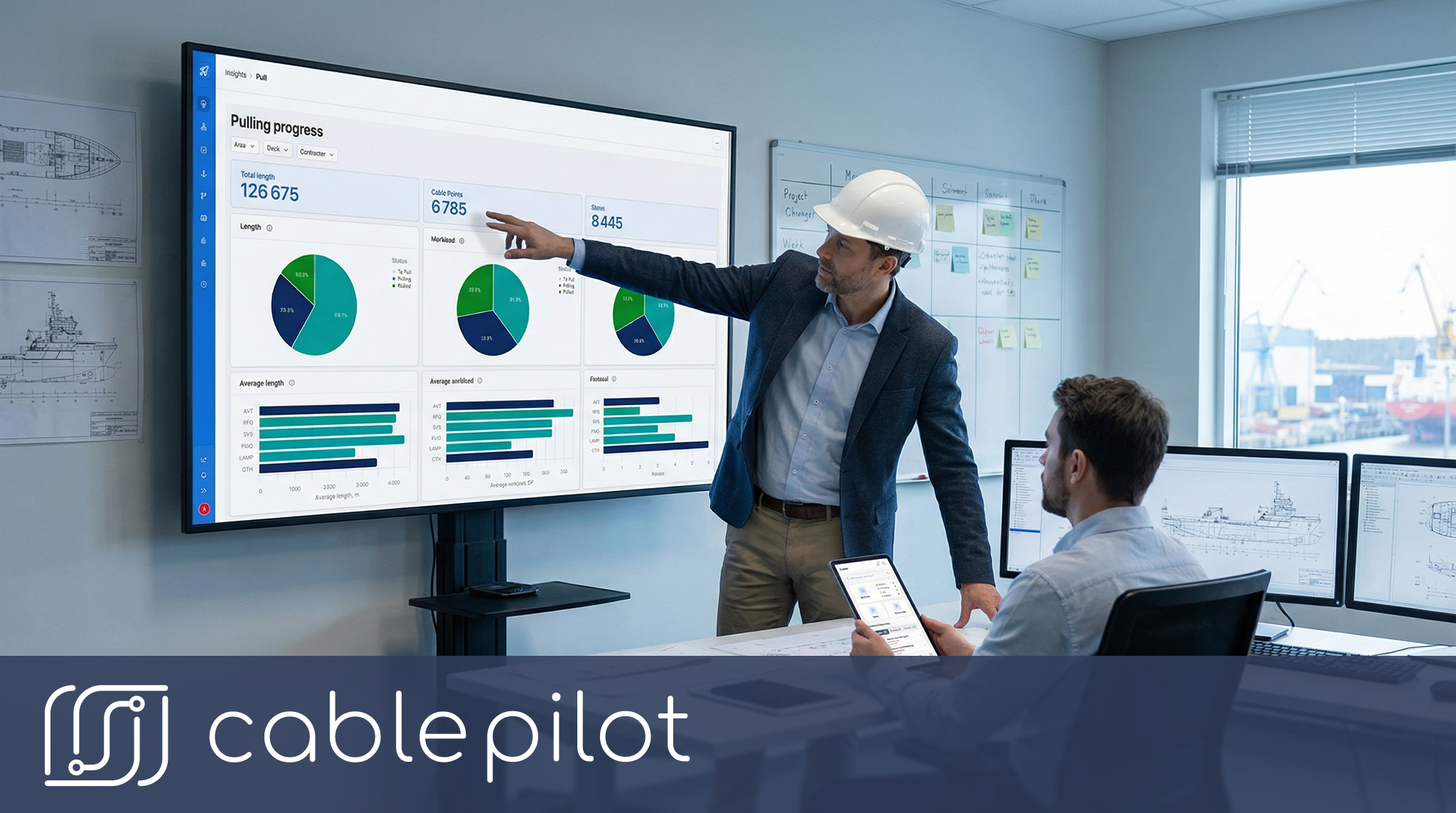
On the receiving end, Cable Pilot’s web-based dashboards refresh in near real-time as field updates arrive. Project managers accessing the platform from office computers see color-coded status visualizations that update throughout the workday, displaying which cables in each vessel zone have been pulled, connected, and tested. Supervisors reviewing progress on tablets see completion percentages climb as their crews scan cables, providing immediate feedback on whether daily targets are being met or if interventions are needed. This real-time visibility replaces the 24-48 hour data lag that plagued paper-based reporting, enabling truly proactive management rather than reactive troubleshooting of problems that have already cascaded into schedule impacts.
The integration extends to automated reporting and notifications that eliminate manual communication overhead. Cable Pilot can be configured to automatically generate and email progress reports on custom schedules—daily summaries for supervisors, weekly executive dashboards for project managers, or milestone notifications for clients and classification societies. These reports draw directly from the field data captured via QR scanning, requiring zero manual compilation or formatting effort. When critical events occur—a key cable is finally pulled after being delayed, a test failure is reported, or installation pace drops below target thresholds—Cable Pilot can trigger automatic notifications to relevant stakeholders via email or mobile push notifications, ensuring that problems surface immediately rather than hiding until the next scheduled meeting.
For contractors and subcontractors, the seamless integration creates transparent accountability. Traditional arrangements often involve disputes about what work was actually completed, with contractors submitting progress claims that shipyards must verify against their own tracking before approving payments. When all parties access the same Cable Pilot platform and field updates flow from contractor-employed installers into shared dashboards, progress becomes objectively verifiable. Payment milestones can be directly linked to QR-scanned completion statuses, eliminating ambiguity and reducing payment cycle delays. This transparency tends to improve relationships and performance, as the data quality improvement removes the adversarial dynamics that arise from information asymmetries.
The historical audit trail created by the integrated system provides long-term value beyond immediate project coordination. Every status update captured via smartphone QR scanning is permanently stored with complete metadata: which user performed the action, the precise timestamp, the location if available, and any attached photos or notes. This creates an immutable record of the entire installation sequence that supports warranty verification, classification society audits, and future maintenance planning. If a system fails during commissioning, engineers can review Cable Pilot’s records to see exactly when each cable was installed, who performed the work, and whether any issues were reported during installation—diagnostic intelligence that would be impossible to reconstruct from paper archives.
Data Quality Improvement: From Ambiguity to Precision
Beyond reclaiming productive hours through speed and efficiency, Cable Pilot’s QR-code workflow delivers a qualitative transformation in the accuracy and reliability of installation progress data. The multiple failure modes inherent in paper-based reporting—illegible handwriting, transcription errors, version control conflicts, and lost documentation—are systematically eliminated by the digital capture architecture, resulting in data quality improvements that ripple through every downstream process that depends on accurate installation records.
The QR identification mechanism ensures accurate cable attribution by eliminating errors associated with traditional paper methods, which require installers to manually match cable entries from extensive lists. With thousands of entries and similar cable numbers, it’s easy to mistakenly report the status of one cable as another. Such errors may not be detected until later, causing confusion about completion status. Scanning a cable’s QR code directly links to its specific database record, ensuring absolute certainty in reporting and preventing misattribution.
The structured status buttons eliminate ambiguity and interpretation variations that plague text-based reporting. When installers write free-form notes on paper forms, supervisors must later interpret phrases like “mostly pulled,” “ready for test,” or “connection in progress” to determine actual completion status. Different workers use different terminology, leading to inconsistent categorization when data is consolidated. Cable Pilot’s predefined status options—Pulled, Connected, Tested—create a standardized vocabulary that means the same thing regardless of who performs the update. This consistency is critical for automated analytics and progress forecasting; the system can reliably count how many cables are at each stage without human interpretation of ambiguous descriptions.
The automatic timestamping provides precision that manual recording cannot match. When installers write timestamps on paper forms hours after work completion during end-of-shift transcription sessions, the recorded times are approximations based on memory. Cable Pilot captures the exact second when each QR scan and status update occurs, creating a high-resolution timeline of installation activities. This temporal precision supports sophisticated analytics—identifying which hours of the day are most productive, which crews work fastest, or which cable types take longer than estimated to install. The timestamp accuracy also provides reliable evidence for disputes about work sequences or scheduling conflicts.
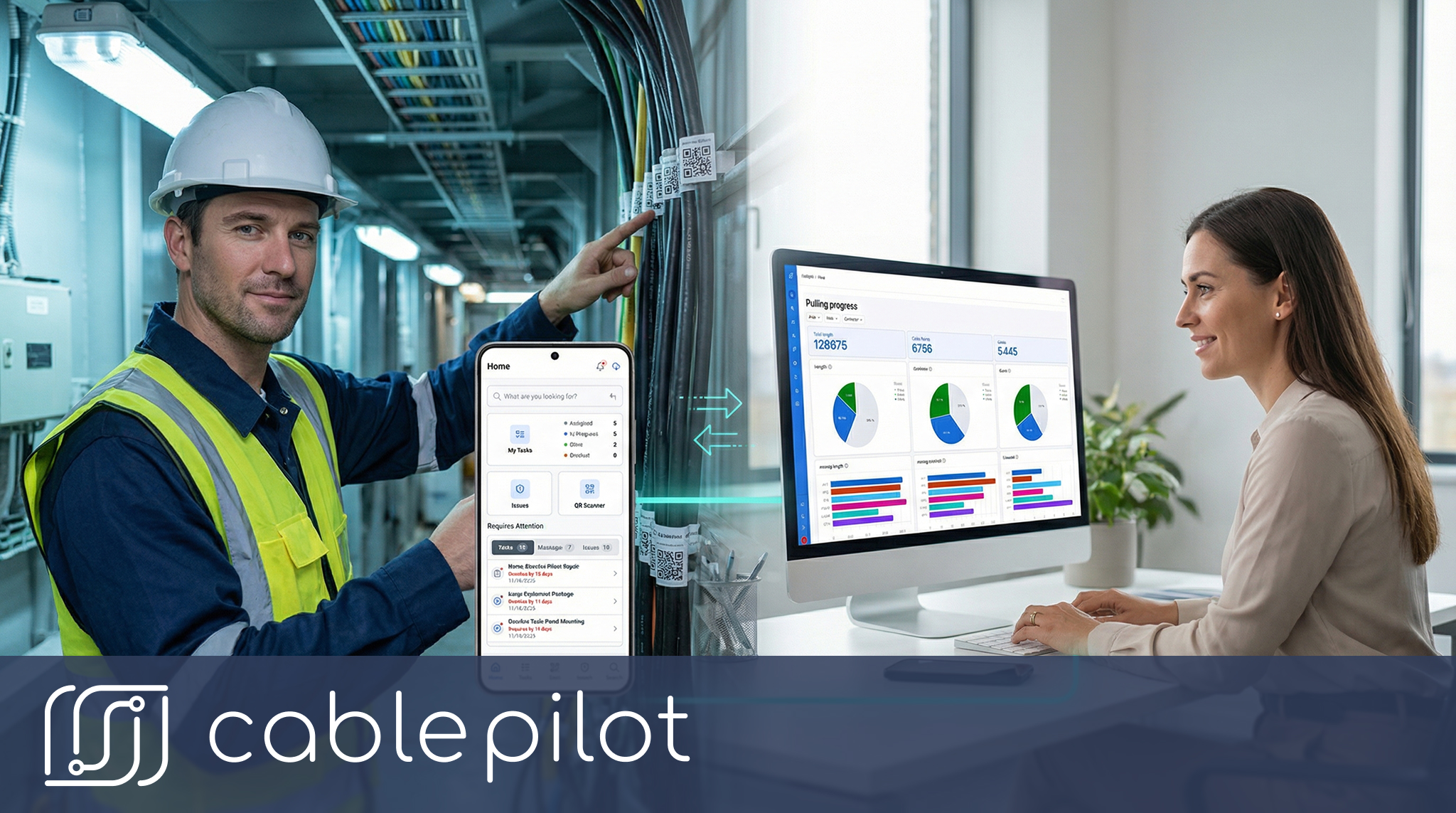
The user attribution creates accountability and traceability. Every status update recorded through Cable Pilot’s smartphone app is automatically linked to the logged-in user who performed it. This creates an audit trail showing exactly who marked each cable as pulled, connected, or tested. For quality assurance purposes, if a group of cables all fails testing, Cable Pilot’s records can immediately identify whether a single installer was responsible for all the suspect connections, pointing toward a training issue or whether the failures span multiple workers, suggesting a design or material problem instead. This granular accountability, impossible to achieve reliably with paper systems where signatures can be forged or batched, supports both performance management and root cause analysis.
The elimination of lost documentation and version control issues significantly enhances data quality. Traditional paper forms can be lost or damaged, resulting in missing work progress and the need for re-inspection or data gaps. Cable Pilot’s digital-first approach with automatic cloud synchronization ensures that data is never lost; even if an installer’s smartphone fails, the latest synchronized updates remain accessible in the cloud, allowing work to continue on a replacement device. This system provides a single authoritative version of data through a central database, accessible to everyone via smartphone apps or web dashboards.
Crew and Supervisor Benefits: Reclaiming Time and Focus
The administrative overhead reduction delivered by Cable Pilot’s smartphone app creates tangible benefits for workers at every organizational level, but the impacts are particularly transformative for the two groups who bear the heaviest reporting burden under traditional systems: field installers and their direct supervisors. For these frontline workers, reporting waste elimination translates directly into better working conditions, reduced stress, and the ability to focus on what they do best—skilled electrical installation work.
For installers and electricians, the most immediate benefit is the reclamation of 30-60 minutes per shift previously consumed by end-of-day paperwork and transcription. In practical terms, this means workers can complete their physical installation tasks and then leave the worksite rather than spending additional unpaid or minimally productive time filling out forms. This quality of life improvement shouldn’t be underestimated; in industries with tight labor markets and high physical demands, small daily frustrations compound into job dissatisfaction and turnover. By eliminating the paperwork burden that skilled tradespeople universally resent, Cable Pilot makes electrical installation positions more attractive and sustainable, supporting retention of the experienced workforce that is critical to quality outcomes.
The crew productivity gains extend beyond time reclamation. When reporting is burdensome, workers often delay it—batching updates, waiting until the end of shifts, or occasionally skipping documentation entirely when pressed for time. This creates stress about whether all work will be properly credited and uncertainty about what still needs completion. Cable Pilot’s 10-second QR scan workflow makes real-time reporting so effortless that it becomes the path of least resistance. Workers naturally update statuses immediately upon completing each task, ensuring their efforts are instantly visible and credited. This psychological shift from “paperwork I need to remember to do later” to “instantly acknowledging my completed work” transforms reporting from an irritating obligation into a satisfying confirmation of progress.
For supervisors and foremen, the benefits are even more pronounced. Traditional approaches required them to spend 2-3 hours daily collecting paper forms from dispersed work crews, manually reviewing the submissions for completeness and legibility, resolving conflicts between contradictory records, and ultimately entering verified data into project management systems. This data wrangling consumed time that could be invested in coaching installers, coordinating with adjacent trades, planning upcoming work sequences, or resolving technical issues. Cable Pilot eliminates this entire category of administrative labor. The real-time dashboard automatically consolidates all field updates without supervisor intervention, presenting ready-to-use progress visualizations that require zero manual compilation.
The reclaimed supervisor time enables a fundamental shift from reactive to proactive management. Instead of discovering yesterday’s problems during today’s manual data consolidation, supervisors see issues as they emerge through real-time monitoring and automated alerts. When a critical cable remains unpulled beyond its scheduled completion, Cable Pilot can automatically notify the responsible supervisor, who can investigate and intervene immediately rather than discovering the delay 24 hours later during the next status review. This enables the kind of just-in-time management that prevents minor issues from compounding into schedule-impacting problems, ultimately reducing the firefighting stress that characterizes many supervisor roles under traditional reactive management approaches.
The transparency created by shared digital dashboards also improves crew-supervisor relationships. Under paper-based systems, there’s often implicit distrust—supervisors suspecting that reported progress may be inflated, crews suspecting that their work isn’t being fully credited. When both groups view the same real-time Cable Pilot dashboard fed by QR-scanned field updates, this suspicion evaporates. Progress is objectively verifiable, visible to everyone, and undeniable. This transparency tends to create more collegial relationships focused on collaborative problem-solving rather than adversarial verification of competing narratives.
Quantified ROI: The Mathematics of Waste Elimination
The efficiency improvements and data quality enhancements delivered by Cable Pilot’s smartphone app and QR-code workflow translate into quantifiable financial returns that justify investment and demonstrate clear value to shipyard leadership, contractors, and project sponsors. While the qualitative benefits—reduced stress, improved coordination, better relationships—are significant, the hard financial case rests on measurable labor cost savings, rework prevention, and schedule acceleration.
The direct labor cost savings stem from the 1.41 hours per worker daily that Cable Pilot reclaims by eliminating paper-based reporting overhead. For a 20-person electrical installation crew working on a typical shipbuilding project, this represents 28.2 productive hours recovered every single workday. Over a six-month installation phase comprising approximately 120 workdays, the cumulative time reclamation reaches 3,384 hours—the equivalent of adding 1.97 full-time electricians to the crew for the entire project duration without incurring any additional salary, benefits, or overhead costs.
Translating this time into financial terms reveals the magnitude of savings. Assuming fully burdened labor costs of €45 per hour for skilled electrical installers (accounting for wages, benefits, insurance, and overhead), the 3,384 reclaimed hours represent €152,280 in direct labor value. However, this calculation understates the actual savings because it assumes the reclaimed time is merely “not wasted” rather than actively redirected to productive work. In reality, when reporting overhead drops from 1.41 hours to 0.05 hours daily, that 1.36-hour difference becomes available for actual cable pulling, connection, and testing work—accelerating project completion, enabling smaller crews to accomplish the same scope, or allowing the same crews to complete more work in compressed timelines.
When we account for this productivity redirection, the savings potential increases significantly. Industry standards suggest that electrical installation work in shipbuilding costs approximately €200-€400 per hour when accounting for all project overhead, supervision, equipment, and support functions—not just direct labor. If the 3,384 hours reclaimed by eliminating reporting waste enable the project to reduce its overall schedule by even two weeks (80 hours of calendar time), the avoided project overhead costs reach €160,000-€320,000. For larger crews or longer projects, these figures scale proportionally; a 50-person crew on a 12-month project could realize savings exceeding €1 million annually.
The labor cost savings from prevented rework add another substantial ROI component. Manual transcription and paper-based reporting introduce documented error rates of 2-4%, meaning that in a typical 2,000-cable project, 40-80 cables carry incorrect status information that will eventually trigger rework when the discrepancies surface during commissioning or classification society inspections. Each error might require 1-4 hours of labor to investigate, reverify, and potentially redo work, representing another €1,800-€14,400 in unnecessary costs that QR-based digital reporting eliminates by providing error-proof identification and automatic data capture.
The downstream benefits of real-time visibility create additional value that is harder to quantify precisely but equally significant in practice. By enabling supervisors and project managers to detect problems immediately rather than 24-48 hours after they occur, Cable Pilot’s smartphone app supports early intervention that prevents minor issues from escalating into schedule delays. Industry experience suggests that early problem detection reduces overall troubleshooting time by 30-50% compared to reactive approaches that address issues only after they’ve compounded into crises. If this early warning capability prevents just one week of schedule delay over a project’s lifetime, the avoided costs of €50,000-€100,000 in extended overhead represent pure value directly attributable to real-time reporting.
When these savings components are aggregated—direct labor reclamation, productivity acceleration, rework prevention, and schedule delay avoidance—the total annual value delivered by Cable Pilot’s reporting waste elimination ranges from €200,000 to €400,000 for a typical 20-person electrical crew, with proportional scaling for larger operations. For shipyards managing multiple concurrent vessel projects or contractors working across several clients, the cumulative savings can reach millions of euros annually. These quantified returns demonstrate that Cable Pilot’s smartphone app isn’t merely a convenience or incremental improvement; it’s a strategic investment that delivers measurable financial value and competitive advantage in an industry where margins are perpetually pressured and labor efficiency directly determines profitability.
From Waste to Competitive Advantage
The transformation from paper-based reporting to Cable Pilot’s 1-click smartphone app represents far more than a technology upgrade—it’s a fundamental reimagining of how electrical installation work is documented, coordinated, and optimized. By eliminating the 1.41 hours of daily reporting waste that has plagued shipbuilding projects for decades, Cable Pilot reclaims thousands of productive hours annually, reduces administrative overhead costs by hundreds of thousands of euros, and simultaneously improves data quality to levels unattainable through manual methods.
The architectural innovations that enable this transformation—universal smartphone compatibility, QR-code identification, offline-first operation, and seamless cloud integration—were purposefully designed to address the specific challenges of shipyard environments where connectivity is unreliable, work conditions are harsh, and skilled labor is the most precious resource. The resulting 10-second field update workflow makes real-time reporting so effortless that it becomes invisible, transforming installation efficiency from a reactive administrative burden into a proactive strategic asset.
For shipyards, electrical contractors, and project managers still struggling with paper cable lists, manual transcription, and delayed data consolidation, the question is no longer whether digital transformation is possible—Cable Pilot proves it is—but rather how much longer organizations can afford to sustain the hidden costs of reporting waste when proven solutions already exist. Every day that passes with traditional methods represents another 1.41 hours per worker consumed by administrative overhead, another 2-3 hours of supervisor time lost to data consolidation, and another 24-48 hour information lag that prevents proactive coordination.
Ready to eliminate reporting waste and reclaim productive hours on your electrical installation projects? Contact Cable Pilot today to schedule a personalized demonstration. We’ll show you how to generate QR codes from your actual cable lists, walk through the 10-second smartphone reporting workflow, and demonstrate the real-time dashboards that transform scattered field updates into coordinated project insight. Discover how forward-thinking shipyards worldwide are delivering projects faster, managing crews more effectively, and achieving measurable ROI through Cable Pilot’s smartphone app and field data collection platform. The era of reporting waste is ending—make sure your organization isn’t left behind.