
Modern shipyards and electrical contractors face a persistent challenge that costs thousands of hours annually: fragmented data scattered across spreadsheets, emails, revision-marked drawings, and disconnected systems. When a project manager needs to verify cable installation status, they might check three different Excel files, chase down field supervisors via radio, and cross-reference outdated PDF drawings—only to discover the information contradicts itself. This chaos stems from data silo elimination failures that plague electrical installation management across the maritime construction industry.
In complex electrical projects involving multiple contractors, engineering teams, quality assurance personnel, and installation crews, information fragments naturally occur. One team updates their local spreadsheet while another marks changes on printed drawings. Engineering issues a revision that never reaches the installation crew’s smartphone. The quality inspector logs test results in a separate database that the project office cannot access in real time. Each silo creates version conflicts, stale updates, and ultimately costly rework when cables are installed based on outdated specifications.
The traditional approach to electrical installation management relies on manual coordination: weekly meetings to reconcile conflicting data, phone calls to verify installation progress, and hours spent compiling status reports from disparate sources. This methodology worked when vessels were simpler and projects smaller, but today’s complex electrical systems—with thousands of cables, multiple voltage levels, intricate routing through congested spaces, and strict regulatory requirements—demand a fundamentally different approach. The industry needs a single source of truth that unifies every data point, every status update, and every document into one live platform accessible to all stakeholders.
Cable Pilot delivers this solution: a comprehensive cable tracking platform that transforms how shipyards and contractors manage electrical installations. By consolidating all project data into a synchronized digital environment, Cable Pilot eliminates the version conflicts and information gaps that drive errors, disputes, and schedule delays. This article explores how Cable Pilot’s architecture creates a true single source of truth, the specific features that enable real-time data synchronization, and the quantifiable impact on project efficiency and contractor collaboration.

Understanding the Single Source of Truth Architecture
At the core of Cable Pilot lies a fundamental principle: every cable exists as a unified digital object within the platform’s database, not as scattered entries across multiple files. This digital twin approach means that when you look at Cable ID “A-001-PS-001” in Cable Pilot, you see not just a line in a cable list, but a complete, live representation of that cable’s entire lifecycle. The digital object contains its technical specifications pulled from engineering documents, its current installation status updated minutes ago by a field technician, its physical location within the vessel’s area, deck, and compartment hierarchy, its associated test results logged by quality assurance, and its complete change history showing every modification from initial design through final commissioning.
This unified object model solves the version conflict problem at its root. In traditional workflows, the same cable exists as separate entities: one row in the engineering cable list Excel file, another entry in the contractor’s installation tracking spreadsheet, a line on the routing drawing, and a record in the inspection database. When specifications change, each copy must be manually updated, creating inevitable discrepancies. With Cable Pilot’s single source of truth architecture, there is only one “A-001-PS-001” object. When engineering updates its voltage rating, that change instantly propagates to every view, every report, and every field technician’s smartphone screen without manual intervention.
The platform’s documentation management platform capabilities extend this principle to associated files. Cable routing drawings, installation procedures, test protocols, and certification documents link directly to their relevant cable objects. When a field supervisor opens a cable in the mobile application, they immediately access the current approved drawing revision—not whatever PDF they downloaded last week. When quality assurance uploads test results, those documents attach automatically to the tested cables, creating an installation audit trail that survives throughout the vessel’s operational life.
This architecture enables true contractor collaboration system functionality because all parties—shipyard personnel, electrical contractors, engineering consultants, and classification society inspectors—work within the same data environment. Role-based access controls ensure each user sees appropriate information while maintaining data security, but everyone references the same underlying truth. When a contractor updates installation progress, the project manager’s dashboard reflects that change immediately. When engineering issues a field change notice, affected cables flag instantly on installation crew smartphones. No email chains, no manual data transfers, no reconciliation meetings to align conflicting spreadsheets.
AI-Powered Data Import: Building Your Single Source of Truth
Establishing a single source of truth requires importing existing project data—typically scattered across multiple Excel workbooks, legacy databases, and PDF cable lists. Cable Pilot’s artificial intelligence import engine accelerates this critical first step, transforming weeks of manual data entry into hours of supervised automation. The AI analyzes uploaded spreadsheets, identifies column patterns corresponding to cable attributes (cable ID, from/to equipment, cable type, length, routing), and maps them automatically to Cable Pilot’s data schema.
For shipyards transitioning from traditional spreadsheet-based electrical installation management, this capability is a major advantage. A typical vessel project might contain 3,000 to 15,000 cables documented across multiple Excel files maintained by different engineering disciplines—power distribution, control systems, communication networks, and instrumentation. Manually re-entering this data would require weeks of tedious work with high error risk. Cable Pilot’s AI import processes these files in hours, validating data consistency, flagging anomalies for review, and creating the initial digital twin population.
The import intelligence extends beyond simple column mapping. The import module recognizes common data patterns, identifies column structures corresponding to cable attributes, and maps them to the platform’s data model. When it encounters ambiguous data—perhaps a cable length listed in an unusual format or equipment identifiers that don’t match standard patterns—the system flags these items for user review rather than making assumptions. This supervised approach ensures data quality while dramatically reducing manual effort.
Once imported, the cable tracking platform becomes the authoritative data repository. Engineering updates flow through Cable Pilot rather than through revised Excel files. This transition eliminates the common scenario where multiple “current” cable list versions circulate simultaneously, with different teams working from different baselines. New cables added during detailed engineering enter directly into Cable Pilot. Field changes discovered during installation update the same system. The result: one continuously updated single source of truth that all stakeholders trust because they know it reflects the latest verified information.
Real-Time Field Updates: Keeping Data Current
The most sophisticated database becomes useless if it doesn’t reflect current installation reality. Traditional electrical installation management suffers from update lag: field crews install cables throughout the day, supervisors compile progress reports in the evening, and the project office updates master tracking spreadsheets the following morning—creating a 24 to 48-hour information delay. During that lag, project managers make decisions based on outdated status, materials coordinators order supplies without knowing actual consumption rates, and quality assurance schedules inspections for cables not yet ready.
Cable Pilot’s smartphone application eliminates this delay through instant field updates that synchronize to the central platform in real time. When an electrician completes cable pulling for “A-001-PS-001”, they scan its QR code with their smartphone, tap the status change button, and the update propagates immediately. The project manager’s dashboard shows the new status within seconds. The quality inspector’s pending work list automatically adds that cable for continuity testing. The materials coordinator’s consumption report reflects the cable length actually installed. This real-time data synchronization transforms information flow from a daily batch process into a continuous stream.
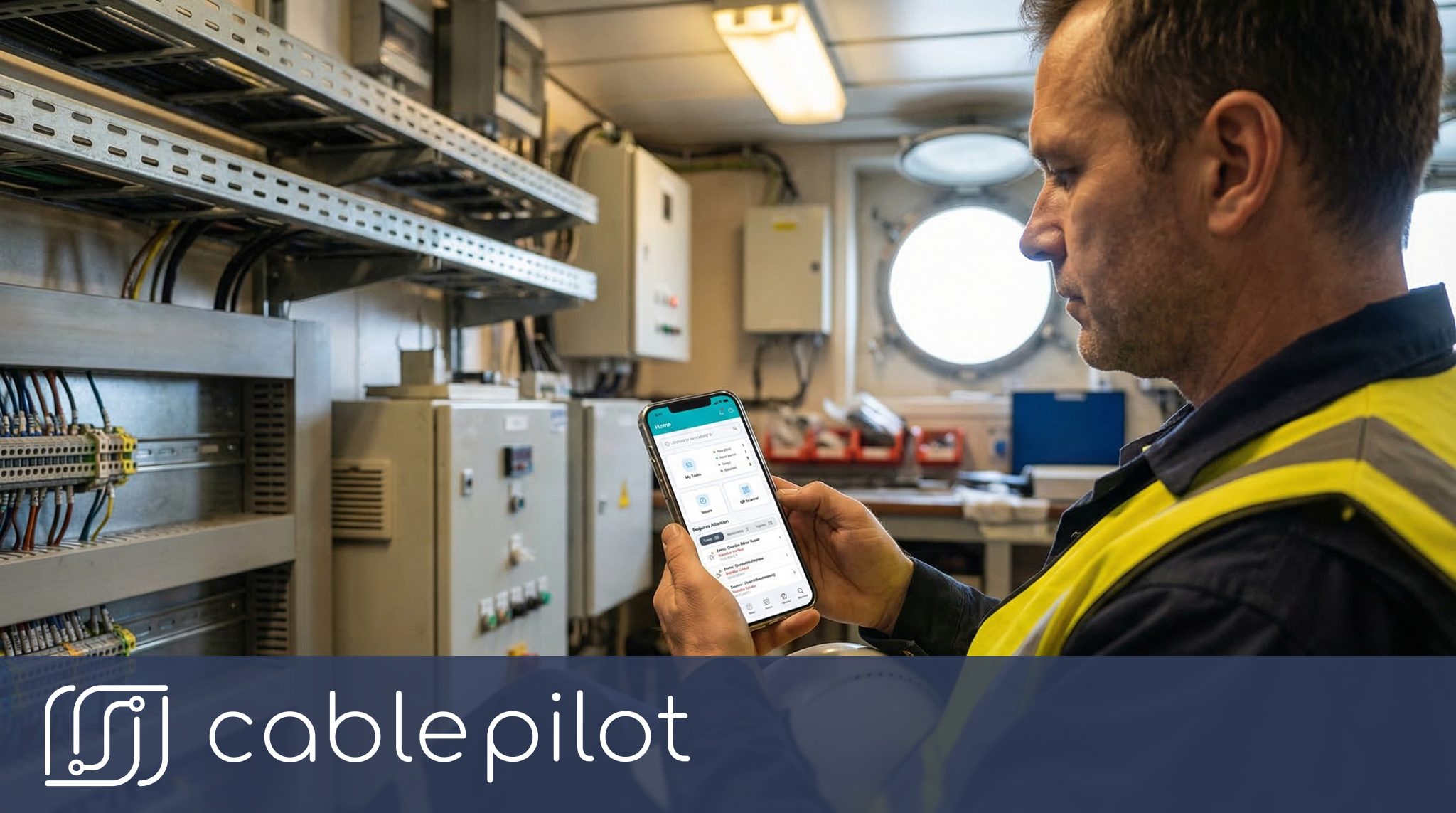
The mobile application’s design recognizes shipboard realities: limited connectivity, harsh environmental conditions, and workers wearing gloves. Cable identification works through QR codes attached to cable ends, or manual search if codes are damaged. Status updates use large, easily tapped buttons rather than complex forms. The application caches data locally so work continues even in spaces with no network signal, synchronizing automatically when connectivity restores. Photos documenting installation conditions, routing deviations, or damage upload directly to the relevant cable’s record, maintaining context and eliminating the common problem of orphaned photos that no one can later associate with specific work.
This field connectivity creates a complete installation audit trail. Every status change captures who made the update, when, and where. If a cable’s installation status seems suspicious—perhaps marked complete but missing required test results—supervisors can trace exactly who updated it and review any photos taken at that time. During disputes about work scope or quality, this detailed history provides objective evidence. For handover to ship owners, the complete installation timeline demonstrates due diligence and regulatory compliance.
The digital workflow automation extends to exception handling. When a field technician encounters a problem—a cable route blocked by late steelwork, a cable length insufficient due to as-built deviations, or equipment terminals different than drawings—they flag the issue directly in the application. The flag triggers notifications to relevant stakeholders: the project engineer receives an engineering query, the project manager sees a potential schedule impact, and the affected cable highlights on everyone’s attention list. This immediate escalation replaces the traditional delay where problems might not surface until weekly progress meetings, by which time schedule impacts have compounded.
Automated Document Synchronization: Connecting Data and Drawings
Electrical installations cannot proceed from data tables alone; technicians need routing drawings, termination diagrams, and installation specifications. In traditional workflows, managing these documents creates its own data silos elimination challenge. Engineering issues drawing revisions, but ensuring every field supervisor has the current version requires manual distribution. Installers work from printed drawings that become outdated when revisions occur mid-week. Quality inspectors reference different document versions than installers, creating confusion during inspections.
Cable Pilot’s documentation management platform solves this through automated synchronization between cable data objects and their associated documents. When engineers upload a revised routing drawing, they tag it with the cables it depicts. The system automatically links that drawing to each cable object and pushes notifications to any field technician currently working on those cables. The next time a technician opens “A-001-PS-001” in their smartphone application, they see a document update indicator and can view the revised drawing immediately. No manual distribution, no outdated printouts, no version confusion.
This automated linking works bidirectionally. When a field technician views a cable and accesses its routing drawing, they can tap through to see all other cables on that same drawing, their current installation status, and any issues flagged against them. This contextual navigation helps supervisors plan work sequences: if a drawing shows ten cables in a bundle and eight are already installed, the supervisor knows to prioritize the remaining two to complete that route section. Traditional spreadsheet tracking cannot provide this spatial intelligence because it lacks the drawing connection.
The platform maintains complete document version history. If a question arises about what information was available when a cable was installed three months ago, users can view the exact drawing revision linked to that cable at that time. This historical access proves invaluable during troubleshooting, warranty disputes, or regulatory inquiries. Rather than searching email archives or document control systems for historical revisions, all relevant documents remain accessible through the cable tracking platform interface, contextualized to specific cables and time periods.
For projects involving multiple document formats—AutoCAD drawings, PDF schematics, 3D model exports, Excel termination schedules—Cable Pilot accommodates all types through its flexible document management architecture. The platform uses AI to automatically index complex PDF drawings for fast referencing, linking cables to their locations on schematics. This versatility ensures the single source of truth encompasses not just cable data tables but the complete information ecosystem required for installation execution.
Multi-Role Access: Customized Views for Every Stakeholder
A contractor collaboration system succeeds only when it serves each stakeholder’s specific needs without overwhelming them with irrelevant information. Cable Pilot implements sophisticated role-based access controls and customized interface views that present the right information to the right person at the right time. An installation electrician sees a focused list of cables assigned to their work package with clear status indicators and easy access to routing drawings. A project manager views high-level progress dashboards, exception reports, and trend analyses. A quality assurance inspector filters cables ready for testing and accesses test protocol templates.
This role customization eliminates information overload while maintaining the underlying single source of truth. When the electrician updates a cable status, the project manager’s dashboard reflects that change in aggregate progress metrics, the QA inspector sees the cable appear on their testing queue, and the materials coordinator’s consumption report includes the installed cable length—all derived from the same single update to the same single cable object. No duplicate data entry across different systems, no reconciliation of conflicting information sources, just synchronized views into unified data.
For installation contractors managing multiple vessels simultaneously, Cable Pilot’s project segmentation provides logical separation while maintaining operational efficiency. A contractor’s supervisor can view progress across all their projects through a consolidated dashboard, then drill down into vessel-specific details when investigating an issue. Field crews see only their assigned project and work packages, reducing interface complexity for users who might access the system occasionally. This hierarchical access structure scales from single-project shipyards to large contractors managing dozens of concurrent installations.
The platform’s shipbuilding coordination capabilities shine in multi-contractor scenarios common in modern shipbuilding. When a vessel’s electrical installation involves separate contractors for main power distribution, communication systems, and control networks, coordinating their work traditionally requires extensive meetings and manual progress reporting. With Cable Pilot, each contractor’s progress becomes visible to the shipyard project management and to other contractors whose work depends on prior completions. If the power distribution contractor delays a cable route that the control systems contractor needs, the impact becomes immediately apparent through the real-time data synchronization, enabling proactive schedule adjustments rather than reactive crisis management.
Classification society surveyors and ship owner representatives receive read-only access tailored to inspection and oversight needs. They can verify installation progress, review test results, audit the installation audit trail for compliance, and download certification documentation—all without requiring shipyard personnel to compile special reports or host extensive document review sessions. This transparency builds trust and accelerates approval processes, reducing the common delays associated with information requests and verification cycles.
Quantifying the Impact: Metrics That Matter
Implementing a single source of truth through Cable Pilot delivers measurable operational improvements that directly impact project economics and schedule performance. Shipyards and contractors that have transitioned from spreadsheet-based electrical installation management report consistent patterns of efficiency gains and error reductions across multiple vessel projects.
Rework reduction represents the most significant financial impact. When cables are installed based on current, accurate information—verified specifications, correct routing drawings, valid equipment terminal assignments—the error rate drops dramatically. Traditional workflows with their version conflicts and stale updates typically generate 8-12% rework rates for electrical installations: cables pulled to wrong locations, incorrect cable types installed, terminations made to outdated terminal assignments. Cable Pilot users consistently report rework reduction of 30-50% reduction in costly do-over work. The financial savings from rework reduction alone often exceed the Cable Pilot implementation cost within a single project.
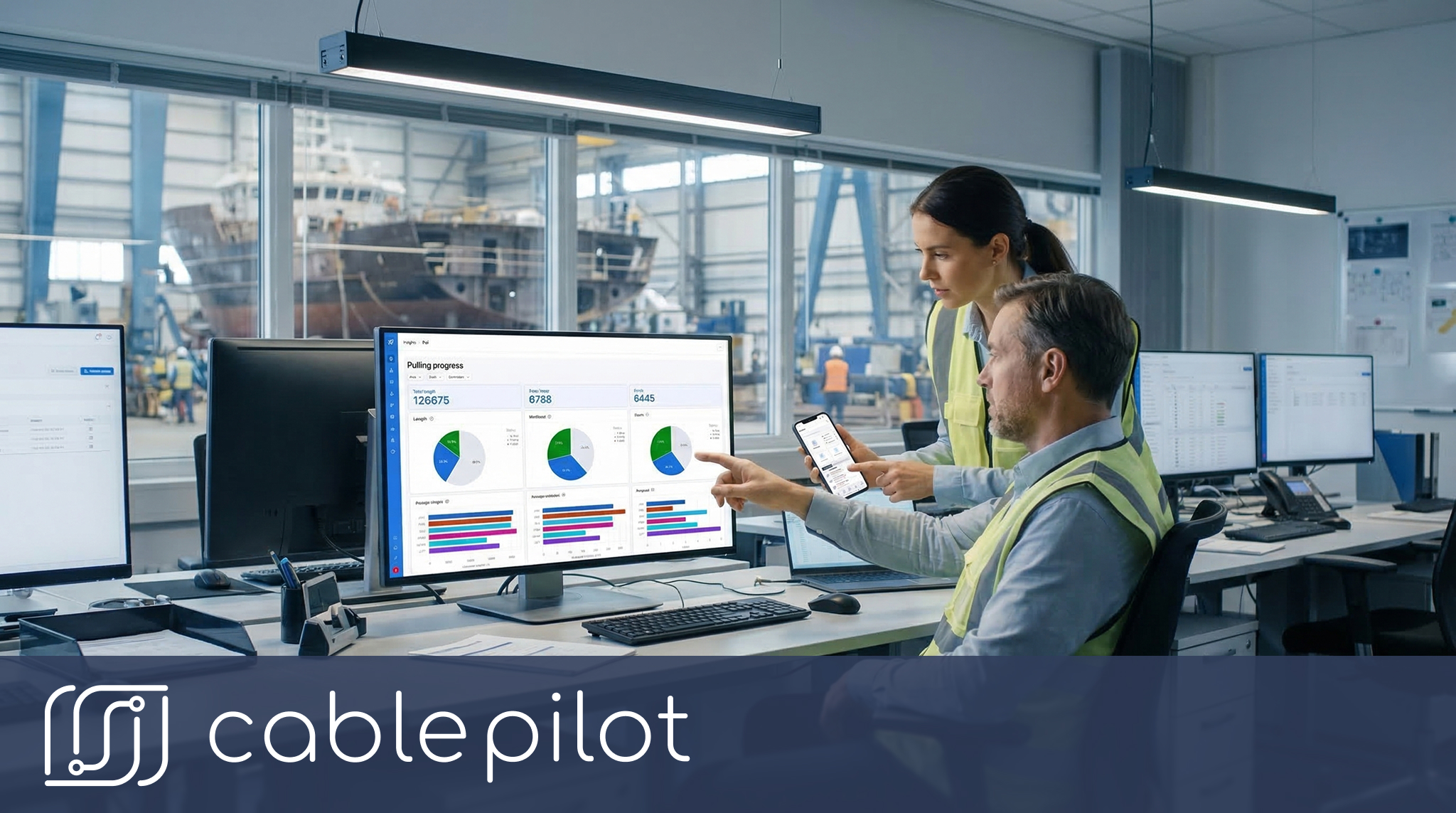
Time savings compound across multiple activities. Project managers report spending significantly less time chasing current installation status because the cable tracking platform dashboard provides immediate answers. Supervisors save hours each week previously spent reconciling conflicting data sources and compiling progress reports—the system generates these reports automatically from current synchronized data. Engineering teams eliminate hours spent responding to field questions about drawing revisions because technicians access current documents directly through their smartphones. Quality assurance personnel reduce inspection planning time because the platform automatically identifies cables ready for testing based on installation status. Across a medium-sized vessel project, these cumulative time savings typically hundreds of hours of skilled labor that can redirect to productive work rather than data administration.
Schedule acceleration results from faster decision-making enabled by trusted, current information. When project managers can instantly verify which cable routes are complete, which are blocked by prerequisite work, and which face material constraints, they optimize work sequencing daily rather than weekly. This agility reduces the idle time where crews wait for task assignments or start work only to discover blocking issues. Projects managed with Cable Pilot consistently demonstrate a significant schedule compression that brings vessels to revenue service faster.
Quality improvements manifest in more consistent compliance with specifications and regulatory requirements. The installation audit trail creates accountability that encourages careful work. The automated documentation linkage ensures technicians reference current specifications rather than outdated information. The structured inspection workflow guides QA personnel through complete test protocols rather than ad-hoc checking. These factors combine to reduce defects identified during final inspections and classification surveys, minimizing the stressful pre-delivery sprint to correct accumulated issues.
Dispute avoidance provides less tangible but equally valuable benefits. When all parties work from the same single source of truth, arguments about work scope, completion status, and quality compliance become less frequent and resolve faster. The objective data trail—who installed which cables when, what information was available at that time, what inspections were conducted—provides clear evidence that prevents disputes from escalating. Contractors report improved relationships with shipyard clients because transparency builds mutual trust.
Building Your Single Source of Truth: Implementation Strategy
Transitioning to Cable Pilot’s single source of truth architecture requires thoughtful planning, but the process proves more straightforward than many shipyards anticipate. The implementation follows a staged approach that minimizes disruption while delivering quick wins that build organizational confidence.
The initial phase focuses on data migration using Cable Pilot’s AI-powered import engine. The implementation team gathers existing cable lists, equipment databases, and routing drawings, then uses the platform’s import tools to populate the initial cable objects. This phase typically requires a few days to a couple of weeks for a medium-sized vessel project, with most time spent on data quality verification rather than mechanical import. Organizations often discover data inconsistencies during this process—duplicate cable IDs, missing equipment references, contradictory specifications—and resolve them before they propagate into installation work.
User training proceeds in parallel through role-specific sessions. Field technicians receive focused instruction on the smartphone application: scanning cables, updating status, capturing photos, and flagging issues. This training typically requires only two to three hours because the application’s intuitive design minimizes the learning curve. Project managers and supervisors attend deeper sessions covering dashboard configuration, report generation, and workflow customization. Engineering personnel learn document management and change notification procedures. This tiered training approach ensures each user group gains relevant skills without information overload.
The pilot deployment launches with a limited work scope—perhaps a single deck or system—allowing teams to adapt processes while limiting risk. During this phase, Cable Pilot operates alongside existing spreadsheet tracking as a verification mechanism. Field crews update both systems, and supervisors compare results to build confidence in the platform’s accuracy and reliability. This parallel operation typically continues for four to six weeks until stakeholders trust the cable tracking platform sufficiently to designate it as the primary system.
Full deployment transitions all tracking to Cable Pilot while retiring spreadsheet-based methods. This transition point represents a critical change management moment: some team members may resist abandoning familiar Excel-based workflows despite their limitations. Strong project leadership, visible management commitment, and highlighting early wins—time saved, errors avoided, disputes prevented—help overcome this resistance. Organizations that successfully navigate this transition typically appoint Cable Pilot champions within each stakeholder group who mentor colleagues and model effective platform use.
Continuous optimization extends throughout the vessel project and into subsequent projects. As teams gain experience, they discover advanced features, customize workflows to their specific context, and integrate Cable Pilot more deeply into their operational procedures. The platform’s flexibility supports this evolution through configurable dashboards, customizable status workflows, and adaptable reporting structures. Organizations treating Cable Pilot as an evolving toolset rather than a static system extract maximum value through ongoing refinement.
Integration with Broader Digital Transformation
Cable Pilot’s single source of truth for electrical installations fits within broader shipbuilding digital transformation initiatives. Forward-thinking shipyards are replacing fragmented legacy systems with integrated digital platforms spanning engineering, production planning, procurement, and quality management. Cable Pilot supports integration with enterprise systems through its CAD, ERP, and PLM connectivity features.
For shipyards using product lifecycle management (PLM) systems for engineering data management, Cable Pilot can import cable specifications from PLM systems, while installation progress data can be exported for as-built documentation. This integration eliminates duplicate data maintenance while preserving each system’s specialized strengths—PLM for design engineering, Cable Pilot for installation execution.
Enterprise resource planning (ERP) integration enables digital workflow automation spanning procurement, inventory management, and project accounting. Cable Pilot’s data export capabilities support integration with ERP workflows for procurement planning and project cost tracking, reducing manual data transfers between systems.
For organizations implementing building information modeling (BIM) or 3D vessel models. While Cable Pilot focuses on installation data management and workflow rather than 3D modeling, completed installation data can be exported for use in as-built documentation and vessel handover packages.
Moving Forward: Start Your Single Source of Truth Journey
The maritime construction industry stands at a digital transformation inflection point. Shipyards and electrical contractors face increasing complexity—more sophisticated electrical systems, tighter schedules, stricter quality requirements, and more demanding clients—that traditional spreadsheet-based electrical installation management cannot adequately support. The data silos elimination that Cable Pilot enables represents not merely an incremental improvement but a fundamental capability shift that determines competitive positioning in a demanding market.
Organizations that have implemented Cable Pilot’s single source of truth architecture consistently report that they cannot imagine returning to fragmented spreadsheet workflows. The transparency, coordination efficiency, and decision-making speed enabled by unified, synchronized data prove transformative. Project managers describe the confidence of knowing their status information is current and trustworthy. Field supervisors appreciate eliminating hours spent compiling reports. Technicians value having specifications and drawings immediately accessible on their smartphones. Quality inspectors rely on the complete installation audit trail for compliance verification. These operational improvements translate directly into faster project delivery, lower costs, and higher quality outcomes.
The implementation path begins with a conversation. Cable Pilot’s team works with shipyards and contractors to assess current workflows, identify specific pain points causing the most disruption, and design tailored deployment strategies that align with organizational culture and project constraints. Many organizations start with a pilot project—a single vessel or even a single work package—to demonstrate value and build internal expertise before broader rollout.
The business case for transitioning to Cable Pilot’s cable tracking platform strengthens as electrical systems grow more complex and competitive pressures intensify. The question facing shipyards and contractors is not whether to implement a single source of truth architecture, but when and how. Organizations that delay digital transformation face growing competitive disadvantages as more agile competitors leverage these capabilities to deliver projects faster, cheaper, and with higher quality.
Cable Pilot invites shipyards, electrical contractors, and project managers to explore how eliminating data silos through a unified documentation management platform can transform their electrical installation operations. Contact us today to schedule a demonstration, discuss your specific challenges, and design an implementation roadmap that delivers rapid value while minimizing organizational disruption.
Your journey toward a single source of truth begins with a single step. Cable Pilot provides the platform, expertise, and partnership to make that journey successful. Stop chasing data across spreadsheets and start managing electrical installations with the confidence that comes from unified, synchronized, trusted information accessible to every stakeholder exactly when they need it.
Ready to eliminate data silos and establish your single source of truth? Contact Cable Pilot today to schedule a personalized demonstration and discover how our platform transforms electrical installation management for modern shipbuilding projects.