
Cable Points – a new dimension of efficiency and project progress in shipbuilding.
You’ve seen the report a hundred times. The Gantt chart glows with green bars, and the headline number is reassuring: 5,000 out of 10,000 meters of cable have been pulled. 50% complete. On paper, you’re exactly where you need to be.
But a knot forms in your stomach. You know the report, while technically accurate, is telling a dangerous lie.

As a Project Manager in the maritime industry, you know the truth hidden behind that clean, satisfying percentage. You know that the first 5,000 meters were the easy ones—lightweight signal cables pulled through open, accessible trays. And you know that the remaining 5,000 meters consist of heavy-duty, multi-core power cables that need to be wrestled through congested, complex routes. The work that took 20% of your schedule so far will consume the remaining 80%.
This is the project progress metrics trap. It’s the dangerous illusion of well-being created by metrics that measure quantity but ignore complexity. It’s a trap that leads to schedule overruns, blown budgets, and tense conversations with stakeholders who look at the same report and ask, “What went wrong? We were right on track!”
The problem isn’t your team’s performance. The problem is your ruler.
In this article, we will prove that measuring project progress in simple units is like comparing an elephant and a mouse by counting their legs—the tally is the same, but the substance is worlds apart. We will introduce the new unique concept of Cable Points (CP), a standardized unit of workload, and demonstrate concrete examples why measuring the actual effort, not just the physical output, is the only way to get an accurate picture of your project’s health and eliminate disastrous surprises at the finish line.
The Diagnosis: The Lie of Simple Project Progress Metrics
In complex fields like shipbuilding, we crave simplicity. Metrics like “meters pulled” or “cables connected” are wonderfully simple. They are easy to count, easy to report, and easy to put into a chart. The only problem? They are fundamentally dishonest.
These traditional project progress metrics, often called vanity metrics, operate on a false assumption: that all work is created equal. They assign the same value to installing a simple, single-pair signal cable as they do to a heavy, armored power cable with a large cross-section.

Let’s break down this absurdity with a real-world example.
- Team A spends a week pulling 500 meters of a lightweight signal cable, like an “LJST-HF 1X2X0,75”. The work is fast and straightforward.
- Team B spends the same week pulling 500 meters of a heavy power cable, “LSM-HF 3X95”. The work is slow, physically demanding, and requires more coordination.
According to your traditional progress report, their performance was identical. Both teams contributed 500 meters to the project goal. This is a dangerously flawed conclusion. Any experienced Site Manager knows that Team B accomplished a vastly greater volume of work.
By ignoring the crucial factor of complexity, these vanity project progress metrics create a distorted reality. They systematically under-report progress in the early, easy phases of a project and create a massive, hidden backlog of effort that only becomes apparent when it’s too late. You’re not just tracking progress; you’re actively misleading yourself and your client.
The Turning Point: Measuring Work, Not Just Output
To escape the progress trap, you need a fundamental shift in thinking.
You must stop asking, “How many meters did we pull?” and start asking, “How much work did we complete?“

This requires a new unit of measurement—one that reflects the true labor effort required for any given task. This is the principle behind Cable Points (CP).
Cable Points (CP) is a standardized, weighted unit of measurement that represents the total workload associated with installing and connecting a cable. Instead of treating all cables as equal, the CP system assigns a “point” value to each cable type based on its key physical characteristics that influence labor effort:
- Cross-sectional area
- Number of cores
- Weight per meter
- Installation complexity (e.g., stiffness, required equipment)
- AI based algorithm
The logic for calculating CP is built directly into the project’s technical specifications. A simple signal cable might be worth 10 CP per meter. A complex power cable could be worth 285 CP per meter or more.
By using Cable Points, you are no longer measuring length; you are measuring a standardized unit of effort. You are finally weighing the elephant and the mouse on an appropriate scale.
The Payoff: From Misleading Data to Decisive Insight
Let’s revisit our two teams, but this time, we’ll measure their progress in Cable Points.
- Team A (500 meters of light signal cable at 10 CP/meter) completed 5,000 Cable Points of work.
- Team B (500 meters of heavy power cable at 285 CP/meter) completed 142,500 Cable Points of work.
Suddenly, the picture is crystal clear. The objective data proves that Team B’s workload was nearly 30 times greater than Team A’s. This isn’t a subjective opinion; it’s a hard, quantifiable fact. As a Project Manager, this objective insight is a superpower. It unlocks three critical capabilities that are impossible to achieve with traditional project progress metrics.
1. Accurate Plan-Fact Analysis
- You are no longer fooled by misleading percentages.
- Your project plan isn’t just a list of cables; it’s a total budget of Cable Points.
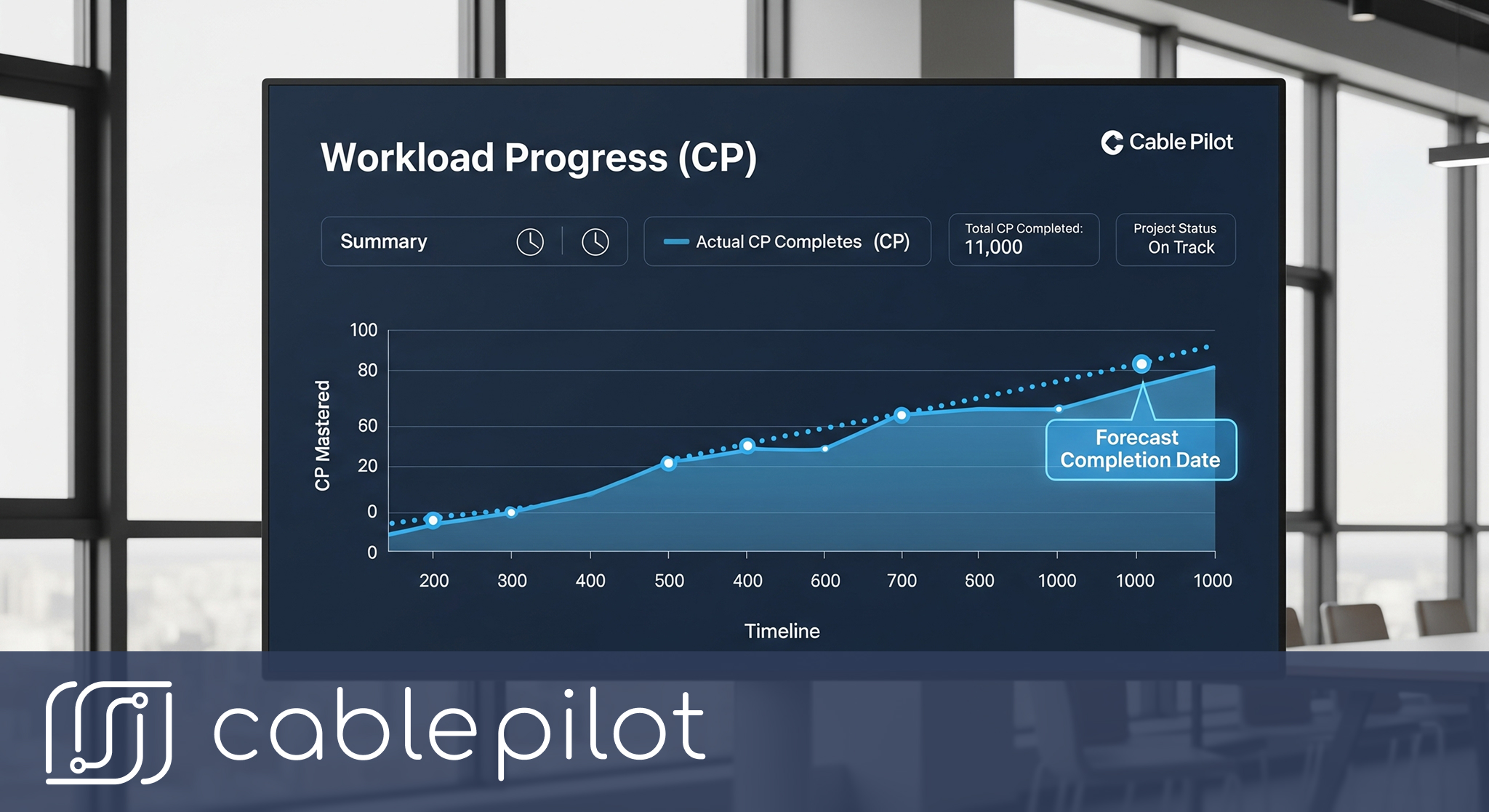
- Your weekly progress report shows the number of CPs completed versus the number planned.
If you see a deviation—for example, if your teams are completing 8,000 CP per week instead of the planned 10,000—you know you have a real productivity issue long before it shows up in the high-level Gantt chart. You can intervene early, diagnose the problem (Is it a supply chain issue? A contractor problem? An access delay?), and take corrective action while you still have time.
2. Realistic, Data-Driven Forecasting
Predicting a project’s completion date with traditional metrics is little more than educated guesswork. With Cable Points, it becomes a simple, reliable calculation.
Imagine your total project scope is 2,000,000 CP. Your reports show that you have completed 1,000,000 CP. You know, with mathematical certainty, that you have completed exactly 50% of the total workload, regardless of how many meters of cable are left. Furthermore, you know that your teams’ average weekly productivity is 50,000 CP. You can now forecast with high confidence:
(Remaining Workload) / (Average Weekly Productivity) = Weeks to Completion(1,000,000 CP) / (50,000 CP/week) = 20 weeks.You can walk into any stakeholder meeting with a forecast backed by undeniable data, not just a hopeful estimate.
3. Unbreakable Trust with Your Client
The most difficult conversation a Project Manager can have is explaining to a client why the “last 10% of the work” is going to take 30% of the schedule. It sounds like an excuse. It erodes trust and makes it seem like the project is poorly managed.
Cable Points transform this conversation. You can sit down with your client and show them a report that visualizes progress in terms of workload.
“As you can see, we’ve completed 90% of the cables by count,” you can explain. “However, the CP chart shows those cables represent only 70% of the total budgeted workload. The remaining 10% are the most complex, representing 30% of the labor effort. Our forecast is based on this data.”
The conversation shifts from one of excuses to one of shared understanding and transparency. You are not defending a delay; you are presenting a professional analysis based on objective facts. This level of transparency is the bedrock of a strong, trusting client relationship.
The Vision: From Guesswork to Genuine Control
Managing a complex shipbuilding project using “meters pulled” is a recipe for stress, budget overruns, and sleepless nights. It forces you to manage by intuition, to constantly fight fires, and to hope that your gut feelings about the project’s health are correct.
The only way to reclaim control is to measure what truly matters: the volume of work completed.
By adopting a standardized metric like Cable Points, you are not just getting better reports. You are fundamentally changing how you manage. You are replacing the illusion of progress with a real-time, data-driven understanding of your project. You are transforming project management from a reactive art into a proactive science.
The choice is yours. You can remain in the fog of misleading metrics, or you can step into the control room and manage your project with the clarity of objective truth.
Ready to see how objective metrics can transform your projects? Learn more about the power of Cable Points.