
The maritime industry stands at an inflection point. Global decarbonization mandates, stricter emission regulations, and rising fuel costs have accelerated the adoption of hybrid and fully electric propulsion systems across commercial shipping, ferries, offshore support vessels, and specialized craft. According to industry forecasts, the electric ships market is projected to grow from USD 6.5 billion in 2023 to USD 58.8 billion by 2035—representing a compound annual growth rate of 24.6 percent. By 2025, electric propulsion is expected to capture 66 percent of this rapidly expanding market, fundamentally reshaping vessel design and onboard electrical architecture.
Yet beneath this transformation lies a critical challenge that shipyards and electrical contractors cannot afford to ignore: the exponential increase in electrical installation complexity. Hybrid and electric vessels demand integration of battery systems, fuel cells, solar arrays, shore-power connections, sophisticated power management systems, and real-time monitoring infrastructure—each introducing hundreds of new cable runs, interdependencies, and control loops that exceed the scope of traditional shipbuilding workflows.
For project managers, electrical contractors, and shipyard managers, the question is no longer whether to embrace hybrid-electric propulsion—it is how to manage the installation complexity without derailing schedules, inflating costs, or compromising safety. This article explores why conventional electrical installation workflows fail in hybrid-electric environments and how shipyards are leveraging real-time data management platforms, including cable pilot solutions, to turn multi-trade chaos into predictable, auditable delivery.
The New Electrical Reality: What Hybrid-Electric Propulsion Means for Installation Workflows
Traditional diesel-powered vessels follow established electrical architectures: generators supply switchboards, switchboards distribute power to consumers, and cable lists remain relatively stable throughout construction. Electrical contractors work from mature cable lists, follow proven routing protocols, and rely on decades of institutional knowledge to execute installations efficiently.
Hybrid and fully electric propulsion systems shatter this predictability.
A modern hybrid-electric ferry, for example, integrates lithium-ion battery banks, diesel generators for backup power, shore-power converters for emission-free docking, solar panels on upper decks, PTI / PTO systems tied to propulsion motors, and power management system that continuously optimizes power flow. Each of these systems introduces new electrical subsystems with distinct voltage levels, cable segregation requirements, and monitoring linkages that must be coordinated across multiple contractor disciplines.
The operational consequences are significant:
Increased cable count and routing complexity: Battery systems alone can introduce hundreds of high-voltage DC cables connecting battery modules to inverters, inverters to distribution panels, and distribution panels to propulsion motors. Each cable must follow strict segregation rules to prevent electromagnetic interference with navigation and communication systems—a constraint that traditional shipbuilding cable lists rarely account for in granular detail.
Multi-source power management: Unlike single-generator configurations, hybrid-electric systems require real-time coordination between multiple power sources. Energy management systems monitor battery charge levels, generator loads, solar production, and consumer demand—then dynamically route power to optimize efficiency and emissions. Every electrical connection supporting this intelligence layer must be documented, verified, and commissioned as part of a tightly integrated control network.
Contractor coordination pressure: Hybrid-electric installations involve battery specialists, renewable energy contractors, traditional marine electricians, automation integrators, and commissioning engineers—all working concurrently in confined spaces with overlapping schedules. Without a unified data platform, each trade operates from separate documentation versions, leading to duplicated work, conflicting routing decisions, and late-stage rework when integration testing reveals mismatches.
Zero tolerance for errors: A misrouted cable in a diesel-powered vessel may cause a lighting circuit failure—annoying, but manageable. A misrouted cable in a hybrid-electric propulsion system can trigger battery management failures, inverter faults, or power distribution instability—potentially compromising vessel safety and delaying certification for months.
The challenge is clear: hybrid-electric propulsion demands electrical installation workflows that are fundamentally more coordinated, more precise, and more transparent than traditional methods allow.
Why Conventional Tools Cannot Handle Hybrid-Electric Complexity
Most shipyards still manage electrical installations through a combination of paper cable lists, Excel spreadsheets, and periodic status meetings. Installers receive printed work packages, mark completion on paper, and hand off documentation to office staff for manual data entry into project management systems. This workflow, inherited from simpler vessel architectures, fails catastrophically in hybrid-electric environments for three reasons:
Information Lag Prevents Real-Time Coordination
In hybrid-electric builds, design changes are constant. Battery vendors revise module specifications, energy management software updates require new sensor cables, and regulatory inspections demand additional monitoring points. By the time paper-based status updates reach project managers, the information is already outdated—leading to coordination failures, duplicated work, and missed dependencies between trades.
A battery contractor may complete module installations based on an outdated cable list, only to discover during integration testing that the inverter manufacturer changed connection diagrams two weeks earlier. The result: rework, schedule delays, and contractor disputes over responsibility.
Fragmented Documentation Undermines Quality Control
Hybrid-electric systems generate exponentially more documentation than conventional builds: battery commissioning logs, inverter configuration files, energy management test reports, segregation verification records, and EMI compliance certificates. When each contractor maintains separate documentation systems, no single source of truth exists to verify installation completeness or trace cable paths from source to termination.
Commissioning engineers arriving for final testing face a documentation puzzle: Did the battery contractor actually verify all terminations? Are the high-voltage DC cables properly segregated from communication lines? Has the shore-power system been tested under load? Without unified, auditable records, certification becomes a prolonged negotiation rather than a systematic verification process.
Manual Processes Cannot Scale to Hybrid-Electric Complexity
A conventional cargo vessel may have 3,000 cable runs documented in the cable list. A hybrid-electric ferry can exceed 7,000 cable runs—many with complex interdependencies that require coordinated installation sequences. Managing this complexity through Excel spreadsheets and periodic status meetings is operationally infeasible.
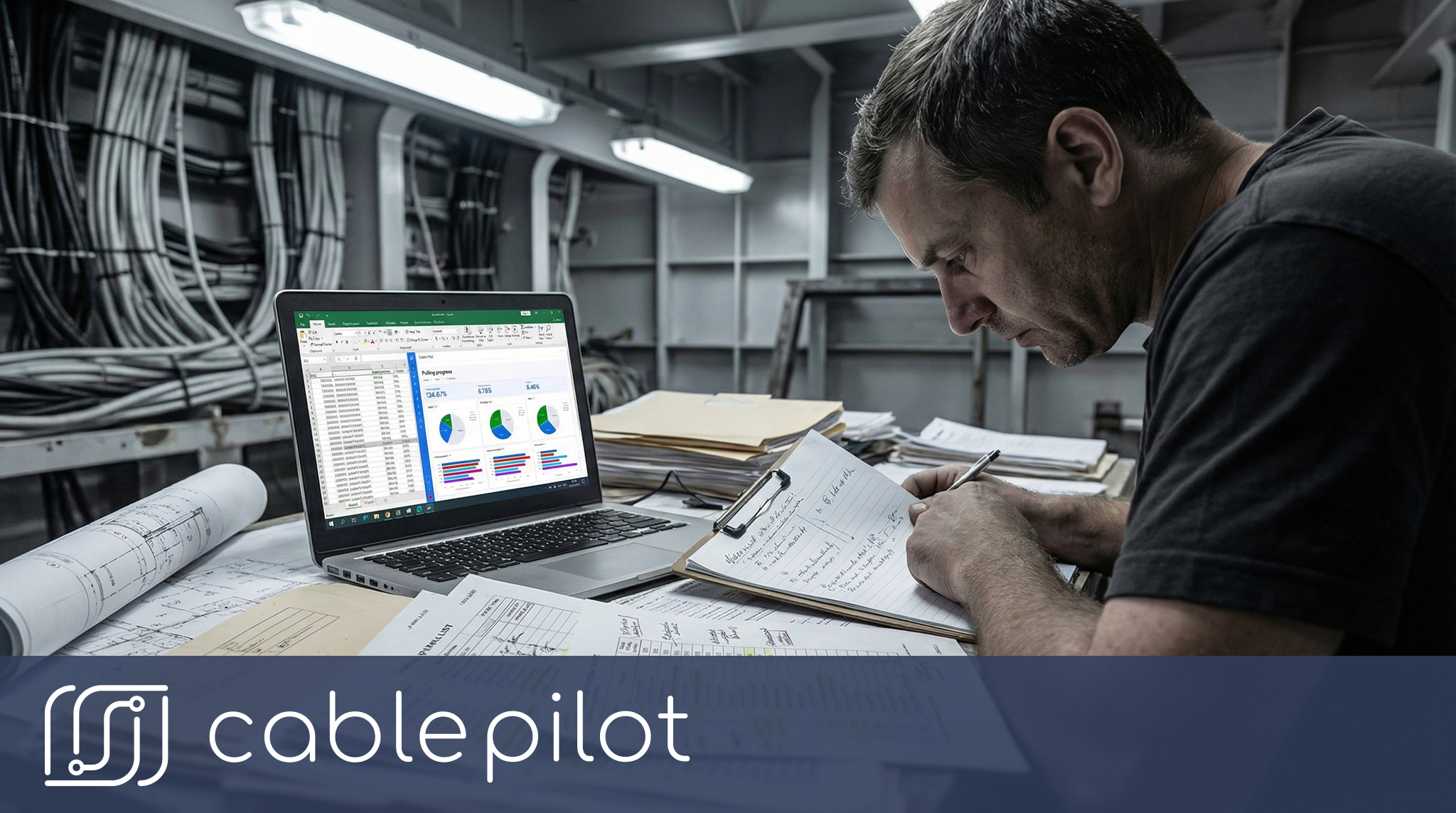
Project managers spend hours reconciling conflicting status reports, chasing contractors for updates, and manually verifying that critical dependencies have been addressed. Meanwhile, actual installation progress slows because installers lack real-time visibility into adjacent trades’ work—leading to access conflicts, rework loops, and compressed commissioning windows.
The Cable Pilot Advantage: Real-Time Data Management for Hybrid-Electric Installations
Cable Pilot was designed specifically for the complexity of modern shipbuilding electrical installations—and hybrid-electric propulsion systems represent the environment where its capabilities deliver maximum impact. By replacing fragmented paper workflows with smartphone-based reporting, AI-assisted design comparison, and a living digital twin of the electrical installation, Cable Pilot transforms multi-trade chaos into predictable, auditable delivery.
Smartphone Reporting: Context-Rich Documentation at the Point of Work
In a hybrid-electric installation, every cable connection carries critical context. Cable Pilot enables installers to capture this context in real time using their smartphones:
- QR code scanning: Each cable termination point is tagged with a unique QR code. Installers scan the code, photograph the completed connection if needed, and log the installation status instantly—eliminating manual paperwork and ensuring that location data is accurate.
- Dependency tracking: Battery-to-inverter cables depend on battery mounting completion; shore-power cables depend on converter installation. Cable Pilot enforces these dependencies automatically, preventing installers from attempting work sequences that will require later rework.
- Photo-verified quality: High-voltage DC terminations, fiber-optic connections, and EMI shielding installations are documented with timestamped photographs, creating immutable evidence for certification inspections and resolving contractor disputes before they escalate.
The operational impact is immediate: project managers gain real-time visibility into installation progress without chasing contractors for updates, and commissioning engineers arrive onsite with complete, photo-verified documentation rather than fragmented paper records.
AI-Assisted Design Comparison: Catching Changes Before They Become Rework
Hybrid-electric designs evolve continuously as battery vendors refine specifications, energy management software adds new monitoring requirements, and regulatory agencies impose additional compliance checks. In traditional workflows, these changes propagate slowly through paper cable lists—often reaching installers weeks after implementation, triggering costly rework loops.
Cable Pilot’s AI-assisted comparison engine monitors design documents continuously, flagging changes the moment they occur:
- Automated change detection: When a battery vendor updates module wiring diagrams, Cable Pilot compares the new specifications against the existing cable list and highlights affected cable runs, termination points, and installation sequences.
- Proactive alerts: Project managers receive instant notifications of design changes, enabling them to redirect contractors before rework becomes necessary. Instead of discovering termination mismatches during commissioning, teams address them during installation—when corrections are fastest and least expensive.
- Version control and traceability: Every design revision is logged with timestamps and approval records, creating an auditable trail that satisfies certification inspectors and protects shipyards from contractor claims of inadequate documentation.

For hybrid-electric projects where design stability is elusive, AI-assisted comparison transforms reactive firefighting into proactive risk management.
Digital Twin: Enforcing Segregation Rules and Preventing EMI Failures
Electromagnetic interference is a pervasive risk in hybrid-electric installations. High-voltage AC and DC cables carrying battery power must be segregated from low-voltage communication cables serving navigation systems, energy management sensors, and automation networks. Traditional cable lists document segregation requirements in text notes—easily overlooked by installers working under schedule pressure.
Cable Pilot’s digital twin enforces segregation rules automatically:
- Segregation data in your smartphone: Rather than discovering EMI-induced failures during sea trials, teams address routing conflicts during installation.
- Integration readiness verification: Hybrid-electric commissioning depends on verifying that all interdependent systems are complete and correctly connected. The digital twin provides a real-time, system-level view of installation status, enabling commissioning engineers to verify readiness before scheduling expensive integration tests.
The result: faster commissioning cycles, reduced rework costs, and higher confidence in emissions-compliance certification—critical advantages for shipyards competing in the premium hybrid-electric segment.
Operational Payoff: Accelerated Commissioning and Reduced Integration Rework
The true measure of any electrical installation workflow is not the elegance of its documentation but the speed and certainty of commissioning. Hybrid-electric vessels face uniquely compressed commissioning windows because integration testing requires all power sources—batteries, generators, shore-power converters, renewable systems—to be simultaneously operational, correctly connected, and communicating with energy management software.
Cable Pilot delivers three operational benefits that directly accelerate hybrid-electric commissioning:
Real-Time Visibility Into Installation Status
Traditional workflows force project managers to reconstruct installation progress from periodic contractor reports, often discovering completion gaps only when commissioning engineers arrive onsite. Cable Pilot provides continuous, system-level visibility:
- Battery installation tracking Track battery module mounting, cell connection completion, battery management system wiring, and high-voltage DC cable terminations—all in a single view that updates in real time as installers log work.
- Shore-power readiness tracking: Monitor converter installation, cable pulling completion, switchboard connection verification, and load testing status—ensuring that shore-power systems are commission-ready before scheduling expensive dock-side testing.
- Energy management integration status: Verify that all sensors, control cables, and communication links supporting energy management software are installed, tested, and documented—preventing integration failures caused by missing or misrouted monitoring cables.
Real-time visibility transforms commissioning from a discover-and-fix process into a systematic verification of known-complete work—compressing schedules and reducing contractor standby costs.
Reduced Rework Through Early Error Detection
Every cable misrouted, every termination missed, and every design change overlooked during installation becomes rework during commissioning—often at 3x to 5x the original installation cost due to access restrictions, contractor mobilization, and schedule delays. Cable Pilot’s real-time data capture and AI-assisted comparison catch errors when they are easiest and cheapest to correct:
- Design change propagation: When battery vendors update specifications, affected installers are notified immediately, preventing completion of work that will require later revision.
- Quality gate enforcement: Critical installation milestones—battery bank completion, inverter termination verification, shore-power load testing—cannot be marked complete until all prerequisite work is documented and verified, preventing premature commissioning attempts.
Shipyards using Cable Pilot report rework reduction in the range of 30 to 40 percent on hybrid-electric projects—translating directly into shorter schedules and higher margins.
Accelerated Certification Through Auditable Records
Hybrid-electric vessels face rigorous certification requirements for battery safety, high-voltage electrical systems, EMI compliance, and energy management integration. Classification societies and regulatory agencies demand complete, auditable documentation proving that installations meet design specifications and safety standards.
Cable Pilot’s immutable, photo-verified installation logs provide certification-ready documentation from day one:
- Timestamped photo evidence: Every high-voltage termination, battery connection, and segregation installation is documented with timestamped photographs—eliminating disputes over work quality and providing inspectors with visual verification.
- Automated compliance reports: Generate instant reports showing completion status for battery installations, shore-power systems, renewable energy connections, and energy management wiring—organized by classification society requirements rather than internal project structures.
- Traceability from design to installation: Every cable logged in Cable Pilot links directly to design specifications, revision history, and approval records—enabling inspectors to verify that as-built installations match certified designs without manual cross-referencing.
Shipyards report certification cycle reductions of 20 to 30 percent on hybrid-electric projects, shortening time-to-delivery and accelerating cash flow.
Strategic Imperative: Capturing the Premium Hybrid-Electric Segment
The hybrid-electric propulsion market represents the fastest-growing, highest-margin segment in commercial shipbuilding. Ferry operators, offshore support vessel owners, and environmentally conscious cargo operators are willing to pay premium prices for vessels that deliver emission reductions, fuel cost savings, and regulatory compliance—but only if shipyards can deliver on time, on budget, and with proven reliability.
Shipyards that master hybrid-electric electrical installation workflows gain three strategic advantages:
Competitive Moat Against Low-Cost Competitors
Lower-cost shipyards compete primarily on labor rates and material costs—advantages that erode quickly in hybrid-electric builds where installation complexity, coordination overhead, and rework risk dominate project economics. Yards that implement integrated data platforms like Cable Pilot can execute hybrid-electric projects with lower total costs despite higher hourly labor rates, creating a competitive moat that protects premium positioning.
Preferred Partner Status With Repeat Clients
Hybrid-electric vessel owners operate fleets—ferries, offshore support vessels, coastal cargo ships—creating opportunities for long-term partnerships with shipyards that deliver predictable schedules and reliable commissioning. A single successful hybrid-electric delivery, supported by auditable documentation and transparent progress reporting, positions shipyards as preferred partners for follow-on orders in the fastest-growing segment.
Future-Proofing Against Regulatory Acceleration
Emission regulations are tightening globally, and hybrid-electric propulsion is becoming mandatory for certain vessel classes and operating regions. Shipyards that delay investment in hybrid-electric capabilities risk losing access to premium clients as regulatory mandates accelerate. Conversely, yards that build institutional knowledge, standardized workflows, and proven execution records in hybrid-electric installations position themselves to capture market share as the segment expands.
The strategic question is not whether hybrid-electric propulsion will dominate future shipbuilding—it is whether your shipyard will lead or follow.
Turning Complexity Into Competitive Advantage
Hybrid and electric propulsion systems are redefining vessel electrical architecture, creating unprecedented installation complexity that conventional workflows cannot manage. Battery systems, fuel cells, renewable energy sources, and energy management software introduce hundreds of new cable runs, strict segregation requirements, and tight contractor coordination demands—all within compressed schedules and zero tolerance for errors.

Shipyards that continue managing hybrid-electric installations through paper cable lists, Excel spreadsheets, and periodic status meetings will face escalating rework costs, certification delays, and competitive disadvantage against yards that embrace real-time data management.
Cable Pilot transforms hybrid-electric installation chaos into predictable delivery through smartphone-based reporting that captures context-rich documentation at the point of work, AI-assisted design comparison that catches changes before they become rework, and a digital twin that enforces segregation rules and accelerates commissioning. The operational payoff—30 to 40 percent rework reduction, 20 to 30 percent faster certification, and real-time visibility into multi-trade coordination—directly addresses the pain points that make hybrid-electric projects financially risky under traditional workflows.
For project managers, electrical contractors, and shipyard leadership, the path forward is clear: hybrid-electric propulsion is not a niche trend but the future of commercial maritime transportation. The question is whether your workflows are ready.
Ready to Transform Your Hybrid-Electric Electrical Installation Workflow?
Cable Pilot is purpose-built for the complexity of modern shipbuilding, with specialized capabilities for hybrid and electric propulsion systems. Discover how real-time data management, smartphone reporting, and digital twin technology can reduce rework, accelerate commissioning, and position your shipyard as the preferred partner for the fastest-growing vessel segment.
Schedule a demonstration today and see how Cable Pilot turns hybrid-electric installation complexity into competitive advantage.