
For any experienced project manager in shipbuilding, it’s a familiar and dreadful feeling. The dashboard glows with reassuring, positive numbers. The report states that 480 out of 500 main cables have been pulled. 96% complete. Equipment installation is at 94%. On paper, the project is a resounding success, coasting smoothly toward its deadline.
Yet, you feel a deep, gnawing anxiety.
The Hidden Cost of Measuring the Wrong Things
Your “gut feeling,” born from years on the shipyard floor, screams that the project is on the brink of chaos. You know the “remaining” 4% of cables aren’t just any cables; they are the complex, problematic ones, routed through the most congested, access-restricted areas of the engine room and bridge. You know the “remaining” 6% of equipment isn’t just mounting panels; it’s the final, delicate termination and testing of navigation systems and high-voltage switchboards.
Your team is already showing signs of burnout, and the subcontractor is asking for a change order, claiming the workload is far beyond the original scope. The dashboard says 96% done. Your experience says you’re facing a mountain of work that will consume 40% of your remaining budget and 100% of your schedule contingency.
This disconnect isn’t a personal failure. It is a data failure. It’s the catastrophic, costly result of using antiquated electrical installation metrics in a complex, modern shipbuilding environment. Traditional KPIs—like kilometers of cable pulled, number of cables installed, or total equipment units—create a dangerous illusion of progress. They measure inventory, not effort.
These metrics lack any correlation to the actual labor effort required to get the job done. And without an accurate measurement of labor effort, true shipbuilding project management is impossible. You are forced to rely on guesswork, intuition, and reactive firefighting. The fundamental truth of all management remains: you cannot manage what you cannot accurately measure.
This article explores the catastrophic failure of traditional electrical installation metrics and introduces a modern, data-driven solution: a universal, weighted metric for labor effort that moves your project from guesswork to predictable control.
The “90% Done” Syndrome: Shipbuilding’s Most Expensive Illusion
The “90% Done Syndrome” is the formal name for the project manager’s anxiety described above. It’s a common phenomenon in complex engineering projects, and it is particularly devastating in maritime electrical installations. This syndrome is the direct result of “flat” metrics that treat every task as equal.
When your project plan measures progress by a simple “count” of cables, a 50-meter lighting cable pulled through an open ceiling void in a cabin corridor is counted as “1 cable.” A 15-meter, multi-core, armored control cable that must be routed, glanded, and terminated inside a cramped, EX-rated compartment is also counted as “1 cable.”

In the reality of labor effort, the second cable is not 1 task; it is a 100-task equivalent. It requires more planning, more skilled labor, more safety precautions, and exponentially more time. But on your progress report, it’s just one tick-box, identical to all the others.
This is why the “last 10%” of a project often takes 50% of the time and budget. It was never the “last 10%.” It was, in reality, the “hardest 50%” of the total labor effort, which was deferred, ignored, or simply invisible until the very end.
The consequences of this illusion are devastating:
- Budget Overruns: You exhaust 90% of your labor budget to complete what you thought was 90% of the work. The remaining “10%” (which is actually 50% of the effort) must be funded through painful change orders, depleted contingencies, or pure financial loss.
- Schedule Collapse: The project “hits a wall.” Progress grinds to a halt. Deadlines fly by, triggering liquidated damages and destroying the client’s confidence.
- Team Burnout and Conflict: To “solve” the problem, management demands massive overtime. Teams are pushed to their breaking point, working on the most complex tasks under the most intense pressure. This breeds resentment, increases safety incidents, and leads to high turnover of your most skilled electricians.
- Loss of Credibility: When a project manager repeatedly reports “90% complete” for three consecutive months, they lose all credibility. Management, clients, and subcontractors stop trusting the data, and the project descends into chaos management.
This syndrome is not an unavoidable cost of business. It is a choice. It is the direct result of clinging to metrics that were designed for a simpler, analog era of shipbuilding.
Deconstructing the Failure: Why Traditional KPIs Lie
To build a better system, we must first dissect the old one. Let’s examine the three most common, and most flawed, electrical installation metrics.
1. The Myth of “Kilometers of Cable”
On the surface, this metric feels substantial. “We pulled 250km of cable this quarter.” It sounds impressive. It is also profoundly misleading. This metric is perhaps the worst offender, as it actively punishes efficiency and complexity.
Consider two teams.
- Team A is assigned to pull 2 kilometers of high-voltage power cables. These are thick, heavy, but simple. They run along a single, wide-open, easily accessible cable tray from the main switchboard to the propulsion room. The task is physically demanding but logistically simple.
- Team B is assigned to pull 0.5 kilometers of cable. Their work involves 80 different, small-cross-section control and fiber-optic cables. The routes are complex, running through multiple decks, congested compartments, and existing penetrations.
At the end of the week, Team A reports 2km pulled. Team B reports 0.5km pulled.
According to the “kilometers” metric, Team A was 400% more productive. But which task required more skill? More planning? More problem-solving? Which task had a higher risk of error? By measuring length instead of effort, you have just rewarded simple, repetitive labor and penalized complex, high-skill work. You have also learned nothing about your project’s actual progress, as the 0.5km of control cables may be far more critical to system completion than the 2km of power cable.
2. The Fallacy of “Cable Count”
This metric is the root cause of the “90% Done Syndrome.” It is a simple tally, a head-count of items. As our earlier example showed, treating a simple 1-hour cable pull as equivalent to a complex 2-day cable installation is a fatal management error.
This metric fails to account for:
- Cable Type: Armored vs. unarmored, fiber vs. control vs. power, cross-section, weight.
- Routing: Congestion, number of transits, vertical vs. horizontal, working at height.
- Glanding & Termination: The type of gland, the number of cores to terminate, the type of connection.
- Location: Access difficulty, environmental hazards (EX zones, hot work), required scaffolding.
A “cable count” is a measure of inventory from your cable list. It has zero correlation to the work required to install that inventory. It is a vanity metric that offers a false sense of security, encouraging teams to “cherry-pick” the easiest cables first to make their numbers look good, pushing all the high-effort tasks to the end of the project.
3. The “Number of Connections” Trap
This metric is slightly more granular and, in theory, closer to measuring actual work. Instead of one cable, it measures two (or more) connections. This is an improvement, but it still falls into the same trap. It assumes all connections are equal.
Reality check: Is terminating 20 simple 2.5mm wires onto a terminal block in an open, climate-controlled cabinet the same amount of labor effort as performing two multi-stage, armored, EX-rated glands on a 240mm cable in a 50°C bilge space?
Of course not. The first task might take an electrician 30 minutes. The second could take a specialized team an entire day, requiring hot work permits, specialized tools, and rigorous quality checks.

By “number of connections,” the first task is ten times larger than the second. By actual labor effort, the second task is twenty times larger. The metric is not just wrong; it is inverted. It tells you the exact opposite of the truth.
This metric fails because it ignores the type of connection, the complexity of the glanding, the location of the work, and the testing required for each termination.
All three traditional metrics fail for the same reason: they are simple, “flat” counts of things, not weighted measurements of effort.
The Solution: The “Cable Point” as a Universal Unit of Labor Effort
If the old metrics are broken, what is the alternative? The solution is to stop measuring inventory and start measuring labor effort.
To do this, you need a new unit of measurement. We call it the Cable Point (CP).
The Cable Point is an abstract, composite, and weighted metric. It is a universal unit of value that represents one standardized quantum of labor effort.
A simple task, like pulling a single, short cable in an open tray, might be worth 5 Cable Points.
A complex task, like routing, glanding, and terminating a multi-core armored cable in a congested, access-restricted zone, might be worth 150 Cable Points.
Suddenly, the project manager’s world shifts from ambiguity to clarity. You are no longer comparing apples to oranges (one “easy” cable vs. one “hard” cable). You are now comparing value: 5 CPs vs. 150 CPs. The “hard” cable is now visibly, measurably, and trackably 30 times more work than the “easy” cable.
How are Cable Points Calculated?
Cable Points are not “guestimates.” They are the output of a sophisticated calculation engine that lives within a digital twin of the vessel. This engine (which is the core of the Cable Pilot platform) algorithmically processes dozens of data points from your project’s engineering data to assign a fair, objective CP value to every single installation task.
The inputs to this algorithm include:
- Cable Data: From the cable list (type, cross-section, core count, weight, armor).
- Routing Data: From the 3D model (true 3D path length, number of compartment transits, number of penetrations, vertical/horizontal segments).
- Equipment Data: From the equipment list (termination type, connection complexity).
- Task Data: Glanding type, termination method, specific installation requirements.
- Location Data: From the 3D model (compartment classification, access difficulty).
- Testing Data: Required tests for each cable (e.g., continuity, insulation, OTDR).
The engine processes these data points for every cable and assigns a separate CP value for each “atomic” task: one value for pulling, one for each gland/termination, and one for testing.
This granular, data-driven weighting is the key. It transforms your entire project plan from a simple “to-do list” into a fully-weighted, effort-based “value ledger.”

How Cable Points Create Fair, Accurate, and Balanced Management
When your entire project is quantified in Cable Points, the “90% Done Syndrome” vanishes. The “gut feeling” and the “dashboard data” merge into one single, accurate source of truth.
This new clarity revolutionizes how every stakeholder manages the project.
For the Project Manager (The “Macro” View)
The PM’s primary concerns are schedule, budget, and progress. Cable Points provide unprecedented clarity for all three.
- True Progress Tracking: You no longer see “96% of cables installed.” You see “80% of total Cable Points completed.” You now know, with data-driven certainty, that 20% of the total labor effort remains. That 20% might be contained in only 4% of the “cables,” but the metric exposes the truth. The anxiety is replaced with actionable data.
- Predictable Project Velocity: Your team isn’t just “installing 50 cables per week.” This number is meaningless, as it fluctuates based on the type of cables. Instead, your team is “completing 2,000 Cable Points per week.” This velocity is stable, meaningful, and, most importantly, predictable. You can now accurately forecast your completion date. If you have 20,000 CPs remaining, you know you have 10 weeks of work left. No guesswork.
- Data-Driven Budgeting: Labor costs are no longer a mystery. You know the cost per Cable Point. You can track your “earned value” based on CPs completed vs. CPs planned, giving you a real-time, accurate measure of project financial health.
For the Team Leader & Supervisor (The “Micro” View)
The supervisor’s primary concerns are workload, team performance, and quality.
- Fair Workload Distribution: This is the most powerful human-centric benefit. As a supervisor, you no longer have to guess at task fairness. You can build work packages that are truly balanced. Team A gets a package of tasks totaling 500 CPs. Team B gets a different set of tasks, also totaling 500 CPs. The work is fair and seen to be fair, which has a massive positive impact on team morale.
- Objective Performance Analytics: Why is Team A completing 1,200 CPs per week while Team B only completes 900 CPs? Now you can have a real conversation. The “Cable Point” metric is a fair baseline. Perhaps Team B is working in a more congested area. Perhaps they are missing a specific tool. You can pinpoint the real bottleneck and solve it, rather than just blaming Team B for a “low cable count.”
- Proactive Problem-Solving: You can look at the week ahead and see a work package with an unusually high CP-per-cable ratio. You instantly know this is a complex, high-risk job and can assign your most senior, skilled electricians to it before it becomes a problem.
For the Planner (The “Future” View)
The planner’s primary concern is resource allocation and avoiding future bottlenecks.
- Accurate Forecasting & Resourcing: The “90% Done” problem is solved at the planning stage. The planner can see from Day 1 that the last 4% of cables actually represent 20% of the total CP load. They can allocate resources, budget, and time for this in the original plan.
- Preventing Team Overload: The planner can smooth the workload. They can see that a specific system (e.g., Navigation) has a massive 10,000 CP “spike” in Week 30. They can now break that work package apart and feed it to the teams over several weeks, or schedule an additional team, to prevent a single, catastrophic overload. The invisible “wall” of work becomes a manageable, visible incline.
Cable Pilot in Action: The Engine for Fair Metrics
This “Cable Point” system is not theoretical. It is the integrated, beating heart of the Cable Pilot platform. Cable Pilot is the end-to-end digital tool that makes this level of data-driven management possible.
- The Digital Twin Integration: Cable Pilot begins by consuming all your engineering data. It creates a single, unified “digital twin” of the entire electrical installation.
- The Calculation Engine: This is where the magic happens. The platform’s algorithm analyzes the digital twin and automatically calculates and assigns a unique Cable Point value to every single atomic task for every cable in your project.
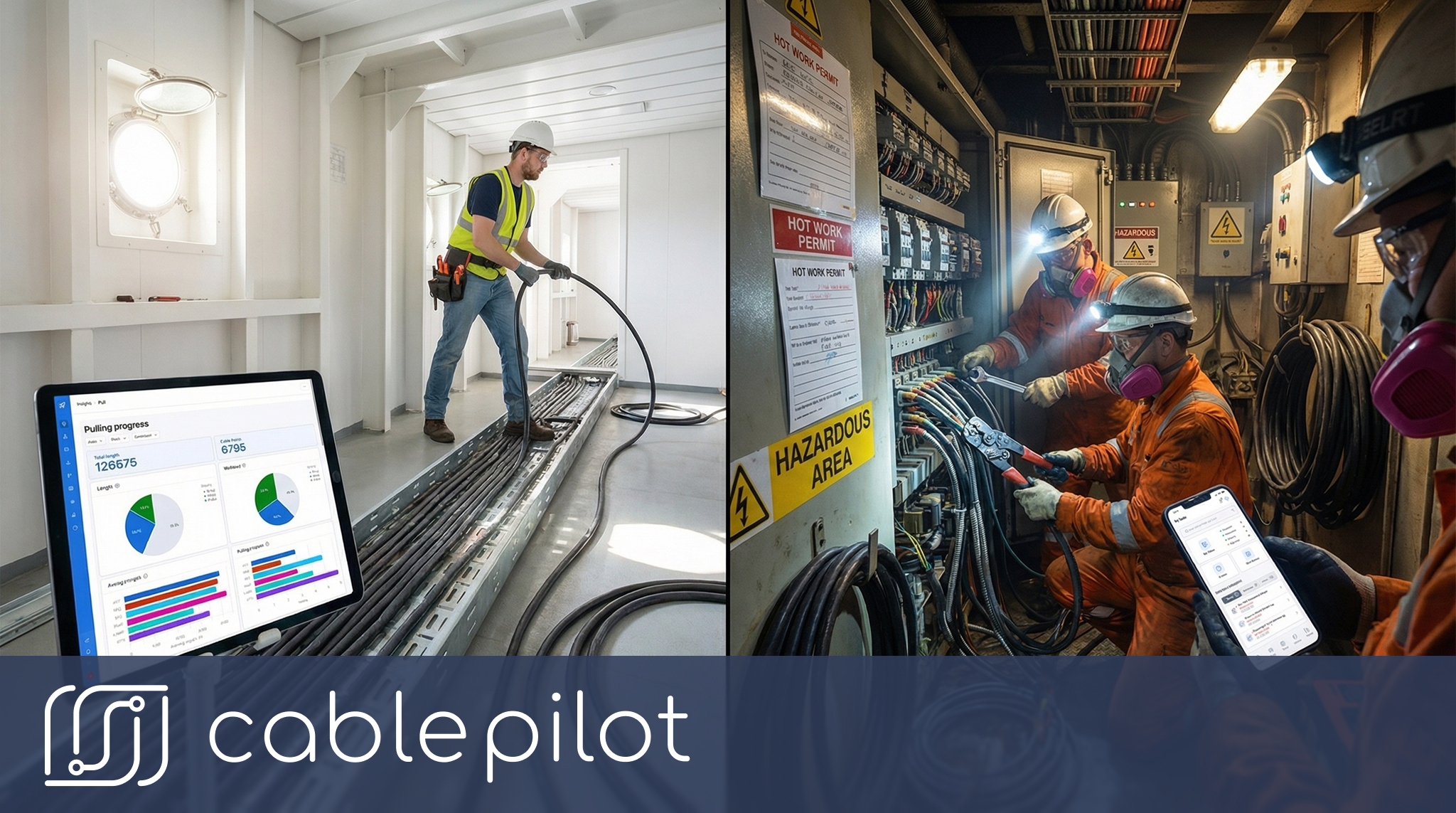
- The Smartphone Application: This is how real-world progress is captured. The electrician on the vessel doesn’t need to understand CPs. They receive their work package on a rugged smartphone. They scan a QR code at their work location, see their tasks (e.g., “Pull Cable XA-101,” “Gland & Terminate Cable YB-205”), and tap “Complete” when finished.
- The Real-Time Feedback Loop: The moment the electrician taps “Complete,” the digital twin is updated. The project manager’s dashboard instantly reflects this. The “CPs Completed” ticks up, the “Remaining CPs” ticks down. The project’s “true progress” percentage is updated in real-time.
- The Web Dashboard: This is the PM’s and Planner’s command center. Here, they see the high-level KPIs: Total CPs vs. Completed CPs, Project Velocity (CPs/week), forecasted completion date, and workload distribution charts. They can drill down from a system-level view (e.g., “Propulsion System – 65% CPs complete”) to a single cable, and even to a single electrician’s work history.
Cable Pilot is the engine that connects the complex reality of the shipyard floor to a simple, powerful, and truthful set of metrics, all based on the fair and universal Cable Point.
The Strategic Impact: From Reactive Firefighting to Proactive Control
Adopting a fair, effort-based metric like the Cable Point is more than just a new way to build a dashboard. It is a fundamental shift in your entire project management philosophy. It moves your entire organization from a state of reactive, gut-feel-based firefighting to one of proactive, data-driven control.
The strategic benefits are profound:
- A Historical Performance Database: This is the ultimate competitive advantage. After you complete a project with Cable Pilot, you know exactly how many CPs it required. You know your true cost-per-CP. When you bid on the next, similar vessel, your bid is not a guess. It is a data-driven calculation. You know a “Sister Ship 2” will require 1.2 million CPs, and you know exactly what that will cost. Your bids become radically more accurate and competitive.
- Objective Commercial Management: Change orders are no longer a matter of opinion. When the client adds a new piece of equipment, you don’t “estimate” the impact. You run the new cables through the Cable Pilot engine. It calculates the exact CP value of the change. You can now go to the client and say, “This change adds 4,500 CPs of labor effort, which, at our established project rate, will cost $X and add 2.5 weeks to the schedule.” It is an objective, indisputable, data-driven conversation.
- Massively Improved Team Morale: Fair workload measurement is the key to a happy and productive team. When skilled electricians know they are being measured fairly on the effort they expend, not a “vanity metric” like cable count, their job satisfaction and buy-in increase dramatically. High-performing teams are recognized and rewarded for their actual efficiency, not just for “looking busy.”
- De-Risking Projects: The “90% Done Syndrome” is, at its core, a risk. It’s the risk of hidden complexity. A Cable Point system eliminates this risk by making complexity visible from Day 1. You identify the true hotspots in the project—the high-CP-value systems and compartments—and can proactively manage them with the right resources.

Stop Measuring Inventory, Start Measuring Effort
For decades, shipbuilding has been managed by looking in the rearview mirror, using analog metrics that measure what’s already been inventoried. Kilometers, counts, and connections are relics of a time when we lacked the digital tools to understand the work itself.
That time is over.
Clinging to these metrics is the direct cause of the “90% Done Syndrome,” the financial black hole that swallows budgets, shatters schedules, and burns out your best people. The anxiety you feel when your dashboard lies to you is a symptom of a broken system.
The future of successful shipbuilding project management lies in measuring what matters: labor effort.
A universal, weighted metric like the Cable Point, powered by a digital twin platform like Cable Pilot, provides this single source of truth. It transforms ambiguity into clarity, chaos into predictability, and unfair workloads into balanced, high-performance teams.
To gain control of your projects, you must first have clarity. And true clarity only comes when you stop counting things and start measuring effort.
Ready to stop guessing and start managing with real data? Discover how Cable Pilot’s digital twin and universal metrics can bring true predictability and control to your next shipbuilding project. Schedule a demo today to see fair metrics in action.
Pingback: 7 Indulgence Ways Real-time Dashboards Boost Efficiency In Shipbuilding