
It’s 07:30 on the vessel, and the daily meeting begins. The air is thick with the smell of coffee and the unspoken frustration of time being lost. For the next hour, project managers, site managers, and supervisors will go around the room, one by one, giving verbal status updates based on memory, handwritten notes, and data pulled from yesterday’s spreadsheets.
A supervisor reports, “Zone C is about 80% complete on cable pulling.” A lead engineer says, “We should be ready for terminations in compartment 4012 by tomorrow.” The project manager nods, types these “facts” into a master Excel file, and moves on.

The meeting ends, and everyone feels like they’ve done their duty. Yet, a week later, it’s discovered that “80% complete” was actually 50%, and the compartment “ready by tomorrow” is still missing three critical cable transits that were never inspected. The schedule slips, teams are re-tasked, and the ‘cost of rework’ ticks up.
This scenario is the reality for countless shipbuilding projects. The daily meeting, intended to be the central hub for coordination and progress, has become a “daily meeting sinkhole”—a mandatory ritual that drains thousands of man-hours while providing a dangerously inaccurate picture of the project.
The problem isn’t the meeting itself. The problem is the data.
The Anatomy of a Failed Meeting: Verbal Reports vs. Verifiable Facts
The traditional approach to ‘shipbuilding project management’ runs on a foundation of outdated, subjective, and fragmented information. The daily meeting is simply the stage where this flawed data is presented.
The Lag of the Spreadsheet
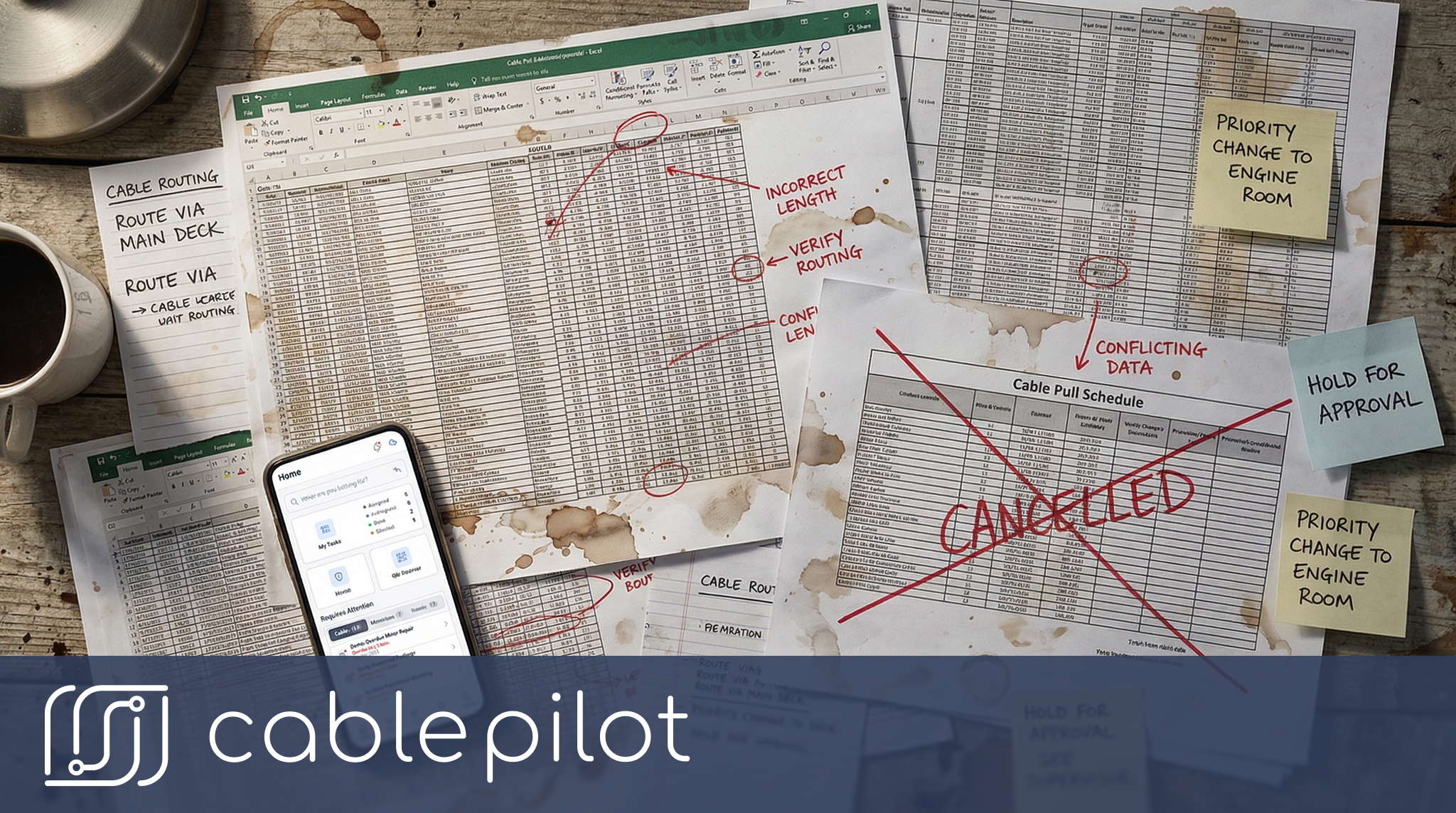
The most “advanced” traditional teams might use a master ‘cable list’ in Excel. Foremen or supervisors are expected to update this file at the end of their shift. This means that the data presented in the 07:30 meeting is, at best, 12 to 24 hours old. In the fast-paced, high-density environment of electrical installation, this data lag is fatal. Decisions are being made based on history, not the present. A critical bottleneck that emerged three hours ago is completely invisible.
The Unreliability of “Guesstimates”
Worse still is the reliance on verbal reporting. When a supervisor is asked for a progress update on 3,000 cables in their section, their answer is, by necessity, a “guesstimate.” It’s a gut feeling, a vibe. “We’re about 80% done” is a statement of confidence, not a metric. This subjectivity masks a host of problems:
- Hidden Bottlenecks: The 20% of work remaining might be the 20% that is blocked by another trade, but this detail is lost.
- Inaccurate ‘Labor Effort’ Tracking: The project manager has no way to know if that 80% took 500 man-hours or 1,000. They can’t measure productivity, which makes future planning a guessing game.
- The “Watermelon” Effect: The status looks “green” on the outside (in the meeting) but is “red” on the inside (on the vessel). Progress charts based on this data are works of fiction, lulling the management team into a false sense of security until a major deadline is inevitably missed.
This entire process is a colossal waste of high-value time. Instead of using the collective expertise of the project’s leadership to solve problems, the meeting is spent on the low-value task of data entry. You are paying your most expensive personnel to read a spreadsheet aloud.
The Hidden Costs of a Bad Meeting: More Than Just Time
The inefficiency of the daily meeting sinkhole goes far beyond the 30 or 60 minutes it occupies on the calendar. The real damage is inflicted on the project’s bottom line, driven by two corrosive forces: the ‘cost of rework’ and the paralysis of ‘risk mitigation’.
1. The Exploding ‘Cost of Rework’
When progress is based on “good vibes” instead of hard data, mistakes are not caught until it is too late. A cable is pulled through the wrong transit, an incorrect cable type is installed, or a connection is missed. In a traditional workflow, this error might not be discovered for days or even weeks—often during the testing and commissioning phase.
By that point, the cost to fix it has multiplied exponentially. Other installations may have been built on top of the error. To correct it, teams must now be pulled off their current tasks, work must be disassembled, the error fixed, and then everything re-installed and re-inspected. This is the ‘cost of rework’ in action, and it is a direct consequence of a data-poor environment. The meeting that should have flagged the deviation (“Why was this cable pulled before the transit was approved?”) failed because it didn’t have the data.
2. The Impossibility of Proactive ‘Risk Mitigation’
Effective ‘risk mitigation’ is about seeing the future. It’s about identifying a potential problem and solving it before it becomes an actual problem. The traditional daily meeting makes this impossible. It is, by its very nature, a reactive event.
You cannot mitigate a risk you cannot see. When the entire team is looking at 24-hour-old “guesstimates,” you aren’t managing risk; you are documenting history. You only learn about the blocked cable transit after the installation team has already arrived, wasted half a shift, and moved on. You only learn about the material shortage when the foreman reports they couldn’t complete their tasks. This isn’t management; it’s firefighting.
The ‘Single Source of Truth’: A New Foundation for Project Management
To fix the daily meeting, you must first fix the data. The solution is to create a “single source of truth”—a centralized, live, and objective database that reflects the exact status of every single component on the vessel, in real-time.

This is the fundamental shift from analogue guesswork to digital certainty. When you have a single source of truth, the entire dynamic of project management changes.
- Subjective becomes Objective: “I feel like we’re 80% done” is replaced by “The dashboard shows 1,245 of 1,500 cables in Zone C are logged as ‘Pulled’.”
- Lagging becomes Real-Time: “This is what we did yesterday” is replaced by “This is the status of the vessel right now.”
- Fragmented becomes Centralized: Dozens of spreadsheets, notebooks, and verbal reports are replaced by one dashboard that everyone—from the installer to the CEO—can trust.
This concept is the core of a modern ‘digital twin‘ for electrical installations. It’s not just a 3D model; it’s a living, breathing data model of the project’s progress, fed by direct-from-field information.
How Cable Pilot Transforms the Daily Meeting
This digital transformation is precisely what Cable Pilot is designed to deliver. It replaces the broken, manual workflow with a seamless, data-driven system that connects the field directly to the project office, turning the daily meeting from a time sink into a powerful strategic tool.
Here is the new workflow:
1. The Central Hub: The Web Application
All project data lives in the Cable Pilot web application. This is where the Project Manager and engineers manage the master ‘cable list’, define installation routes, and, crucially, create and assign digital work packages for the installation teams. This is the command center.
2. The Field Tool: The Smartphone Application
On the vessel, the installer, electrician, or supervisor opens the Cable Pilot smartphone application. They see a clear, simple list of tasks assigned directly to them—no more printing spreadsheets, no more ambiguous verbal instructions.
3. The Point of Action: On-Site Data Capture
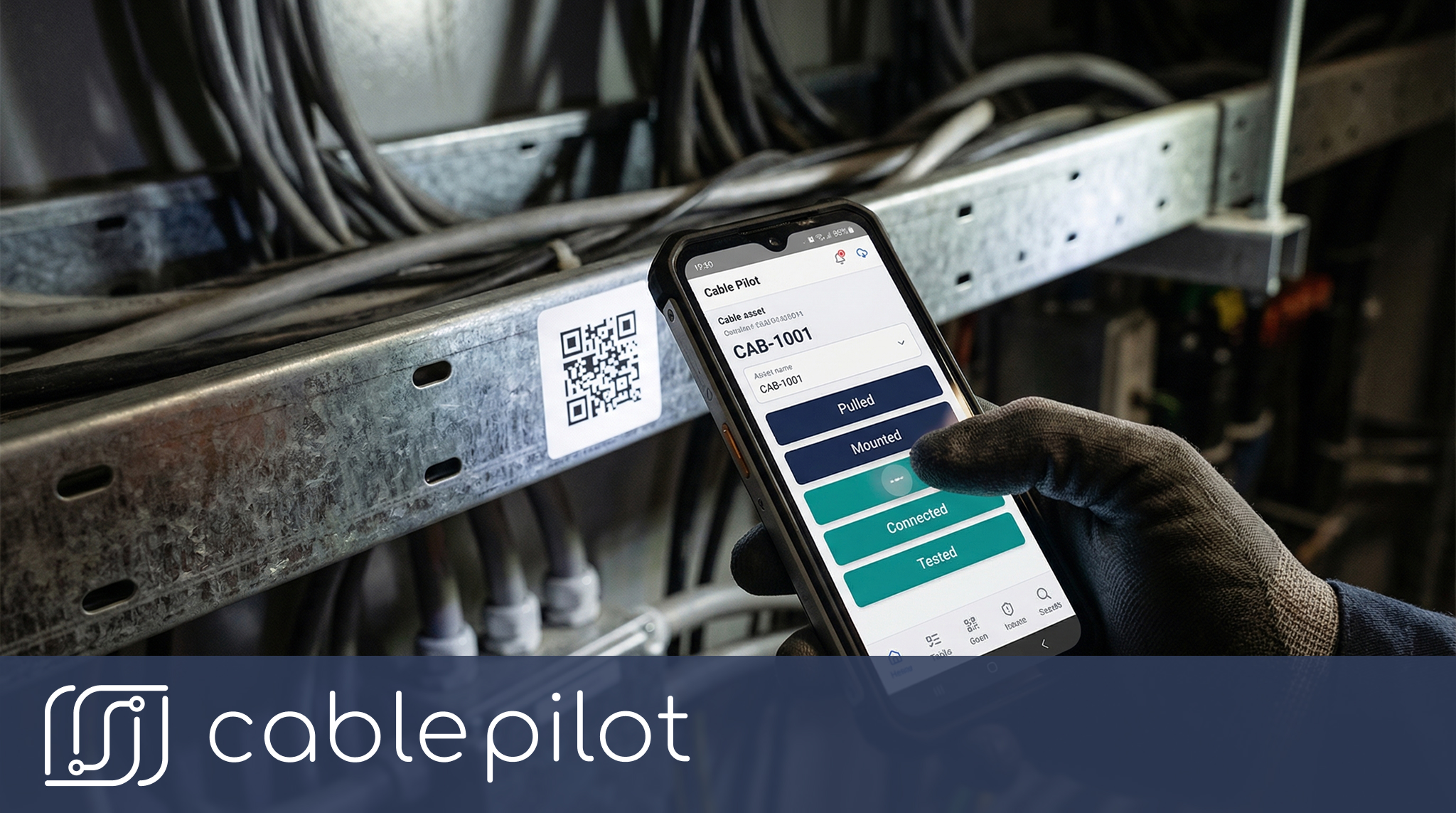
This is where the magic happens. The installer arrives at a compartment, scans a QR code on the wall, and Cable Pilot immediately displays all tasks (cables to be pulled, devices to be mounted, connections to be made) for that specific location.
As the installer completes a task, they update its status in the smartphone app. This is a one-time, two-second action.
- Cable ‘CAB-1001’ pulled? Tap ‘Pulled’.
- Equipment ‘EQ-205’ mounted? Tap ‘Mounted’.
- Terminations complete? Tap ‘Connected’.
4. The Payoff: The Real-Time Dashboard
The instant the installer taps “Pulled” on their smartphone, the central database is updated. In the project office, the Project Manager’s dashboard automatically refreshes. The progress bar for Zone C ticks up. The status of ‘CAB-1001’ changes from ‘Assigned’ to ‘Pulled’ for everyone on the project to see.
5. The New Daily Meeting
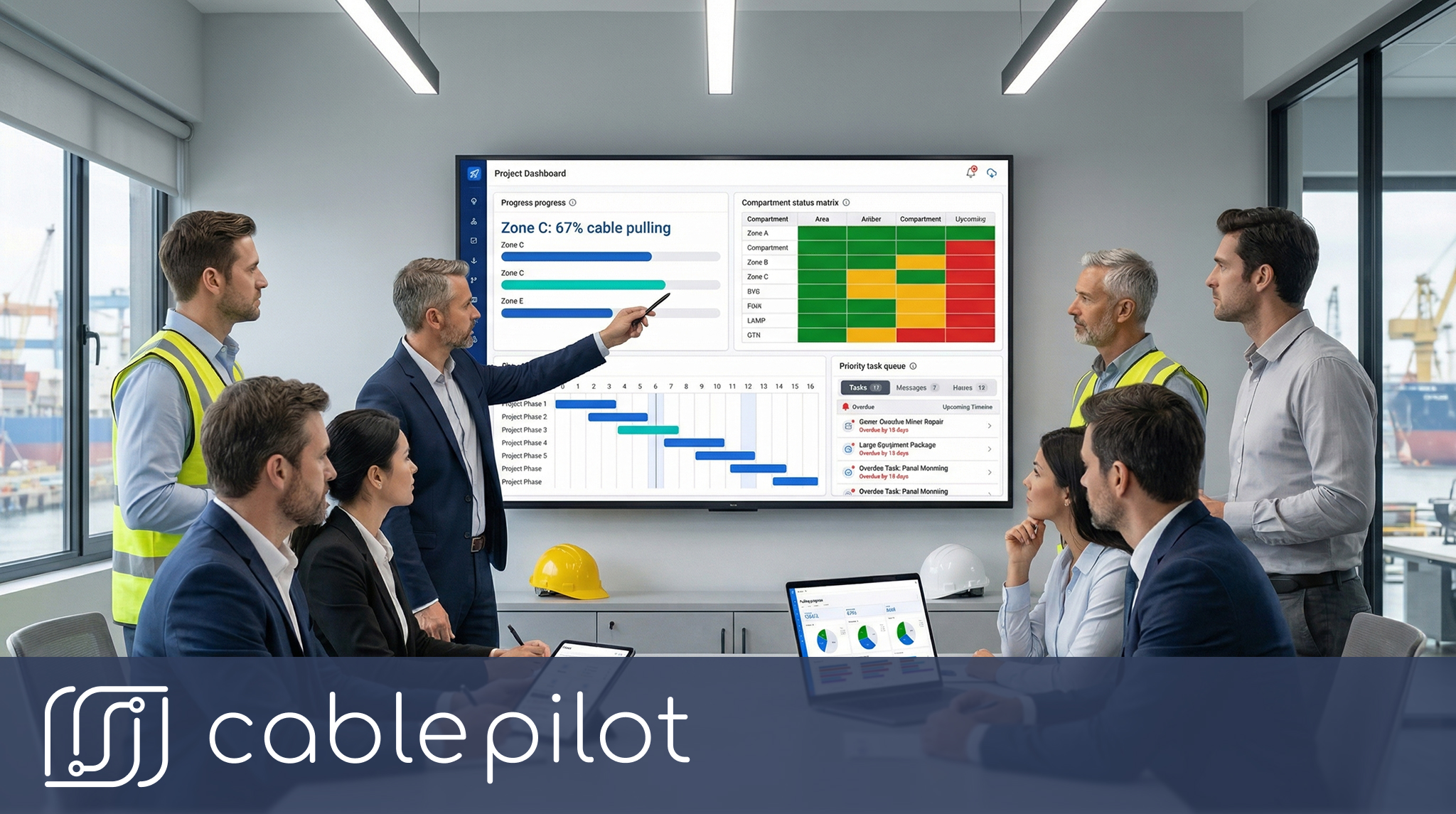
Now, the 07:30 daily meeting is unrecognizable. The team gathers, and the Project Manager projects the Cable Pilot dashboard on the screen. The meeting is no longer about reporting; it’s about analysis.
- Old Question: “Supervisor A, what’s your progress in Zone C?” (10-minute subjective answer)
- New Question: “The dashboard shows Zone C’s pulling progress stalled at 45% yesterday at 14:00. The data shows the next 20 cables are all blocked by ‘Transit T-501’, which is still marked ‘Pending Inspection’. Let’s solve this.”
The conversation is now focused, evidence-based, and lasts 10 minutes. The team’s collective brainpower is spent solving the identified bottleneck, not trying to find it. This is the difference between wasting time and investing it.
From Reactive Firefighting to Proactive Risk Mitigation
This real-time ‘electrical installation tracking’ system fundamentally changes the ‘risk mitigation’ equation. Problems are no longer landmines waiting to be stepped on; they are blips on a radar screen that can be avoided.
Consider this common, costly scenario: A team is sent to pull 50 cables into a compartment. They arrive to find that a different trade has unexpectedly re-routed a large ventilation duct, blocking their cable transits. In the traditional workflow, this is a disaster. The team’s entire shift is wasted. They return, report the problem, and a cascade of delays begins.
In the Cable Pilot workflow, this risk is mitigated before it’s even a risk. The supervisor, reviewing the live dashboard, can see the status of all prerequisite work. They see the transit’s inspection status is ‘Not Approved’. They see the compartment’s general status is ‘Blocked by HVAC’. They simply do not assign the pulling tasks for that area. The installation team is instead re-allocated to a different, fully prepared workfront.
Zero time is wasted. Zero ‘labor effort’ is misspent. This is proactive, data-driven ‘shipbuilding project management’. The system provides foresight, allowing managers to manage the project, not just react to it.
The Tangible ROI: Quantifying Time Savings and Quality
For a Project Manager, the ultimate measures are time and money. The transformation of the daily meeting provides a massive, measurable return on investment in both.
1. A Tsunami of ‘Time Savings’
Let’s do the math. A typical project might have 20 managers, supervisors, and lead engineers in the daily meeting.
- Old Way: 1 hour/day x 20 people = 20 man-hoursper day.
- New Way: 15 minutes/day x 20 people = 5 man-hoursper day.
That is a saving of 15 high-value man-hours every single day. Over a 200-day project, that is 3,000 man-hours saved. That is the equivalent of adding a new full-time expert to your team for over a year, for free. This calculation doesn’t even include the ‘time savings’ for the installers, who no longer have to fill out paper reports or travel back to the office to update spreadsheets.
2. Slashing the ‘Cost of Rework’
Real-time data is a powerful quality control tool. With Cable Pilot, quality is verified at the source, at the moment of installation.
- If an installer tries to scan a cable that isn’t part of their work package, the app alerts them.
- If a cable is marked ‘Connected’ before it has been marked ‘Tested’, a quality flag is raised on the dashboard.
This “digital-first” process makes it incredibly difficult to make a mistake, and incredibly easy to catch one if it does. Errors that previously would have festered for weeks, buried under other installations, are now caught within minutes. This immediate feedback loop virtually eliminates the downstream ‘cost of rework’, saving hundreds of thousands of dollars in hidden project-killing expenses.
Conclusion: From a Time Drain to a Strategic Weapon
Continuing to run your shipbuilding projects on a foundation of verbal updates and fragmented spreadsheets is a choice—a choice to accept inefficiency, budget overruns, and a high ‘cost of rework’ as the status quo. The daily meeting, in its traditional form, is the most visible symbol of this outdated methodology. It’s a sinkhole that drains productivity, morale, and profit.
The shift to a digital tool like Cable Pilot is not about adding another layer of technology; it’s about fundamentally changing how work is tracked, communicated, and managed. By building a foundation on a clean, objective, single source of truth, you provide your team with real-time data.
This transforms the daily meeting from a mandatory chore into your most powerful strategic weapon. It becomes a focused, 10-minute, evidence-based session where your best minds solve real problems, ensuring your projects are delivered on time, within budget, and with a level of predictability your competitors can only dream of.
Ready to turn your daily meetings from a time drain into a strategic advantage? Explore how Cable Pilot can provide the data-driven certainty your shipbuilding projects deserve.
Pingback: The Scaling Trap In Shipbuilding Projects: A Technical Insight