
In modern shipbuilding, electrical installation represents one of the most complex and time-sensitive phases of vessel construction. Yet despite advances in CAD design and project management software, the reality on many construction sites remains stubbornly analog: paper cable lists, email-based status updates, and multi-hour information lags between field work and management decisions. This disconnect creates an “information fog” where supervisors make critical resource allocation decisions based on data that may be hours or even days old. The result? Costly cascading delays, crew downtime, and missed schedule commitments that ripple across multiple trades.
Cable Pilot’s mobile-first architecture fundamentally reimagines this workflow. By placing real-time data capture directly in installers’ hands through smartphone apps and QR-code scanning, the platform compresses the traditional hours-long reporting cycle into seconds. This transformation eliminates the information fog that plagues conventional workflows, enabling project managers and site supervisors to shift from reactive firefighting to proactive exception management.
The Hidden Cost of Information Lag in Electrical Installation
Traditional electrical installation workflows in shipbuilding follow a familiar pattern. Electricians receive printed cable lists at morning briefings, work through their assignments throughout the day, and submit handwritten completion reports at shift end. These paper reports are then manually transcribed into spreadsheets by site administrators, typically the following morning. Only then does project management gain visibility into previous day’s progress.
This multi-hour delay creates several critical problems. First, blockers discovered in the field—a missing cable terminator, an inaccessible compartment, or a design discrepancy—may not reach the responsible engineer until 12-24 hours after the installer first encounters them. During this lag, the affected crew either waits idle or shifts to lower-priority work, while the blocker remains unresolved.
Second, cascade effects multiply across interconnected systems. When one electrical system’s completion is delayed, dependent trades—insulation teams, painters, system testers—face schedule disruption. But because management learns of the delay only after daily reports are processed, the cascade is already underway before preventive action can be taken.
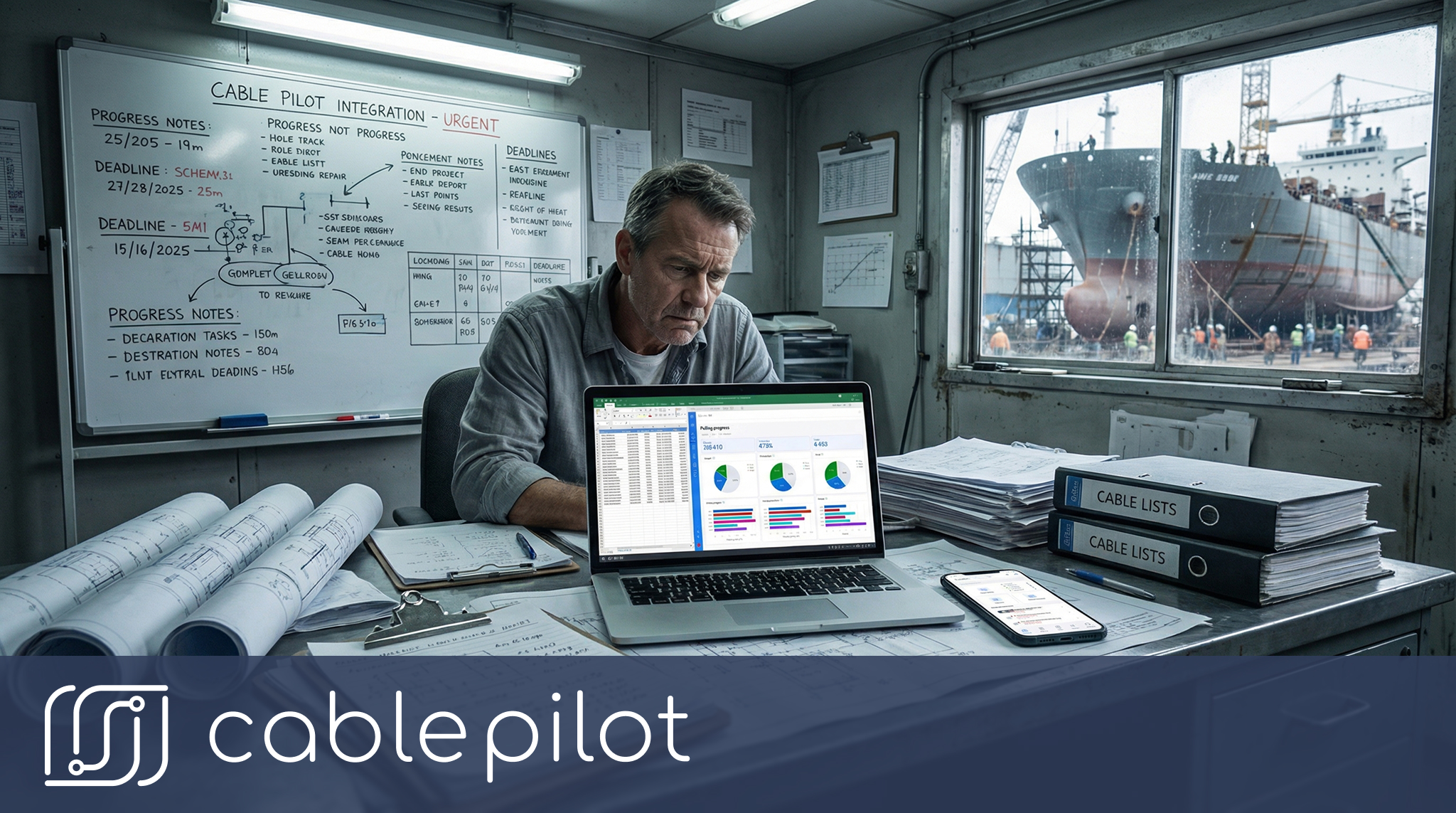
Third, data quality suffers. Handwritten reports are subject to transcription errors, illegible handwriting, and incomplete documentation. When an installer marks a cable “complete” on paper, there’s no automated verification that prerequisite steps were actually finished or that photo documentation was captured. These data quality gaps create false confidence in project dashboards, leading to planning decisions based on inaccurate completion percentages.
The cumulative impact of these lags is measured not just in wasted labor hours but in schedule unpredictability. Project managers lack real-time visibility into where crews are actually working, which compartments are truly complete, and where emerging bottlenecks threaten critical path activities. This information deficit forces a reactive management posture: problems are addressed only after they’ve already caused delays.
Cable Pilot’s Mobile-First Architecture: Compressing Hours to Seconds
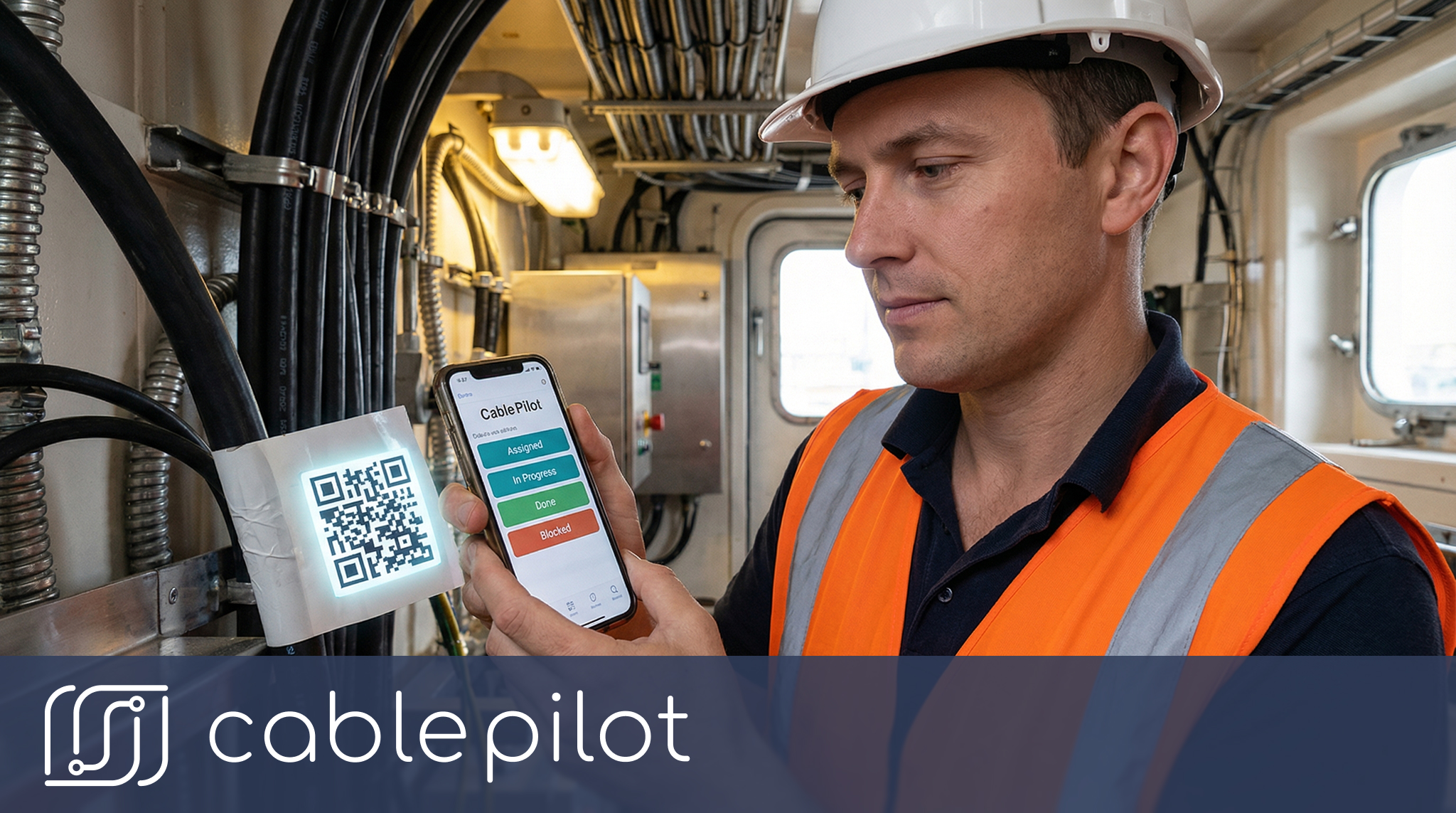
Cable Pilot eliminates information lag through a mobile-first architecture that places data capture directly at the point of work. Field installers use standard smartphones—no specialized tablets or ruggedized devices required—to interact with the platform through an intuitive app interface. The workflow is deliberately streamlined for speed: scanning a cable’s QR code and updating its status takes under 10 seconds, comparable to making a checkmark on a paper list.
The technical foundation rests on three integrated components. First, unique QR codes are generated for each cable, equipment, transit and compartment during the data import and work preparation phase, typically printed on adhesive labels. These codes link physical assets to their digital records in Cable Pilot’s central database. Second, the smartphone app provides offline-capable scanning and status updates, ensuring field crews can work without interruption even in areas with poor connectivity. Third, a cloud-based synchronization engine pushes field updates to the central database within seconds once connectivity is restored, triggering instant dashboard refreshes and notifications.
This architecture creates what Cable Pilot calls the “real-time feedback loop.” When an installer scans a cable and taps “Pulled,” that status change is immediately visible to supervisors monitoring live dashboards. When the same cable is later scanned and marked “Connected,” the system automatically verifies that prerequisite steps were completed and prompts the installer to capture photo documentation if required. This enforced workflow ensures data quality while maintaining field efficiency.
Cascade Prevention in Action: From Problem Discovery to Solution in Minutes
The true power of real-time visibility becomes apparent when field crews encounter blockers. Consider a common scenario: an electrician scans a cable scheduled for pulling, but discovers the specified terminator is missing from the ship stores. In a traditional workflow, this problem would be noted on a paper list, reported at shift end, transcribed the following morning, and routed to procurement—a 12-24 hour cycle minimum.
With Cable Pilot’s mobile app, the installer taps “Blocker” immediately upon discovery, selects “Missing Material” from a predefined list, captures a photo of the affected location, and adds a brief text note. This report is instantly synced to the central database and triggers a notification to the responsible procurement engineer. The engineer reviews the issue on their desktop dashboard—complete with photo, location data, and cable specifications—and can issue a solution (expedite delivery, authorize a substitute, or reschedule dependent work) within minutes.
This compression from hours to minutes has cascading benefits. The affected crew can shift to alternative work immediately, rather than continuing down a path that will ultimately dead-end. The procurement team addresses the material shortage before multiple crews are impacted. And project management gains visibility into emerging bottlenecks while there’s still time to mobilize resources or adjust schedules.
Real-world implementation data demonstrates the impact. Pre-implementation, installers spent an average of 1.41 hours per person per day waiting for blocker resolution or clarification on unclear instructions—time during which they were on site but unable to progress productive work. Post-implementation, this idle time dropped to 0.32 hours per person per day, a 77% reduction. The difference: real-time blocker reporting enabled supervisors to intervene and redirect crews before extended downtime accumulated.
The financial implications are substantial. For a 20-person electrical installation crew, reducing idle time by 1.09 hours per person per day translates to 21.8 productive hours recovered daily, or approximately €655 in direct labor cost savings per day (assuming €30/hour fully burdened labor cost). Over a typical 90-day installation phase, this compounds to nearly €59,000 in recovered productivity—from a single improvement in information velocity.
Real-Time Dashboards: Turning Data Into Proactive Management
Real-time field updates are valuable only if they’re accompanied by real-time visibility for decision-makers. Cable Pilot’s dashboard architecture is designed for rapid pattern recognition and exception management, allowing supervisors to monitor hundreds of cables and compartments without information overload.
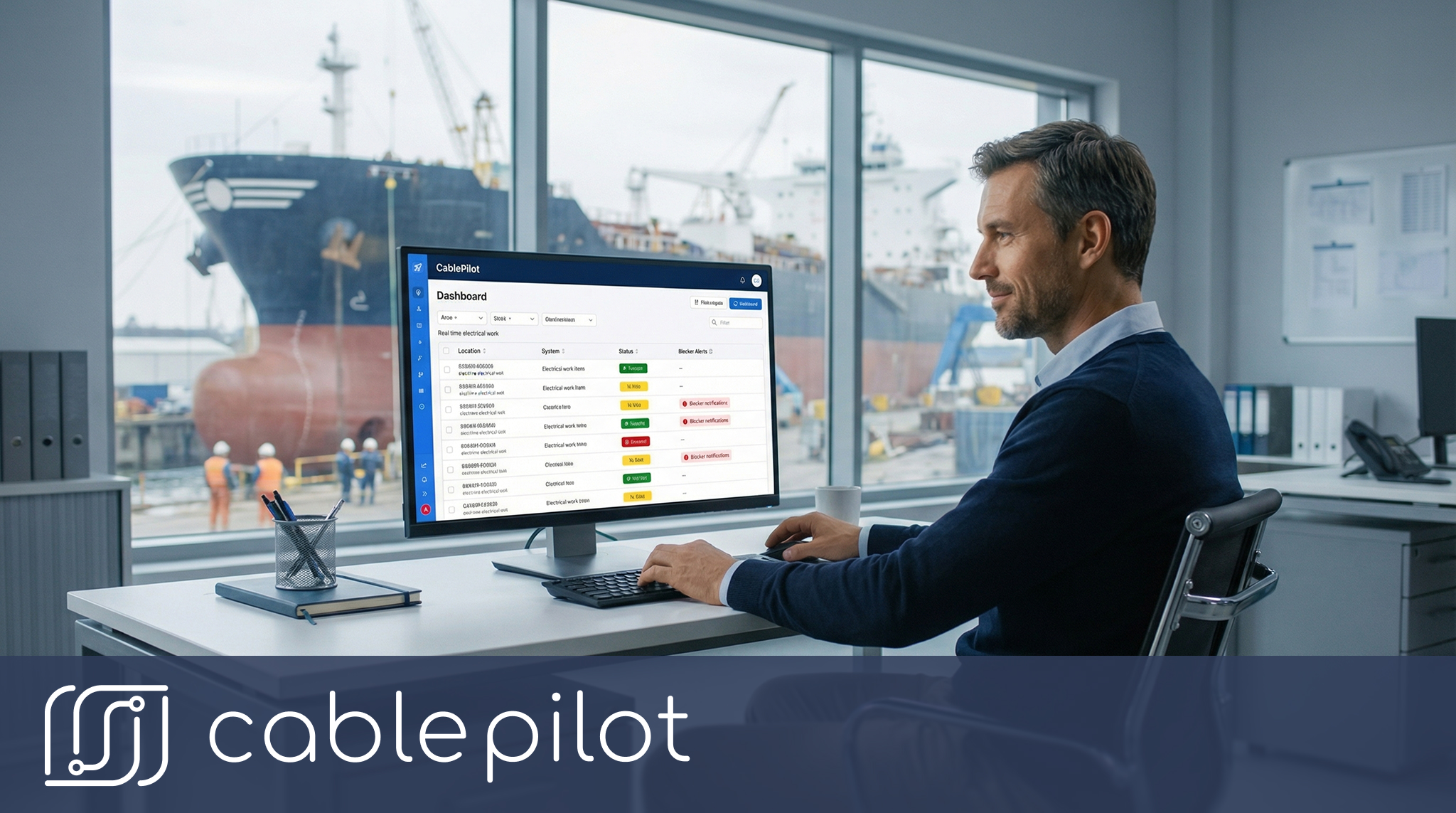
The primary dashboard view presents electrical installation progress as a filterable, real-time grid. Supervisors can slice data by zone or location (e.g., “Engine Room”), system (e.g., “Lighting System 3”), contractor (for multi-vendor projects), or status (e.g., “show only cables with blockers”). Each cable row displays current status, responsible persons, and time since last update, with color coding to highlight exceptions.
This filtering capability transforms raw data into actionable intelligence. A site manager preparing for a morning coordination meeting can instantly generate a “blocker report” showing all electrical work items currently stopped, their locations, and responsible parties. This report—generated in seconds—replaces the manual compilation that previously required hours of phone calls and email exchanges. The result is faster coordination meetings focused on problem-solving rather than information gathering.
The dashboard’s drill-down capability provides additional context without overwhelming the user. Clicking any cable row reveals its full history: when each status change occurred, who performed the work, photos captured at each step, and any blockers reported. This audit trail serves both quality control and dispute resolution purposes. When a contractor claims a compartment was completed on a specific date, the time-stamped photo evidence and completion records provide objective verification.
For project managers overseeing multiple vessels or construction phases simultaneously, Cable Pilot offers portfolio-level dashboards aggregating data across projects. These executive views highlight schedule variance trends, contractor performance comparisons, and system-level completion rates. The ability to identify patterns—such as one contractor consistently reporting more blockers than others, or certain cable types experiencing repeated installation delays—enables proactive interventions before small issues become project-level problems.
Operational Shift: From Reactive Firefighting to Proactive Exception Management
The combination of mobile data capture and real-time dashboards creates a fundamental shift in how site supervisors and project managers allocate their time and attention. In paper-based workflows, management’s primary activity is information gathering: walking the site to visually inspect progress, calling crews for status updates, and compiling fragmented data into coherent progress reports. This reactive posture leaves little time for proactive problem-solving.
Cable Pilot inverts this dynamic. Because accurate, real-time progress data flows automatically from field to dashboard, supervisors no longer need to spend hours gathering information. Instead, they can focus on exception management—reviewing blocker reports, coordinating solutions with engineering teams, and optimizing crew assignments based on emerging bottlenecks. This shift from data compilation to decision-making dramatically improves management leverage.
A concrete example illustrates the impact. In a traditional workflow, a site supervisor might discover at 4 PM that a crew has been stuck on a single compartment all day due to unclear cable routing instructions. By the time this is identified and escalated to the responsible design engineer, it’s end of shift—resolution must wait until the following day, and the crew loses an entire day’s productivity.
With Cable Pilot, the crew reports the ambiguity as a blocker at 9 AM when first encountered. The supervisor sees the issue on their dashboard within minutes, reviews the reported photos, and immediately coordinates with the design engineer. The engineer clarifies the routing by 10 AM, and the crew proceeds with the corrected understanding—losing one hour instead of one day.
This proactive management extends to resource allocation. When real-time dashboards show one zone progressing faster than planned while another lags, supervisors can dynamically reallocate crews to maintain overall schedule balance. In paper-based systems, such reallocation decisions are made days late, after weekly progress reviews reveal the imbalance.
The quality control dimension is equally significant. Cable Pilot’s automated dependency checks and photo documentation create “quality gates” that prevent incomplete work from being marked finished. In traditional workflows, an installer might mark a cable “connected” when physical connection is complete but termination labeling and insulation checks remain unfinished. This creates false completion signals that cascade through project planning. Cable Pilot’s enforced workflow ensures each status transition meets predefined completion criteria, eliminating false signals and improving handover quality.
Measurable Outcomes: Quantifying the Impact of Real-Time Workflows
The business case for mobile-first, real-time electrical installation workflows rests on measurable outcomes across multiple dimensions: labor productivity, schedule predictability, data quality, and contractor accountability.
Labor productivity gains are the most immediately quantifiable. As noted earlier, reduced crew idle time directly translates to recovered labor hours. But productivity improvements extend beyond idle time reduction. Cable Pilot’s streamlined mobile interface eliminates the administrative burden of paper reports, saving each installer 10-15 minutes per shift previously spent on end-of-day paperwork. Across a 20-person crew over a 90-day installation, this compounds to approximately 450 hours of recovered productive time.
Schedule predictability improves through earlier blocker identification and faster resolution cycles. One shipyard tracked “days lost to unresolved blockers” before and after Cable Pilot deployment. Pre-implementation, the average time from blocker discovery to resolution was 2.3 days, during which affected work items remained stalled. Post-implementation, this dropped to 0.4 days—a reduction that prevented an estimated 15 days of cumulative delay across the project’s critical path. For shipyards facing contractual delivery penalties, this schedule compression has direct financial value often exceeding the software investment by an order of magnitude.
Data quality improvements manifest in reduced rework and fewer handover disputes. When cable installation records include time-stamped photos, used documents revisions, and installer identification, there’s objective evidence of work completion. This eliminates the “he said, she said” disputes that arise when paper records are ambiguous or incomplete. Handover meetings—previously multi-day affairs requiring extensive visual re-inspection—are compressed to single-day reviews because Cable Pilot’s documentation provided sufficient evidence of completion.
Contractor accountability gains occur naturally when all parties work from the same real-time data source. In multi-contractor electrical installations, disputes often arise over which party caused delays or failed to meet quality standards. Cable Pilot’s audit trail provides objective evidence: which contractor’s crew performed each installation step, when work occurred, and what blockers were reported. This transparency incentivizes quality performance and enables fair, data-driven performance evaluations.
Strategic Advantage: Faster Cycles, Higher Quality, Better Predictability
The cumulative impact of mobile-first, real-time workflows extends beyond individual project efficiency to strategic competitive advantage. Shipyards that consistently deliver electrical installations faster, with fewer quality defects, and on more predictable schedules win repeat business and command premium pricing.
Faster electrical installation cycles compress overall vessel construction timelines, enabling earlier delivery and reduced overhead costs. In competitive bidding scenarios, shipyards with proven track records of on-time electrical completion can offer more aggressive schedules, winning contracts that might otherwise go to competitors. The 10-15% cycle time reduction with Cable Pilot deployment translates directly to earlier revenue recognition and improved cash flow.
Higher quality handovers reduce post-installation rework and warranty claims. When electrical systems are completed with comprehensive photo documentation and enforced quality gates, system commissioning proceeds more smoothly and defect rates decline. This improves customer satisfaction and protects profit margins from unanticipated rework costs.
Better schedule predictability allows shipyards to optimize resource allocation across multiple concurrent projects. When electrical installation progress is visible in real-time, management can confidently commit crews to overlapping projects, knowing that schedule variances will be identified and addressed before they cascade into conflicts. This improved resource utilization increases overall yard throughput without proportional increases in labor costs.
Implementation Considerations: Making the Transition from Paper to Real-Time
Transitioning from paper-based to mobile-first workflows requires more than software deployment—it demands change management, training, and process redesign. Successful implementations follow a structured approach that addresses technical, organizational, and cultural dimensions.
The technical foundation begins with cable list preparation. Cable Pilot generates unique QR codes for each cable and compartment during import of design data, typically from electrical CAD systems. These codes are printed on adhesive labels and applied to physical cables and compartment signage before installation begins. This upfront preparation—usually requiring 2-3 days for a mid-size vessel—is critical for field workflow efficiency.
Smartphone provisioning is straightforward but requires planning. Most shipyards adopt a BYOD (Bring Your Own Device) model, with installers using their personal smartphones to access Cable Pilot’s app. This eliminates hardware procurement costs but requires clear device compatibility guidelines and data security policies. For yards preferring shipyard-provided devices, Cable Pilot runs on standard Android or iOS smartphones—no specialized hardware needed.
Training focuses on field workflow adoption. Cable Pilot’s app is deliberately simple—scan cable, tap status, add photo if required—but installers accustomed to paper lists need hands-on practice to build confidence. Successful implementations include half-day training sessions where crews practice scanning and status updates on mock-up cables before working on live vessels. This practice builds muscle memory and addresses initial reluctance.
Organizational process redesign centers on management workflows. Supervisors and project managers must shift from daily manual progress compilation to real-time dashboard monitoring. This requires defining new routines: morning blocker review sessions, real-time crew reallocation protocols, and automated reporting schedules. Change management efforts that clearly communicate the “why”—faster issue resolution, less firefighting, more proactive management—accelerate adoption.
Cultural resistance often emerges from two sources: installer concern that real-time tracking enables “micromanagement,” and supervisor fear that automation threatens their role. Addressing these concerns requires transparent communication. Installers need assurance that the goal is faster blocker resolution, not punitive monitoring. Supervisors need to understand that automation frees them from data compilation drudgery to focus on higher-value problem-solving. Successful implementations involve field crews and supervisors in pilot phases, gathering their feedback to refine workflows before full-scale rollout.
The Path Forward: Real-Time as the New Standard
The transition from paper to real-time in electrical installation workflows is not merely a technological upgrade—it represents a fundamental reimagining of how complex construction projects manage information flow. As shipbuilding projects grow more complex, schedules more compressed, and quality standards more stringent, the information fog created by paper-based systems becomes increasingly untenable.
Cable Pilot’s mobile-first architecture demonstrates that real-time visibility is achievable without exotic technology or prohibitive costs. Standard smartphones, cloud synchronization, and intuitive app interfaces are sufficient to compress hours-long reporting cycles into seconds. The resulting improvements—reduced crew idle time, faster blocker resolution, proactive exception management—deliver measurable ROI that justifies implementation investment within a single project.
Looking forward, real-time workflows will become the standard, not the exception. As younger, digitally native workers enter the shipbuilding trades, expectations for mobile-enabled, real-time information access will only intensify. Shipyards that embrace this transition now will build competitive advantages that compound over time: reputations for on-time delivery, efficient resource utilization, and high-quality handovers.
The journey from paper to real-time begins with a simple recognition: in modern shipbuilding, information velocity is as critical as labor productivity. When field data reaches decision-makers in seconds rather than hours, problems get solved before they become crises, resources get allocated based on current reality rather than stale reports, and projects stay on schedule. Cable Pilot provides the platform to make this vision operational reality.
Ready to eliminate installation delays and transform your electrical installation workflow? Request a Cable Pilot demonstration to see real-time mobile workflows in action, or contact our team to discuss how mobile-first architecture can accelerate your next shipbuilding project.