
The modern shipyard operates under relentless pressure. Fixed-price contracts, compressed schedules, and razor-thin margins mean that every hour wasted on administrative overhead directly erodes profitability. Yet across the electrical installation workflow—one of the most complex and labor-intensive phases of vessel construction—project managers and installation teams continue to wrestle with a stubborn productivity drain: manual reporting.
When electricians spend their afternoons transcribing handwritten notes, when supervisors compile progress updates by phone calls and clipboard inspections, and when Project Managers wait until end-of-day to discover critical installation errors, the hidden costs compound rapidly. These delays don’t just slow reporting cycles—they inflate labor expenses, postpone corrective actions, and ultimately threaten project delivery timelines.
Real-time reporting represents a fundamental shift in how shipyards manage electrical installation data. By enabling instant capture and automated updates through mobile-based systems, modern digital solutions eliminate the lag between field work and management visibility. For organizations implementing Cable Pilot’s QR-code-driven workflow, the transformation is quantifiable: reporting cycles that traditionally consumed hours of skilled labor now complete in seconds. This article examines the financial and productivity mechanics behind that shift, demonstrating why real-time data collection has evolved from a convenience feature into a strategic financial imperative.
The Hidden Cost Structure of Manual Reporting Systems
Before understanding the impact of real-time systems, we must quantify what traditional workflows actually cost. In conventional electrical installation projects, reporting follows a predictable but inefficient pattern. Electricians complete cable pulls, terminations, and testing during core work hours. At shift end, they return to site offices or trailers to document progress—transcribing cable identifiers from notebooks, marking completion percentages on printed drawings, and filling out paper forms that supervisors later consolidate.
This manual reconciliation process consumes substantial time. A typical electrician might spend 30–45 minutes at day’s end on administrative tasks that produce no direct installation value. Multiply that across a team of 20 installers over a six-month project, and the lost labor hours become staggering. At an average fully loaded hourly rate of 75 USD for skilled electrical labor, those daily reporting sessions translate to approximately 450–675 USD in pure administrative overhead per day—or 67,500–101,250 USD over a 150-working-day installation phase.

But the financial impact extends beyond direct labor waste. Manual systems introduce lag in decision-making. When a Project Manager reviews progress reports compiled the previous evening, any installation errors, missing materials, or sequence deviations discovered in that report are already 12–24 hours old. Corrective actions—reordering components, reallocating crews, or revising work sequences—begin only after this delay. In high-density installation environments where multiple contractors coordinate in shared spaces, such delays cascade. An electrician discovers a mechanical obstruction blocking cable routing at 10 AM, but the mechanical contractor doesn’t receive notification until the next day’s coordination meeting. The electrical crew stands idle or performs lower-priority tasks while waiting, inflating labor costs and pushing critical path activities.
The administrative burden also degrades data quality. Handwritten notes suffer from illegibility, transcription errors, and incomplete information. When supervisors consolidate reports from multiple sources—paper forms, Excel spreadsheets, verbal updates—version control becomes problematic. The engineering team works from cable lists that don’t reflect yesterday’s field changes. The procurement department orders materials based on outdated completion percentages. These information gaps trigger expensive rework cycles, emergency material orders, and schedule compression that often requires overtime premiums.
Manual reporting systems impose another subtle cost: they demotivate skilled tradespeople. Electricians enter the profession to install complex systems, solve technical problems, and take pride in completed work. When forced to spend afternoons on paperwork they perceive as bureaucratic overhead, job satisfaction erodes. This cultural friction contributes to turnover in tight labor markets, imposing recruitment and training costs that further burden project finances.
How Cable Pilot Transforms the Reporting Workflow
Cable Pilot’s approach to real-time reporting eliminates these inefficiencies through mobile-based data capture integrated directly into the installation workflow. The system’s architecture centers on QR code labels applied to every cable and equipment during material preparation. These labels encode the cable’s unique identifier, linking it to the master cable list and engineering documentation stored in Cable Pilot’s cloud platform.
When an electrician completes a cable pull, they use their smartphone to scan the cable’s QR code. The Cable Pilot mobile application presents a simple interface: mark the cable as “Pulled,” “Terminated,” “Tested,” or “Complete,” add optional photos or notes, and submit. The entire interaction takes 5–10 seconds per cable. No forms to fill out, no handwritten logs, no end-of-day transcription sessions. The status update transmits instantly to the cloud database, where it updates the centralized cable list, progress dashboards, and work order tracking in real time.
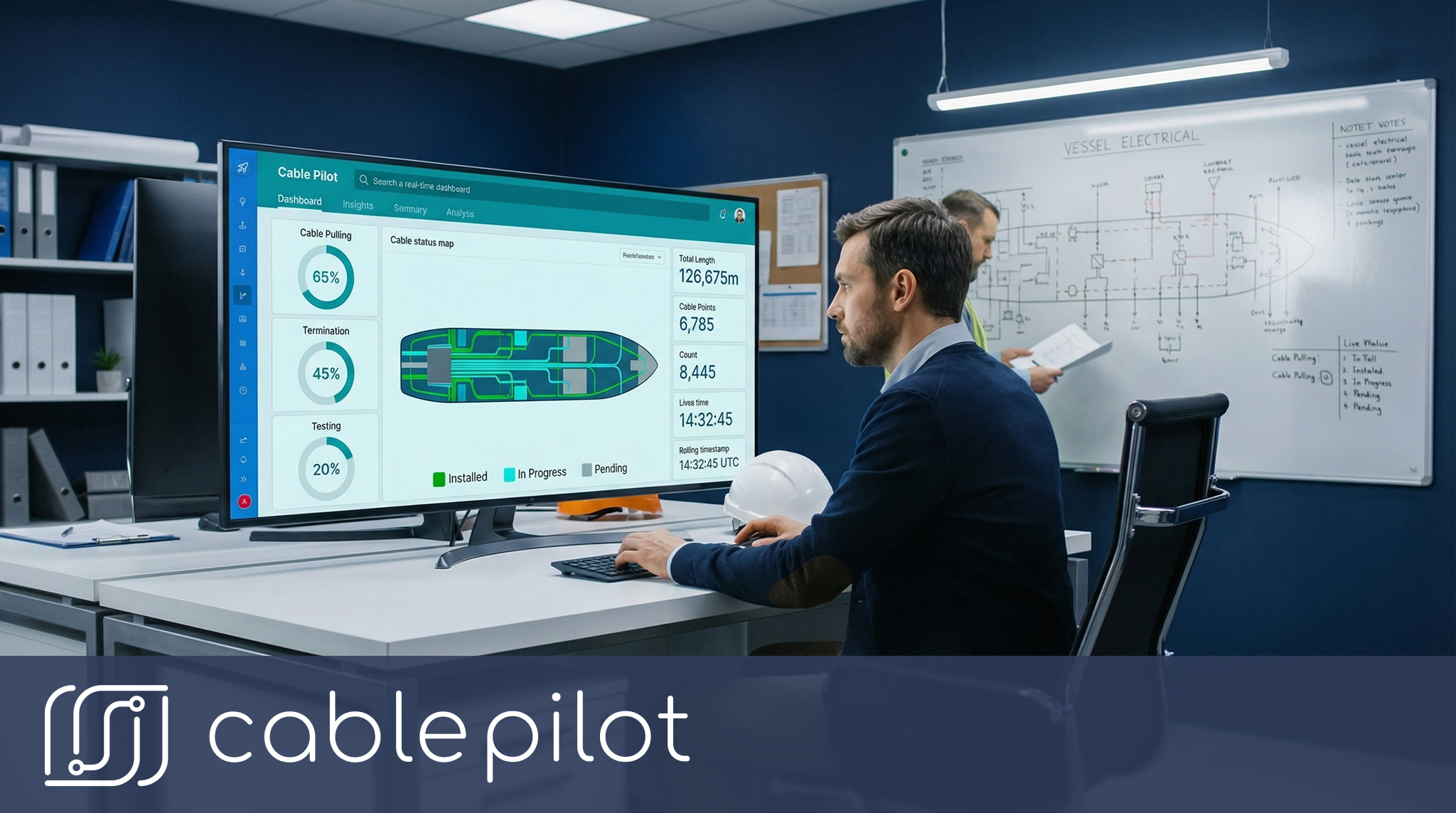
This instant synchronization transforms management visibility. Project Managers monitoring the Cable Pilot dashboard see cable status updates appear live as installation teams work. Instead of waiting for evening reports, they identify completion trends, spot bottlenecks, and detect anomalies throughout the workday. If an electrician marks a cable as “Pulled” but another cable in the same routing sequence remains at “Not Started” status hours later, the system flags the discrepancy. The Project Manager investigates immediately—discovering, for example, that the second cable is missing from delivered material—and initiates procurement action before the crew reaches that work package.
The mobile workflow also improves field-level communication. When installers encounter issues—damaged cables, incorrect routing specifications, or interference with other trades’ work—they document the problem through Cable Pilot’s issue-reporting feature while standing at the installation point. They photograph the condition, tag the relevant cable identifier, and submit a timestamped report that routes automatically to the responsible party: engineering, procurement, or contractor coordination. This contextual documentation replaces the traditional game of telephone, where verbal descriptions conveyed through multiple intermediaries lose critical details.
For supervisors, Cable Pilot automates the consolidation work that previously consumed their afternoons. Instead of collecting paper forms, cross-checking spreadsheets, and compiling summary reports, they access pre-generated dashboards displaying real-time completion percentages, work package status, and resource allocation. The system calculates labor productivity metrics automatically—cables installed per crew per day, average installation time per cable type—providing objective performance data without manual computation. Supervisors shift their focus from administrative compilation to value-added activities: coaching underperforming crews, optimizing work sequences, and proactively resolving coordination conflicts.

Quantifying the Time Savings: A Typical Project Scenario
To understand the financial impact concretely, consider a representative mid-sized vessel project: a 120-meter offshore support vessel with approximately 8,000 cables in its electrical installation scope. The project employs a core electrical installation team of 15 electricians working over a 140-day installation period, supported by three supervisors and one Project Manager.
Traditional manual reporting workflow:
- Each electrician spends 40 minutes per day on reporting tasks (completing forms, updating notebooks, coordinating with supervisors): 15 electricians × 40 minutes × 140 days = 1,400 hours of installer administrative time.
- Supervisors spend 2 hours per day consolidating reports, updating master spreadsheets, and preparing management updates: 3 supervisors × 2 hours × 140 days = 840 hours of supervisor administrative time.
- The Project Manager spends 1.5 hours daily reviewing reports, reconciling discrepancies, and manually updating executive dashboards: 1 PM × 1.5 hours × 140 days = 210 hours of Project Manager administrative time.
- Total administrative overhead: 2,450 hours at a blended hourly rate of 70 USD = 171,500 USD in labor costs producing no direct installation value.
Cable Pilot real-time reporting workflow:
- Each electrician spends approximately 8 seconds per cable scanning QR codes and updating status. For 8,000 cables with an average of 1.5 status updates per cable (pulled, terminated, tested): 8,000 × 1.5 × 8 seconds = 26.7 hours total across the entire project duration, distributed across 15 installers.
- Supervisors spend 30 minutes per day reviewing automated dashboards and investigating flagged exceptions: 3 supervisors × 0.5 hours × 140 days = 210 hours of supervisor review time.
- The Project Manager spends 45 minutes daily reviewing real-time dashboards and directing corrective actions: 1 PM × 0.75 hours × 140 days = 105 hours of Project Manager oversight.
- Total time investment: 341.7 hours at a blended hourly rate of 70 USD = 23,919 USD in labor costs for reporting infrastructure.
Net savings: 2,108.3 hours or 147,581 USD in direct labor costs—an 86% reduction in reporting-related administrative overhead. These recovered hours return to productive installation work, accelerating project completion and improving resource utilization.
Beyond Time Savings: Cascading Productivity Gains
The financial benefits of real-time reporting extend beyond reclaimed administrative hours. Early problem detection—enabled by instant visibility into installation status—prevents expensive downstream impacts that traditional systems fail to catch until costly consequences have accumulated.
Accelerated issue resolution:
When installation teams document problems in real time with contextual photos and precise cable identifiers, resolution cycles compress dramatically. In manual systems, a damaged cable discovered Monday afternoon might not reach the procurement department’s attention until Wednesday’s coordination meeting, with replacement material arriving the following week. By that point, the installation crew has moved to other areas, requiring schedule disruption and crew remobilization when the replacement cable arrives. Cable Pilot’s instant issue reporting routes problems to responsible parties within minutes. Procurement initiates orders the same day, engineering clarifies specifications immediately, and contractors coordinate interference resolutions without waiting for scheduled meetings. This responsiveness typically reduces issue resolution cycles from 5–7 days to 1–2 days, minimizing idle time and schedule disruptions that inflate labor costs.
Reduced rework cycles:
Real-time data quality validation prevents the accumulation of errors that require expensive corrections. When electricians scan QR codes, Cable Pilot cross-references the scanned identifier against the cable list’s engineering specifications. If an installer attempts to mark a 4-core cable as “Terminated” when the system expects a 7-core cable in that location, the application flags the discrepancy immediately. The electrician verifies and corrects the error before moving to the next task—avoiding the scenario where incorrect installations remain undiscovered until system testing weeks later, at which point full replacement becomes necessary. Industry data suggests that real-time validation reduces electrical installation rework rates by 40–60%, translating to substantial direct cost savings. In our 8,000-cable example, if traditional rework rates average 3% of installed cables and real-time systems cut that to 1.5%, the project avoids reworking 120 cables. At an average 2.5 hours per cable for removal, replacement, and re-termination, this prevention saves 300 labor hours or approximately 22,500 USD.
Improved resource allocation:
Minute-by-minute visibility into work package completion rates enables dynamic crew optimization. Project Managers monitoring Cable Pilot’s real-time dashboards identify productivity variances as they develop—recognizing, for example, that Crew A is completing cable pulls 20% faster than planned while Crew B lags behind schedule. Instead of discovering these patterns in weekly review meetings, managers reallocate resources the same day: reassigning workers, adjusting work sequences, or investigating whether Crew B faces obstacles requiring support. This adaptive management prevents the schedule erosion and labor inefficiency that occurs when suboptimal crew assignments persist for weeks before correction. Over a project’s duration, this agility typically improves overall labor productivity by 8–12%, adding thousands of recovered hours to the savings calculation.
Material management efficiency:
Real-time installation progress data synchronizes material flow with actual consumption rates, reducing both stockpile carrying costs and emergency procurement premiums. When the Cable Pilot system shows that cable installation in a specific zone is progressing faster than planned, procurement adjusts delivery schedules to maintain appropriate inventory levels without tying up working capital in excess material stockpiles. Conversely, when progress lags, material orders slow accordingly, avoiding storage congestion and potential damage to cables awaiting installation. This just-in-time coordination typically reduces material carrying costs by 15–20% and nearly eliminates the 25–40% cost premiums associated with emergency expedited shipments that become necessary when manual tracking fails to detect material shortages until crews arrive ready to work.
The Field Experience: How Mobile-Based Updates Transform Installer Morale
Financial models and productivity metrics capture quantifiable benefits, but the human dimension of real-time reporting deserves equal attention. Cable Pilot’s mobile-first design fundamentally changes how electricians experience the documentation burden, with cultural impacts that reinforce the business case.
Traditional paper-based reporting creates an adversarial relationship between installation work and administrative compliance. Electricians view end-of-day form-filling as mandatory drudgery imposed by management—time stolen from their primary craft identity. This resentment manifests in incomplete documentation, minimal detail, and rushed transcription that degrades data quality. The cultural message is clear: reporting is overhead, not value.
Cable Pilot’s QR-code workflow repositions documentation as an integrated element of skilled installation work. Scanning a cable after termination feels less like paperwork and more like confirmation of completed quality work—a digital signature on craftsmanship. The interaction is brief enough (5–10 seconds) that it doesn’t interrupt work rhythm or require context switching from physical installation to administrative mindset. Electricians can complete updates while standing at the installation point, smartphone in hand, without returning to offices or trailers. This seamlessness reduces friction and the psychological burden that makes traditional reporting feel onerous.
The instant visibility also creates positive feedback loops for motivation. When installers see their completed cables immediately reflected in project dashboards—visible to supervisors, Project Managers, and even client representatives—the work gains recognition that paper forms buried in filing cabinets never provided. High-performing crews take pride in watching their completion percentages climb in real time, fostering healthy competition and professional satisfaction. This recognition matters in skilled trades, where tangible evidence of contribution reinforces job engagement.
For younger workers entering the electrical installation profession—a demographic that represents the industry’s future workforce—mobile-based systems align with technological expectations shaped by consumer applications. Millennials and Gen Z tradespeople expect smartphone integration, intuitive interfaces, and instant feedback. Organizations that adopt Cable Pilot signal technological sophistication and respect for modern work practices, strengthening recruitment and retention in competitive labor markets. This cultural positioning reduces the hidden costs of high turnover: recruitment expenses, training periods where new workers operate below full productivity, and the knowledge loss when experienced installers leave.
The morale benefits also manifest in safety outcomes. When documentation systems are cumbersome, workers rush to minimize time spent on administrative tasks, increasing risks of distraction and fatigue-related errors. Streamlined mobile workflows reduce this pressure, allowing electricians to maintain focus on safety protocols and quality standards. While difficult to monetize precisely, improved safety culture reduces workers’ compensation costs, project liability, and schedule disruptions from incident investigations—all contributing to the project’s financial health.
Building the Financial Business Case: Investment Return Analysis
For shipyard leadership evaluating Cable Pilot adoption, the business case rests on comparing total cost of ownership against quantifiable savings and productivity gains. Real-time reporting capabilities sit at the core of this value proposition, but the analysis must address both direct costs and strategic benefits.

Direct implementation costs:
For our 8,000-cable reference project, annual licensing might total 8,000–12,000 USD. Initial setup requires approximately 40 hours of configuration time (importing cable lists, defining work packages, training users) at internal labor rates around 80 USD per hour, adding 3,200 USD in setup labor. Mobile device costs are minimal if installers use personal smartphones with the Cable Pilot application, though organizations preferring company-provided devices might purchase 15 rugged smartphones at approximately 400 USD each (6,000 USD). QR code label printing and application add roughly 0.10 USD per cable (800 USD for 8,000 cables). Total first-year investment: approximately 20,000–30,000 USD depending on device policy and licensing tier.
Direct financial returns:
As quantified earlier, real-time reporting saves approximately 147,581 USD in administrative labor costs over the project duration—a 5–7× return on implementation investment from labor savings alone. Additional returns from reduced rework (22,500 USD), improved material management (estimated 15,000 USD in reduced carrying costs and emergency procurement premiums), and faster issue resolution (conservatively valued at 10,000 USD in prevented schedule delays) push total direct savings to approximately 195,000 USD for a single mid-sized project. The payback period is effectively immediate—savings begin accruing from day one of installation and surpass implementation costs within the first 4–6 weeks of fieldwork.
Strategic productivity benefits:
Beyond direct cost savings, real-time reporting enhances competitive positioning through schedule reliability and client confidence. Fixed-price contracts expose shipyards to significant financial risk when projects overrun schedules—liquidated damages, lost opportunity costs from delayed capacity release, and reputational harm that impacts future bids. Cable Pilot’s early problem detection and adaptive resource management reduce schedule variance, making delivery commitments more reliable. This predictability allows shipyards to bid more aggressively on time-sensitive contracts, expanding market opportunities. While difficult to assign precise dollar values, the strategic value of enhanced competitiveness often exceeds direct operational savings over multi-year horizons.
Risk mitigation value:
Real-time documentation also strengthens audit trails and contractual evidence in dispute scenarios. When clients or regulatory bodies question installation quality or schedule adherence, timestamped photos, QR-code-verified cable identifiers, and systematic progress records provide objective documentation that paper systems cannot match. This evidential strength can prevent or reduce claims that might otherwise cost hundreds of thousands of dollars in legal fees, settlements, or contract penalties. Insurance providers increasingly recognize digital documentation’s risk-reduction value, with some offering reduced premiums for projects employing systematic quality management systems—an additional financial benefit that compounds over time.
Operational Excellence: From Cost Center to Competitive Advantage
The evolution from manual reporting to real-time systems represents more than cost reduction—it repositions electrical installation management from a necessary administrative burden into a source of competitive advantage. Shipyards that embrace this transformation gain operational capabilities that differentiate their proposals in competitive bidding environments.
Clients evaluating shipyard bids increasingly scrutinize project management capabilities alongside price and technical specifications. The ability to provide real-time progress visibility, demonstrate systematic quality control, and offer collaborative platforms where client representatives monitor installation status in real time creates substantial differentiation. When a shipyard’s proposal includes access to Cable Pilot dashboards showing live progress data, photo documentation, and automated reporting, the value proposition extends beyond installation execution to partnership transparency. This transparency reduces client anxiety about schedule adherence and quality consistency—concerns that often drive clients toward more expensive but established shipyard competitors.
Real-time systems also enable performance-based contracting models that were impractical under manual workflows. When shipyards can provide objective, verifiable completion data at cable-level granularity, they can negotiate milestone-based payment terms tied to specific completion percentages. Cable Pilot’s automated progress tracking makes these arrangements administratively feasible, allowing shipyards to accelerate cash flow by demonstrating completion to contractual thresholds with irrefutable digital evidence. This financial flexibility improves working capital management, reducing borrowing costs and strengthening balance sheets.
The data generated by real-time systems compounds in value over multiple projects. Cable Pilot’s historical analytics allow shipyards to benchmark installation productivity across vessels, identify systematic efficiency patterns, and refine estimating models with empirical labor data. When bidding new projects, estimators access actual installation rates from comparable previous vessels—7.2 hours per cable for routing through engine rooms, 3.8 hours per cable in accommodation spaces—rather than relying on generic industry averages or outdated historical assumptions. This precision improves bid accuracy, reducing the risk of underpricing that erodes profitability or overpricing that loses contracts.

Summary: Real-Time Data as Strategic Infrastructure Investment
The transformation from hours-long manual reporting cycles to seconds-long mobile updates represents a fundamental shift in shipbuilding electrical installation economics. For projects implementing Cable Pilot’s real-time reporting workflow, the financial returns are substantial and immediate: labor cost savings exceeding 140,000 USD on mid-sized vessels, rework reductions worth tens of thousands of dollars, and productivity improvements that compress schedules and release capacity faster.
But framing real-time reporting purely as a cost-reduction tool understates its strategic significance. Modern shipyards compete in an environment where schedule predictability, transparent client relationships, and data-driven decision-making increasingly determine contract awards and long-term viability. Cable Pilot’s instant visibility, mobile-first workflow, and systematic quality documentation position electrical installation as a showcase of operational excellence rather than a coordination headache prone to delays and disputes.
The business case extends beyond single-project returns. Organizations that adopt real-time systems build institutional capabilities—empirical performance databases, refined estimating models, enhanced project management expertise—that compound across every subsequent project. The electricians, supervisors, and Project Managers who master mobile-based workflows become more productive, more satisfied with their roles, and better equipped to deliver complex installations reliably. These human capital improvements resist quantification but drive the sustained competitive advantages that separate industry leaders from followers.
For shipyard executives evaluating Cable Pilot adoption, the question is not whether real-time reporting delivers value—the financial evidence is overwhelming. The strategic question is whether to lead the industry’s digital transformation or follow competitors who recognize that in modern shipbuilding, real-time data infrastructure is no longer optional. It is the foundation upon which operational excellence, client confidence, and sustainable profitability are built.
Ready to transform your electrical installation workflow?
Cable Pilot’s real-time reporting platform helps shipyards cut administrative overhead by up to 86% while improving installation quality and schedule predictability. Request a personalized demonstration to see how instant mobile updates, automated progress dashboards, and systematic quality documentation can deliver measurable financial returns on your next vessel project. Contact our team today to discuss your specific operational challenges and explore how Cable Pilot’s proven workflow solutions can strengthen your competitive position.