
Modern shipbuilding projects involve dozens of contractors, hundreds of engineers, and thousands of electrical assets—yet most yards still manage this complexity through fragmented spreadsheets, email chains, and paper documents. This data fragmentation creates invisible silos that cost the maritime industry millions in preventable errors, schedule delays, and compliance disputes. When design specifications in one Excel file contradict the procurement database, and installation records exist only on paper timesheets, the result is predictable: cables installed to outdated specifications, duplicate work orders, and audit failures during class surveys.
Cable Pilot addresses this fundamental challenge by establishing a single source of truth for every aspect of shipboard electrical work—from initial cable list imports through final commissioning sign-offs. This digital twin platform transforms how shipyards coordinate multi-contractor projects, providing real-time visibility into installation progress while maintaining strict data security between competing suppliers. By eliminating data silos and automating document synchronization, Cable Pilot enables electrical installation management teams to make faster decisions, reduce quality defects, and compress project cycles from months to weeks.
The Hidden Cost of Data Silos in Maritime Electrical Projects
How Information Fragmentation Creates Million-Dollar Problems
Traditional shipyard workflows distribute critical electrical installation data across disconnected systems: design engineers maintain cable routing in CAD software, procurement specialists track materials in ERP systems, installation foremen record progress on paper forms, and quality inspectors store test results in departmental databases. This organizational structure creates four distinct failure modes:
Version control collapse occurs when multiple teams work from different revisions of the cable list. A procurement specialist orders cable based on Revision C specifications while installers work from Revision E prints—resulting in materials that don’t match the actual installation requirements. Cable Pilot’s digital twin platform prevents this scenario by making the current-approved cable specification the only accessible version, with automatic notifications when engineering changes affect in-progress work.
Status blindness emerges when no single system tracks a cable’s lifecycle across organizational boundaries. The electrical supervisor superintendent believes Cable #4578 was installed last week because that’s what the contractor reported, while the QA inspector knows the termination failed testing and requires rework. Without a single source of truth, these conflicting realities persist until expensive late-stage discoveries force schedule disruptions. Cable Pilot’s object-centric architecture ensures every stakeholder sees identical real-time status for every cable, equipment panel, and connection point.
Coordination failures multiply when contractors can’t see each other’s progress dependencies. The cable installation crew arrives to pull cables through a routing pathway, unaware that the another contractor hasn’t completed that section. These “dry runs” waste labor hours and delay critical path activities. Cable Pilot’s contractor collaboration features provide filtered visibility—each team sees the status information they need without exposing proprietary methods or competitive pricing data.
Compliance documentation gaps materialize during class surveys when inspectors request installation records that exist across three filing cabinets, twelve email threads, and five different smartphones. Reconstructing the audit trail for a single cable system can consume days of professional time. Cable Pilot’s quality compliance tracking automatically generates complete documentation packages because every measurement, photo, and approval signature is captured in context as the work progresses.

Quantifying the Spreadsheet Tax
Industry benchmarks reveal the true cost of data silos elimination failures. Marine electrical projects typically experience 15-25% rework rates when relying on spreadsheet-based coordination—meaning one in five cables requires reinstallation, retermination, or specification changes. For a mid-size vessel with 10,000 cable segments, this translates to 1,500-2,500 unnecessary labor-hours plus material waste.
Schedule compression further amplifies these costs. When status information requires manual consolidation from multiple sources, project managers make decisions based on data that’s 2-5 days outdated. In fast-track newbuild programs where daily progress matters, this information latency extends delivery timelines by 3-7% on average. Cable Pilot’s real-time coordination capabilities reduce decision lag from days to minutes, enabling dynamic resource reallocation that keeps projects on critical path.
The audit preparation burden represents another hidden cost. Shipyards routinely allocate 200-400 person-hours per vessel to compile compliance documentation for class society reviews—time spent hunting records rather than building ships. Cable Pilot’s document automation reduces this effort to single-button report generation, freeing specialized personnel for value-adding activities.
Cable Pilot’s Single Source of Truth Architecture
The Digital Twin Foundation
At its core, Cable Pilot implements a digital twin platform where every physical electrical asset—each cable segment, junction box, distribution panel, and termination point—exists as a tracked digital object with comprehensive lifecycle metadata. This isn’t merely a database of cable records; it’s an intelligent model that understands relationships, dependencies, and state transitions throughout the installation process.
When project teams import a cable list into Cable Pilot, the platform creates individual digital twins for each cable, automatically parsing cable and equipment lists. These digital objects become persistent throughout the project, accumulating status updates, location confirmations, test results, and photographic evidence as installation progresses. The single source of truth principle means this digital twin is the authoritative record—not a copy or cache of information stored elsewhere.
The object-centric model enables powerful tracking capabilities impossible with spreadsheet approaches. Cable #12-E-045 isn’t just a row in a table; it’s an entity with properties (24 AWG 4-conductor FRNC), current state (installed, pending continuity test), spatial location, responsible contractor (Smith Marine Electric), and complete history (pulled March 15, terminated March 18, first test failed, reterminated March 20, passed inspection March 21). Every stakeholder viewing this cable sees identical information synchronized in real time.
Role-Based Data Access and Multi-Contractor Security
Shipyard projects present a unique challenge: multiple competing contractors need coordinated access to shared installation data without exposing proprietary work methods, labor productivity rates, or commercial terms. Cable Pilot’s contractor collaboration architecture solves this through sophisticated role-based access controls combined with data filtering rules.
Project administrators define which cables, equipment, and zones each contractor can view and modify. Smith Marine Electric sees only their assigned cable segments and connection points, while Jones Electrical Systems accesses their contracted scope—but both teams see shared dependency information like conduit availability or panel readiness status that affects coordination. This filtered transparency eliminates coordination failures without compromising competitive confidentiality.
The platform enforces organizational boundaries automatically. When a field technician from Smith Marine Electric scans a Cable Pilot QR code, the system validates their authorization before allowing status updates. If they accidentally scan a cable outside their assigned scope, the platform politely indicates this asset belongs to another contractor—preventing cross-contamination of work records while maintaining installation visibility for project management oversight.
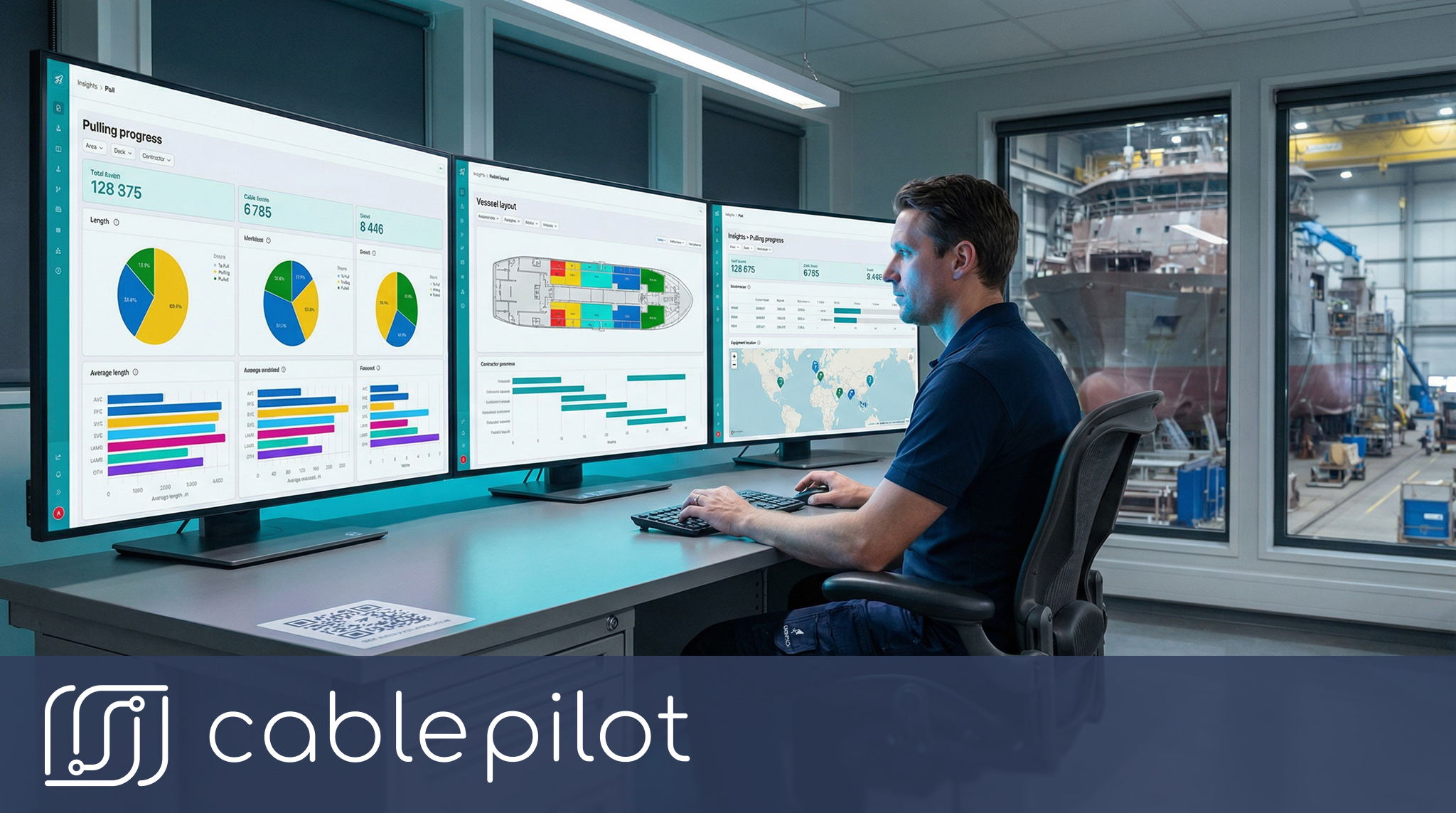
Site supervisors and shipyard engineers receive elevated access spanning all contractors’ work, enabling comprehensive progress monitoring without requiring manual data consolidation. A single dashboard displays installation completion percentages, quality issue rates, and schedule adherence across all electrical contractors simultaneously—the ultimate real-time coordination capability that transforms project control from reactive firefighting to proactive management.
Mobile Integration: Updating Truth at the Point of Work
The single source of truth concept only succeeds if field updates propagate instantly to all stakeholders. Cable Pilot achieves this through native mobile applications that function as bidirectional bridges between physical installation sites and the central digital twin platform.
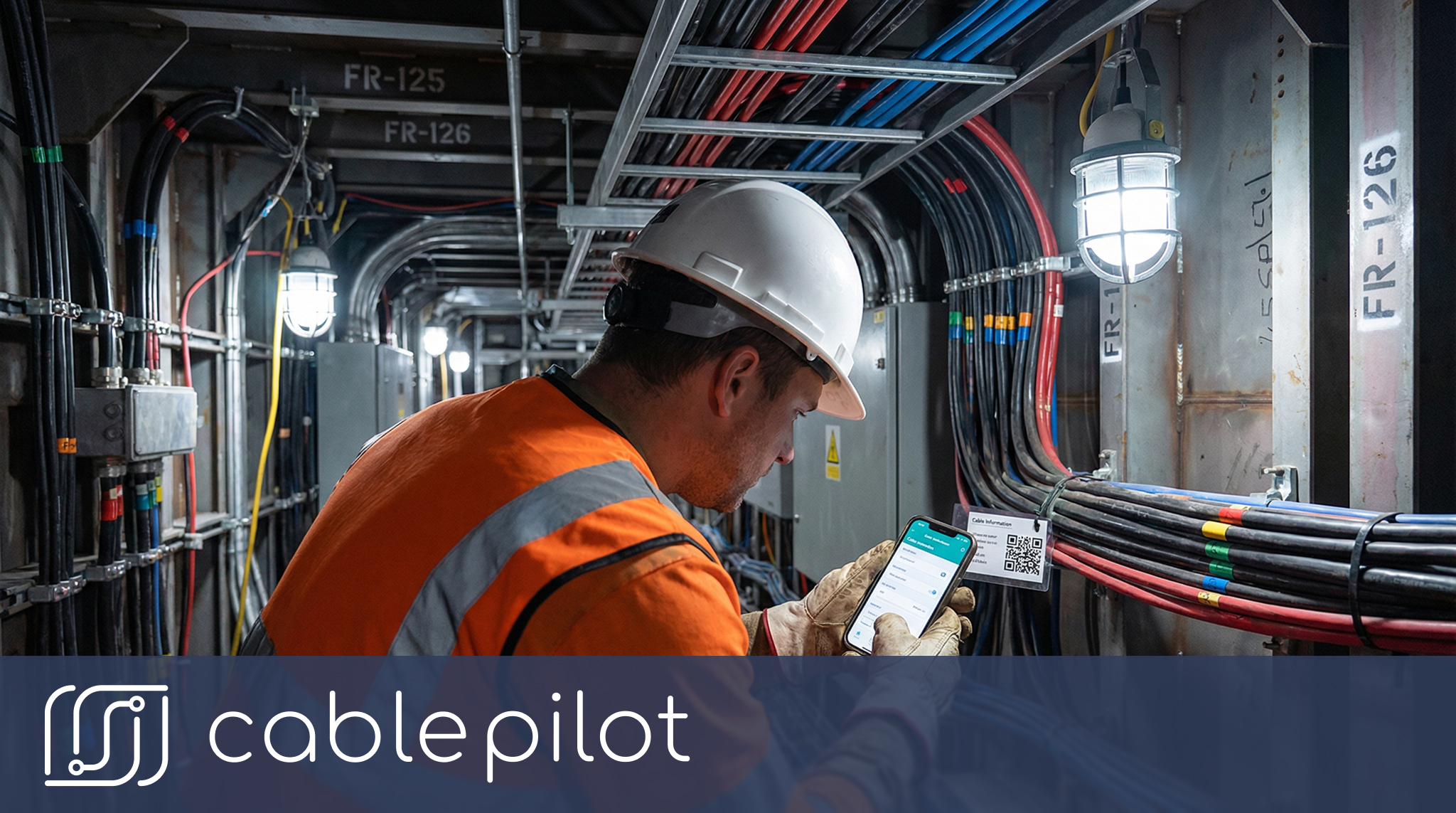
Installation technicians use their smartphones to scan Cable Pilot QR labels at cable endpoints or equipment. The app immediately retrieves the cable’s digital twin, displaying specifications and installation instructions. After completing the pull, the technician updates status to “installed,” and submits data—all within 10 seconds. This update synchronizes instantly to the cloud platform, where it becomes visible on engineering dashboards, contractor management screens, and QA inspection queues without any manual data transfer.
This mobile-first architecture eliminates the traditional data entry bottleneck. In conventional workflows, field technicians record work on paper forms, which office staff transcribe into digital systems hours or days later. Cable Pilot’s direct field updates reduce information latency from 24-72 hours to under one minute, fundamentally changing how quickly projects can respond to installation deviations or quality issues.
The mobile applications work offline in ship compartments with poor connectivity, queuing updates for automatic synchronization when returning to WiFi-equipped areas. This ensures electrical installation management continuity regardless of vessel construction conditions, while maintaining the integrity of the single source of truth through conflict resolution algorithms that prevent data loss during offline operations.
Automated Compliance Documentation and Immutable Audit Trails
Class society surveys and regulatory audits demand comprehensive documentation proving every cable was installed, tested, and inspected according to approved specifications. Cable Pilot’s quality compliance tracking system automatically generates this documentation as a byproduct of normal field operations, eliminating the traditional audit preparation burden.
Every action within Cable Pilot creates an immutable audit record: who performed the work, when it occurred, what the results were, and which revision of drawings governed the installation. When a technician marks a cable’s test as passed, the platform records the tester’s identity, timestamp, measured value, and links to the applicable test procedure document. These records cannot be altered retroactively—ensuring documentary integrity that satisfies even the most rigorous inspection requirements.
The audit trail extends beyond simple status changes to capture the complete quality narrative. If a cable fails initial testing, the platform logs the failure, the diagnosis (e.g., “damaged insulation at termination point”), the corrective action (“reterminated with heat shrink protection”), the retest results, and the inspector’s approval signature. This chronological record eliminates disputes about rework frequency or quality trends, providing objective data for process improvement initiatives.
When auditors request documentation, project administrators generate comprehensive reports in seconds rather than days. A few clicks workflow produces a complete installation package for any cable or equipment panel, including original specifications, all status transitions, test certificates, inspection photos, and approval signatures. This document automation capability reduces audit preparation time by 85-95% compared to manual record compilation, while simultaneously improving documentation quality and completeness.
Transforming Shipyard Operations Through Data Unification
Accelerating Engineering Decision Cycles
Traditional shipyard workflows require 24-72 hours to answer basic questions like “How many cables in Zone 3 are ready for testing?” because the answer requires consolidating data from multiple contractors’ progress reports. Cable Pilot’s single source of truth reduces this query time to seconds through real-time dashboard analytics.
Electrical supervisors access live status breakdowns showing exactly how many cables are in each lifecycle state: design-approved, material-available, ready-to-install, installed-pending-test, tested-passed, or commissioned. Filtering by zone, contractor,system, cable type, or priority level provides instant situational awareness that enables dynamic resource allocation. When a critical power distribution panel’s cables fall behind schedule, managers identify the bottleneck and redirect resources within minutes rather than discovering the delay during weekly coordination meetings.
This real-time coordination capability extends to engineering change management. When design revisions affect in-progress installations, Cable Pilot immediately identifies impacted cables and notifies responsible contractors through automated alerts. The platform distinguishes between cables where work hasn’t started (specifications update automatically) versus cables already installed (triggering formal revision impact assessment). This intelligent change propagation prevents the scenario where half the team works to obsolete specifications while the other half implements the latest revision.
The question-to-answer cycle acceleration transforms project culture from information-seeking to information-exploiting. Instead of spending meetings reconstructing current status, teams focus on forward-looking decisions: Should we expedite materials for Zone 4 to utilize available installation capacity? Does the testing delay in the engine room justify reassigning inspectors from accommodation areas? Cable Pilot’s installation visibility provides the data foundation for these strategic decisions.

Reducing Quality Defects Through Contextual Work Instructions
One of the most powerful aspects of data silos elimination is the ability to deliver contextual information at the exact moment technicians need it. Cable Pilot’s mobile interface displays cable-specific installation instructions, routing diagrams, and specification requirements when field personnel scan QR codes—ensuring the correct information is available at the point of work.
Consider a technician pulling Cable #7-P-224, a 3-conductor 16mm² fire-resistant cable for a critical alarm circuit. Scanning the cable’s QR label retrieves its digital twin, which displays: approved routing path through Frame 38 to Fire Panel FP-3, minimum bend radius of 150mm, required separation from cables, specific termination procedure including ferrule type and torque specifications, and reference photos showing proper installation examples. This just-in-time information delivery reduces installation errors by 30-40% compared to technicians working from memory or generic procedure manuals.
The system enforces quality checkpoints at critical milestones. These quality gates prevent the “we’ll photograph it later” shortcuts that traditionally result in undocumented work and compliance gaps.
Cable Pilot’s quality compliance tracking extends to test result validation. When inspectors enter insulation test measurements, the platform automatically compares results against specified thresholds (e.g., insulation resistance must exceed 1MΩ). Out-of-tolerance results trigger immediate failure notifications, preventing defective installations from progressing to later construction phases where remediation becomes exponentially more expensive.
Enabling Predictive Project Management
The comprehensive data captured in Cable Pilot’s digital twin platform creates opportunities for predictive analytics impossible with traditional tracking methods. Because every cable’s complete lifecycle history exists in structured format, project managers can identify patterns and trends that inform future planning.
Historical installation rate analysis reveals which cable types or routing scenarios consistently take longer than estimated, enabling more accurate scheduling for similar future work. If 24-conductor control cables consistently require 40% more installation time than 12-conductor equivalents, planners adjust labor allocations accordingly. Cable Pilot aggregates this performance data across all projects, building institutional knowledge that improves with each completed vessel.
Quality trend analysis identifies systematic issues before they escalate. If a particular contractor shows increasing test failure rates over several weeks, the platform flags this degradation for investigation. Perhaps tooling needs maintenance, technicians require additional training, or material specifications changed subtly. Early intervention prevents quality problems from compounding into expensive rework campaigns.
Resource utilization forecasting becomes data-driven rather than intuition-based. By analyzing current installation rates and remaining work scope, Cable Pilot projects future capacity requirements with mathematical precision. The platform can predict “at current productivity, Zone 5 installation will require 3 additional weeks, but increasing crew size by two technicians would complete work in target timeline”—enabling proactive staffing adjustments rather than reactive crisis management.
Real-World Impact: Quantifying the Single Source of Truth Advantage
Case Study Metrics from Early Adopters
Shipyards implementing Cable Pilot become consistent operational improvements across multiple performance dimensions. Installation error rates decrease by 30-50% as technicians work from verified, current specifications rather than potentially outdated prints. The just-in-time delivery of contextual work instructions and automated quality checkpoints catch mistakes at the source rather than during later inspection phases.
Project schedule compression averages 15-20% for electrical installation phases. The combination of faster decision cycles, reduced rework, and improved coordination eliminates the friction that traditionally extends timelines. When every stakeholder operates from the same single source of truth, coordination meetings become shorter and more productive, status reporting becomes automatic rather than laborious, and change management becomes controlled rather than chaotic.
Audit preparation time decreases by 85-95%, as mentioned previously. More significantly, audit pass rates improve because documentation is complete, consistent, and verifiable. Class surveyors appreciate the comprehensive audit trails and instant access to supporting evidence, often completing inspections 30-40% faster than with traditional paper-based documentation.
Commercial benefits extend beyond direct cost savings. Faster, more predictable delivery schedules improve customer satisfaction and enable more competitive pricing on fixed-price contracts. Demonstrable quality improvements through quality compliance tracking systems provide marketing differentiation in competitive bidding scenarios. For shipyards report that Cable Pilot implementation become a win factor in securing new contracts from shipowners who value construction quality and schedule certainty.
The Competitive Advantage of Operational Excellence
In mature industries like shipbuilding, competitive advantage increasingly derives from operational excellence rather than technical capabilities—most yards can build to specification, but not all can deliver on time, on budget, and with minimal defects. Cable Pilot’s electrical installation management platform provides the operational foundation for this excellence.
The real-time coordination enabled by unified data creates organizational agility. When schedule changes or design modifications occur, the impact propagates instantly through the platform rather than gradually through meeting cycles and email chains. This responsiveness reduces the cascading delays that turn minor disruptions into major schedule impacts.
Knowledge retention improves dramatically when institutional experience resides in structured digital systems rather than individual memories. When experienced superintendents retire, their expertise remains accessible through historical project data, lessons learned annotations, and optimized workflow templates. Cable Pilot becomes an organizational memory system that preserves and amplifies collective knowledge.
The shift from defensive documentation to proactive process improvement changes organizational culture. When compliance records generate automatically, quality teams spend less time creating paperwork and more time analyzing data for systemic improvements. When status information updates in real time, project managers shift from information collection to strategic decision-making. This professional time reallocation multiplies the value of specialized personnel.
Implementation Strategy: Migrating to Your Single Source of Truth
The AI-Powered Import Process
One significant barrier to adopting new electrical installation management systems is the challenge of migrating existing cable lists from spreadsheets into the new platform. Cable Pilot addresses this through cutting edge AI-powered import capabilities that automatically parse and structure existing Excel files, regardless of format variations.
Project teams simply upload their current cable schedules—whether they’re formatted as procurement lists, routing schedules, or installation tracking sheets. Cable Pilot’s import algorithm identifies key data fields (cable identification, conductor specifications, from/to locations, cable length), validates data consistency, and creates corresponding digital twin objects in the platform. The import process typically handles 10,000+ cable records in under 10 minutes, transforming months of potential manual data entry into a simple file upload.
The AI import includes intelligent error detection. If cable specifications appear inconsistent, the platform flags these for review before finalizing the import. This validation step often reveals data quality issues in the source spreadsheets that would otherwise propagate into the new system—providing immediate value by cleaning historical data.
After import, Cable Pilot generates comparison reports showing the imported data structure and flagging any records requiring manual attention. This validation step ensures project teams maintain full control over the migration process while benefiting from automation acceleration.
Phased Deployment for Risk Mitigation
Organizations concerned about disrupting ongoing projects can implement Cable Pilot through phased deployment strategies. The most common approach starts with a single vessel or project section as a pilot, demonstrating value before expanding to full shipyard operations.
During pilot phases, teams often run parallel systems—maintaining existing spreadsheets while also using Cable Pilot for the pilot scope. This redundancy provides safety nets while personnel develop familiarity with the new platform. As confidence builds, teams progressively shift responsibility from legacy systems to Cable Pilot until the single source of truth becomes the only active system.
Training requirements prove surprisingly minimal due to Cable Pilot’s intuitive smartphone interface. Field technicians typically become proficient within 30-60 minutes of hands-on practice, while project managers and engineers require 2-4 hours to master dashboard analytics and reporting functions. This rapid proficiency development enables quick deployment without extensive training programs.
Integration with existing enterprise systems (ERP, PLM, document management) proceeds through standard APIs that exchange data without requiring custom development. Cable Pilot can import material specifications from procurement systems, export progress data to project management tools, and synchronize design documents from engineering databases—creating a connected ecosystem rather than isolated information islands.
The Future-Proof Foundation for Digital Shipbuilding
Beyond Electrical: Expanding the Digital Twin
While Cable Pilot currently specializes in shipboard electrical work, the underlying digital twin platform architecture extends naturally to other installation disciplines. Forward-thinking shipyards are beginning to envision comprehensive digital twins encompassing HVAC systems, piping installations, equipment positioning, and structural assembly—all coordinated through unified platforms that eliminate data silos across the entire construction process.
This expansion follows a logical progression. Once electrical installations operate from a single source of truth, the adjacent disciplines face increasing pressure to match this transparency and coordination capability. Contractors working on cable trays naturally want similar visibility for conduit installations. Equipment suppliers want to coordinate panel deliveries against installation readiness status. The network effects of digital transformation create momentum toward comprehensive digitalization.
The competitive dynamics reinforce this trajectory. Shipyards achieving 20-30% productivity improvements in electrical work through Cable Pilot implementation immediately seek similar gains in other disciplines. Successful digital transformation in one area proves the business case for expansion, reducing organizational resistance and accelerating subsequent deployments.
Preparing for the Autonomous Future
Looking further ahead, electrical installation management platforms like Cable Pilot create the data foundations necessary for emerging automation technologies. Comprehensive digital twins with precise spatial coordinates, detailed specifications, and real-time status information could eventually guide robotic installation systems, automated testing equipment, and autonomous quality inspection tools.
While fully autonomous shipboard installation remains years away, intermediate augmentation technologies are emerging. Smart glasses displaying cable routing instructions through augmented reality overlays depend on precise digital twin data. Automated cable cutting and labeling systems require integration with centralized specification databases. Machine learning algorithms that optimize installation sequencing need historical performance data across thousands of cable installations.
Cable Pilot’s architecture anticipates these future capabilities by capturing rich, structured data in formats compatible with advanced analytics and automation systems. Shipyards implementing digital transformation today aren’t merely solving current coordination challenges—they’re building the information infrastructure that will enable the next generation of construction productivity improvements.
Taking the First Step Toward Data Unification
The journey from fragmented spreadsheets to a comprehensive single source of truth begins with a simple decision: recognizing that data silos represent unnecessary costs rather than inevitable realities. Every hour spent reconciling conflicting cable lists, every rework cycle caused by outdated specifications, and every delayed audit due to missing documentation reflects an organizational choice to tolerate inefficiency.
Cable Pilot offers an immediate alternative. The platform’s AI-powered import capabilities mean existing cable schedules transform into structured digital twins within hours rather than months. The intuitive mobile interface requires minimal training investment. The phased deployment approach allows risk-controlled validation before full commitment. The contractor collaboration architecture works within existing commercial structures rather than requiring wholesale contract renegotiation.
For electrical superintendents frustrated by coordination failures, Cable Pilot provides the real-time coordination visibility that transforms reactive problem-solving into proactive project control. For quality managers buried in audit preparation, the automated quality compliance tracking liberates time for value-adding process improvements. For shipyard executives seeking competitive advantage, the operational excellence enabled by electrical installation management digitalization provides measurable differentiation in delivery performance and customer satisfaction.
The maritime industry stands at an inflection point where digital transformation transitions from experimental innovation to competitive necessity. Shipyards that establish their single source of truth today position themselves to lead this transformation, while those deferring digitalization risk progressive competitive disadvantage as the productivity gap widens.
Transform Your Electrical Installation Management Today
Ready to eliminate data silos and establish your single source of truth? Cable Pilot’s import system can migrate your existing cable lists in minutes, providing immediate visibility into installation progress across all contractors and systems.
Schedule a demonstration to see how Cable Pilot’s digital twin platform delivers real-time coordination, automated compliance documentation, and measurable productivity improvements for shipboard electrical projects. Discover why leading shipyards are choosing Cable Pilot as their foundation for construction excellence—and join the digital transformation that’s redefining maritime electrical installation management.