
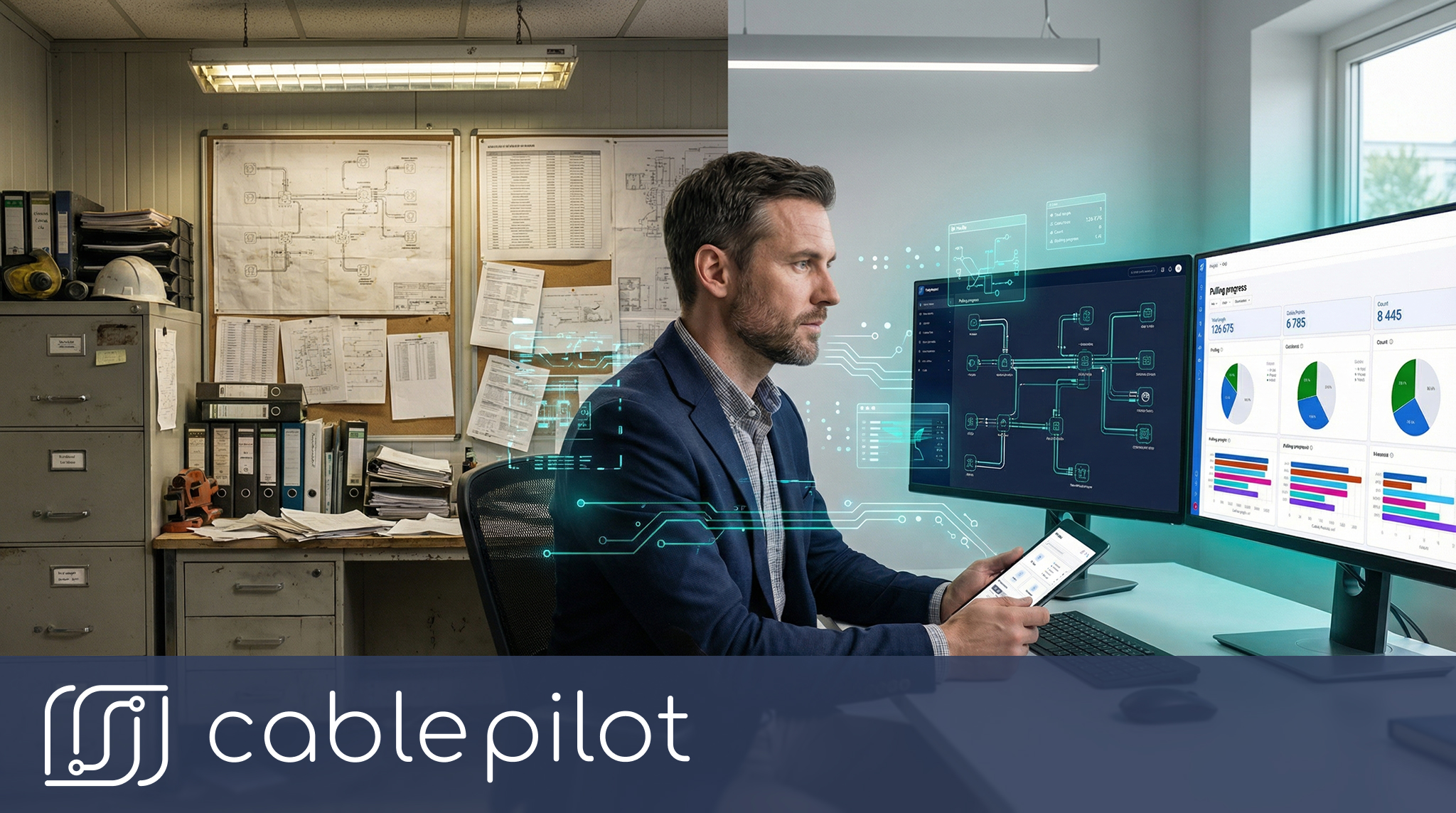
The average shipyard electrical installation project begins with optimism: clear drawings, detailed cable lists, and precise specifications. Yet within weeks, that clarity dissolves into chaos. Project managers juggle seven versions of the same cable list. Installation teams work from outdated drawings stored on personal laptops. Quality inspectors discover that specifications changed three weeks ago, but nobody told the contractors. Rework orders multiply. Arguments erupt over who approved what. Deadlines slip.
This isn’t incompetence—it’s the inevitable consequence of fragmented information systems. When critical project data lives in disconnected silos—Excel files on shared drives, PDF drawings in email threads, paper test sheets in binders, specification changes buried in meeting minutes—every stakeholder operates with incomplete information. The result is expensive: studies show that poor data management accounts for up to 30% of total rework costs in complex industrial projects.
This isn’t incompetence—it’s the inevitable consequence of fragmented information systems. When critical project data lives in disconnected silos—Excel files on shared drives, PDF drawings in email threads, paper test sheets in binders, specification changes buried in meeting minutes—every stakeholder operates with incomplete information. The result is expensive: studies show that poor data management accounts for up to 30% of total rework costs in complex industrial projects.
Cable Pilot was built to solve this fundamental problem by establishing what modern project management calls a single source of truth: one authoritative, real-time repository where every cable, every piece of equipment, every drawing, and every specification lives as a connected, traceable digital object. This article explains how this architectural approach transforms electrical installation from information chaos into operational clarity—and why shipyards adopting this model consistently report dramatic reductions in rework, faster decision-making, and smoother project handovers.
The Hidden Cost of Information Fragmentation
Before examining the solution, let’s map the problem precisely. In traditional shipyard electrical installation workflows, information exists in disconnected formats across multiple locations:
Cable lists live in Excel files. The master version sits on a shared drive, but within days, contractors download local copies. Engineers make updates to their versions. Procurement adds delivery dates to another copy. When someone asks “Which cable list is correct?”, nobody can answer with confidence. Version control becomes a guessing game tracked through file names like “CableList_ Rev3_ FINAL_ v2_ USE_ THIS_ ONE.xlsx.”
Drawings and schematics exist as static PDF files scattered across email attachments, personal folders, and document management systems that nobody consistently uses. When design teams issue updated drawings, they send revision notifications—but installation teams working in remote compartments often miss those emails. The consequence: teams install cables according to outdated routing plans, discover the error during inspection, and must rework entire cable runs.
Drawings and schematics exist as static PDF files scattered across email attachments, personal folders, and document management systems that nobody consistently uses. When design teams issue updated drawings, they send revision notifications—but installation teams working in remote compartments often miss those emails. The consequence: teams install cables according to outdated routing plans, discover the error during inspection, and must rework entire cable runs.
Specifications and technical documentation arrive from classification societies, equipment manufacturers, and engineering firms in various formats. Some specifications reference cable types that appear in drawings but use different naming conventions. Others contain installation requirements that contradict field conditions. These documents rarely connect directly to the assets they describe, forcing workers to manually cross-reference multiple sources—a process prone to interpretation errors.
Change orders and field modifications travel through email chains, markup sheets, and verbal instructions. Someone draws a red circle on a printed drawing. Someone else updates their local cable list. The official document repository eventually receives a scanned PDF weeks later. Meanwhile, multiple teams make decisions based on different understandings of what changed.
Test records and quality documentation begin on paper forms, migrate to Excel sheets, then get summarized in Word reports for final submission. Each transformation introduces transcription errors and breaks the connection between test data and the specific cables being tested. When inspectors question a result, teams waste hours hunting through folders to find the original form.
This fragmentation creates three critical problems that compound throughout the project lifecycle:
Change orders and field modifications travel through email chains, markup sheets, and verbal instructions. Someone draws a red circle on a printed drawing. Someone else updates their local cable list. The official document repository eventually receives a scanned PDF weeks later. Meanwhile, multiple teams make decisions based on different understandings of what changed.
This fragmentation creates three critical problems that compound throughout the project lifecycle:

Information latency: Updates made in one system take days or weeks to reach all stakeholders. By the time everyone has current information, it’s already outdated again.
Version confusion: Nobody can confidently answer “What is the current, approved version of this information?” Different teams work from different versions, each believing theirs is correct.
Broken traceability: When a problem surfaces—a failed test, a missing cable, a specification conflict—project teams cannot quickly trace back through the information chain to understand root causes, who made decisions, or when changes occurred. The financial impact is substantial.
The financial impact is substantial. One European shipyard calculated that information-related rework on a single cruise ship project cost €2.8 million in direct labor, materials, and schedule delays. Another Asian yard found that quality inspectors spent 40% of their time simply locating and verifying documentation rather than performing actual quality work.
The Single Source of Truth Architecture
Cable Pilot addresses information fragmentation through a fundamentally different architectural approach: instead of treating cables, equipment, drawings, and specifications as separate documents to be managed, it represents them as interconnected digital objects within a unified data model—a living digital twin of the electrical installation.
At the foundation sits the asset registry: every cable, junction box, panel, motor, and piece of electrical equipment becomes a distinct object with a unique identifier, properties, relationships, and history. A cable isn’t just a line in an Excel sheet—it’s a digital entity that knows its origin equipment, destination equipment, routing path, specification requirements, installation status, test results, associated drawings, and complete change history.
Around these core assets, Cable Pilot organizes all related information as connected attributes and relationships:
Specifications attach directly to asset types. When a cable object is created as “instrument cable type A,” it automatically inherits all specification requirements defined for that cable type—insulation class, voltage rating, bend radius, terminal types, testing requirements. If specifications change, every affected cable immediately reflects the update. Workers opening that cable on their smartphones instantly see current requirements, eliminating the need to cross-reference separate specification documents.
Drawings link to the specific assets they depict. A routing diagram for compartment E-04 connects directly to every cable that runs through that compartment. When workers view a cable, they see all drawings where it appears. When they view a drawing, they see the installation status of every cable on that drawing. If the engineering team issues an updated drawing, Cable Pilot marks all affected cables and notifies relevant teams through the dashboard. Nobody works from outdated plans because the system itself knows which drawing version is current.
Test records become properties of assets. When a technician completes insulation resistance testing on cable C-1247, that test data attaches directly to C-1247’s digital object along with timestamp, inspector identity, and measured values. Quality managers reviewing test completion don’t open separate spreadsheets—they filter the asset list by test status and instantly see which cables passed, which failed, and which haven’t been tested yet. Audit trails are automatic because every test is permanently linked to its specific asset.
Change history preserves context. Every modification to an asset’s properties—status updates, specification changes, routing alterations, blocker reports—is recorded with timestamp and user identity. When a cable’s destination equipment changes, Cable Pilot doesn’t just update the field; it preserves the original value, records who made the change and when, and can show the complete evolution of that cable’s definition from design through final commissioning. This eliminates “he said / she said” disputes and provides the forensic capability to understand how problems developed.
Relationships create navigation paths. Because assets know their connections—this cable runs from that panel to this motor—users can navigate the electrical system intuitively. A project manager reviewing motor M-45 can click through to see all cables serving that motor, then click any cable to see its routing compartments, then click a compartment to see all work in progress there. The digital twin becomes an explorable map of the physical installation.
This interconnected structure means that information updates in one place automatically propagate everywhere that information matters. When a specification changes, every affected cable reflects the change. When a drawing updates, every team working on those cables receives notification. When a test completes, progress dashboards and quality reports update instantly. There are no delays, no manual synchronization, no version confusion—just one coherent, always-current representation of reality.
AI-Powered Import: Building the Twin from Existing Data
The single source of truth architecture sounds compelling in theory, but shipyards face a practical obstacle: electrical installation projects arrive with existing documentation—hundreds or thousands of cables defined in legacy Excel lists, drawing packages already distributed, specifications scattered across multiple documents. Rebuilding all this information manually would take weeks and create resistance to adoption.
Cable Pilot solves this through AI-powered data import that ingests existing cable lists “as is” and automatically structures them into the digital twin.
Here’s how the process works in practice:
A project manager uploads the master cable list—typically a complex Excel file with columns for cable ID, origin equipment, destination equipment, cable type, compartment, length, and various specification codes. This file might use non-standard column names, inconsistent formatting, merged cells, and embedded notes—the messy reality of documentation created over years by multiple engineering teams.
Cable Pilot’s AI engine analyzes the structure, identifies data patterns, recognizes column purposes, and maps the information to its asset model. Within minutes, it generates a complete proposal showing how it will interpret the file: “Column B appears to contain cable identifiers. Column F looks like equipment codes. Column J might be compartment numbers.” Project managers review the mapping, make corrections where the AI misinterpreted something, then approve the import.
The system then creates digital asset objects for every cable, automatically establishing relationships: Cable C-1247 connects to Panel-12-A (origin) and Motor-45 (destination). It routes through compartments E-04 and E-05. It’s specified as Type-A instrumentation cable. All this structure emerges from the flat Excel data, transformed into navigable, interconnected objects.
For cables without complete information—perhaps the original list lacks compartment data—Cable Pilot creates the core object and marks missing properties. Installation teams can fill gaps using the smartphone app in the field as they discover actual routing paths. The digital twin grows progressively more complete as the project proceeds, rather than requiring perfect data upfront.
This interconnected structure means that information updates in one place automatically propagate everywhere that information matters. When a specification changes, every affected cable reflects the change. When a drawing updates, every team working on those cables receives notification. When a test completes, progress dashboards and quality reports update instantly. There are no delays, no manual synchronization, no version confusion—just one coherent, always-current representation of reality.
Drawings and specifications integrate through document attachment. Project managers upload PDF drawing packages and link them to relevant compartments, equipment, or cable sets. When workers view a cable on their smartphone, they see thumbnails of associated drawings and can open full PDFs instantly. Revision management is straightforward: upload the updated drawing, link it to the same assets, and Cable Pilot marks the old version as superseded while notifying teams who recently viewed those assets that new information is available.
This import capability means adopting a single source of truth doesn’t require abandoning existing work. Projects can migrate into Cable Pilot mid-execution, bringing their accumulated documentation with them and immediately gaining unified visibility without massive data re-entry overhead.
One View, Every Stakeholder: How Single Source of Truth Transforms Daily Operations
The operational power of a single source of truth becomes clear when examining how different project stakeholders use it throughout the installation lifecycle.
Installation teams working in compartments no longer carry printed cable lists and drawing bundles. They open Cable Pilot on smartphones, scan a cable’s QR code, and instantly see everything relevant: the cable’s origin and destination, routing path, specification requirements, current status, associated drawings, and any special instructions or blockers. If they encounter a field condition that prevents installation as designed—an unexpected pipe obstruction, for example—they report it through the app with photos. That blocker immediately appears on project dashboards and notifies relevant engineers. The cable’s status updates to “blocked,” preventing quality inspectors from flagging it as incomplete installation when it’s actually awaiting design resolution.
Quality inspectors receive test assignments through Cable Pilot based on installation completion status. When cables in compartment E-04 reach “pulled” status, the system automatically notifies the QA-managers and makes test assignments for those cables. Inspectors navigate to the compartment, scan each cable, and record test results directly in the app—insulation resistance, continuity etc. Results attach instantly to the cable objects. If a cable fails, the inspector marks it as “test-failed” with failure details, triggering rework assignment and notifications to the installation contractor. There’s no paperwork to transfer, no spreadsheets to update, no risk of recording test data against the wrong cable identifier.
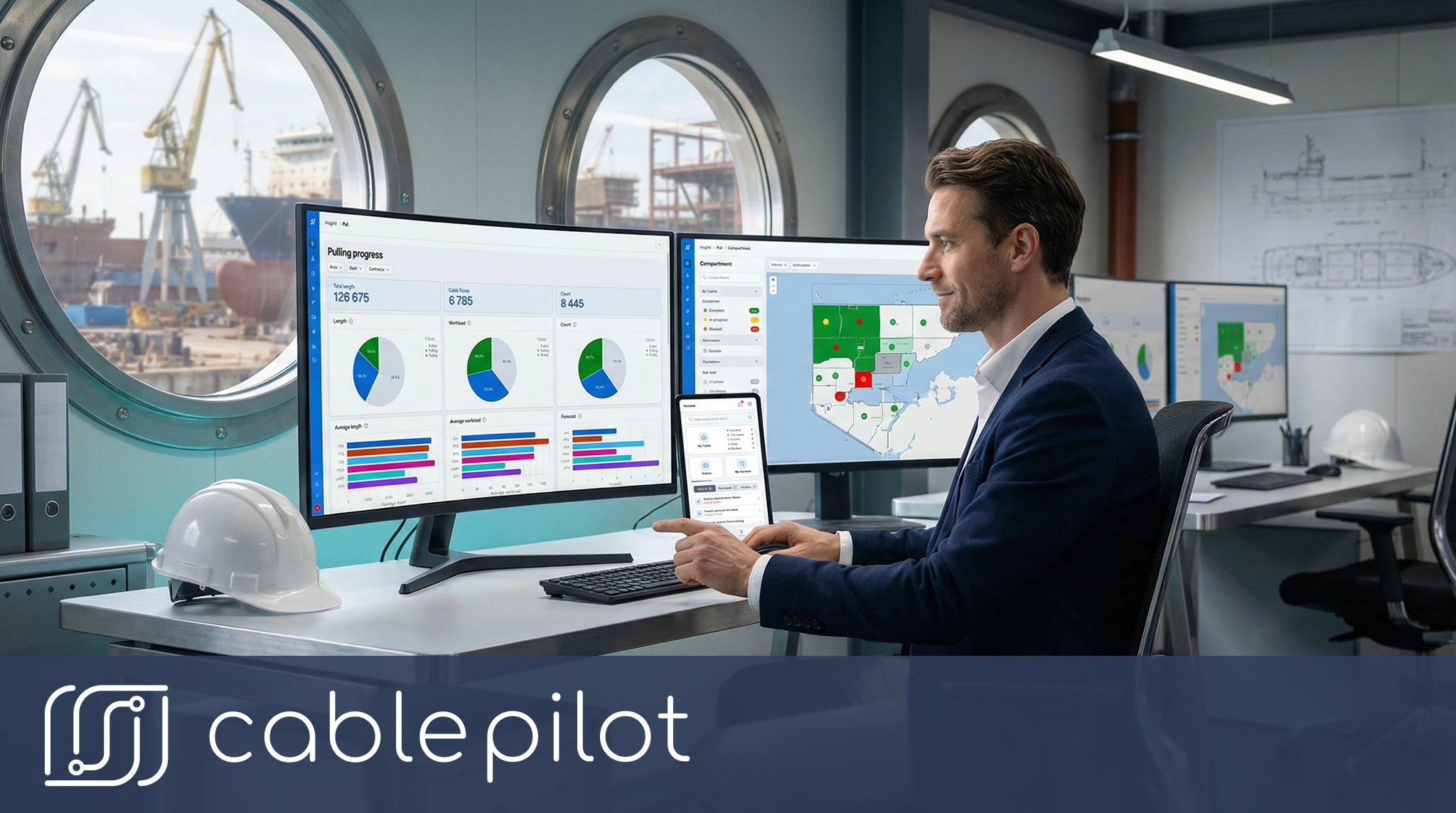
Project managers use real-time dashboards that aggregate asset status across the entire project. They can filter views by contractor, compartment, system, or equipment type to understand precisely where progress stands: 1,247 cables installed out of 3,600 planned. 892 cables tested and passed. 34 cables blocked awaiting design resolution. 15 cables failed testing and require rework. Because this data comes directly from field teams updating asset objects, it’s current as of the last smartphone sync—typically within minutes—rather than waiting for weekly progress reports compiled from handwritten notes.
Engineering and Supervising teams receive blocker notifications immediately when field teams encounter issues. They can view blocker reports complete with photos and location context, research solutions, update drawings or specifications, and mark blockers resolved—all within Cable Pilot. When they issue updated drawings, they upload the new version, link it to affected cables, and the system notifies installation teams who favorited those cables or recently worked in those compartments. Change propagation becomes automatic rather than hoping everyone sees the email announcement.
Subcontractors and vendors accessing Cable Pilot through limited permissions see only their scope of work but benefit from the same unified information structure. Everyone works from the same current information, reducing coordination conflicts.
Surveyors and classification society inspectors conducting acceptance testing receive instant access to complete documentation packages. They can filter cables by test status, review test records with timestamps and inspector signatures, trace any cable back through its complete installation and change history, and verify that work matches approved drawings and specifications—all without requesting binders of paperwork. Inspection cycles that traditionally took weeks of document collection and review compress into days because information is already organized, complete, and auditable.
The common thread across all these use cases: every stakeholder views the same authoritative information through interfaces appropriate to their role. There’s no ambiguity about currency, no hunting through folders for the right file, no manual synchronization between field updates and office systems. Information flows from field reality into the digital twin instantly and propagates to all relevant decision-makers automatically.
Change Management Without Chaos
Electrical installation projects change constantly. Equipment specifications get revised. Routing paths shift to accommodate late structural modifications. Cables get added or deleted as system commissioning reveals real requirements. In fragmented information environments, managing these changes becomes a nightmare of email threads, markup sheets, and conference calls to align everyone on what’s current.
Cable Pilot’s single source of truth architecture transforms change management from chaos into controlled process.
When a specification change arrives—say a motor manufacturer issues an updated wiring diagram requiring different cable types—the engineering team updates the affected cable objects’ specifications in Cable Pilot. The system immediately identifies all cables impacted by this change: 47 cables connected to motors of this type, 12 already installed, 8 currently in-progress, 27 not yet started.
Cable Pilot automatically generates change notifications to relevant teams. The key advantage: everyone learns about changes simultaneously from a single authoritative source, and the system itself tracks which work was performed before the change (and might need review) versus after the change (already complying with new requirements). There’s no possibility of some teams working to old specifications while others implement new ones because the specification is a property of the cable object, not a separate document that might or might not reach everyone.
Version history provides complete forensic capability. When a dispute arises—”Why was this cable installed with Type-B connectors when the specification calls for Type-A?”—project managers can review that cable’s complete change history and see that when the cable was installed three weeks ago, the specification did call for Type-B connectors. The specification changed to Type-A two weeks ago, after installation. This historical context, automatically preserved, defuses conflicts and clarifies accountability.
Drawing revision management follows the same pattern. When engineers issue updated routing drawings, they upload the new PDF and link it to the same compartment or cable set. Cable Pilot marks the previous drawing version as superseded and notifies teams who recently viewed it: “The routing diagram for compartment E-04 has been updated. You viewed the previous version yesterday. Please review changes before continuing work.” Installation teams can compare versions side-by-side, understand what changed, and adapt their work accordingly.
This approach doesn’t eliminate changes—changes are inevitable in complex projects—but it ensures changes propagate completely and immediately to everyone affected, with full traceability and context preservation.
Multi-Contractor Collaboration Without Document Gymnastics
Large shipyard projects typically involve multiple electrical contractors, each responsible for different systems: one contractor handles power distribution, another manages lighting, a third installs instrumentation and control wiring. Additionally, mechanical contractors, structural teams, and commissioning vendors all need visibility into electrical installation status for coordination.
In traditional workflows, this multi-party coordination happens through weekly progress meetings where contractors present Excel status reports, discuss conflicts, and request information from each other. Between meetings, coordination happens through email requests, phone calls, and occasional shouting matches when someone’s team inadvertently blocks another contractor’s access or damages their work.
Cable Pilot’s single source of truth enables structured collaboration without requiring contractors to share their internal documents or adopt identical workflows.
Each contractor receives permissions to view and update only their scope of work. The power distribution contractor sees all cables in their scope, can update installation status on those cables, report blockers, and attach field photos—but doesn’t see instrumentation contractor’s internal notes or data. Yet both contractors see each other’s installation progress because cable status is a shared property in the digital twin.This creates passive coordination through transparency.
Blocker visibility prevents cascade failures. When the instrumentation contractor reports that they can’t install cables in panel room A-12 because the power contractor hasn’t completed panel installation yet, that blocker appears on project dashboards visible to all stakeholders. The power contractor sees they’re blocking downstream work and can prioritize accordingly. The project manager sees the dependency and adjusts schedules. The commissioning team sees potential delays to system testing and alerts stakeholders early. Information that traditionally surfaced weeks late in weekly meetings becomes visible instantly.
Handover and commissioning become data transfers rather than document collection nightmares. When electrical installation reaches substantial completion, the commissioning team doesn’t need contractors to compile test records and as-built drawings into submission packages. They simply filter Cable Pilot assets by status: show all cables marked “tested-passed” with complete test records attached. Export a report containing cable IDs, test results, inspector names, timestamps, and links to as-built drawings. The system compiles handover documentation automatically because the information was structured and connected throughout the project rather than accumulated in separate files.
Before and After: A Compartment Case Study
The transformation from fragmented information to single source of truth is most vivid when comparing specific work sequences before and after Cable Pilot adoption.
Before Cable Pilot: Compartment E-04 Without Single Source of Truth
The electrical installation foreman receives an email with a PDF cable list for compartment E-04: 87 cables to install. He prints the list and brings it to the compartment. His team consults a separate PDF drawing showing routing paths, also printed and already marked up from previous work in adjacent compartments—though nobody’s certain if those markups apply here.
As they work, they discover cable C-1247’s origin equipment is located differently than the drawing suggests, requiring a routing path change. The foreman makes a handwritten note on his printed cable list but doesn’t have access to update the master cable list on the shared drive. He mentions it to the project manager in passing.
Meanwhile, the quality inspector arrives to test completed cables using her own Excel list exported from the quality system last week. She discovers that five cables on her test list don’t exist in the compartment—they were deleted in a design change nobody told her about. She wastes an hour cross-checking with the latest cable list (which she eventually locates in her email from three days ago, though she’s not certain it’s the absolute latest version) before determining which cables actually need testing.
Three cables fail testing. The inspector records failure details on paper forms she’ll transcribe into the quality system back in her office. She emails the installation foreman (who’s moved to another compartment) about the failures. He gets the email two days later, returns to E-04 with his team to investigate, but can’t remember which specific cables failed because the email didn’t include clear identifiers. They retest several cables to figure out which ones need rework.
The project manager compiles weekly progress reports by emailing each foreman for status updates, consolidating their responses into a summary spreadsheet. He doesn’t discover the routing change on C-1247 until a commissioning engineer questions the deviation four weeks later, triggering a formal investigation, retroactive approval paperwork, and as-built drawing updates.
Total administrative overhead for compartment E-04: approximately 16 hours of foreman time, 8 hours of quality inspector time, 6 hours of project manager time, and 4 hours of engineering time resolving documentation discrepancies—34 hours that produced no physical installation progress. Three cables required rework due to information gaps. Final inspection took an extra day while auditors located and verified documentation scattered across email, shared drives, and paper binders.
After Cable Pilot: Compartment E-04 With Single Source of Truth
The installation foreman opens Cable Pilot on his smartphone and filters for compartment E-04: 87 cables appear with status indicators showing which are not-started (his team’s work), in-progress (partially pulled by the previous team), or installed (work complete, ready for testing). He taps any cable to see routing drawings, specifications, and current status.
As his team works, they discover cable C-1247’s origin equipment is located differently than expected. The foreman scans C-1247’s QR code, taps “report blocker,” types “Origin equipment E-45 located 2m to port side of drawing position, requires routing path change,” and attaches a photo. Cable Pilot marks C-1247 as blocked and notifies the engineering team. That afternoon, an engineer reviews the blocker with the photo context, approves a revised routing path, updates the cable’s route property in Cable Pilot, and marks the blocker resolved. The foreman receives notification that C-1247 is unblocked and sees the updated routing instruction. He installs the cable correctly the first time and marks it installed. The change is documented automatically with full history and photo evidence.
The quality inspector opens her Cable Pilot dashboard, filters for compartment E-04 cables with status “installed” (meaning ready for testing), and sees the actual 87 cables requiring inspection—no deleted cables, no confusion about scope, because her view comes from the same asset registry the installation team used. She navigates to E-04, scans cable QR codes, and records test results directly in the app. Three cables fail. She marks them “test-failed” with failure reasons, and Cable Pilot immediately notifies the installation foreman and updates the project dashboard showing three cables in rework status.
The foreman sees the failure notifications on his smartphone within minutes, reviews the specific cables and failure descriptions, assigns his team to investigate, and marks them “in-rework.” When repairs complete, he updates status to “installed,” triggering automatic re-test assignment to the quality inspector. She verifies repairs the next day and marks cables “test-passed.”
The project manager views his real-time dashboard and sees compartment E-04 progress without sending a single email: 84 cables tested and passed, 3 cables completed rework and passed retest, 0 cables blocked, 0 cables remaining. He clicks through to see C-1247’s history—the initial blocker report, engineering resolution, installation completion—understanding the routing change issue without needing an investigation. When commissioning auditors request compartment E-04 documentation, he exports a PDF report directly from Cable Pilot containing all cable IDs, test results, inspector names, timestamps, and links to approved routing drawings. The export takes 3 minutes.
Total administrative overhead for compartment E-04: approximately 1 hour of foreman time (mostly scanning QR codes and reporting the one blocker), 4 hours of quality inspector time (actual testing, minimal administration), 1 hour of project manager time (reviewing dashboard, generating report), and 30 minutes of engineering time (resolving the single blocker with full context immediately visible). 6.5 hours total versus 34 hours in the fragmented workflow—a 81% reduction in non-productive administrative time. Zero rework due to information gaps. Final inspection took 2 hours because documentation was complete, organized, and auditable from the beginning.
The difference: every stakeholder worked from the same authoritative, current information source, updates propagated automatically, and documentation generated itself as a byproduct of structured field work rather than requiring separate administrative effort.
Implementation Strategy: Building Your Single Source of Truth
Transitioning from fragmented information systems to a unified single source of truth requires thoughtful implementation strategy. Successful shipyards typically follow a phased approach:
Phase 1: Pilot Compartment or System.
Rather than attempting to onboard an entire project simultaneously, select one representative compartment or electrical system (typically 100-300 cables) as a pilot scope. Import the cable list for that scope, upload relevant drawings, train one installation team and one quality inspector, and run the pilot through the complete installation and testing cycle. This validates the workflow, builds internal expertise, and generates proof-of-concept data—usually 40-60% reductions in administrative time and significant quality improvements—that justifies broader rollout.
Phase 2: Contractor Onboarding.
Expand scope to include all electrical contractors working on the project. Conduct training sessions focused on smartphone app usage for field teams and dashboard usage for foremen and project managers. Establish clear protocols: all status updates must flow through Cable Pilot, blocker reports must include photos and clear descriptions, test results must be recorded in the app rather than on paper. Enforcement during the first two weeks is critical—teams default to old habits if not consistently redirected.
Phase 3: Cross-Functional Integration.
Bring commissioning teams, quality managers, and surveying staff into the platform. Upload complete drawing packages and specifications. Expand asset coverage to include junction boxes, panels, and other equipment beyond cables. Implement automated notifications and dashboard alerts that enable proactive rather than reactive management. This is when the single source of truth reaches full operational power and administrative overhead reductions become dramatic.
Phase 4: Continuous Improvement.
Use Cable Pilot’s analytics to identify workflow bottlenecks: which types of blockers occur most frequently, which contractors consistently update status late, which compartments require rework, which test types have high failure rates. Apply these insights to improve processes and training. Update cable import mappings and document attachment protocols based on lessons learned.
The key success factor across all phases: leadership commitment to enforcing the single source of truth principle. If project managers allow some teams to continue working from local Excel files “just for now” or accept test results submitted on paper forms “because the inspector doesn’t like smartphones,” the fragmentation returns. The single source of truth only functions when it actually becomes the authoritative source that everyone uses consistently.
Measuring the Transformation
Shipyards implementing Cable Pilot’s single source of truth architecture consistently gain measurable improvements across multiple operational dimensions:
Administrative time reduction: 50-70% decreases in time spent locating documentation, chasing status updates, compiling reports, and resolving information discrepancies. Project managers shift from information brokers to decision-makers.
Rework reduction: 30-50% decreases in cables requiring reinstallation or repair due to outdated specifications, missed drawing changes, or incorrect installation instructions. Installation teams work from current, accurate information consistently.
Inspection cycle compression: 40-60% faster completion of quality inspections and final acceptance testing because documentation is complete, organized, and auditable from the start rather than requiring collection and verification.
Dispute resolution speed: 80-90% reduction in time resolving contractor disputes, change order questions, and accountability issues because complete history with timestamps and user attribution is automatically preserved.
Handover efficiency: Commissioning documentation packages that traditionally took 2-3 weeks to compile now generate in hours through automated exports, and acceptance rates by classification societies and owners improve because documentation quality and completeness is higher.
These improvements stem from a fundamental shift: from treating information management as administrative overhead to embedding it as a natural byproduct of structured workflows. When field teams update cable status, they’re not “filling out paperwork”—they’re capturing reality in the digital twin. When quality inspectors record test results, they’re not “doing administration”—they’re completing the asset record. Documentation becomes a natural consequence of work rather than a separate task.
Conclusion: From Chaos to Clarity, From Cost to Value
The chaos of fragmented information isn’t inevitable. It’s a choice—often an unconscious one—to accept disconnected tools, manual synchronization, and version confusion as “just how things are.” Cable Pilot offers an alternative: a unified digital architecture where cables, equipment, drawings, specifications, and test records exist as interconnected objects within a single source of truth.
This architectural shift transforms electrical installation from an information management nightmare into an operationally transparent, analytically rich, and audit-ready process. Project managers gain real-time visibility without chasing status reports. Installation teams work confidently from current information without hunting through folders. Quality inspectors focus on actual testing rather than documentation verification. Changes propagate instantly and completely rather than requiring manual coordination cascades. Handovers compress from weeks to hours because documentation was structured throughout rather than compiled at the end.
The shipyards seeing the greatest value aren’t just using Cable Pilot as a better cable list manager—they’re fundamentally rethinking how electrical installation information flows, who needs access to what data, and how to structure workflows so that documentation becomes an automatic byproduct of coordinated field work rather than a separate administrative burden.
If your electrical installation projects suffer from version confusion, documentation chases, information-related rework, or handover delays, you’re experiencing the symptoms of fragmented information systems. The solution isn’t better spreadsheet discipline or more rigorous email protocols—it’s establishing a single source of truth that makes chaos structurally impossible and clarity operationally inevitable.
The shipyards seeing the greatest value aren’t just using Cable Pilot as a better cable list manager—they’re fundamentally rethinking how electrical installation information flows, who needs access to what data, and how to structure workflows so that documentation becomes an automatic byproduct of coordinated field work rather than a separate administrative burden.
If your electrical installation projects suffer from version confusion, documentation chases, information-related rework, or handover delays, you’re experiencing the symptoms of fragmented information systems. The solution isn’t better spreadsheet discipline or more rigorous email protocols—it’s establishing a single source of truth that makes chaos structurally impossible and clarity operationally inevitable.
Ready to transform your electrical installation information architecture? Cable Pilot’s digital twin platform eliminates fragmentation and establishes the single source of truth your project needs. Contact our team to discuss how we can import your existing cable lists and drawings into a unified platform within days—and start seeing administrative time reductions and quality improvements within the first pilot project.