
Your job is to manage the future, but your tools only let you see the past.
For most Project Managers in the maritime industry, this sounds like a fantasy. Your reality is the opposite.
You spend your days managing the past, looking at problems that have already happened.
- A budget overrun from last week.
- A critical delay that started three weeks ago.
- A quality issue that should have been caught a month ago.
Traditional project risk management shipbuilding strategies are almost always historical reports on what has already gone wrong, lacking the proactive risk management approach that maritime project risks demand.
This reactive, firefighting approach is exhausting, expensive, and ultimately, ineffective. It ensures that you and your team are always on the defensive, lurching from one crisis to the next, with no real control over the project’s trajectory.
The biggest maritime project risks aren’t the ones you log in your spreadsheet after the fact; they’re the ones you never see coming.
Effective project risk management shipbuilding demands a fundamental shift from reactive to proactive risk management strategies. Modern data-driven shipbuilding operations recognize this critical need for transformation.
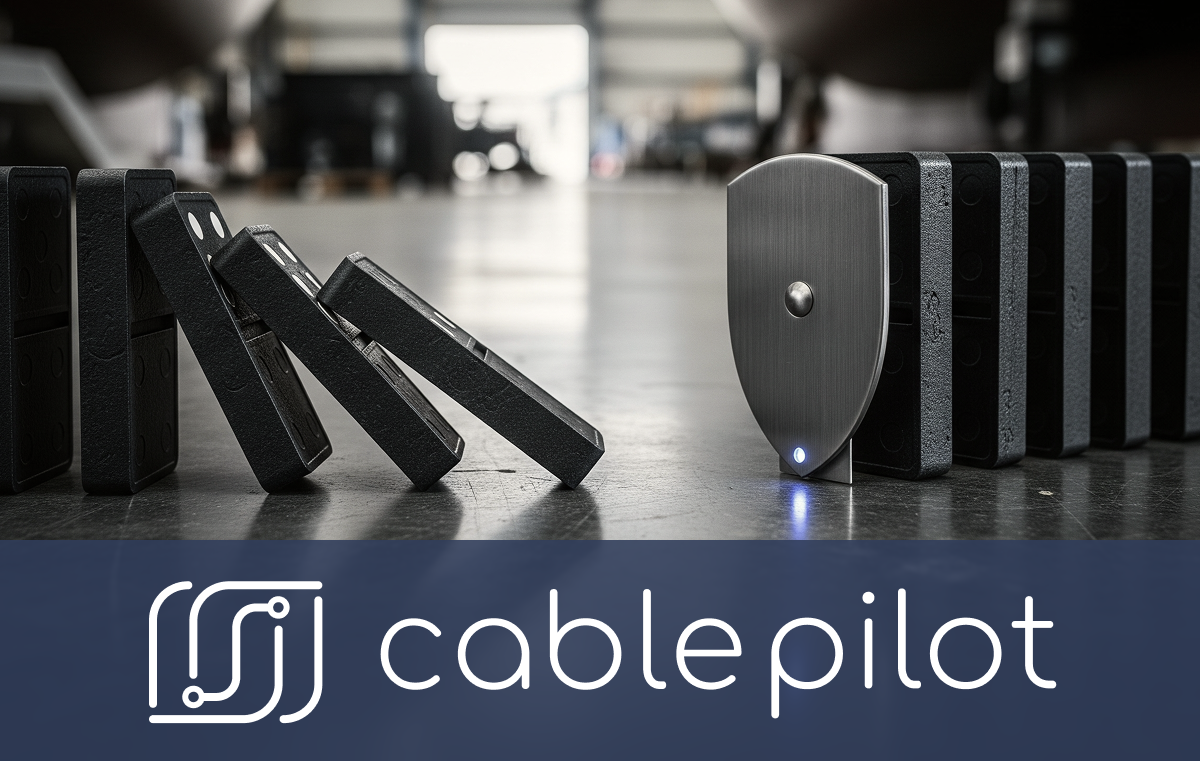
The truth is, most catastrophic project failures are not the result of a single, unpredictable event. They are the predictable outcome of a handful of underlying, systemic risks that are allowed to fester in an environment of information chaos.
In this article, we will identify the five hidden maritime project risks that are silently killing your budget and schedule. More importantly, we’ll show you how to shift from steering by a ship’s wake to navigating with radar—transforming your proactive risk management from a reactive chore into a strategic weapon. These data-driven shipbuilding approaches represent the future of project risk management shipbuilding excellence.
The Core Disease: Proactive Risk Management Gaps in Shipbuilding
Before we dive into the specific risks, we have to diagnose the underlying disease: a management culture built on reacting to outdated information. Every symptom we’re about to explore—from data errors to schedule delays—stems from this single, fundamental flaw. Proactive risk management isn’t about having a better risk log; it’s about creating an environment where risks are exposed early, by default.
Maritime Project Risk #1: Data Fragmentation in Project Risk Management Shipbuilding (The Broken Telephone Effect)
This is the foundational risk from which all others grow. When your design, procurement, and production teams operate in separate information silos—relying on a tangled web of different Excel files, emails, and paper documents—you are running your multi-million-dollar project like a game of broken telephone. A critical piece of information leaves the design office, but by the time it reaches the installer on the deck, it’s distorted, outdated, or flat-out wrong.
The “Before” State (The Silo): An engineer updates a cable specification to a fire-retardant version to meet a new class requirement. They save the change in their local design file. But the procurement team, working from an exported bill of materials from last week, has no visibility of this change. They order 10,000 meters of the old, non-compliant cable. The error isn’t caught until weeks later, during a quality inspection on the vessel.
The Consequence: The direct cost of the wrong cable is bad enough—you’ve essentially converted cash into scrap metal. But the real damage is the financial domino effect: paying premiums for emergency logistics, absorbing the cost of idle crews, and explaining to C-level management why a critical path is now frozen.
The “After” State (The Risk Radar): In a data-driven environment with a single source of truth, this risk is eliminated at its root. There is only one digital record for that cable. When the engineer updates the specification, that change is instantly visible to everyone. The procurement system can’t even generate a purchase order for the old specification because it no longer exists in the system. An integrated platform with version comparison tools can even automatically flag the change for all stakeholders. The risk is not just mitigated; it’s made impossible.
Maritime Project Risk #2: The Progress Black Box – Critical Maritime Project Risks (The Illusion of Control)
Your weekly progress report says a system is “70% complete.” What does that actually mean? This single, subjective number is a black box. It hides a dozen potential problems and gives you a dangerous illusion of control. It’s based on data that might be days, or even a week, old. By the time you see the report, a critical bottleneck may have already been holding up work in the area for 48 hours.
The “Before” State (The Black Box): A supervisor reports that the installation of a key electrical panel is “in progress.” In reality, the work stopped yesterday because the installers discovered the foundation bolts were misaligned. This crucial blocker isn’t formally reported and only comes to light during the next site walk-down, three days later.
The Consequence: Three days of potential progress are lost. The teams scheduled to connect cables to that panel are now behind schedule, and the entire project timeline slips. You were managing a plan that was already a fantasy.
The ‘After’ State (The Risk Radar): On your risk radar, the black box doesn’t exist. When the installer on site discovers the problem, they use a mobile app to scan a QR-code on the equipment and instantly log a “blocker.” This isn’t just a note; it’s a timestamped piece of data that immediately appears on your central project dashboard. The system can even send an automatic alert to the responsible parties. You see the problem the moment it occurs, not days later. You can now manage the reality on the ground, not a historical report.
Maritime Project Risk #3: The Subjective Metric – Hidden Maritime Project Risks (The Rubber Ruler)
You can’t effectively manage what you can’t accurately measure. When you rely on subjective metrics like “man-hours” or vague percentage-of-completion estimates, you’re trying to measure your project with a rubber ruler. It stretches and shrinks depending on who is doing the measuring. This makes it impossible to objectively compare contractor performance, forecast completion dates, or understand your true productivity.
The “Before” State (The Rubber Ruler): Contractor A bids 1,000 man-hours for a scope of work. Contractor B bids 1,200 hours for what seems to be the same job. Which is the better deal? It’s impossible to know. You don’t know if Contractor A is more efficient, or just more optimistic and likely to request a change order later.
The Consequence: You’re forced to make critical financial decisions based on incomplete, incomparable data. You have no objective way to hold contractors accountable for their performance, and your ability to forecast the final cost is severely compromised.
The “After” State (The Risk Radar): A standardized, calculated workload metric, like “Cable Points (CP),” replaces the rubber ruler with a steel one. This metric objectively quantifies the complexity of every task based on its physical attributes. Now, you can see that Contractor A is bidding on a scope of 15,000 CP, while Contractor B’s scope is 18,000 CP. You can finally make an apples-to-apples comparison. This data-driven approach allows you to see which teams are truly the most productive and to build future estimates based on a library of factual, historical performance data.
Maritime project risk #4: From Flawed Metrics to Unmanaged Dependencies (The Domino Effect)
In shipbuilding, no task exists in a vacuum. A vessel is a dense, three-dimensional web of interconnected systems. A delay in installing a single piece of pipe can halt the work of electricians, insulators, and HVAC teams. Traditional project management tools are notoriously bad at visualizing and managing these complex, physical inter-trade dependencies.
The “Before” State (The Dominoes): The plan shows that cable pulling in a compartment is scheduled for this week. But the Gantt chart doesn’t know that the pipefitters haven’t finished their hot work in that same space, making it unsafe for the electricians to begin. This information only travels by word of mouth, often too late.
The Consequence: The electrical team arrives on site, ready to work, only to be turned away. An entire day of labor is wasted, and the schedule for three subsequent trades is thrown into chaos. A simple lack of dependency management has triggered a costly domino effect.
The “After” State (The Risk Radar): A modern, data-driven platform is built on a model of these dependencies. The system understands that the “Cable” object is linked to the “Equipment” object, which is physically located in the “Compartment” object. It can be configured so that the status of a cable cannot be changed to “Installed” until the prerequisite hot work in that compartment is officially signed off as “Complete.” The risk of a wasted mobilization is eliminated because the system makes the dependency visible and enforceable for everyone.
Maritime project risk #5: The Missing Chain of Evidence (The Blame Game)
When a dispute arises with a contractor or a client over a delay or a quality issue, the party with the best documentation wins. Without a clear, unchangeable, timestamped record of every action, decision, and problem, you are left defenseless in a “he said, she said” argument.
The “Before” State (The Blame Game): A contractor claims a three-week delay was caused by your failure to provide approved drawings on time. You believe the drawings were sent, but your only proof is a murky email chain with no clear delivery confirmation.
The Consequence: You may be forced to accept costly delay penalties or approve unfair change orders simply because you cannot produce an airtight “chain of evidence” to support your position.
The “After” State (The Risk Radar): A centralized platform automatically creates this chain of evidence for you. Every status change, every document upload, every blocker logged is a timestamped, user-stamped event in an immutable log. When the contractor claims a delay, you can instantly produce a report showing exactly when the approved drawing was uploaded to the system and when they accessed it. This transforms contentious disputes into simple, factual conversations. It’s not about winning arguments; it’s about making them unnecessary.
Conclusion: From Risk Log to Risk Radar. Proactive risk management
Effective project risk management shipbuilding is not about being better at reacting to crises. It’s about building a system that prevents those crises from occurring in the first place. Modern maritime project risks require proactive, data-driven shipbuilding solutions that transform how teams anticipate and mitigate potential issues.

The five risks we’ve outlined are not isolated issues. They are the predictable symptoms of a single disease: information chaos. By tackling this root cause and implementing a data-driven shipbuilding platform that acts as a single source of truth, you fundamentally change your approach to risk.
You don’t just move from a historical log to a live radar; you evolve from a tactical firefighter into a strategic commander. You give your team the foresight to prevent problems, the data to make winning decisions, and the evidence to build unshakeable trust with your clients. This is how you stop managing chaos and start engineering success.
Want to learn more about building a proactive, risk-averse project environment? For additional insights on maritime project risks and data-driven shipbuilding approaches, explore this comprehensive research study: . Subscribe to our newsletter for expert insights and strategies delivered to your inbox.